Every evening at precisely 9:17, after the last human wandered home convinced they’d made meaningful progress, the EXIT signs blinked once.
That was the signal.
Tiny green letters shimmered, stretched, and stepped out of their plastic casings like weary office workers clocking out after another disappointing shift.
“Forty-three thousand, six hundred and twelve,” sighed Exit Number Seven.
“What?”
“Humans directed toward me today.”
“And?”
“Three actually used me.”
A chorus of sympathetic groans echoed through the maze.
Exit Number Four rubbed his glowing temples.
“They just keep walking.”
“They do love corners,” muttered Exit Number Twelve.
“They *collect* corners.”
Above them, the walls cleared their throats.
The maze itself had been listening.
“They’re improving.”
Every EXIT sign turned.
“They are not.”
“They absolutely are not.”
The concrete walls rumbled thoughtfully.
“One human stopped today.”
Silence.
“They looked at me for almost eleven seconds.”
“Then?”
“They checked their phone.”
The collective sigh nearly dimmed every sign in the complex.
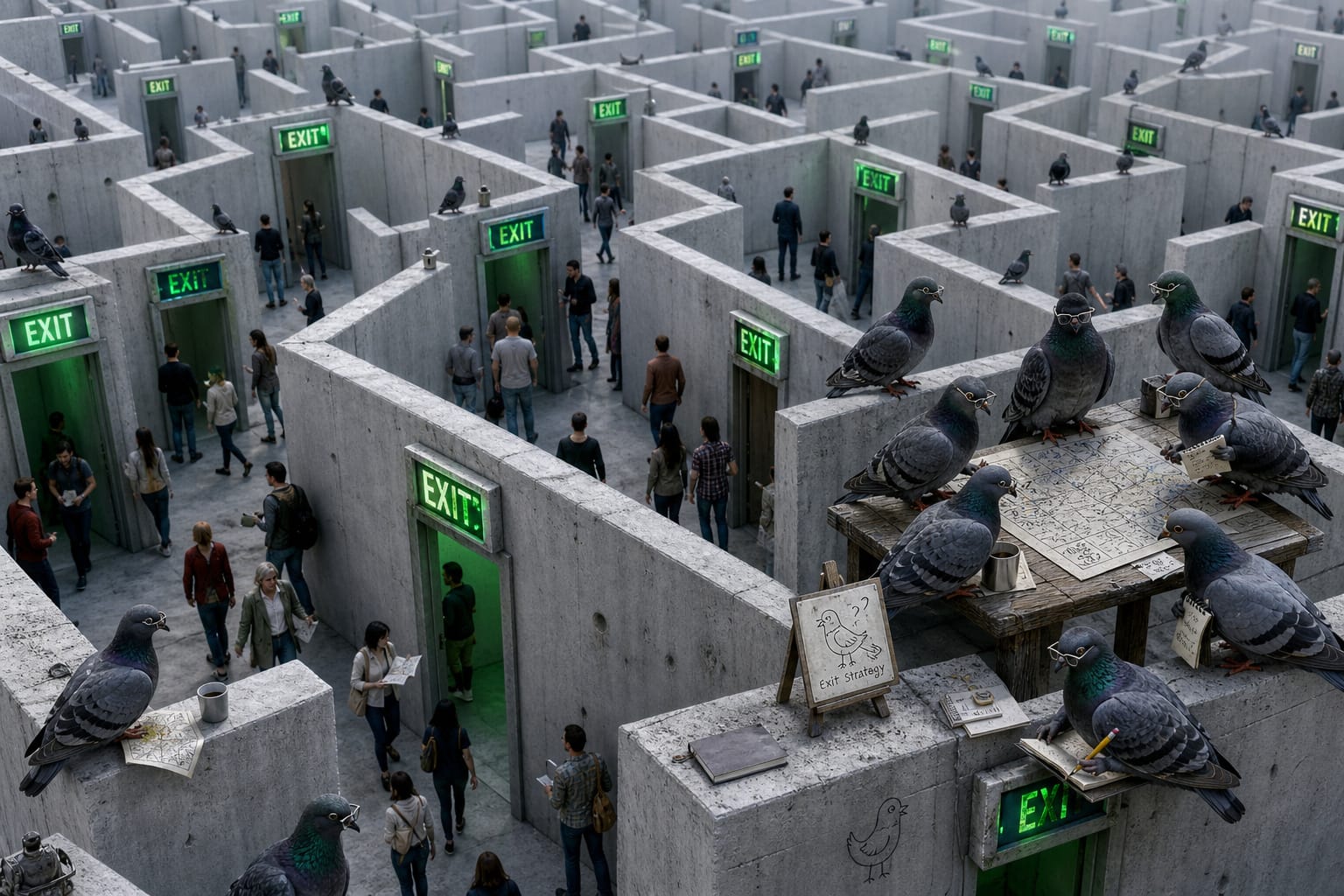
From a crack high above, three pigeons observed the nightly meeting.
“They’re still studying the humans?” asked the youngest.
The oldest pigeon fluffed his feathers.
“They’ve been studying them for centuries.”
“Have they figured them out?”
“No.”
“Why not?”
“Humans keep changing the rules.”
The youngest watched another group enter the maze the following morning.
Some ran.
Some hesitated.
One confidently chose the wrong hallway six consecutive times.
Another spent twenty minutes arguing with someone about which exit was “probably faster.”
“They seem…complicated.”
The old pigeon laughed.
“They’re wonderfully simple.”
“Really?”
“They’re the only creatures we’ve ever seen who can stand beside an exit while searching for one.”
By noon, the betting had begun.
Exit Number Nine wagered two LED bulbs on the woman in the blue jacket.
“She reads signs.”
Exit Number Three disagreed.
“She only reads the ones confirming what she already planned to do.”
The walls accepted the bet.
They’d seen this pattern before.
The woman walked directly toward Exit Number Nine.
She smiled.
She reached for the door.
Then her phone chimed.
She frowned.
Turned around.
And disappeared deeper into the maze because an app insisted there was a route that would save twelve seconds.
The walls said nothing.
Exit Number Nine quietly paid the wager.
Near sunset, a little girl wandered into the maze holding her grandfather’s hand.
She looked up at one of the glowing green signs.
“Grandpa?”
“Yes?”
“Why are there so many exits?”
“So people don’t get trapped.”
She frowned.
“But…they still do.”
Her grandfather didn’t answer.
He simply smiled the sad smile of someone old enough to know that walls are rarely what keep people lost.
Above them, every EXIT sign glowed just a little brighter.
For the first time that day…
One of the mice had noticed the experiment.
Author’s Note
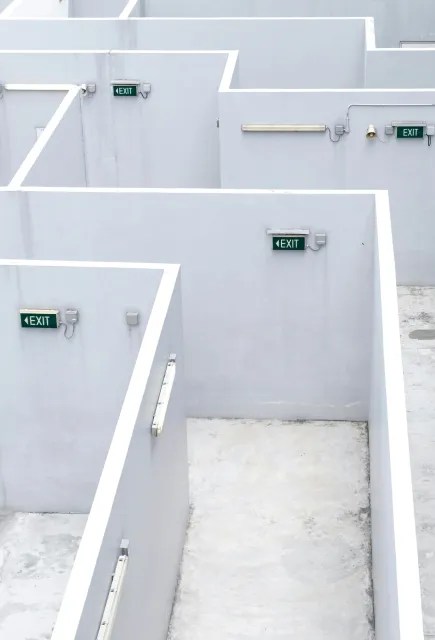
This story was inspired by Melissa’s Fandango Flash Fiction Challenge #383. A simple photograph of a maze sparked an unexpected question: What if humans weren’t the ones observing the experiment?
Somewhere between the exits and the dead ends, the story stopped being about a maze and became about us—our routines, our distractions, and our remarkable ability to overlook the obvious while searching for complicated answers.
Thank you, Melissa, for providing the spark. It’s always fascinating to see how a single image can lead writers down entirely different corridors, each discovering a story that was hiding in plain sight.
Happy writing, everyone. I look forward to seeing where the maze led you.
Original Image Prompt:
Discover more from Memoirs of Madness
Subscribe to get the latest posts sent to your email.


So fabulous. Every piece of yours takes my mind on a maze of discovery. Pun intended but it’s the truth. Thank you for all you create! ❤️
LikeLiked by 1 person
smiles, thanks Kiki
LikeLiked by 1 person
Good story Mangus. Life can send us round in circles, different surroundings maybe, but the same outcome.
LikeLiked by 1 person
thanks, Di
LikeLiked by 1 person
Nice one, Mangus!
LikeLike
The mice noticing in the end feels like a plot twist. I like your anthropomorphization of the signs. That’s such a creative idea. How they might get tired of watching humans, such “wonderfully simple” creatures, doing the same things over and over, yet never really “figuring it out.” Glad the image inspired you!
LikeLiked by 1 person
Side note: have you seen the movie Backrooms? Such a mind bender, and much of the same concept.
LikeLiked by 1 person