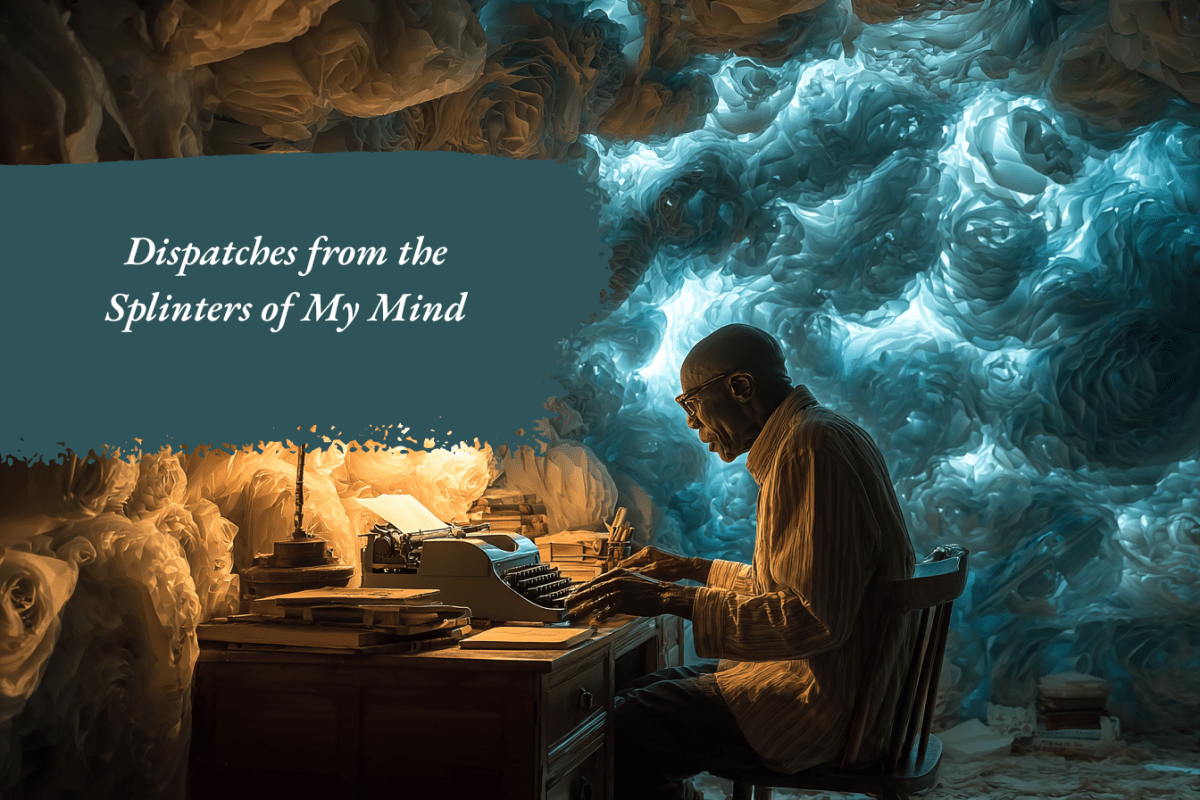
Dispatches of Splinters of My Mind: Entry 19
There was a time when I believed I had to remain intact—held together not just in appearance, but in feeling, in thought, in the quiet architecture of who I was when no one was watching. I believed that survival depended on coherence, on keeping every part of myself aligned, predictable, stable. There was comfort in that belief. It gave me something to hold onto when everything else felt uncertain. But the longer I tried to maintain that shape, the more I became aware of the strain it required—the subtle tightening in my chest, the way my breath shortened without permission, the low hum of tension that never fully disappeared, even in moments that should have felt still.
The pressure did not arrive all at once. It built slowly, almost politely, adjusting itself to my limits until I no longer noticed the weight. It lived in the way I responded before I thought, in the way I adjusted my tone to match the room, in the quiet recalibration of posture and presence that happened without conscious effort. I told myself it was growth, that I was becoming more refined, more controlled, more capable of moving through the world without friction. And for a while, that explanation held. It felt reasonable. It felt necessary.
But adaptation has a threshold, and I crossed it without realizing.
The moment you cross it is not dramatic. There is no visible fracture, no clear line between what you were and what you are becoming. It feels more like a slow thinning, as if the boundary between you and everything around you has begun to dissolve. Your thoughts feel less anchored. Your reactions feel slightly delayed, as if they have to pass through something before reaching the surface. You begin to notice small inconsistencies—how your voice sounds unfamiliar in certain conversations, how your reflection lingers a second too long before it feels like yours again, how silence begins to carry more weight than it should.
The sphere is clear, but it is not open.
You can feel that difference even if you cannot explain it. The air inside feels denser, quieter, as if sound itself has to move more carefully to exist. When you breathe, it feels contained—not restricted, but shaped, as though each inhale must fit within a boundary already defined. From the outside, everything appears intact, preserved in a kind of suspended clarity. But inside, the stillness is not peace. It is compression.
You become aware of the edges first.
Not visually—internally.
A subtle pressure where your thoughts meet expectation. A slight resistance when something true rises too quickly and has to be slowed, adjusted, translated into something acceptable. It feels like friction beneath the surface, like two versions of yourself trying to occupy the same space without fully touching. You learn how to manage that friction. You learn how to smooth it out, how to redirect it before it becomes visible.
And for a time, that works.
Until the first fracture.
It doesn’t announce itself. It doesn’t demand attention. It happens quietly, somewhere at the edge of your awareness—a moment where you respond in a way that doesn’t quite feel like you, or where you hesitate when you should be certain. You dismiss it. You adjust. You move forward. But something has shifted, and you can feel it, even if you don’t yet understand it.
Then it happens again.
And again.
Each time, something small separates—not physically, not in a way you can point to, but in a way you can sense. A thought that doesn’t return. A feeling that lingers just out of reach. A version of yourself that no longer fits within the structure you’ve been maintaining. You try to pull it back, to reassemble what you assume is being lost. Your focus sharpens. Your control tightens. You become more deliberate, more precise, more careful about how you hold yourself together.
But the tighter you hold, the more you feel it slipping.
Fragmentation is not violent.
It is quiet.
It feels like something loosening rather than breaking, like threads being gently pulled apart rather than cut. There is no sudden collapse, no dramatic loss. Just a gradual awareness that what you are holding no longer aligns in the way it used to. And with that awareness comes something unexpected.
Relief.
It is subtle at first. Almost unnoticeable. A slight release in your shoulders. A breath that moves deeper than it has in a long time. A moment where you are not actively maintaining yourself, and nothing falls apart. You hesitate when you feel it, because it contradicts everything you’ve been taught—that losing structure is dangerous, that stability must be preserved at all costs.
But what if the cost is the problem?
What if the effort required to remain intact is what has been distorting you all along?
You begin to observe rather than correct. You let the next fracture happen without interference. You feel it as it moves through you—a shift in how you think, how you respond, how you exist in your own body. It is not comfortable, but it is not catastrophic either. It is… honest in a way you have not experienced in a long time.
The pieces do not disappear.
They move.
You sense them just beyond the immediate space you occupy, like fragments suspended in a field you can feel but not fully see. They carry something with them—residue, memory, aspects of yourself that could not remain compressed within the structure you were maintaining. You expect absence. Instead, you feel expansion.
Not outward.
Inward.
As if the space you occupy has deepened rather than diminished.
The need to reassemble begins to fade. Not because you have solved anything, but because you no longer feel the urgency to return to what you were. The shape you were holding required constant attention, constant correction, constant effort. What remains does not demand the same level of control.
It breathes differently.
So do you.
There is more space between thoughts. More room for contradiction. More tolerance for not immediately understanding what you are experiencing. The silence inside you shifts from something heavy to something open. It is no longer filled with pressure. It becomes something else—something that does not need to be resolved to be real.
You realize then that the shape you were trying to preserve was never stable.
It was sustained.
There is a difference.
What is sustained requires effort.
What is real requires attention.
The sphere does not break.
It remains, but it no longer defines you. It becomes something you move within, something you are aware of rather than confined by. The boundary is still there, but it has lost its authority. You can feel it without obeying it. You can see it without shaping yourself to match it.
And the fragments?
They are no longer something you have to retrieve.
What they carried is already part of you—integrated not through reconstruction, but through release. You do not become whole by pulling everything back together. You become something else entirely.
Something less rigid.
Less controlled.
More present.
There is a quiet moment when this realization settles—not as a thought, but as a sensation. Your body loosens in ways you didn’t know it could. Your breath deepens without instruction. Your awareness expands without effort. Nothing dramatic changes, and yet everything feels different.
You are no longer holding yourself in place.
You are allowing yourself to exist.
The shape you couldn’t hold was never meant to be permanent.
It was a phase you outgrew without permission.
And the moment you stop trying to force it back together—
is the moment you realize
you were never breaking.
You were shedding the structure
that kept you from feeling
what it means
to finally
become.
Discover more from Memoirs of Madness
Subscribe to get the latest posts sent to your email.
 Memoirs of Madness
Love this
LikeLike