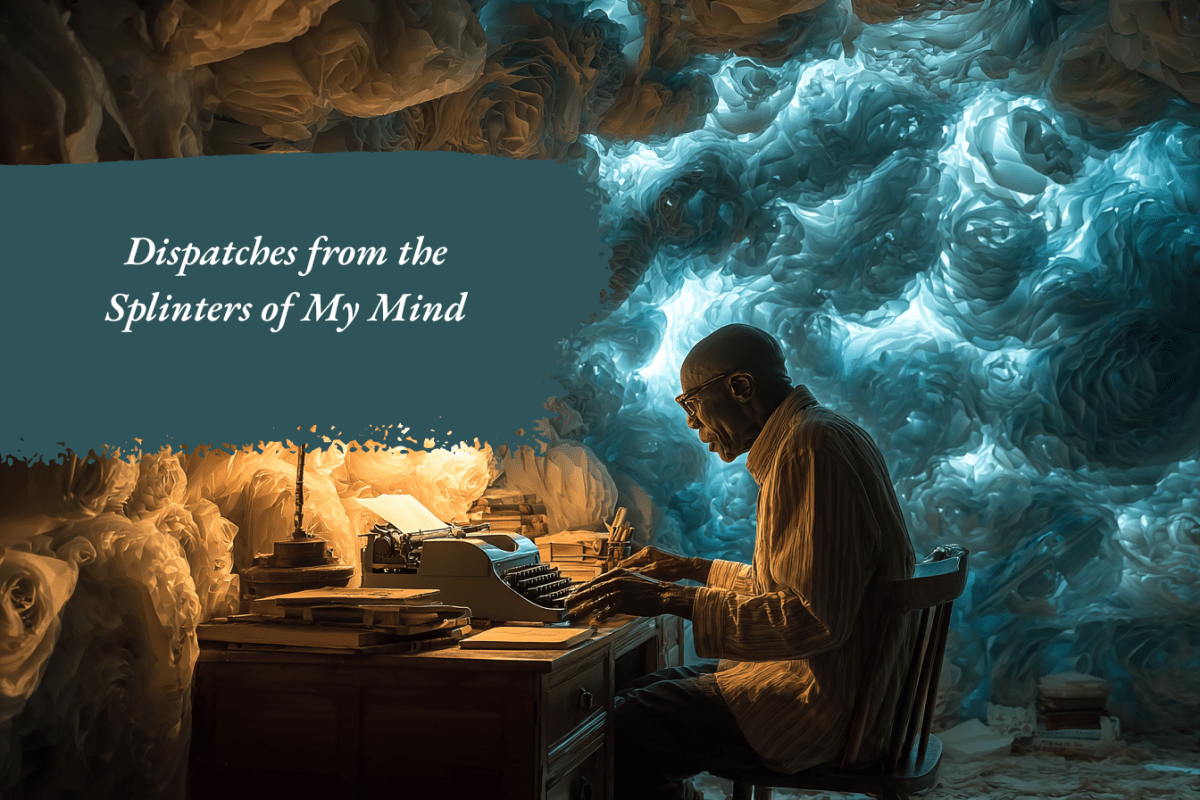

Dispatches from the Splinters of My Mind: Entry 14:
There is a version of you that has never spoken. Not because it lacks words, but because it understands the cost of being heard. It lives somewhere behind your eyes, just beyond the reach of mirrors and rehearsed conversations—a quiet architecture of memory and instinct built from moments you swallowed instead of expressed. It is not hidden in the way a secret is hidden; it is hidden in the way a scar disappears under skin—still there, still shaping the structure, just no longer visible to those who don’t know where to press.
You feel it sometimes—in the pause before you answer a question you’ve been asked a hundred times, in the moment when the truth rises sharp and immediate, only to be softened, reshaped, diluted into something acceptable. Something survivable. Something that won’t make the room shift. That version of you doesn’t argue. It watches. It has learned the language of tolerance—not the kind that expands understanding, but the kind that compresses identity into manageable pieces, the kind that allows you to sit in rooms where you are only partially present. You call it maturity. You call it growth. But somewhere beneath those polished names, something quieter calls it what it is: survival.
Inside you, there is a forest. You don’t visit it often. It is not curated, not symmetrical, not safe. It does not exist for aesthetic appreciation or poetic metaphor; it exists because it grew that way—wild, tangled, ungoverned. The trees lean at angles that don’t make sense, the ground shifts underfoot, and the deeper you go, the less certain you are that you can find your way back. That is why you stay at the edge, because the edge is manageable. The edge is where society lives. Out here, everything has a name, a function, a script. You learn quickly which parts of yourself are welcome and which ones should remain theoretical.
So you edit. You refine. You present. You become a version of yourself that fits within the boundaries of collective comfort—and they applaud you for it. They tell you to be an individual while handing you a template. They tell you to stand out while rewarding you for blending in. Somewhere along the way, you begin to forget what your unedited voice sounds like. But the forest remembers. It remembers every thought you abandoned halfway through, every instinct you silenced before it reached your mouth, every moment you chose peace over truth—not because peace was right, but because truth would have cost you something you weren’t ready to lose.
The forest is not empty. It is crowded. It is filled with versions of you that never made it past the threshold of expression. They move between the trees like ghosts of possibility—not dead, not gone, just unrealized. Waiting. Watching. Becoming something else in the absence of acknowledgment. This is where the anomalous begins, because those versions do not remain static. They evolve. They distort. They adapt to the darkness you’ve left them in. What starts as silence becomes pressure. What starts as avoidance becomes fragmentation.
You feel it in small ways at first—a hesitation you can’t explain, a reaction that feels disproportionate, a quiet sense that you are not entirely aligned. You tell yourself it’s stress, fatigue, nothing—but it is not nothing. It is the accumulation of everything you refused to explore, everything you labeled inconvenient, everything you chose not to understand because understanding would have required change. The mind does not discard unused pieces; it repurposes them. And when those pieces are left in the dark long enough, they begin to form something unfamiliar—something that does not recognize the version of you that stands in the light.
That is the part no one warns you about. They talk about self-discovery like it is clean, like opening a door to neatly arranged truths waiting patiently for your arrival. They do not talk about the possibility that what waits inside may not be interested in being understood, that it may not be gentle, that it may not recognize you as its origin—because you abandoned it, because you taught it that it did not belong. So it built something else. Something that could survive without you.
Now, when you feel that pull—that quiet, persistent pressure to look inward—you hesitate. Not because you are afraid of what you will find, but because you are afraid of what will recognize you. Society has an answer for this, as it always does: stay busy, stay distracted, stay within the lines. There is comfort in repetition, safety in conformity, peace in not asking questions that don’t have easy answers. What they do not tell you is that this peace comes at a cost—that every unasked question leaves a mark, that every suppressed truth adds weight to something already struggling to hold itself together.
They do not tell you that becoming part of the herd requires a slow, deliberate quieting of everything that makes you unpredictable—not because unpredictability is dangerous to you, but because it is dangerous to them, to the structure, to the illusion that everything is under control. So they teach you to sleep—not physically, but mentally, emotionally, spiritually. They teach you to function without fully engaging, to exist without fully inhabiting yourself, to move through the world as a shape that resembles you but does not require the full presence of your internal world. And you comply, because it works, because it keeps things smooth, because it avoids conflict.
But survival is not the same as being whole.
Somewhere, in the quiet moments you try to avoid, you feel that difference—a fracture, a subtle misalignment between who you are and who you allow yourself to be. You feel it when you are alone, when the noise drops, when there is no one to perform for. That version of you steps forward—not loudly, not aggressively, but with a presence that cannot be ignored. It does not accuse. It does not demand. It simply exists. And in that existence, it asks a question you’ve spent years avoiding: what would happen if you stopped editing yourself?
Not recklessly. Not destructively. But deliberately. Quietly. In a way that acknowledges the forest instead of pretending it isn’t there. In a way that steps beyond the edge—not to conquer it, not to control it, but to understand it. To walk among the trees without needing to name everything. To sit with the versions of yourself that never had the chance to speak, and to listen—not for comfort, not for validation, but for truth.
That is where things begin to shift. Not outwardly, not immediately, but internally. The fragmentation slows. The pressure eases. The anomalous becomes less foreign, less threatening—not because it disappears, but because it is no longer ignored, no longer abandoned, no longer left to evolve in isolation. There are no applause lines here. No audience. Just you, and everything you’ve avoided, and the quiet, uncomfortable, necessary work of becoming someone who can hold all of it without turning away.
That is not conformity. That is not rebellion. That is integration—and it is far more difficult than either, because it requires you to let go of the illusion that you can be accepted without being fully known, even by yourself.
So the question isn’t whether you have these unspoken worlds within you.
You do.
Everyone does.
The question is whether you are willing to step into them.
Because the longer you pretend they don’t exist… the louder they become.
And eventually—
they stop asking to be heard.
They start demanding it.
Discover more from Memoirs of Madness
Subscribe to get the latest posts sent to your email.
 Memoirs of Madness
”So the question isn’t whether you have these unspoken worlds within you. You do. Everyone does.
The question is whether you are willing to step into them.”
Or maybe the cacophony resulting from the insanity that has taken over the world has become so loud as to have drowned out the sound of the words never spoken to the point that we’ve lost total awareness of their existence.
LikeLike