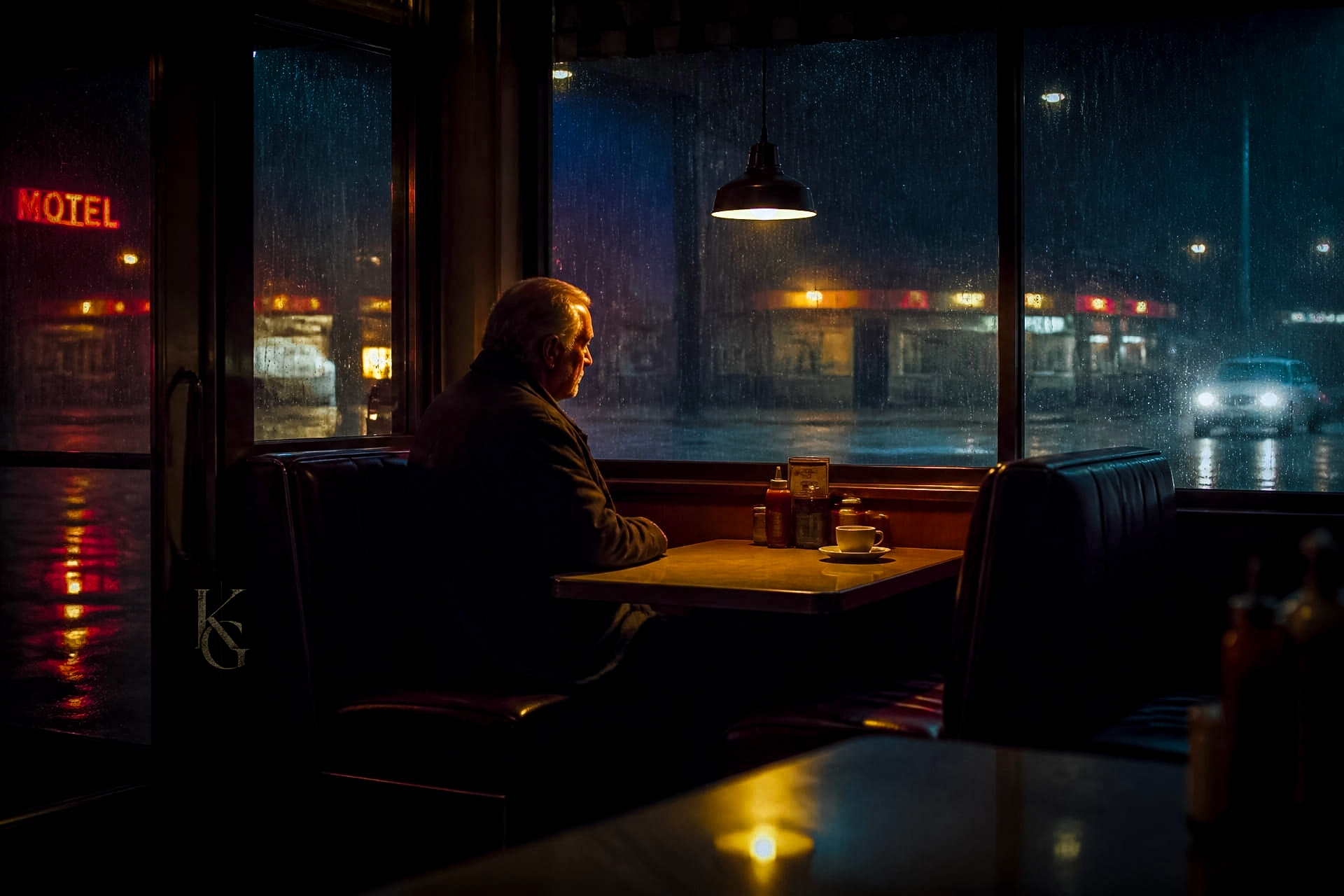
For thirty-two years, Martin Adler had spent every Thursday morning sitting in the same booth at the Blue Star Diner, a narrow corner booth positioned beside a set of rain-streaked windows that overlooked a stretch of highway where people were always traveling somewhere else. The ritual had survived marriages, funerals, layoffs, promotions, birthdays, and enough seasons to make the passage of time feel less like a river and more like a slow erosion. Every Thursday he arrived at seven fifty-five, ordered the same coffee from whichever waitress happened to be working, unfolded the newspaper more out of habit than interest, and settled into a silence that had become as familiar to him as his own reflection. The diner changed around him over the years. Owners came and went. The menu evolved. Booths were reupholstered. Waitresses retired. Yet one thing never changed. The seat across from Martin remained empty, guarded by a small brass RESERVED sign that nobody questioned anymore because the mystery had outlived the curiosity it once inspired.
The sign had become one of those peculiar local traditions that no one could explain but everyone accepted. New employees always asked about it during their first week. Travelers occasionally complained when the diner filled and an unused seat remained unavailable. The answers they received were always vague and unsatisfying. The booth was reserved because it had always been reserved. Reserved for whom was a question nobody seemed interested in answering. Martin himself had spent years trying to understand it before eventually surrendering to the comfort of not knowing. Age had taught him that some questions remained unresolved not because answers were unavailable, but because answers had a habit of complicating things people preferred to leave simple. Over time the sign stopped feeling mysterious and began feeling inevitable, another permanent fixture in a life increasingly defined by routine.
Outside, rain fell with the steady determination of something that intended to last all day. Water streamed down the windows in wavering patterns that transformed passing headlights into smears of gold and white, while across the street the faded neon motel sign cast a crimson glow onto the wet pavement, making the storm appear as though it had stained the morning with old blood. Martin wrapped both hands around his coffee mug and watched the weather perform its slow dance. There was something comforting about storms. They reminded him that not everything could be controlled, predicted, or managed. At sixty-eight, he spent more time than he cared to admit thinking about the decisions that had shaped his life. Not with regret exactly, because regret suggested certainty about an alternative outcome, and certainty was a luxury reserved for people who had never lived long enough to understand how complicated life actually was. What occupied his thoughts instead was curiosity. He found himself wondering about intersections, those seemingly insignificant moments where one decision quietly redirected an entire future. Forty years earlier he had been offered a position in Seattle, a promotion that would have doubled his income and transported him into a life completely different from the one he eventually inhabited. The same week the offer arrived, his father became seriously ill. Martin stayed. Then his father recovered. Then life happened. One year became five. Five became twenty. Twenty became forty. The decision hardened into history while the question attached to it remained stubbornly alive.
The bell above the diner’s entrance jingled softly, and although customers entered and exited throughout the morning with enough frequency that he normally ignored them, something compelled him to look up. A woman stood just inside the doorway holding a rain-darkened umbrella. She appeared to be somewhere in her sixties, though there was a weariness about her that made age difficult to estimate. Silver threaded through dark hair pulled loosely away from her face, and her eyes carried the exhausted focus of someone who had traveled a considerable distance to reach a destination she was not entirely certain existed. She paused near the entrance and surveyed the diner with unusual concentration, not as though she were searching for an empty seat, but as though she were searching for a specific memory. The waitress approached and gestured toward an open booth near the front window. The woman shook her head. Another booth was offered. Again she refused. Then her gaze settled on Martin.
A strange sensation tightened beneath his ribs. He had never seen her before. He was absolutely certain of that. Yet something about her felt familiar in the same way an old scar feels familiar, not because you think about it often, but because it becomes part of the landscape of who you are. He watched as she crossed the diner, ignoring the confusion of the waitress and the questioning look from the owner emerging from the kitchen. Conversation softened around her passage. A few customers glanced up from their meals. Even the rain seemed quieter against the windows. By the time she reached his booth, Martin felt as though he were standing on unstable ground while pretending otherwise. The woman looked briefly at the reserved sign, then at him, and the expression that crossed her face was not one of triumph or relief but recognition. Without asking permission, she slid into the seat that had remained empty for more than three decades.
The first words she spoke struck him with the force of a physical blow. She told him he should have taken the job in Seattle, and for a moment Martin forgot how to breathe. The diner seemed to recede around him until only the woman remained. Nobody alive knew about Seattle anymore. His parents were gone. His wife had been gone for nearly ten years. Friends drifted away, moved away, or died. The decision existed now only as a private artifact stored somewhere deep inside his memory, yet somehow this stranger had reached into that hidden corner of his life and spoken its name aloud. When he asked who she was, she responded with a sadness that suggested the answer would matter less than the reason she had come. Her voice carried the weight of someone who had spent years rehearsing a difficult conversation, and Martin found himself listening despite every instinct urging caution.
What unsettled him most was not what she knew but how she knew it. As the storm continued beyond the windows and fresh coffee appeared on the table without either of them requesting it, the woman began speaking about moments from his life that no stranger should have been able to access. She spoke about sitting alone in his truck after his father’s funeral because he could not face another person telling him they were sorry. She spoke about the Christmas when money had grown so tight that he spent nights calculating bills while pretending everything was fine. She spoke about the evening his wife received her diagnosis and the helpless terror he carried home afterward. Yet she did not describe these events the way a biographer might describe them. She described them the way Martin remembered them. She remembered the silence. She remembered the fear. She remembered the precise shape of the loneliness. Listening to her felt less like hearing stories and more like hearing memories spoken aloud by someone who had been standing beside him the entire time.
Eventually the conversation returned to Seattle, though not in the way he expected. The woman told him that he had spent most of his life believing that decision represented a door that had closed forever, when in reality it represented a door that had opened. She explained that people often became obsessed with the lives they never lived because those lives remained perfect in their imaginations. Imagined futures never suffered disappointments. Imagined futures never accumulated mistakes. Imagined futures remained forever suspended at the moment of possibility. The life Martin had actually lived, however, contained all the imperfections of reality. It contained grief and heartbreak and failure. It also contained children, grandchildren, friendships, laughter, resilience, and countless moments that would never have existed had he boarded that plane. As she spoke, Martin felt something uncomfortable shifting inside him. He realized he had spent decades treating curiosity like regret. He had mistaken wondering for mourning.
The woman eventually leaned back in the booth and studied him with the tired patience of someone who had finally reached the end of a long journey. She told him that he had spent years asking whether he should have gone to Seattle, when the more important question was how many lives existed because he stayed. The observation settled heavily over him. He thought about his children. His grandchildren. His wife. His father. Every meaningful relationship in his life emerged from a decision he had spent years quietly second-guessing. The realization did not erase uncertainty. It did not provide answers. Instead it replaced one question with another, and somehow that felt more honest.
When the woman finally stood to leave, Martin experienced an unexpected surge of panic. It wasn’t fear of her departure so much as fear that whatever understanding had begun taking shape inside him might vanish alongside her. He asked what he was supposed to have done differently. The woman paused beside the booth while rain traced silver rivers down the glass behind her, and after a long moment she smiled with a gentleness that felt almost painful. She told him he had spent most of his life treating existence like an examination he had somehow failed, when the truth was far simpler and far more difficult to accept. He had never been graded. Life was never a test. It was only life. Then she gathered her coat, walked toward the door, and disappeared into the storm without looking back.
Hours later, after the lunch crowd had come and gone and the rain had softened into a distant whisper, Martin remained alone in the booth staring at the empty seat. Something felt different. Not resolved. Not explained. Different. As though a window had opened somewhere deep inside him and allowed fresh air into a room that had been sealed for decades. Almost without thinking, he reached beneath the table and brushed his fingers against rough wood. Curious, he leaned forward and discovered a fresh carving etched into the underside of the table. It contained tomorrow’s date, and beneath it, carved with deliberate precision, were four simple words: YOUR RESERVATION IS READY. For the first time in forty years, Martin found himself looking toward tomorrow not with curiosity about what might have been, but with anticipation for what might still be.
Discover more from Memoirs of Madness
Subscribe to get the latest posts sent to your email.


Loved this Mangus.
LikeLike
Mangus, I found myself totally focused right along with Martin. Indeed, we are blessed with an invitation to experience tomorrow. It doesn’t even require that a deposit be paid for a reservation. Outstanding!
LikeLike
What a beautifully crafted story…that tells a tale all too familiar for probably every person in the world at one time or another. The ending is so precious! Moving on, from what might have been to anticipation of what might still be. Totally loved by this, moved to tears…it touched me deeply.
LikeLike
Life is only life.
LikeLike