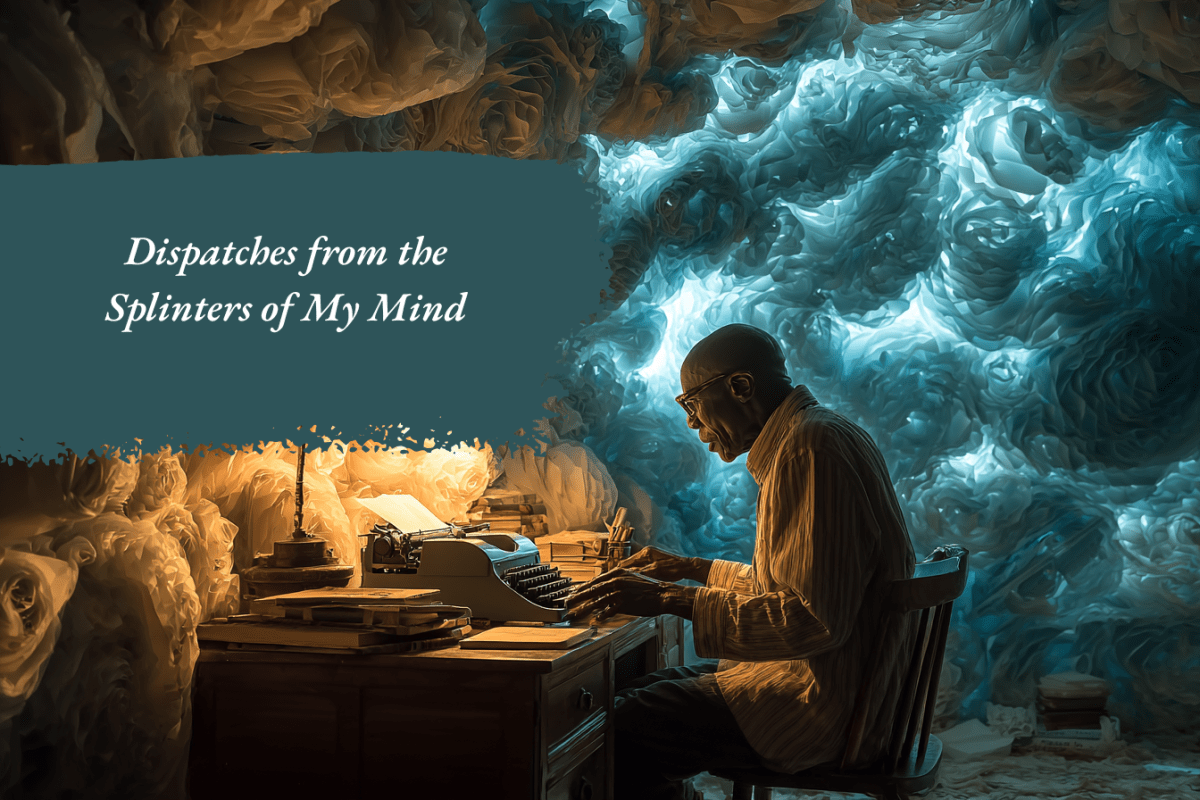
Dispatches from the Splinters of My Mind – Entry 42
Some people disappear only once. Others disappear a little more every time we try to remember them.
The first thing Eleanor Whitcomb forgot was the sound of her husband’s laughter. Not his name, not the shape of his face, nor the way he used to leave his shoes beneath the kitchen table despite her repeated complaints. Those things remained stubbornly intact, preserved somewhere in the cluttered rooms of her mind. But his laughter, that deep, unrestrained sound that once filled the house like a second source of heat, had vanished without ceremony. She discovered its absence one Tuesday afternoon while washing a chipped porcelain cup, and the realization frightened her enough that she dropped it into the sink.
The cup survived. She was less certain about herself.
She stood at the kitchen window for a long while afterward, watching rain collect along the rusted gutter. Somewhere beyond the glass, a delivery truck coughed its way down the street, its tires whispering across wet pavement. The world continued its ordinary business, apparently indifferent to the fact that something irreplaceable had just disappeared.
Eleanor had always believed forgetting happened gradually, the way paint peeled from old wood or wallpaper surrendered to dampness. She imagined memories fading around their edges until only their general shapes remained. What she had not anticipated was the precision of the losses. One day she could remember every detail of an afternoon spent beside her husband on a fishing pier, including the unpleasant smell of bait and the peculiar green of the water. The next, she could recall the pier, the weather, even the weight of his hand against her back, but not the words he had spoken.
It was as though someone had reached into the memory and carefully removed a single thread.
The photographs began changing three weeks later.
She noticed it while dusting the mantelpiece in the sitting room. There were seven framed photographs arranged beneath the clock, each occupying a place she had assigned decades earlier. Weddings, birthdays, a family picnic beside a lake whose name escaped her. She had cleaned those frames every Sunday for forty years, long enough to know the scratches in their glass and the stubborn fingerprints that refused to disappear.
In the photograph taken on her twenty-fifth wedding anniversary, her husband’s face had become indistinct.
Not faded. Not discolored.
Indistinct.
His dark suit remained perfectly visible, as did the pale carnation pinned to his lapel. Eleanor could count the buttons on his jacket and identify the delicate stitching along his collar. But where his face should have been, there was a peculiar arrangement of gray squares, each slightly different in shade, resembling the mosaic tiles of a bathroom floor.
She removed the frame and held it beneath the lamp.
The squares remained.
She rubbed the glass with her sleeve, then opened the backing and examined the photograph itself. Nothing changed. The distortion was part of the image, embedded in the paper as thoroughly as the silver grains that had once captured the light.
Eleanor sat down.
For the first time in many years, she wished someone else lived in the house.
By Thursday, she could no longer remember the color of her husband’s eyes.
The house had been built before the war, though Eleanor could never remember which war the estate agent had meant. Its narrow hallways smelled of beeswax, damp plaster, and the medicinal sweetness of lavender sachets tucked into drawers. The floorboards complained beneath her slippers. Pipes knocked inside the walls after midnight, and the grandfather clock in the sitting room occasionally struck thirteen, a defect her husband had promised to repair but never did.
She had grown accustomed to the house’s small betrayals.
The photographs were different.
Every morning, another detail disappeared.
Her sister’s wedding veil dissolved into a patchwork of pale rectangles. A childhood friend lost the left side of her face. The family dog became an indistinguishable brown shape beside a garden fence, though Eleanor could still remember the animal’s rough tongue and the particular smell of its wet fur.
She began keeping a notebook.
October 12. Margaret’s face is changing.
October 14. I cannot remember where Margaret lived.
October 16. I had a sister named Margaret. I think.
She wrote carefully, pressing the pen hard enough to leave impressions on the pages beneath. Sometimes she read earlier entries and found herself irritated by the woman who had written them, as though Eleanor Whitcomb were a stranger making unreasonable demands upon her attention.
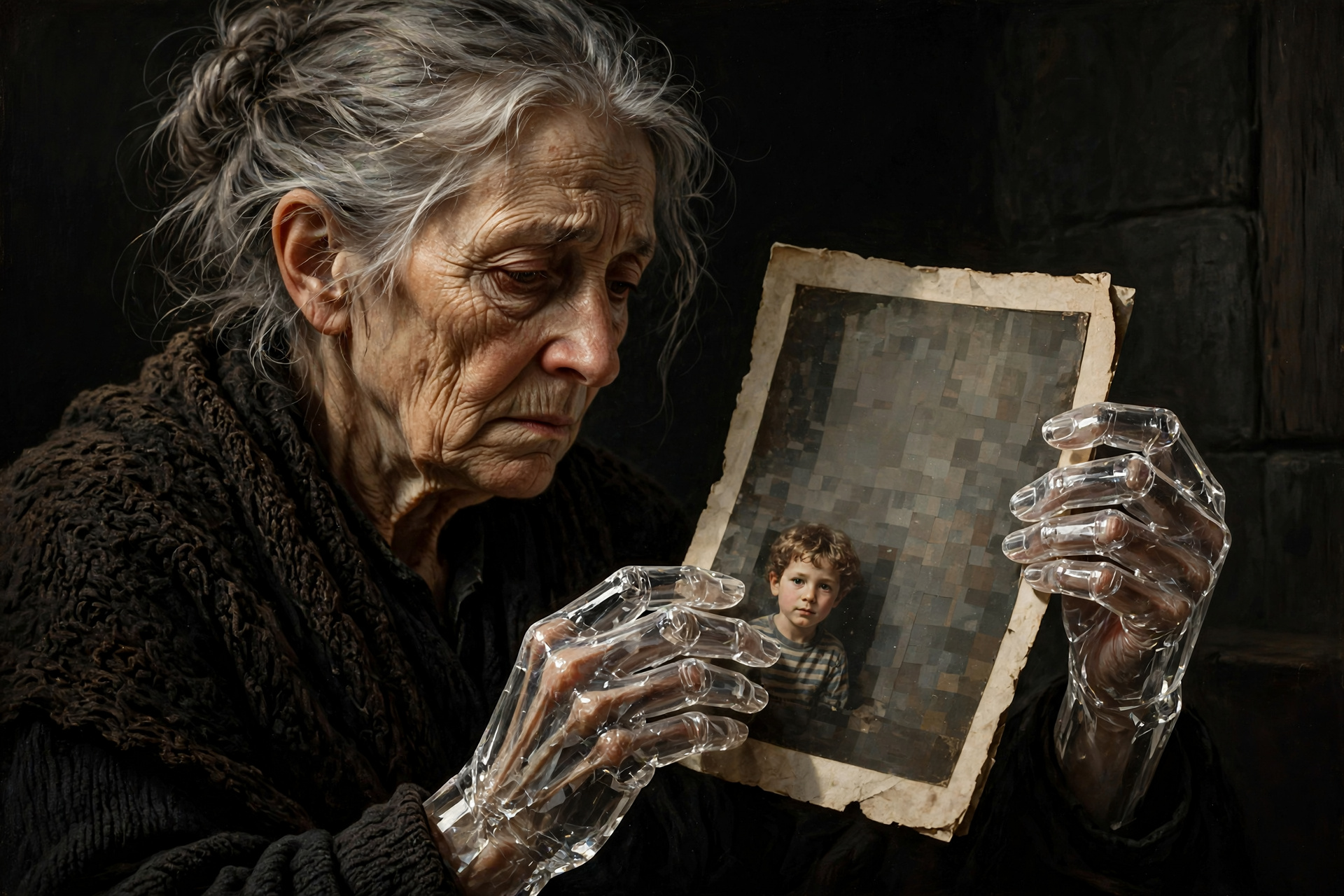
On October 19, she discovered that her hands were becoming transparent.
At first, she mistook the effect for poor lighting. The afternoon sun came through the curtains in narrow amber bands, illuminating the dust above her sewing basket. As she reached for a needle, she noticed the floral pattern of the upholstery showing faintly through her fingers.
She turned her hand over.
The bones were visible, but not in the manner of an X-ray. They appeared suspended inside something resembling thick glass, surrounded by delicate veins and tendons that caught the light like fine silver wire. Her skin remained in places, particularly around the knuckles, where age had gathered it into familiar folds.
There was no pain.
That frightened her more than pain would have.
She pressed her palm against the table. The wood felt solid and cold. She could still lift a cup, turn a page, fasten the buttons of her cardigan. Whatever was happening had not yet diminished her ability to touch the world.
Only her ability to belong to it.
She considered calling a doctor, but could not imagine how to explain the situation without sounding ridiculous. Besides, the telephone had begun ringing occasionally with nobody on the other end, and she had developed an unreasonable suspicion that whoever was calling already knew.
The photograph of the boy appeared on a Sunday morning.
Eleanor found it beneath the sugar bowl, although she was certain she had cleaned the kitchen table the previous evening. It was an old photograph, its edges yellowed and curled, the paper softened by years of handling. A little boy stood against a background of dark, indistinct shapes, wearing a striped sweater and an expression of solemn patience.
He could not have been older than seven.
His hair was brown and untidy, his eyes an uncertain shade between green and gray. There was something peculiar about the way he faced the camera, not frightened exactly, but watchful, as though waiting for the photographer to finish so he could return to something more important.
The background had been reduced to a mosaic of square fragments.
Only the boy remained clear.
Eleanor touched his face with one transparent finger.
An unexpected sensation moved through her chest, sharp enough to interrupt her breathing. It was not recognition, at least not the kind she understood. She could not recall his name or where the photograph had been taken. Yet she knew, with an intimacy that bypassed thought, that she had once loved this child.
She also knew she had once been afraid of him.
The contradiction unsettled her.
She carried the photograph into the sitting room and placed it beside her notebook. For several hours, she studied the boy’s expression, searching for some small resemblance to the people whose faces were disappearing from the mantelpiece.
Nothing came.
Then, shortly after four, she remembered the smell of oranges.
Not the fruit itself, but orange peel crushed beneath a small shoe. A hallway. Rain striking a window. Someone crying behind a closed door.
And a voice, very young, asking whether she would remember this time.
Eleanor closed her eyes.
The memory vanished.
That night, she dreamed of a staircase.
It descended farther than the house should have allowed, its wooden steps damp beneath her bare feet. Somewhere below, water dripped into a metal basin, each drop producing a hollow note that seemed to travel upward through the darkness.
A boy stood at the bottom.
She could not see his face.
“You’re late,” he said.
Eleanor tried to answer, but her mouth filled with the taste of pennies.
“Did you forget again?”
She woke with her nightdress soaked in perspiration and the sound of dripping water continuing somewhere beneath the floorboards.
The next morning, the cellar door was locked.
She did not remember the house having a cellar.
By November, Eleanor had stopped covering the mirrors.
She had begun doing so after discovering that her reflection sometimes lagged behind her movements. A raised hand would remain motionless for an instant before following. Once, while brushing her hair, she watched the woman in the glass close her eyes even though Eleanor’s remained open.
The mirrors were unpleasant, but the photographs were worse.
She could no longer identify anyone on the mantelpiece. Their bodies remained arranged in familiar domestic scenes, but their faces had become collections of muted squares. She recognized the furniture, the clothing, the curtains behind them. The people themselves had disappeared.
Her notebook contained seventeen pages of names she no longer understood.
One afternoon, she found an entry written in a different hand.
Don’t let him convince you it was an accident.
Eleanor examined the sentence beneath the lamp. The ink was darker than the surrounding entries, the letters cramped and hurried. She turned to the following page.
He remembers what you did.
She stared at the words until they seemed to rearrange themselves.
Then she heard a small sound from the kitchen.
A chair scraping across the floor.
Eleanor remained seated, listening.
The house was silent again, but she could smell oranges.
She found the photograph on the table where she had left it, although she was certain she had placed it inside the notebook. The boy looked unchanged. His small face remained clear, his striped sweater sharply defined against the disintegrating background.
Something about his expression had altered.
He appeared disappointed.
Eleanor lowered herself into the chair. Her hands were almost entirely transparent now, and the wood grain showed through her palms as she rested them on the table. She could see the pale outline of her wedding ring floating around a finger that barely seemed to exist.
“I don’t know who you are,” she whispered.
The kitchen clock ticked.
“But I think I should.”
A memory stirred.
A narrow bedroom. A quilt patterned with blue birds. A glass of water beside a bed. The faint smell of antiseptic and damp wool.
A child’s voice asking her to promise something.
She tried to hold the memory, but it slipped away, leaving behind an emotion so powerful that she bent forward beneath its weight.
Shame.
Not sorrow. Not fear.
Shame.
She turned the photograph over.
On the back, written in the careful, slightly slanted handwriting she had used throughout her adult life, were six words.
You promised you wouldn’t remember.
Eleanor read them several times.
The sentence seemed to belong to another woman, someone who had made decisions Eleanor could no longer understand. She tried to imagine the circumstances under which forgetting a child might constitute a promise rather than a failure.
A mercy, perhaps.
Or a punishment.
From somewhere beneath the kitchen floor came three slow knocks.
Eleanor looked toward the hallway.
For an instant, she remembered a small hand gripping hers so tightly that his fingernails left crescents in her skin. She remembered telling him that everything would be all right, although she had known perfectly well that it would not.
Then another memory surfaced, quieter and infinitely worse.
She had not been trying to comfort him.
She had been asking him to forgive her.
The kitchen clock stopped.
Eleanor looked down at her hands.
They were solid.
Every wrinkle had returned, every blue vein and brown age spot. She pressed her palms together, feeling the familiar friction of skin against skin. Her wedding ring sat heavily against her knuckle.
She turned the photograph over.
The boy was gone.
Only the square fragments remained, spreading across the paper in shades of gray and brown, a mosaic of something that might once have been a room.
Eleanor stared at the empty image.
She could no longer remember why she had been crying.
Then, from the other side of the locked cellar door, a child began to sob.
She listened for a long time, her hands resting quietly in her lap.
Eventually, she rose and walked toward the hallway.
Halfway there, she stopped.
There was something she had meant to do.
Something important.
But the thought had already begun to fade, and the house was growing cold.
She returned to the kitchen, put the kettle on, and waited for the water to boil.
Behind her, beneath the sugar bowl, the photograph slowly developed a new face.
It was an elderly woman with silver hair and frightened eyes.
Her hands were made of glass.
And on the other side of the cellar door, the crying stopped.
Some memories fade because time takes them. Others disappear because we once begged them to.
Until next Tuesday, when another splinter finds its way to the surface.
Discover more from Memoirs of Madness
Subscribe to get the latest posts sent to your email.

