Stories in Monochrome — Episode Four
Margaret Voss had spent the better part of forty-eight years learning that trouble rarely announced itself with anything resembling courtesy. It arrived wearing expensive shoes, carrying official identification, or speaking in the reassuring tones of someone who had already decided how much your cooperation was worth. Occasionally, it came disguised as an opportunity. More often, it appeared on an otherwise ordinary Tuesday, just when a person had begun entertaining the dangerous possibility that life might finally leave them alone.
On the morning of January seventeenth, 1975, trouble arrived by telephone.
Maggie was standing in the kitchen of her rented farmhouse, attempting to persuade a stubborn coffeepot to produce something drinkable, when the telephone rang. Outside, a hard wind swept across the frozen fields, rattling the loose windowpanes and sending powdered snow skittering along the porch. The house smelled of motor oil, burnt toast, and the wood smoke that had settled into its walls during winters Maggie preferred not to remember.
She let the telephone ring four times.
People who knew her understood that calling before eight in the morning constituted an invitation to be disappointed.
On the fifth ring, she answered.
“Somebody better be dead.”
A small voice spoke.
“Are you Maggie Voss?”
She frowned.
“Who’s asking?”
“My name’s Nathaniel.”
Maggie looked toward the clock.
“Well, Nathaniel, unless you’re selling something I desperately need, you’ve got about ten seconds.”
The boy hesitated.
“Do you remember a girl named Clara?”
The coffeepot began sputtering.
Maggie stopped breathing.
For a moment, she heard nothing except the wind scraping against the kitchen windows.
“Who is this?”
“I told you. Nathaniel.”
“Where’d you get this number?”
The boy seemed confused.
“I don’t know.”
Maggie’s grip tightened around the receiver.
“Listen carefully, son. Who told you to call me?”
Nobody answered.
Then the boy whispered:
“She said you promised.”
Maggie hung up.
She stood beside the telephone, staring at it as though the instrument had developed an unpleasant personality.
Sixteen years.
Sixteen goddamned years.
She poured herself a cup of coffee, discovered she’d forgotten to add the grounds, and drank the hot water anyway.
Ten minutes later, the telephone rang again.
Maggie considered letting it ring.
Instead, she answered.
“Listen here, you little—”
“Margaret.”
The voice was male.
Older.
Deep and weathered.
Maggie felt the room contract around her.
Nobody had called her Margaret in years.
Not since her father died.
Not since the night at Bellwether House.
“Who is this?”
“You took something that didn’t belong to you.”
She closed her eyes.
The voice continued.
“You’ve carried it long enough.”
Maggie leaned against the kitchen counter.
“You’re dead.”
A pause.
Then:
“Not yet.”
The line went silent.
By nine-thirty, Maggie had packed a change of clothes, two cartons of cigarettes, a thermos of coffee, and the leather satchel she’d kept locked inside an old ammunition box beneath her bed.
She hadn’t opened the satchel since October 1958.
That wasn’t entirely true.
She’d opened it twice.
Once in 1963, after receiving a Christmas card addressed in handwriting she recognized but couldn’t explain.
And once in 1969, when she woke from a dream in which a little girl stood beside her bed, asking why Maggie had left her behind.
Both times, she’d closed the satchel without examining its contents.
Some things were easier to carry when you didn’t look directly at them.
Her motorcycle waited beneath a canvas cover in the barn.
It was an aging British machine, a 1956 Triumph Thunderbird she’d purchased secondhand from a man who claimed it had belonged to a police officer. Maggie had never believed the story, though she’d admired the motorcycle enough not to argue.
The engine required three attempts before surrendering to ignition.
Maggie listened to its uneven idle.
“Don’t start with me today.”
The motorcycle responded with a cough of blue smoke.
She secured the satchel beside the seat, pulled on her leather jacket, and headed east.
The road stretched across frozen farmland beneath a colorless sky. Telephone poles marched along the shoulders, their wires humming in the wind. Occasionally, Maggie passed a farmhouse or a boarded-up service station, but mostly there was nothing except fields, fences, and the long, indifferent distance between places people had decided were worth remembering.
She preferred it that way.
Roads didn’t ask questions.
They simply demanded that you keep moving.
In October 1958, Maggie Voss had been thirty-one years old and employed as an independent courier, transporting documents and medical supplies between hospitals, laboratories, and municipal offices. It wasn’t glamorous work, but it paid well enough, and nobody complained when she arrived smelling of gasoline and cigarettes.
She met Evelyn Mercer through St. Agnes Hospital.
Evelyn was a nurse with an irritating habit of asking questions that made other people uncomfortable. Maggie liked her immediately, though she would later regret having been so generous with her affection.
Their friendship developed over late-night coffee, arguments about politics, and occasional motorcycle rides through the countryside.
Evelyn had never ridden before meeting Maggie.
The first time, she’d screamed so loudly that Maggie thought something had gone wrong with the engine.
When they stopped, Evelyn climbed off the motorcycle, removed her helmet, and announced that she’d never felt so alive.
Maggie laughed.
“That’s because you nearly weren’t.”
Evelyn punched her shoulder.
“You’re an awful woman.”
“Been called worse.”
They became friends.
Real friends.
The kind who could sit together without speaking and still feel as though something important had been said.
Which was why Maggie agreed to help when Evelyn appeared at her apartment one rainy evening carrying a package wrapped in brown paper.
“I need you to take this somewhere safe.”
Maggie looked at the package.
“What’s in it?”
“Photographs.”
“Of what?”
Evelyn hesitated.
“People.”
Maggie raised an eyebrow.
“Well, that narrows it down.”
Evelyn didn’t smile.
That was when Maggie knew something was wrong.
“What’s happened?”
Evelyn sat at the kitchen table.
For a long moment, she stared at her hands.
Then she said something Maggie would spend the next sixteen years trying to understand.
“There’s a room in Bellwether House that doesn’t stay where it’s supposed to.”
Maggie laughed.
Evelyn didn’t.
The laughter died.
“What do you mean?”
“I mean sometimes it’s there. Sometimes it isn’t. And sometimes people go inside and come out somewhere else.”
Maggie studied her friend.
“Somewhere else where?”
Evelyn looked up.
“I don’t know.”
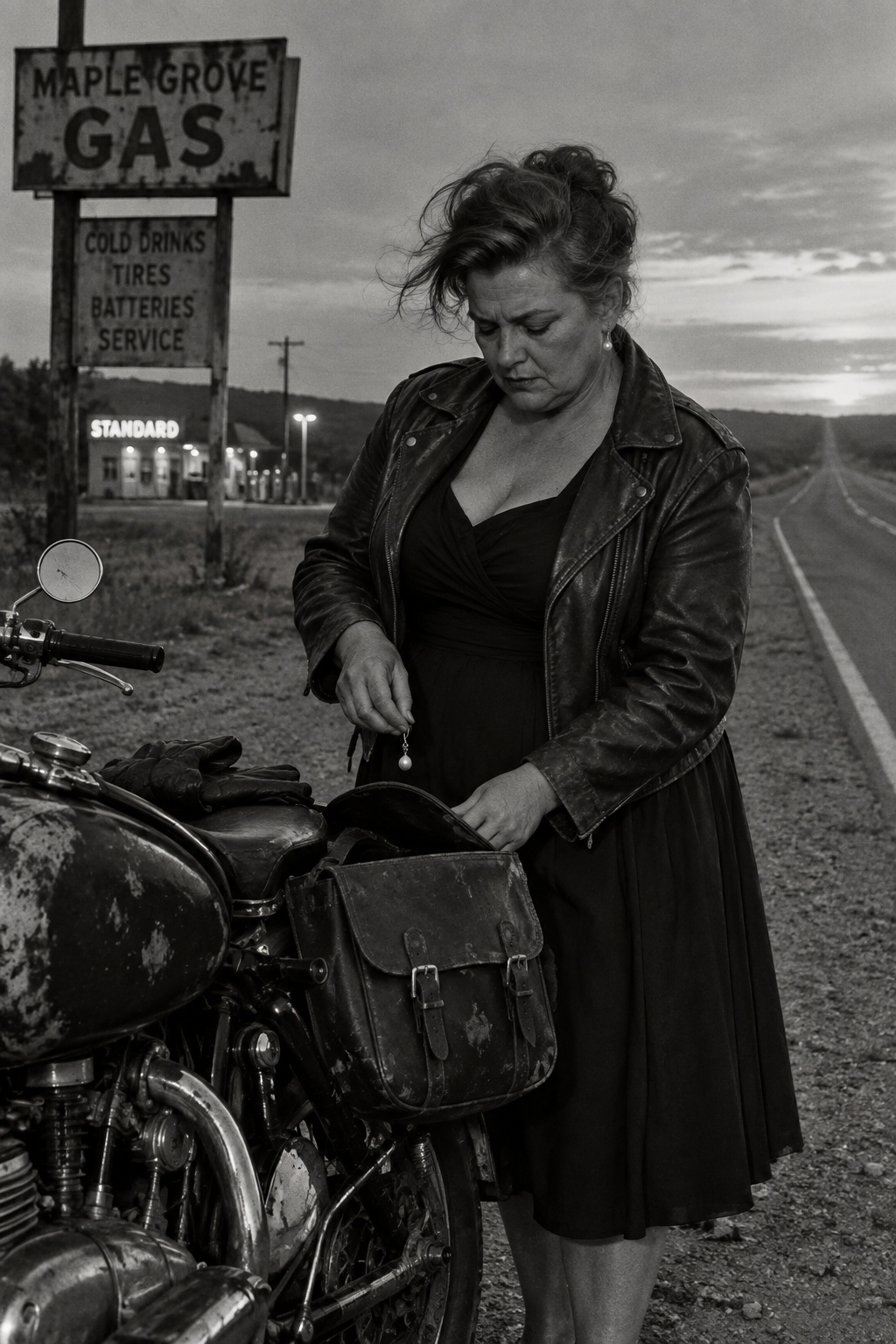
Maggie stopped at Maple Grove Gas shortly after three in the afternoon.
The service station stood beside a narrow two-lane highway, its rusted sign announcing gasoline, cold drinks, tires, batteries, and service with an optimism the building itself no longer supported. A faded Standard Oil sign hung above the pumps, and a row of bare trees stood beyond the gravel lot.
The motorcycle had begun misfiring twenty miles earlier.
Maggie suspected the ignition points.
She also suspected the machine had developed a personal objection to returning to Bellwether House.
She shut off the engine and listened to the sudden silence.
A truck passed on the highway.
Somewhere behind the station, a dog barked.
The attendant emerged from the garage wiping his hands on a rag.
He was a narrow man with thinning hair and a cigarette hanging from his lower lip.
“Afternoon.”
Maggie nodded.
“Got a place I can work on the bike?”
He looked at the motorcycle.
“What’s wrong with it?”
“Won’t run right.”
“That narrows it down.”
Maggie stared at him.
He smiled.
She didn’t.
“Garage is around back,” he said.
“Much obliged.”
She pushed the motorcycle toward the service bay.
The attendant followed.
“Name’s Earl.”
“Maggie.”
“You traveling far?”
“Far enough.”
He nodded as though that explained everything.
Maggie appreciated the discretion.
She spent the next forty minutes cleaning the points, checking the plugs, and adjusting a cable that had begun fraying near the throttle housing. Earl watched from a respectful distance, occasionally offering advice she didn’t need.
When she finished, the engine started on the first attempt.
“Well,” Earl said, “looks like you know what you’re doing.”
“Occasionally.”
He laughed.
Maggie didn’t.
She purchased gasoline, a pack of cigarettes, and a bottle of cola.
Then she carried the satchel to a wooden bench beside the station.
For sixteen years, she’d avoided opening it.
Now, with the winter sun descending behind the hills, she finally unbuckled the straps.
The first photograph showed Bellwether House in 1926.
Maggie recognized the building immediately, though the street had been unpaved and the neighboring storefronts were unfamiliar.
The second photograph showed a group of people standing on the front steps.
A man in a dark suit.
Two women.
Three children.
One of the children was a little girl wearing a white-collared dress.
Clara.
Maggie felt her throat tighten.
She turned the photograph over.
Someone had written:
APRIL 1926 — THE FIRST TENANTS.
The next photograph was dated 1948.
Then 1958.
Then 1974.
Maggie stopped.
The photograph showed a boy standing outside Bellwether House beside a woman carrying two suitcases.
The boy wore a winter coat.
The woman looked exhausted.
Maggie recognized neither of them.
On the back, in Evelyn’s handwriting, were four words.
NATHANIEL PRICE — DECEMBER 1974.
Maggie stared at the date.
Evelyn had given her these photographs in 1958.
Sixteen years before the picture was supposedly taken.
She turned it over again.
The boy’s face was clear.
Eleven years old, perhaps.
Dark hair.
Serious eyes.
A look of concentration that suggested he was listening to something nobody else could hear.
Maggie remembered the telephone call.
My name’s Nathaniel.
She set the photograph beside her.
Her hands had begun trembling.
“Son of a bitch.”
She reached deeper into the satchel.
There were municipal inspection reports, hospital records, and several pages covered with symbols she couldn’t identify.
Beneath them lay a sealed envelope.
Her name was written across the front.
MARGARET VOSS.
She recognized Evelyn’s handwriting.
But she didn’t remember the envelope.
Maggie broke the seal.
Inside was a single sheet of paper.
Three sentences.
You were right to take the photographs.
You were wrong to leave the girl.
She’s still waiting.
Maggie read the words twice.
Then a third time.
The service station seemed to grow very quiet.
She remembered the night they sealed the doorway.
The smell of fresh plaster.
Walter Hensley’s voice giving orders.
The workmen carrying lumber through the third-floor hallway.
And Clara.
Standing beside the door.
Holding her little wooden horse.
Maggie had told herself the girl was safe.
That Evelyn knew what she was doing.
That whatever existed beyond the doorway needed to remain there.
She’d believed those things because the alternative required a kind of courage she hadn’t possessed.
And when the door was sealed, Maggie had walked away.
She’d carried the photographs.
She’d carried the documents.
But she hadn’t carried the child.
Earl emerged from the garage carrying a thermos.
“Coffee?”
Maggie looked up.
“Got anything stronger?”
He smiled.
“Not legally.”
“Coffee’ll do.”
He poured a cup and handed it to her.
His eyes drifted toward the photographs.
“Family?”
Maggie looked down.
“Something like that.”
Earl nodded.
He didn’t ask anything else.
For a while, they sat in silence watching the highway.
Then Earl said, “Funny thing about roads.”
Maggie sighed.
“Here we go.”
He chuckled.
“Seems like everybody’s always trying to get somewhere else. Nobody ever thinks about what they left behind.”
Maggie looked toward him.
“That supposed to be wisdom?”
“Probably not. My wife says I talk too much.”
“Smart woman.”
He laughed.
Maggie almost smiled.
Almost.
Then she gathered the photographs and returned them to the satchel.
She left the envelope on top.
Earl watched her stand.
“Heading east?”
Maggie looked toward the highway.
“Was.”
“Changed your mind?”
She secured the satchel beside the motorcycle.
“Something like that.”
He nodded toward the road.
“Where you headed?”
Maggie pulled on her gloves.
“Back.”
Earl considered the answer.
“Back where?”
She swung a leg over the motorcycle.
“Somewhere I should’ve never left.”
The engine started reluctantly.
Maggie let it idle while she adjusted her scarf.
The winter sky had begun darkening, and the service station lights flickered against the gathering dusk.
She looked toward the highway.
For sixteen years, she’d convinced herself that leaving Bellwether House had been the sensible decision.
She’d told herself that Evelyn knew what she was doing.
That Clara was safe.
That Walter Hensley and the others had understood the danger.
But there had always been one detail she couldn’t explain.
The night they sealed the doorway, Clara had been standing on the wrong side.
Not inside the room.
Outside.
Beside Maggie.
The little girl had been crying.
Maggie remembered taking her hand.
Remembered promising that everything would be all right.
Then Walter had called her away.
When she turned back, Clara was gone.
And the door had been sealed.
For sixteen years, Maggie had believed the child had somehow slipped inside before the workmen finished.
Now, staring at Evelyn’s letter, she began to consider another possibility.
What if Clara hadn’t gone inside?
What if she’d been left outside?
And what if the door hadn’t been sealed to keep something from escaping?
What if it had been sealed to keep something from getting back in?
Maggie looked toward the darkening road.
Then she turned the motorcycle around.
The engine growled beneath her.
The satchel pressed against her leg.
And somewhere, in a boardinghouse she hadn’t seen since 1958, a little girl waited beside a door that no longer existed.
Maggie accelerated onto the highway.
She didn’t know whether Evelyn was alive.
She didn’t know what had happened to Clara.
And she certainly didn’t know why a boy born five years after she’d left Bellwether House had called her that morning.
But she knew one thing.
She was done running.
At 6:17 that evening, the telephone rang inside the reception office of Bellwether House.
Mrs. Whitcomb answered on the third ring.
“Bellwether House.”
A woman’s voice spoke.
“Is Lorraine Price still staying there?”
Mrs. Whitcomb straightened.
“Who’s asking?”
“Maggie Voss.”
For several seconds, the older woman said nothing.
Then:
“I wondered when you’d call.”
Maggie closed her eyes.
“Don’t start with me, Edith.”
Mrs. Whitcomb glanced toward the staircase.
“You coming back?”
“Yes.”
“When?”
Maggie looked through the telephone booth’s glass toward her motorcycle.
“Soon as I can get there.”
Mrs. Whitcomb lowered her voice.
“Then you’d better hurry.”
Maggie felt the familiar tightening in her chest.
“Why?”
From somewhere above the reception desk came a faint knocking.
Three times.
A pause.
Twice more.
Mrs. Whitcomb looked toward the ceiling.
“Because,” she whispered, “the boy’s started hearing them.”
Maggie gripped the receiver.
“And Clara?”
The older woman didn’t answer immediately.
When she finally spoke, her voice was barely audible.
“She’s asking for you.”
Maggie closed her eyes.
For sixteen years, she’d been haunted by the memory of a child she’d failed to protect.
Now the child was calling her home.
And Margaret Voss, who had spent most of her adult life believing that every road led somewhere better, finally understood that some journeys were never about the destination.
They were about having the courage to return.
Discover more from Memoirs of Madness
Subscribe to get the latest posts sent to your email.


What is one thing you wish you could say to someone who is no longer here?
You had so much to tell them, but you thought you had more time.
Now they are gone, and the words are still stuck in your heart.
If heaven had a phone, you would call them just to say that one thing.
What is one thing you wish you could say to someone who is no longer here?
LikeLiked by 1 person