
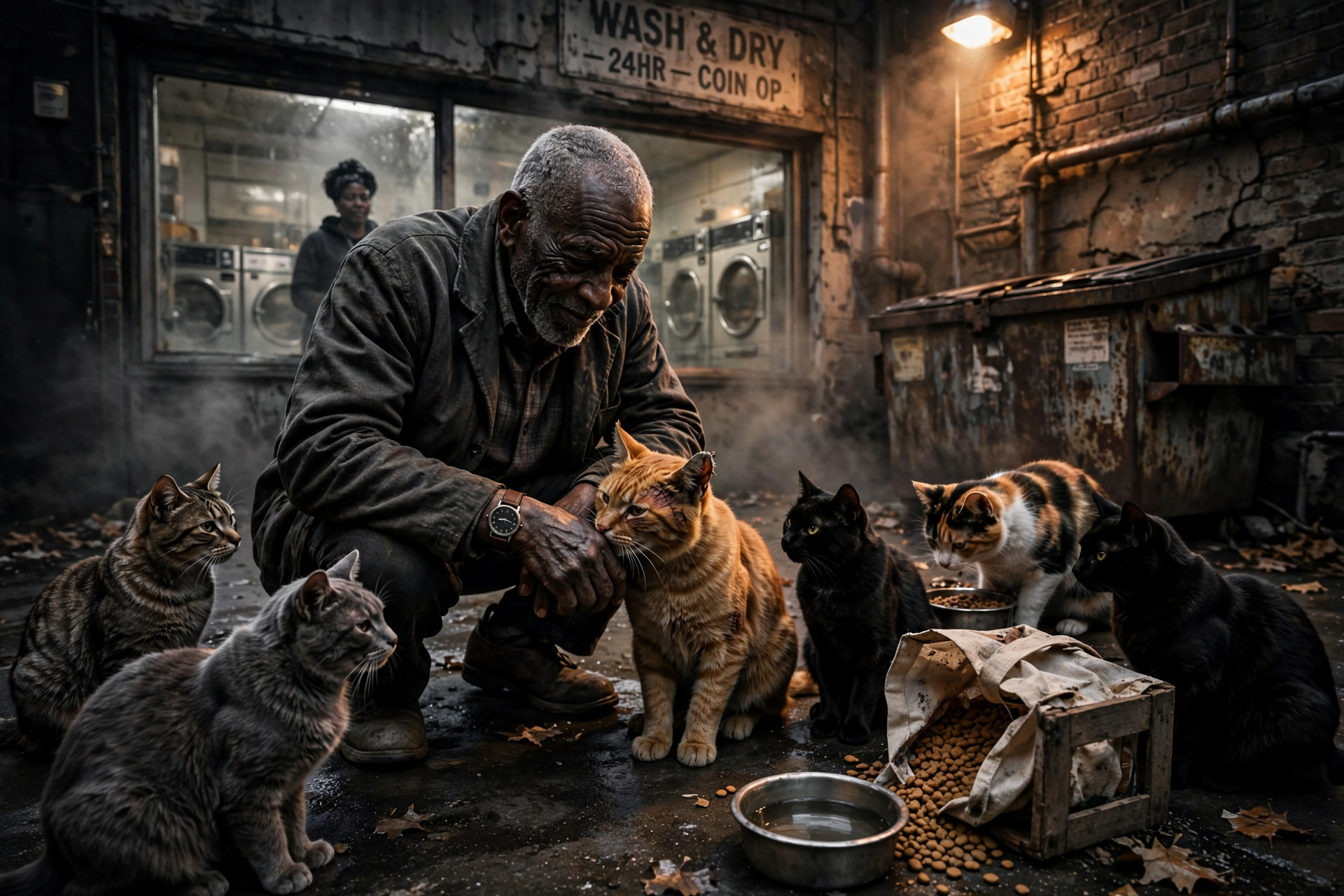
The cats knew him better than most people did, which wasn’t saying much about the people.
Every evening at precisely 9:14, an elderly man appeared behind Bellamy’s Wash & Fold carrying a battered canvas grocery bag and a plastic jug of water. He came regardless of the weather. Rain, snow, the miserable wet cold that crept beneath a man’s collar and settled into his bones—none of it made much difference. At 9:14, he would emerge from the alley between the laundromat and the abandoned furniture store, kneel beside the dumpster, and arrange six mismatched bowls along the cracked concrete.
The cats generally arrived before he did.
There was a large orange tom with half an ear missing, a gray female whose left eye had clouded over, two black cats so nearly identical that only their personalities distinguished them, and a narrow-faced calico who seemed to regard the entire arrangement as an unfortunate necessity. Others came and went, depending on the season and whatever private negotiations governed the neighborhood’s feline population.
The man knew them all.
He called the orange tom General, the gray female Miss Pearl, and the calico Duchess, although she possessed neither the temperament nor the manners appropriate to the title. He spoke to each animal while distributing their food, his voice low and conversational, as though discussing the day’s events with acquaintances who had the good sense not to interrupt.
“Evening, General. I see you’ve been fighting again. One of these days, somebody’s gonna explain to you that winning ain’t the same thing as being right.”
The tom would blink, unimpressed.
“Yeah, well. That’s what I figured.”
The man always fed Miss Pearl first. She was the oldest, or at least looked it, and the others had learned that attempting to interfere with her meal resulted in a stern lecture and occasionally a gentle shove.
Once the bowls were filled, he stepped back and watched the cats eat. He never hurried them. Sometimes he sat on an overturned milk crate, rubbing his knees and humming tunelessly beneath his breath. Other evenings, he simply stood with his hands buried in the pockets of his faded work jacket, watching the small congregation with an expression that suggested their company was enough.
At 9:32, he collected the empty bowls, rinsed them with water from the jug, and returned them to his bag.
Then he left.
Nobody at Bellamy’s knew much about him.
They called him the Cat Man.
It wasn’t an insult. In that neighborhood, people acquired names according to whatever peculiarities made them recognizable. There was Bicycle Eddie, who hadn’t owned a bicycle in fifteen years, and Miss Tuesday, who visited the laundromat every Thursday but had apparently established her reputation before anyone thought to correct it.
The Cat Man was simply the Cat Man.
He never complained about the noise, never asked for money, and never lingered long enough to become somebody else’s problem.
For most people, that was sufficient.
For Loretta Gaines, it wasn’t.
Loretta had managed Bellamy’s Wash & Fold for nineteen years, which she considered seventeen years longer than any reasonable person should be expected to tolerate the smell of industrial detergent and other people’s underwear.
At sixty-three, she possessed a sharp tongue, arthritic fingers, and a remarkable ability to identify trouble before it entered the building. She had raised three children, buried one husband, divorced another, and developed a healthy suspicion of anyone who described themselves as misunderstood.
She first spoke to the Cat Man on a Thursday in November.
The temperature had fallen below freezing, and the wind came down the alley hard enough to make the dumpster lid rattle. Loretta stepped outside to empty a trash bag and found him kneeling on the concrete, struggling to open a can of food with fingers that had gone stiff from the cold.
“You planning on freezing yourself to death out here?”
He looked up.
“Not tonight, ma’am.”
“Then you might consider standing up.”
“These fellows haven’t eaten.”
“They’re cats. They’d eat your face if you fell over.”
He considered that.
“General might. Miss Pearl’s got better manners.”
Loretta stared at him.
Then, against her better judgment, she laughed.
She went inside, returned with a cup of coffee, and handed it to him without asking whether he wanted it.
He accepted it with both hands.
“Much obliged.”
“You got a name?”
“Everybody does.”
“Well, aren’t you a clever one.”
He smiled.
“Isaiah.”
“Isaiah what?”
“Mercer.”
“Loretta Gaines.”
“Pleasure to meet you, Miss Gaines.”
“Don’t get carried away. I haven’t decided whether I like you.”
Isaiah chuckled.
“Fair enough.”
That was how it began.
Over the following months, Loretta learned that Isaiah was seventy-four, lived in a small apartment six blocks away, and had worked most of his life in warehouses, loading docks, and places where a man’s back was considered more valuable than his opinion.
He had no wife.
He didn’t discuss his family.
And every evening, regardless of what else happened in the world, he arrived at 9:14.
One night, Loretta asked him why.
“Why what?”
“Why nine-fourteen? Why not nine o’clock like a normal person?”
Isaiah looked at his watch.
“Because that’s when I said I’d be here.”
“Said to who?”
He glanced toward the cats.
“Somebody who believed me.”
Loretta waited for him to explain.
He didn’t.
She eventually learned that Isaiah’s silences weren’t invitations to keep asking. They were doors he had closed for reasons he wasn’t yet prepared to share.
And Loretta, who had a few locked rooms of her own, respected that.
Isaiah Mercer had not always been a gentle man.
There had been years when his hands shook for reasons that had nothing to do with age, when his temper arrived before his judgment, and when promises escaped his mouth with considerably greater ease than they survived the following morning.
He drank.
Not socially. Not occasionally. Not in the harmless, amusing fashion people described when they wanted to make destruction sound like a personality trait.
He drank until his wife learned to recognize the sound of his footsteps on the porch and his daughter learned to distinguish between the different ways a door could close.
He wasn’t violent in the manner that left obvious bruises. He had never struck either of them.
For years, he used that fact as evidence that he wasn’t as bad as other men.
It took him a long time to understand how little comfort that distinction offered the people who lived with him.
He missed birthdays, school plays, and one particularly important Christmas morning. He forgot promises, borrowed money he couldn’t repay, and turned apologies into a language so familiar that eventually nobody believed he meant anything by them.
His wife, Miriam, left when their daughter was fourteen.
Isaiah remembered the day with painful clarity.
It had been raining. Miriam packed two suitcases while their daughter sat at the kitchen table, pretending to read a magazine.
Isaiah stood in the doorway.
“I can change,” he said.
Miriam didn’t look at him.
“You’ve been saying that for eleven years.”
“This time I mean it.”
She closed the suitcase.
“That’s the problem, Isaiah. You always mean it when you say it.”
Their daughter, Naomi, never raised her eyes from the magazine.
Isaiah remembered wanting her to look at him.
He remembered being angry when she didn’t.
For years afterward, he told himself that Miriam had poisoned the girl against him.
It was easier than admitting that Naomi had reached her own conclusions.
The first object appeared three nights after Isaiah died.
Loretta found it beside the dumpster at 9:14.
A small brass key.
It lay on the concrete where Isaiah usually placed Miss Pearl’s bowl, its surface dulled by age and scratched around the teeth.
The cats sat nearby.
All six of them.
General occupied the overturned milk crate. Duchess watched from beneath a parked delivery truck. The others formed a loose semicircle around the place where Isaiah had knelt every evening.
Loretta looked at the key.
Then at the cats.
“Which one of you little criminals has been stealing?”
General yawned.
She picked up the key and slipped it into her coat pocket.
Isaiah’s death had been announced by a handwritten notice taped to the laundromat’s front door. A neighbor had found him in his apartment after he failed to answer his telephone. The funeral was small, attended by a handful of people from his recovery meetings, two former coworkers, and Loretta.
No family came.
Loretta had been surprised by how much that bothered her.
She knew Isaiah had a daughter. He’d mentioned her once, late one evening, while watching a mother struggle to carry three laundry baskets and a sleeping toddler through the parking lot.
“Got a girl about her age,” he’d said.
Loretta glanced at him.
“That woman?”
“The baby.”
“Your daughter’s still a baby?”
Isaiah smiled sadly.
“Depends on which part of me is remembering.”
He never mentioned Naomi again.
On the fourth night, Loretta found a photograph.
It was tucked beneath the overturned milk crate, protected from the evening drizzle by a piece of cardboard.
The picture showed a younger Isaiah standing beside a woman with a broad smile and tired eyes. A little girl stood between them, holding a stuffed rabbit by one ear.
Isaiah had hair then.
Quite a lot of it, actually.
Loretta studied the photograph.
The little girl couldn’t have been more than eight.
On the back, someone had written:
Summer, 1978. Before everything got complicated.
Loretta turned the photograph over again.
She wondered who had written those words.
Then she wondered who had placed the picture beneath the crate.
The cats offered no assistance.
By the end of the week, other objects had appeared.
A broken wristwatch with its hands stopped at 9:14.
A child’s drawing of a house beneath an enormous yellow sun.
A train ticket dated twenty-three years earlier.
A single brown leather glove.
And a folded piece of paper bearing five words written in an unsteady hand.
I’m sorry I didn’t stay.
Loretta arranged the objects in a shoebox beneath the laundromat’s counter.
She considered calling the police, though she couldn’t imagine what she’d tell them.
Somebody was leaving old junk behind a dumpster.
The cats were acting peculiar.
A dead man seemed determined to complicate her evenings.
None of it struck her as the sort of emergency that would inspire a particularly enthusiastic response from law enforcement.
Instead, she began watching the alley.
She checked the security camera.
Every recording showed the cats gathering at approximately 9:14. Sometimes they arrived individually. Other times, several appeared together.
The objects were never visible until the following morning or until Loretta stepped outside to investigate.
The camera’s view didn’t cover the narrow space behind the dumpster.
Loretta considered moving it.
Then decided she wasn’t entirely certain she wanted to know.
Naomi Mercer arrived on a Tuesday evening.
She was fifty-two, with close-cropped hair beginning to gray at the temples and a face that resembled Isaiah’s more closely than she probably appreciated. She wore a navy coat over hospital scrubs and carried a leather handbag that had seen better days.
She stood near the counter while Loretta finished helping a customer.
“Can I help you?”
Naomi hesitated.
“I’m looking for someone who knew Isaiah Mercer.”
Loretta studied her.
“You his daughter?”
The woman’s expression tightened.
“Yes.”
Loretta nodded toward the back office.
“Come on.”
Naomi followed her through the narrow doorway.
The office smelled of coffee, paper, and the faint electrical warmth of an aging space heater. Loretta pulled out a chair, then retrieved the shoebox from beneath the desk.
“Your daddy was a peculiar man,” she said.
Naomi gave a humorless smile.
“That’s one way of putting it.”
Loretta placed the box on the desk.
“He fed the cats behind this place every night. Same time. Never missed.”
Naomi looked at her.
“Every night?”
“Nine-fourteen. You could set your watch by him.”
Something moved across Naomi’s face.
Loretta couldn’t identify it.
She opened the box.
Naomi stared at the contents.
For a moment, she seemed unable to breathe.
Then she reached for the photograph.
“That’s my mother.”
Loretta nodded.
“And you?”
Naomi touched the little girl’s face.
“Yeah.”
She turned the photograph over.
When she saw the handwriting, her expression changed.
“That’s mine.”
“The writing?”
Naomi nodded.
“I wrote it after they separated. I was going through old pictures and found this one.”
She swallowed.
“I mailed it to him years later.”
Loretta said nothing.
Naomi picked up the child’s drawing.
A small, involuntary sound escaped her throat.
“I made this.”
She traced the crooked outline of the house.
“I remember being so proud of it. He promised he’d put it on the refrigerator.”
“Did he?”
Naomi shook her head.
“I don’t know.”
She looked at the drawing for a long time.
Then she reached for the broken watch.
Her fingers stopped.
“Where did you get this?”
“Found it behind the building.”
Naomi stared at the hands.
Nine-fourteen.
She closed her eyes.
“Oh, Daddy.”
The watch had belonged to Naomi’s grandfather.
He gave it to Isaiah when Isaiah turned eighteen, telling him that a man’s word ought to be as dependable as the time he kept.
Isaiah wore it for nearly thirty years.
The night Naomi left home for college, he promised to drive her to the train station.
He arrived drunk.
Not falling-down drunk, but drunk enough that Miriam took the keys from his hand and told him he wasn’t going anywhere.
Naomi refused to let him accompany them.
The train departed at 9:14.
Isaiah stood on the platform, watching it disappear into the darkness.
He had promised to be there.
Technically, he was.
But Naomi understood that being present and showing up were not necessarily the same thing.
She didn’t speak to him for nearly four years.
By the time she did, Isaiah had begun attending recovery meetings.
He told her he’d stopped drinking.
She congratulated him.
Then she went home and cried because she didn’t know what else she was supposed to feel.
Over the following years, they attempted something resembling reconciliation.
There were telephone calls.
Occasional lunches.
A Christmas dinner that ended badly when Isaiah suggested they ought to stop dwelling on the past.
Naomi told him that he didn’t get to decide when the past stopped mattering.
He accused her of refusing to forgive him.
She accused him of wanting forgiveness more than he wanted understanding.
Neither spoke for eight months.
Eventually, they tried again.
That was how their relationship continued.
In fragments.
A little progress.
A little retreat.
Two people standing on opposite sides of a history neither knew how to cross without reopening old wounds.
Isaiah celebrated twenty-three years of sobriety before he died.
Naomi knew.
She had attended his twentieth anniversary meeting, sitting quietly in the back of the room while strangers praised the man her father had become.
She was proud of him.
That surprised her.
She was also angry.
That surprised her less.
Both feelings occupied the same space, neither willing to surrender it to the other.
Loretta listened while Naomi spoke.
She didn’t interrupt.
She had learned long ago that people sometimes needed an audience more than they needed advice.
When Naomi finished, she sat staring at the objects.
“He kept everything,” she whispered.
“Looks that way.”
Naomi picked up the folded note.
I’m sorry I didn’t stay.
Her eyes filled.
“He wrote this?”
“I reckon so.”
Naomi shook her head.
“He used to leave notes like this. After he’d been drinking. Sometimes he’d apologize for things he hadn’t even done yet.”
Loretta leaned back.
“Sounds exhausting.”
Naomi laughed through her tears.
“It was.”
They sat quietly.
Outside, the dryers hummed and someone dropped a handful of quarters onto the tile floor.
Finally, Loretta said, “I liked your daddy.”
Naomi nodded.
“A lot of people did.”
“He was kind to those cats.”
“I’m glad.”
Loretta studied her.
“I don’t mean that as an excuse for anything.”
Naomi looked up.
“I know.”
“He was a good man to me.”
Naomi considered the words.
Then she said something Loretta would remember for a long time.
“I’m glad you got that version of him.”
There was no bitterness in her voice.
That made it harder to hear.
At 9:10, Loretta took Naomi behind the laundromat.
The evening air smelled of damp concrete, detergent exhaust, and the faint sourness rising from the dumpster.
The cats were already gathering.
General sat on the milk crate.
Miss Pearl emerged from beneath a rusted shopping cart, moving with the deliberate dignity of old age.
Duchess watched Naomi suspiciously.
“These are his friends,” Loretta said.
Naomi looked around.
“He really came here every night?”
“Every blessed night.”
“Why?”
Loretta shrugged.
“Maybe they needed him.”
Naomi watched General descend from the crate and approach the empty feeding area.
“Or maybe he needed them.”
Loretta smiled.
“Could be both.”
They stood together as the minute hand moved toward 9:14.
Naomi reached into her handbag and removed a small bronze coin.
She held it between her fingers.
“Twenty-three years,” she said.
Loretta glanced at it.
“His sobriety?”
Naomi nodded.
“He gave me this at his last anniversary meeting. Said he wanted me to have it.”
“Why?”
Naomi looked at the coin.
“He said I was the reason he started trying.”
She paused.
“I told him I wasn’t responsible for his sobriety.”
“What’d he say?”
Naomi smiled faintly.
“He said he knew. That was why he wanted me to have it.”
Loretta said nothing.
At exactly 9:14, General approached Naomi.
He sniffed her shoes, considered the matter, then rubbed his enormous orange head against her ankle.
Naomi laughed.
“Well, hello to you, too.”
She crouched.
The cat allowed her to scratch behind his remaining ear.
Then he stepped away.
From beneath the dumpster, Miss Pearl emerged carrying something in her mouth.
She approached slowly, dropped the object near Naomi’s knee, and retreated.
Loretta bent to examine it.
A small brass key.
Another one.
Naomi stared.
“That’s impossible.”
Loretta looked at her.
“You recognize it?”
Naomi nodded.
“My father gave me one just like that when I was little.”
“What was it for?”
Naomi swallowed.
“A wooden box he kept in his bedroom. He said it was where he put things he didn’t want to lose.”
Loretta remembered the key she’d found days earlier.
It was still in her coat pocket.
She took it out.
The two keys were identical.
Naomi held them side by side.
For a moment, neither woman spoke.
Then Naomi began to cry.
Not loudly.
Not dramatically.
Just the quiet, exhausted weeping of someone who had spent too many years trying to determine which feelings she was permitted to have.
Loretta placed a hand on her shoulder.
The cats gathered around them.
General settled beside Naomi’s knee.
Miss Pearl sat a few feet away.
Duchess remained beneath the truck, apparently unwilling to compromise her principles for the sake of sentiment.
Naomi laughed through her tears.
“That one doesn’t like me.”
“That one doesn’t like anybody,” Loretta said.
Naomi returned the following evening.
She brought six cans of cat food, a plastic jug of water, and the old canvas grocery bag Loretta had retrieved from Isaiah’s apartment.
At 9:14, she knelt beside the dumpster.
The cats approached cautiously.
She arranged the bowls as she’d seen Loretta do.
Miss Pearl received hers first.
General attempted to steal from the calico and earned a gentle shove.
“Now, don’t start,” Naomi told him.
Loretta watched from the back doorway.
For a moment, the resemblance was almost unbearable.
Not in Naomi’s face.
In the way she moved.
The careful placement of the bowls.
The small pause before stepping back.
The unconscious habit of speaking to animals as though they understood every word.
Naomi finished distributing the food and sat on the overturned crate.
General approached.
She scratched his head.
“My father was a complicated man,” she told him.
The cat blinked.
“He could be selfish. Mean, sometimes. Not always on purpose, which somehow made it worse.”
General began washing his paw.
“He got better, though.”
She watched the other cats eat.
“Took him a long time.”
The orange tom looked up.
Naomi smiled sadly.
“I guess that’s true for most of us.”
She sat with them until the bowls were empty.
Then she gathered everything, rinsed the dishes, and returned them to the bag.
At 9:32, she stood.
Loretta stepped outside.
“You coming back tomorrow?”
Naomi considered the question.
“I think so.”
“You don’t have to.”
“I know.”
Loretta nodded.
“Good.”
Naomi looked toward the empty crate.
“Did he ever talk about me?”
Loretta hesitated.
“Not much.”
Naomi lowered her eyes.
Then Loretta added, “But I think he carried you around with him.”
Naomi looked at her.
“That’s not the same thing.”
“No,” Loretta agreed. “It isn’t.”
Weeks passed.
Naomi didn’t come every night.
She worked twelve-hour shifts at the hospital, had a husband who occasionally complained about eating dinner alone, and a grown son who called when he needed advice but rarely followed it.
Some evenings, she was too tired.
Other evenings, the memories were too close.
On those nights, Loretta fed the cats.
Neither woman considered the arrangement particularly remarkable.
The cats certainly didn’t.
They continued gathering at 9:14, indifferent to the complicated emotional histories of the people responsible for their dinner.
General grew fatter.
Miss Pearl developed a preference for chicken.
Duchess remained an ungrateful little tyrant.
And every so often, another object appeared near the dumpster.
A button.
A rusted bottle opener.
A marble.
Once, a small silver ring that neither woman recognized.
Loretta stopped trying to explain them.
She placed each object in the shoebox beneath her desk.
Naomi never asked her to stop.
One evening in early spring, Naomi arrived carrying a framed photograph.
It showed Isaiah sitting on the overturned milk crate, General sprawled across his lap, both of them looking mildly irritated by the camera.
She placed it on a shelf inside the laundromat.
Beneath it, she set the twenty-three-year sobriety coin.
Loretta studied the arrangement.
“You sure you want to leave that here?”
Naomi nodded.
“He’d like it.”
Then she paused.
“At least, I think he would.”
Loretta smiled.
“Well, if he doesn’t, he can come tell us.”
Naomi laughed.
Outside, the cats began gathering.
It was almost 9:14.
She picked up the canvas bag and headed toward the back door.
Loretta watched her go.
There were things she still didn’t understand about Isaiah Mercer. There were things Naomi would probably never forgive, and others she might eventually learn to remember without the old anger rising to meet them.
None of that changed what had happened.
A man had spent years making promises he couldn’t keep.
Then, somewhere along the way, he began keeping one.
Not because the cats understood redemption.
Not because feeding them erased the damage he’d done.
But because every evening, six hungry creatures gathered behind a laundromat, and Isaiah Mercer had decided that this time, somebody waiting for him would not be disappointed.
At 9:14, Naomi knelt on the concrete.
General approached first.
She placed his bowl before him.
“Evening, General.”
The old tom sniffed the food.
Then he looked past her, toward the mouth of the alley.
Naomi followed his gaze.
Nothing moved in the darkness.
She waited a moment before turning back.
“Yeah,” she murmured. “I miss him, too.”
General lowered his head and began to eat.
And Naomi, who had spent much of her life waiting for her father to become someone she could trust, remained beside him until the last bowl was empty.
Discover more from Memoirs of Madness
Subscribe to get the latest posts sent to your email.


Very touching! Indeed!
LikeLike