The first thing she heard was water.
Not the miserable trickle that sometimes escaped the broken pipes beneath the city, nor the occasional dripping from the rusted ceilings of buildings that had forgotten their original purpose. This was something altogether different, a sound she remembered from childhood, when rivers still possessed names and people believed the world would continue indefinitely.
It was the sound of water moving freely.
Mara stood beneath the skeletal remains of an elevated railway, holding her son against her chest while the wind worried at the loose ends of her clothing. Above them, the towers of the old city leaned toward one another like exhausted giants, their empty windows staring into streets where nothing had grown for nearly seventeen years.
She had been eight when the Silence began.
That was what the survivors called it, although Mara had always considered the name inadequate. The world had not become silent overnight. There had been screaming, certainly, followed by the thunder of collapsing buildings, the terrible grinding of machinery running without purpose, and the desperate voices of people calling for loved ones who would never answer.
The silence came afterward.
It arrived when the birds disappeared, when the insects stopped singing, and when the last trees surrendered their leaves to a wind that carried nothing but dust.
Humanity had survived, although Mara sometimes wondered whether survival and living had ever been intended to mean the same thing.
Her son stirred against her shoulder.
“Mama?”
“I’m here, little one.”
“What’s that noise?”
Mara hesitated. How could she explain something she had not heard in nearly two decades? The boy had never seen a river, never stood beneath a tree heavy with summer leaves, and never experienced the peculiar pleasure of walking barefoot through grass still wet with morning dew.
“It’s water, Elias.”
He considered this with the seriousness only children possess.
“Like when it rains?”
“Something like that.”
“But it isn’t raining.”
“No, sweetheart. It isn’t.”
They followed the sound through streets littered with the remains of another civilization, passing vehicles whose metal bodies had become little more than monuments to journeys never completed. Mara recognized the outlines of storefronts and restaurants, although their names had long since surrendered to rust and weather.
Her mother had once told her that people used to complain about waiting in line for coffee.
Mara had laughed when she heard that.
The notion that people once possessed enough comfort to become irritated by the inconvenience of acquiring a beverage seemed almost obscene.
Then they turned a corner.
And the world changed.
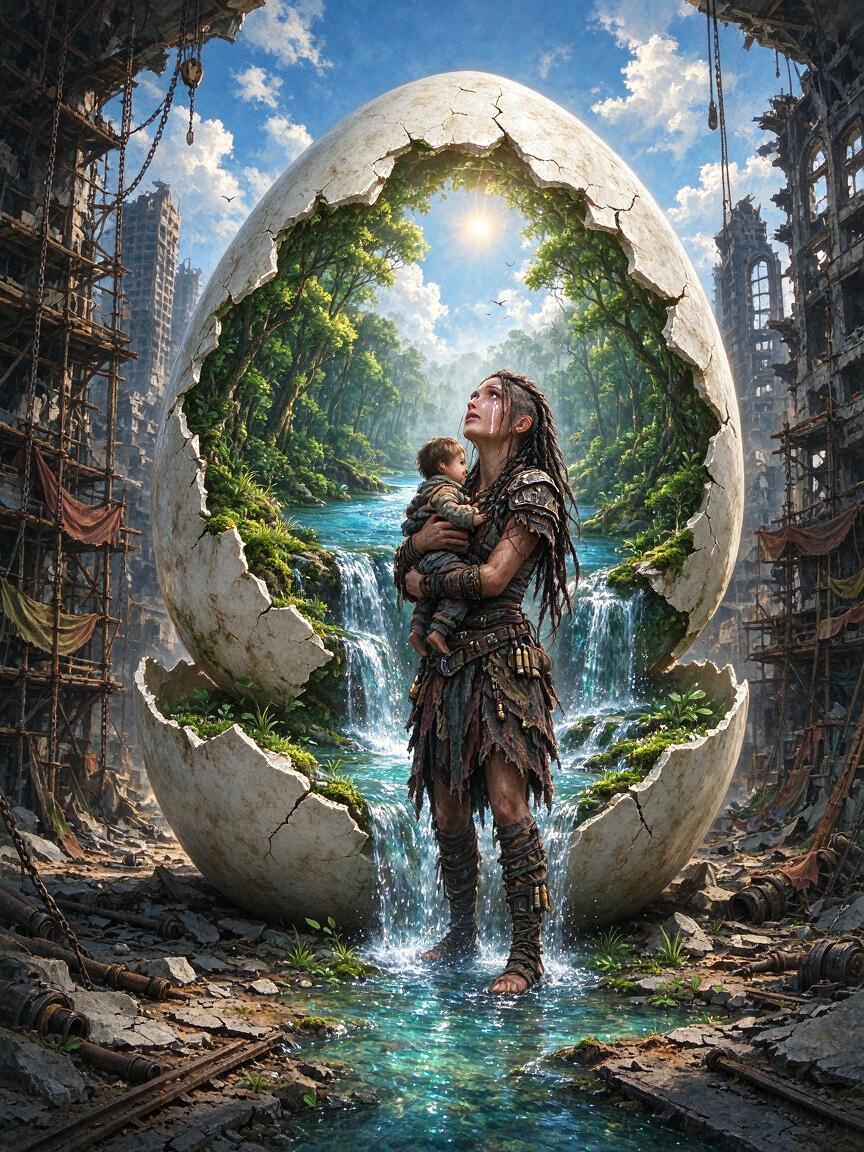
Standing in the center of what had once been the financial district was an enormous white shell, larger than any building that remained intact. Its surface was fractured and weathered, resembling the discarded remains of some ancient creature whose existence had escaped the attention of history.
But the shell was not empty.
Inside its broken walls stood a forest.
Trees rose toward an impossibly blue sky, their branches heavy with leaves that shimmered beneath sunlight untouched by the perpetual gray hanging over the city. Water tumbled across moss-covered stones, gathering into a river that spilled through the fractured opening and wandered into the ruined streets.
Mara stopped walking.
For several moments, she could do nothing but stare.
She had forgotten there were so many shades of green.
Elias lifted his head from her shoulder, his small fingers tightening around the straps of her clothing.
“Mama, what’s that?”
Mara opened her mouth, but no words came.
A bird crossed the opening overhead.
Its wings caught the sunlight before it disappeared into the trees.
She began to cry.
Not because she was frightened, although fear certainly occupied some corner of her mind. She cried because she remembered her father lifting her onto his shoulders beneath the great oaks in the park. She remembered the smell of freshly cut grass, the taste of strawberries, and her mother’s voice calling everyone inside before the summer storms arrived.
She remembered a world that had existed before people began measuring their lives by the number of days they could survive without food.
And standing before her was proof that somewhere, somehow, that world had continued without them.
Elias reached toward the falling water.
“Can we go inside?”
Mara looked at the forest.
There were no fences, no guards, and no warning signs announcing that the sanctuary belonged to someone else. Yet something about its existence troubled her. The shell appeared less like a shelter than a boundary, a deliberate separation between two worlds that had once occupied the same earth.
She lowered Elias to the ground.
He immediately stepped into the shallow stream, laughing as the cold water curled around his ankles.
The sound startled her.
She could not remember the last time she had heard him laugh without first looking over his shoulder.
“Mama! It’s cold!”
“I imagine it is.”
“Come see!”
She stepped forward, allowing the water to wash over her boots. It was clear enough to reveal the stones beneath its surface, each one polished smooth by a current that seemed to have been flowing for centuries.
Then she noticed something.
The water was moving away from the forest, but the ground behind her remained barren. Wherever the stream traveled, small green shoots emerged between the broken stones, unfolding toward the light with an urgency that seemed almost unnatural.
Mara knelt beside one of them.
A tiny flower opened beneath her fingertips.
She withdrew her hand.
For seventeen years, nothing had grown in the city.
Nothing.
Yet here was a flower, delicate and impossibly alive, pushing its way through the accumulated ruin of everything humanity had once considered permanent.
A voice spoke behind her.
“Beautiful, isn’t it?”
Mara turned so quickly that Elias stumbled backward.
An old woman stood beneath the remains of a collapsed archway. She wore a faded blue coat, and her silver hair hung in loose braids around a face deeply marked by age. In one hand she carried a wooden walking stick; in the other, a small cloth bag.
Mara instinctively moved between the stranger and her son.
“Who are you?”
“Someone who remembers.”
“Remembers what?”
The old woman looked toward the forest.
“What we were before we convinced ourselves that everything belonged to us.”
Mara studied her carefully.
“Did you build this?”
The woman laughed softly.
“Good heavens, child. We couldn’t build something like that when we had all the machines in the world.”
“Then where did it come from?”
The old woman approached the water but stopped before stepping into it.
“Perhaps the better question is where it went.”
Mara frowned.
“I don’t understand.”
“Neither did we.”
The woman lowered herself onto a broken concrete slab, resting both hands upon her walking stick.
“Long before the Silence, people believed the earth was dying. They argued about who was responsible, who should pay, and whether anything needed to be done at all. Every year the rivers grew weaker, the forests smaller, and the air a little harder to breathe. We kept telling ourselves there was time.”
She paused.
“Then one morning, the world simply stopped answering.”
Mara looked toward the towering shell.
“You’re saying the earth left us?”
“I’m saying we never considered the possibility that it could.”
Elias tugged at Mara’s clothing.
“Mama, look.”
He was holding a small green leaf.
A perfectly ordinary leaf.
Yet Mara stared at it as though he had placed a precious jewel in her hand.
The old woman smiled.
“There’s something you should know before you go inside.”
Mara looked up.
“What?”
“Not everyone who enters comes back.”
The words settled between them.
Mara tightened her grip on Elias.
“Why?”
“Some discover they no longer wish to return.”
“And the others?”
The old woman turned her gaze toward the ruined city.
“Perhaps they discover they cannot.”
For a long while, Mara said nothing.
Beyond the shell, the forest moved gently in a breeze she could not feel. Somewhere among the trees, birds called to one another, and the waterfalls continued their endless conversation with the stones.
Behind her waited the city, its hunger, its violence, and the exhausted remnants of people who had spent seventeen years fighting over the scraps of a dead civilization.
She thought of the shelter where Elias slept beneath blankets that smelled of mildew. She thought of the men who guarded the communal wells, demanding payment from families who possessed nothing worth surrendering.
She thought of the stories her mother used to tell about a world where children could play outside without fear.
Then she looked at her son.
He was watching a butterfly.
It had landed on his outstretched finger, its delicate wings opening and closing as though testing the possibility of flight.
Elias smiled.
“Mama, I think it likes me.”
Mara felt something loosen inside her chest.
Perhaps hope was not the grand, triumphant emotion people described in the old books. Perhaps it was something smaller, something terribly fragile, like a butterfly resting upon the finger of a child who had never known such a creature existed.
She took his hand.
Together, they stepped toward the forest.
Behind them, the old woman remained seated upon the broken concrete, watching as mother and child disappeared beneath the branches.
For a moment, she seemed almost pleased.
Then the earth trembled.
High above the ruined city, another enormous shell began to crack.
The old woman raised her eyes toward the sound.
“Well,” she whispered, “it appears they’ve finally decided.”
And somewhere beyond the distant towers, something that had been sleeping for seventeen years began to breathe.
Discover more from Memoirs of Madness
Subscribe to get the latest posts sent to your email.

