Dispatches from the Splinters of My Mind — Entry 37
The first thing Evelyn Price did after checking into Room 214 was take off her wedding ring.
Not because she was leaving her husband. Harold had been dead for eleven years, and whatever grievances they had accumulated during thirty-eight years of marriage had long since settled into the peculiar tenderness of remembering someone who could no longer argue with you. She removed the ring because her finger had begun to ache, and because, for the first time in longer than she cared to calculate, she could take something off without somebody asking why.
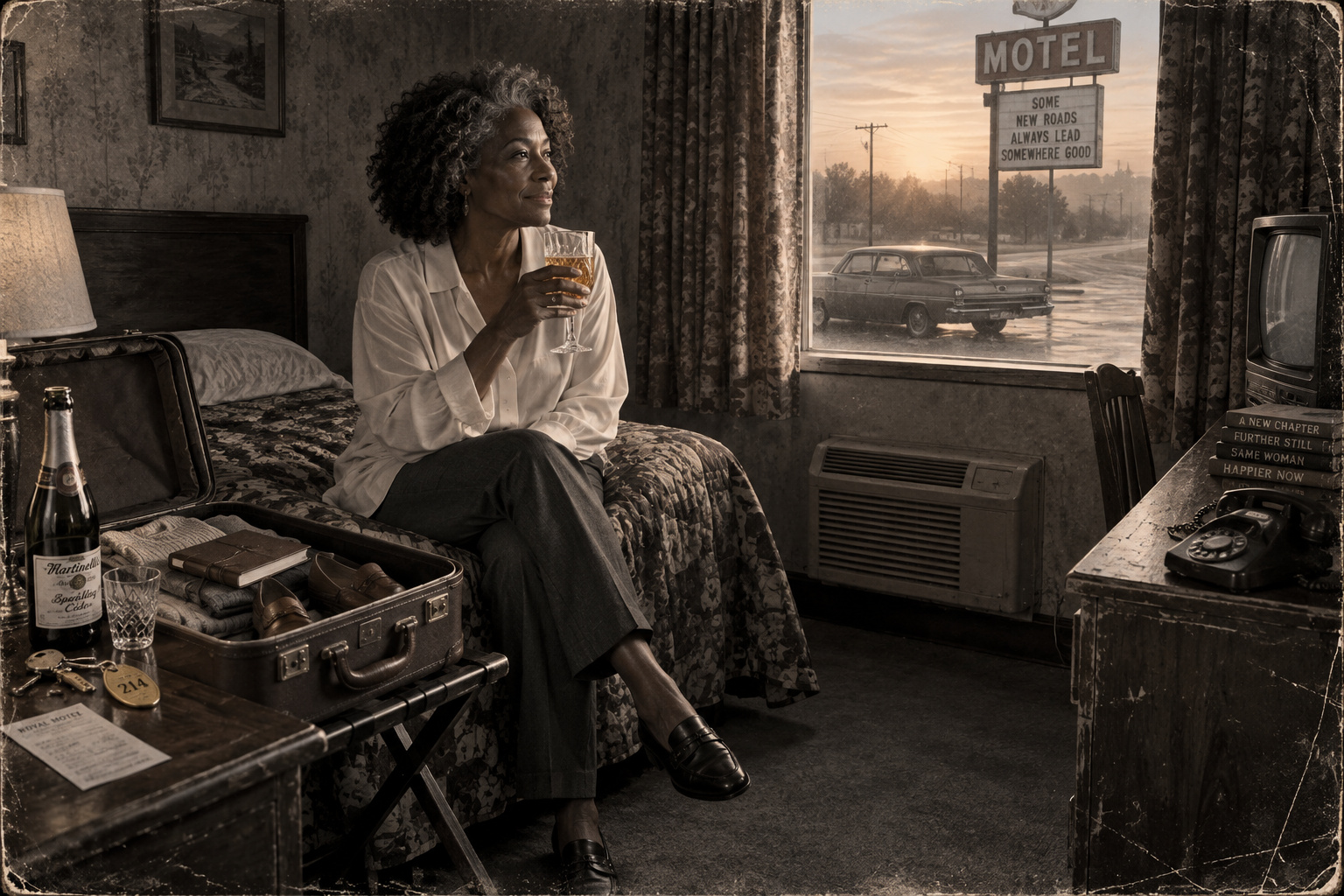
She placed it carefully inside the little leather compartment of her suitcase, alongside a photograph of her parents, two spare keys, and a folded piece of paper containing three telephone numbers she had absolutely no intention of calling.
Then she poured herself a glass of sparkling wine.
At six forty-three in the morning.
Evelyn considered this for a moment, studying the pale gold liquid through the cheap motel glass. She had never been much of a drinker, and the hour was certainly inappropriate by the standards of the respectable woman she had spent sixty-three years becoming. But respectability, she had recently concluded, was an exhausting occupation with terrible benefits and absolutely no retirement plan.
“Well,” she said to the empty room, “here’s to unemployment.”
She took a sip.
Made a face.
“Lord, that’s awful.”
She drank some more.
Outside the window, the highway stretched beneath a thin veil of morning mist. An old sedan sat crookedly in the parking lot, its windows fogged from the overnight rain. Beyond it, a weathered motel sign offered a piece of roadside wisdom that appeared to have been composed by someone with more enthusiasm than editorial supervision.
SOME NEW ROADS ALWAYS LEAD SOMEWHERE GOOD.
Evelyn read it twice.
“Somebody ought to tell that to the people who built Interstate 80.”
She laughed.
The sound startled her.
Not because she hadn’t laughed recently. She laughed often enough, usually at other people’s jokes, occasionally at her grandchildren’s antics, and sometimes at the sheer audacity of people who believed their emergencies should automatically become hers. But this laughter belonged entirely to her. There was nobody present to appreciate it, nobody to encourage it, nobody whose feelings might be injured by its timing.
It was a strange thing, discovering how much of your own behavior had become a performance for an audience you never remembered inviting.
She settled onto the edge of the bed, crossing one leg over the other. The mattress complained beneath her weight. The wallpaper had surrendered to age in several places, exposing pale seams where the adhesive had lost its ambition. A rotary telephone occupied the scratched dresser beside a television old enough to remember when television had been worth watching. The room smelled faintly of furniture polish, stale carpeting, and whatever industrial cleaning solution management considered sufficient to erase the evidence of previous occupants.
It was not beautiful.
Evelyn found that reassuring.
Beautiful places generally came with expectations.
This room asked nothing beyond payment.
She had driven four hundred and seventeen miles to get here.
Not because she had chosen the motel specifically. She had simply grown tired of driving, noticed the sign, and pulled off the highway. The desk clerk, a young man with a magnificent collection of facial piercings and the expression of someone reconsidering several important life decisions, had asked whether she was traveling for business or pleasure.
Evelyn had considered the question.
“I don’t know yet.”
He had looked at her for a moment.
Then handed her the key.
“Room 214. Ice machine’s broken.”
“Anything else?”
“Coffee’s terrible.”
“Sounds like home.”
He hadn’t laughed.
She liked him anyway.
Now, sitting in the soft gray light of morning, Evelyn wondered whether anyone had discovered she was gone.
Of course they had.
Her phone had been vibrating inside her handbag since shortly after midnight. By the time she reached the motel, there were fourteen missed calls, twenty-three messages, and one voicemail from her youngest daughter that began with the words, Mother, this is ridiculous.
Evelyn had listened to that much before deleting it.
Not because her daughter was wrong.
There was something ridiculous about a sixty-three-year-old woman driving across state lines without telling anyone where she was going.
There was also something ridiculous about the fact that this was the first time in her adult life she had done so.
She had spent thirty-eight years married to a man she loved, raised three children, cared for her mother through the long indignities of dementia, helped Harold through the illness that eventually took him, and somehow become the unofficial administrator of a family whose members possessed functioning telephones, automobiles, bank accounts, and, as far as she could determine, perfectly adequate brains.
Yet every inconvenience found its way to her doorstep.
Could she pick up the children?
Could she watch the dog?
Could she make the appointment?
Could she bring something to dinner?
Could she call the insurance company?
Could she remember where somebody had put something that she had never seen in the first place?
Evelyn had become the keeper of everybody else’s missing things.
Keys.
Documents.
Birthdays.
Medication schedules.
Promises.
Apologies.
And somewhere between the school pickups and funeral arrangements, between casseroles and hospital waiting rooms, between being a wife and becoming a widow, she had misplaced herself.
The discovery had not arrived dramatically.
There had been no breakdown, no shouting match, no great declaration delivered across a dining room table.
It had happened on a Tuesday afternoon while she was standing in a grocery store holding two brands of peanut butter.
She had reached automatically for the brand Harold preferred.
Then stopped.
Harold had been dead eleven years.
Her children had their own homes.
Nobody living beneath her roof cared which peanut butter she bought.
Yet she stood there, a grown woman with silver beginning to thread through her hair, unable to remember which brand she actually liked.
She had stared at those jars for nearly five minutes.
Then put them both back.
The following morning, she bought a road atlas.
An actual paper atlas, with folded maps and pages large enough to spread across the kitchen table. Her granddaughter had laughed when she saw it.
“Grandma, you know your phone does that, right?”
“I know.”
“Then why’d you buy it?”
Evelyn had considered explaining that she wanted to see the roads without a little blue line telling her which one she was supposed to take.
Instead, she said, “Because I wanted one.”
Her granddaughter had looked genuinely confused.
Evelyn had found that troubling.
Over the following three weeks, she made preparations.
Nothing dramatic.
She paid her bills. Filled her prescriptions. Arranged for the neighbor to collect her mail. Left instructions for watering the plants, although she suspected the plants would survive perfectly well without supervision. She cleaned the refrigerator, changed the sheets, and placed a note on the kitchen counter.
I’m taking a trip. I’m safe. I’ll call when I’m ready.
She had considered adding an apology.
Then decided against it.
That had been the hardest part.
Not leaving.
Not driving through unfamiliar towns after dark.
Not checking into a motel alone.
Leaving without apologizing for it.
Evelyn finished her drink and set the glass beside the bed.
The telephone rang.
She looked at it.
The sound was surprisingly aggressive in the quiet room, a mechanical insistence that seemed entirely inappropriate for an object sitting on a scratched wooden dresser.
It rang again.
And again.
She wondered whether her family had somehow located her.
Probably.
Her eldest son had always been particularly talented at finding information nobody wanted him to have. He worked in information technology, which Evelyn privately suspected was a respectable way of saying he spent his days interfering with perfectly functional things until they stopped working.
The telephone continued ringing.
She rose, crossed the room, and lifted the receiver.
“Hello?”
“Mrs. Price?”
“Speaking.”
“This is Daniel at the front desk.”
“Good morning, Daniel.”
There was a pause.
“Did you enjoy your stay?”
Evelyn looked toward the bed.
The open suitcase.
The untouched television.
The curtains stirring gently in the air from the ancient heating unit.
“I believe I’m still enjoying it.”
Another pause.
“Right. Well, checkout’s at eleven.”
“What time is it?”
“Seven twenty.”
“Then we’ve got plenty of time.”
“Yes, ma’am.”
She could hear him shifting papers.
“Housekeeping usually starts around nine.”
“That’s lovely.”
“Would you like me to put you down for another night?”
Evelyn looked toward the highway.
She hadn’t decided.
For most of her life, decisions had arrived already burdened with consequences. Every choice required consideration of how it might affect someone else, whether it would inconvenience them, whether they would approve, whether they would understand.
She had become so accustomed to negotiating with absent people that even now, standing alone in a motel room hundreds of miles from home, she could almost hear their objections.
Another night?
What for?
You can’t just disappear.
What about us?
Evelyn closed her eyes.
There was something uncomfortable beneath her newfound freedom.
Guilt.
Not the theatrical kind people enjoyed discussing over coffee. Something older and more stubborn. The kind that settled into the bones after decades of believing love required constant availability.
She knew her absence would inconvenience people.
She also knew some of them genuinely needed her.
Her youngest daughter was struggling through a difficult divorce. Her middle son had recently lost his job. Her eldest was trying to raise two children while maintaining a marriage that seemed to require more effort than either participant had anticipated.
These were not imaginary problems.
They were real.
And Evelyn loved them.
That was what made leaving difficult.
It would have been easier if they were cruel.
Easier if they were selfish beyond redemption.
Easier if she could point to some unforgivable betrayal and declare herself justified.
But they were ordinary people doing their best, occasionally failing, occasionally taking more than they realized, and loving her in ways that had gradually become indistinguishable from needing her.
She had helped create that arrangement.
That was another truth she couldn’t ignore.
She had taught them that she would always be there.
Then grown resentful when they believed her.
“Mrs. Price?”
Daniel’s voice brought her back.
“Yes, sweetheart?”
“Another night?”
Evelyn looked at the suitcase.
The folded clothes.
The notebook.
The road atlas resting on the passenger seat of her car.
“Make it two.”
“Two nights?”
“Unless you’ve got somewhere better I ought to be.”
He laughed.
It was a small, uncertain sound.
“No, ma’am.”
“Good. Neither do I.”
She replaced the receiver.
For a moment, she stood in the middle of the room, surprised by how little had happened.
No thunder.
No collapsing walls.
No divine announcement that she had violated some sacred obligation.
The world continued.
Somewhere outside, a truck shifted gears.
The heating unit rattled.
A bird landed on the windowsill, considered the accommodations, and departed.
Evelyn returned to the bed.
She opened her notebook.
On the first page, she had written a list of places she wanted to visit.
The ocean.
The mountains.
A small town in Vermont where the leaves supposedly turned colors so beautiful they looked artificial.
A jazz club in New Orleans.
A bookstore in Portland.
The Grand Canyon.
She had written the list years earlier, after Harold died, when people kept telling her she needed to start living again.
She had nodded politely.
Then continued doing exactly what she had always done.
Now she examined the list with mild irritation.
“Well, hell. I could’ve been halfway through this thing by now.”
She turned the page.
At the top, she wrote:
Things I Want.
Then stopped.
The pen hovered above the paper.
She could list what she wanted for her children.
For her grandchildren.
For the people she loved.
She could fill pages with hopes and prayers for everyone whose life touched hers.
But what did she want?
Not what she was supposed to want.
Not what would make her appear generous or respectable.
Not what she could explain without feeling selfish.
What did Evelyn Price want?
She stared at the empty page.
The question was embarrassingly difficult.
Eventually, she wrote:
Pancakes.
She looked at the word.
Then added:
With strawberries.
After another moment:
And bacon.
She laughed.
“Well, look at that. We’re making progress.”
Her phone began vibrating again.
She took it from her handbag.
Her youngest daughter’s name appeared on the screen.
Evelyn watched it ring.
She could answer.
She could explain everything.
She could spend the next twenty minutes reassuring someone that she was safe, apologizing for causing worry, and listening to a detailed account of why her decision had been irresponsible.
Or she could let it ring.
She chose a third option.
She answered.
“Good morning, baby.”
“Mother! Where are you?”
“At a motel.”
“A motel? What motel? What are you doing?”
“Having a little adventure.”
“Mom, this isn’t funny.”
“I wasn’t joking.”
There was silence.
Then her daughter sighed.
“Are you okay?”
Evelyn looked around the room.
At the shabby furniture.
The old television.
The morning light gathering against the curtains.
She considered the question carefully.
“I think I might be.”
Another silence.
“Mom, we were worried.”
“I know, sweetheart. I’m sorry I frightened you.”
“Then come home.”
Evelyn closed her eyes.
There it was.
The familiar assumption.
Concern had become instruction.
She understood why. Her departure was unusual, and she had given them little information. They were entitled to worry.
But worry did not automatically grant authority.
“I’ll be home when I’m ready.”
“Mom—”
“I love you.”
“I love you too, but—”
“No buts, sweetheart. I’ll call you tomorrow.”
She ended the conversation before either of them could say something they might regret.
Then she sat very still.
Her hands were trembling.
She hadn’t expected that.
For a moment, she wondered whether she had been unnecessarily harsh. Her daughter had sounded genuinely frightened, and Evelyn knew she could have handled the situation differently.
Perhaps she should have called before leaving.
Perhaps she should have explained.
Perhaps—
“No.”
The word escaped before she realized she had spoken.
She wasn’t going to spend the morning prosecuting herself for failing to execute a perfectly reasonable decision in a perfectly reasonable manner.
She had made a choice.
It was imperfect.
So was she.
That would have to be enough.
At nine seventeen, someone knocked on the door.
“Housekeeping!”
Evelyn glanced toward the suitcase.
The bedspread.
The empty glass.
The notebook lying open beside her.
For a moment, she considered tidying the room.
Old habits.
She had spent decades making things presentable before allowing anyone to see them. Straightening pillows. Clearing counters. Hiding evidence of ordinary living beneath the illusion of effortless order.
Instead, she remained seated.
“Not yet, sweetheart.”
“Okay, ma’am!”
Footsteps retreated along the walkway.
Evelyn smiled.
She had no idea where she would be next week.
She might visit the mountains.
She might drive south.
She might discover that the ocean looked nothing like the photographs.
She might return home after two days and decide the entire adventure had been a terrible mistake.
That possibility amused her.
After all, she had made plenty of mistakes while doing what everyone expected.
It seemed only fair to make a few while doing what she wanted.
She reached for her glass.
Empty.
She considered pouring another.
Then remembered the pancakes.
Evelyn rose, picked up her handbag, and slipped the motel key into her pocket.
At the door, she paused.
For a moment, she looked back at the room.
The suitcase remained open.
The bed was unmade.
The telephone sat silently on the dresser.
Nothing had been put away.
Nothing had been settled.
For once, she found no reason to correct any of it.
She stepped outside and pulled the door closed behind her.
The morning smelled of wet asphalt, gasoline, and distant rain. Somewhere beyond the parking lot, traffic moved steadily along the highway, carrying strangers toward obligations, destinations, and lives she would never know.
Evelyn stood beneath the motel awning and studied the sign.
SOME NEW ROADS ALWAYS LEAD SOMEWHERE GOOD.
“Well,” she murmured, “we’ll see about that.”
She walked toward her car.
Halfway across the parking lot, she stopped.
Turned around.
Looked back at Room 214.
Then she laughed.
Not because she had figured anything out.
Not because she had become someone new.
Not because freedom had suddenly made the world less complicated.
She laughed because she had forgotten to ask Daniel where she could get pancakes.
And for the first time in decades, having absolutely no idea where she was going next seemed like a perfectly reasonable way to begin the day.
Behind her, Room 214 waited to be cleaned.
Evelyn had other plans.
Discover more from Memoirs of Madness
Subscribe to get the latest posts sent to your email.


Loved this Mangus. Some of it struck home, but in a good way. Long time ago now and a lot has changed for me, but saying ‘No’ and not being at everyone’s beck and call tends to stop you in your tracks when you realise you’ve just said and done it!
LikeLike
Oh I love this do much. In truth it happens to all of us diesnt ir? The question of who we are what we want and what we are ready abd willing yo leave behind in that age old need to understand who we are beyond father/mother, eife/ husband. A clear concise beginning. LOVE this do very much.
LikeLike