
Walter Pritchard believed civilization was collapsing, and he had the evidence to prove it. People abandoned shopping carts in parking lots, parked their automobiles at angles suggesting a fundamental misunderstanding of geometry, and conducted telephone conversations in public as though the rest of humanity had purchased tickets to attend. Somewhere along the way, people had stopped returning borrowed tools, holding doors for strangers, and understanding the difference between your and you’re. Walter, who had spent thirty-seven years working for the United States Postal Service, considered these developments symptoms of a larger disease. A society that couldn’t be trusted to put a shopping cart away, he reasoned, was a society that would eventually require instructions for breathing.
His late wife, Margaret, had maintained that Walter was simply getting old.
“There’s a difference between having standards and being a pain in the ass,” she’d told him once, after he spent an entire Sunday afternoon composing a letter to the city about a crooked stop sign.
“That sign is a public safety hazard.”
“Walter, it’s leaning three degrees.”
“That’s how it starts.”
“What’s how it starts?”
“Neglect.”
Margaret had stared at him for a long moment before returning to her crossword puzzle.
“Well, when the republic falls, you can tell everybody you warned them.”
She’d been gone six years now, and Walter still occasionally caught himself preparing arguments for a woman who was no longer there to hear them. He missed her laughter most, particularly the way she’d laugh at him without ever making him feel small. There were mornings when he would turn toward the empty chair at the kitchen table, ready to complain about something he’d read in the newspaper, only to remember that the person best qualified to appreciate his outrage had departed the premises permanently.
On those mornings, Walter usually complained anyway.
It was on an otherwise respectable Tuesday that the garbage can appeared.
The new fellow next door, Daniel Whitcomb, had moved into the old Patterson house three weeks earlier. Forty-three years old, employed by an insurance company, and apparently under the impression that a pickup truck qualified as a personality, Daniel had thus far conducted himself with sufficient courtesy to avoid Walter’s formal disapproval. He waved when he passed, kept his grass cut, and hadn’t hosted any gatherings involving amplified music or inflatable decorations. Walter had begun to suspect the man might be tolerable.
Then Daniel put his garbage bin six inches across the property line.
Walter noticed it at precisely 7:14 that morning.
By 7:19, he’d retrieved a measuring tape.
At 7:23, he’d confirmed the violation.
At 7:31, he’d telephoned Herbert Love.
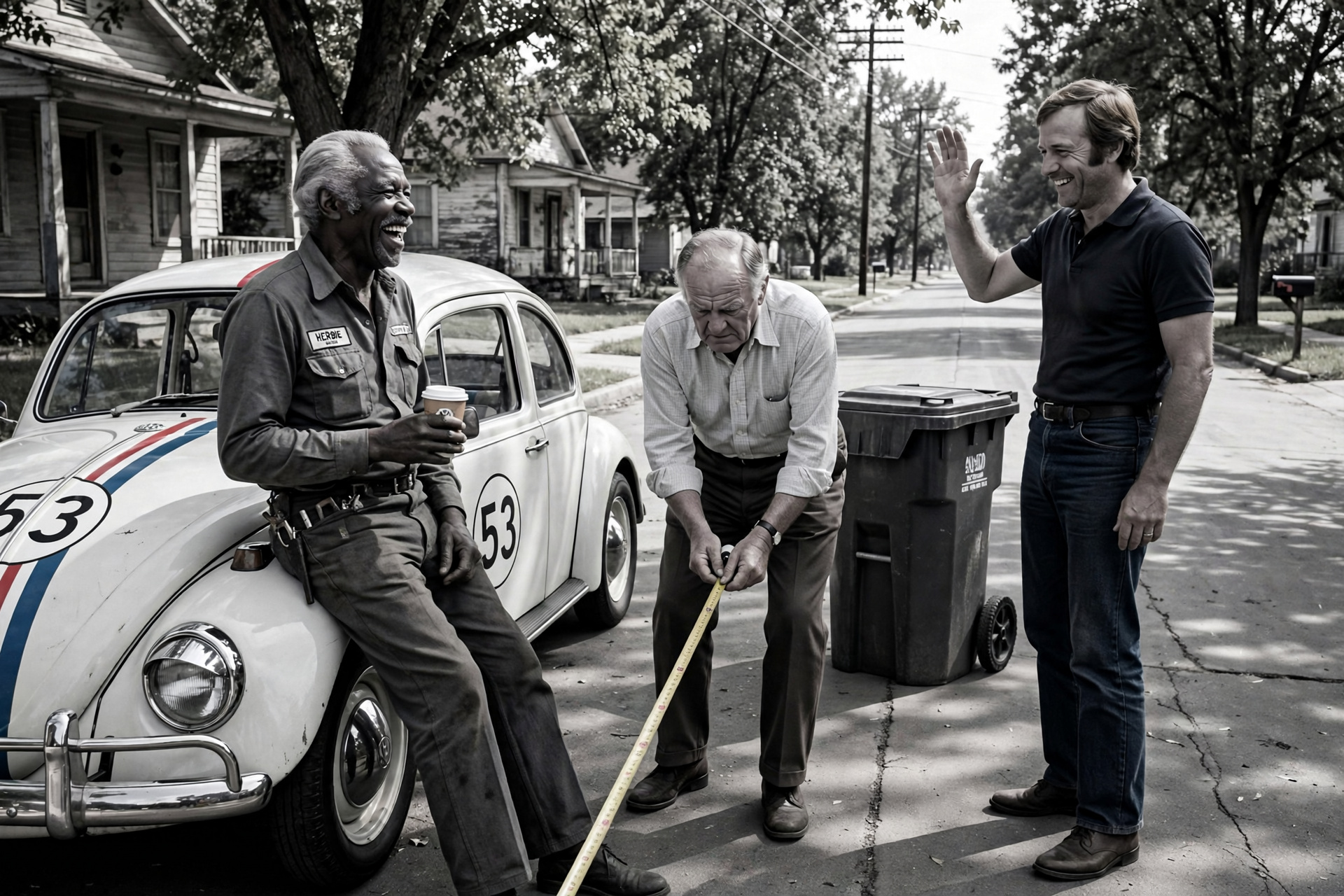
Herbert, known to everybody as Herbie, had been Walter’s best friend for forty-three years, a distinction Walter frequently described as a clerical error that nobody had bothered to correct. At seventy, Herbie was a retired mechanic with a magnificent talent for making a bad situation worse while sincerely believing he was helping. He drove a pearl-white 1967 Volkswagen Beetle decorated with red-and-blue racing stripes and the number 53, an automobile he affectionately called The Love Machine. Its engine made a noise reminiscent of loose silverware in a clothes dryer, and Herbie insisted that replacing it would destroy the vehicle’s personality.
Herbie arrived at 8:06 carrying two coffees and a breakfast sandwich he’d already eaten half of.
He parked the Volkswagen at the curb, climbed out, and surveyed Walter standing beside the offending garbage bin with his arms folded.
“What happened?” Herbie asked. “Somebody die?”
“Worse.”
Herbie looked around. “House on fire?”
“No.”
“Then it ain’t worse.”
Walter pointed toward the bin.
“Look at that.”
Herbie looked.
He waited.
Walter continued pointing.
“Well?”
“Well, what?”
“The garbage can.”
Herbie took a sip of coffee.
“Looks like a garbage can.”
“It’s on my property.”
Herbie examined the strip of grass separating the two driveways.
“How much?”
“Six inches.”
Herbie considered this information with the solemnity of a physician examining an X-ray.
“Six whole inches?”
“That’s right.”
“Good Lord.”
Walter nodded.
“Exactly.”
Herbie handed him a coffee.
“Have you considered moving it?”
Walter stared at him.
“That’s exactly what they want you to do.”
Herbie blinked.
“Who?”
“People.”
“People want you to move a garbage can?”
“They want you to accept things.”
Herbie looked at the bin again.
“Well, Walter, I hate to be the one to tell you this, but civilization’s probably gonna survive six inches of garbage.”
Walter took his coffee.
“That’s the kind of thinking that got us into this mess.”
Before Herbie could respond, the front door of the Patterson house opened and Daniel Whitcomb stepped outside, dressed for work and carrying a travel mug. He stopped when he saw the two older men standing beside his garbage bin.
“Morning, gentlemen.”
Walter turned.
“Mr. Whitcomb.”
Daniel looked from Walter to Herbie, then down at the measuring tape hanging from Walter’s hand.
“Everything all right?”
“That depends,” Walter replied, “on your definition of all right.”
Daniel considered this.
“Well, nobody’s bleeding, the house is still standing, and my coffee’s hot. I’d say we’re doing pretty good.”
Herbie chuckled.
Walter didn’t.
“Your garbage can is on my property.”
Daniel glanced at the bin.
“Is it?”
“Six inches.”
Daniel looked at the tape measure.
“You measured it?”
“Somebody had to.”
Daniel took a sip of coffee and studied Walter for a moment.
“You know, all you need now is an American flag in your yard, and you’d be the perfect example of a grumpy jackass.”
Herbie nearly inhaled his coffee.
Walter turned toward him.
“Get off my porch.”
Herbie looked down at the sidewalk where he was standing.
“I’m not even on your porch.”
“Then get off my property.”
“I’m not going anywhere. Whenever you get butt-hurt, you start with your nonsense.”
Daniel chuckled.
Walter pointed at him.
“Who pulled your talk cord?”
Daniel raised both hands in surrender, laughing.
Herbie was laughing now, too, which only deepened Walter’s conviction that society had reached the final stages of decay.
“Look,” Daniel said, catching his breath, “if the can’s bothering you, I’ll move it.”
“That would be appreciated.”
Daniel walked over, grabbed the handle, and rolled the bin several inches toward his driveway.
“There. Better?”
Walter looked down.
His expression changed.
“You moved it the wrong way.”
Daniel examined the ground.
“Did I?”
“Now it’s eight inches over.”
Herbie bent forward, laughing so hard he had to brace himself against the Volkswagen.
Daniel looked at Walter.
“Well, I’ll be damned. I’m getting worse.”
Walter closed his eyes.
There were moments when he wondered whether the Lord had placed certain people on Earth specifically to test him.
This, he decided, was one of those moments.
By Thursday, the matter had escalated.
Walter had printed eleven pages of municipal ordinances, highlighted three passages he considered relevant, and prepared a folder labeled WHITCOMB — PROPERTY ENCROACHMENT. He’d also purchased six small orange survey flags from the hardware store, which he’d arranged along the disputed boundary with the precision of a man establishing an international border.
Herbie, who’d been summoned to assist, stood beside the Volkswagen examining the flags.
“You know what this looks like?”
“A clearly marked property line.”
“Looks like you’re preparing to invade Poland.”
Walter adjusted one of the flags.
“Would you stop talking?”
“I’m just saying. You got flags, paperwork, and a measuring tape. All you’re missing is a tank.”
“You’re not helping.”
“That’s never stopped you from calling me.”
Across the street, Dolores Washington emerged from her house carrying a canvas shopping bag. At sixty-six, Dolores had spent most of her professional life as an elementary school principal, which meant she’d developed an extraordinary ability to identify foolishness without requiring anyone to explain it. She read stories to children at the public library every Saturday, made what many residents considered the finest peach cobbler in town, and possessed several county-fair ribbons for her snickerdoodle cookies.
She was also one of the few people on Mercer Street who could make Walter stop talking simply by raising an eyebrow.
Dolores approached the two men and surveyed the orange flags.
“Well,” she said, “what are we protesting this week?”
“Nobody’s protesting anything,” Walter replied.
“Then why does your driveway look like a crime scene?”
Herbie grinned.
“International border dispute.”
Dolores looked at Walter.
“Again?”
Walter straightened.
“What do you mean, again?”
“Last spring it was Mr. Henderson’s Christmas lights.”
“They were still up in April.”
“And before that, the squirrel.”
“That animal was destroying my bird feeder.”
“Walter, you wrote a letter to Animal Control.”
“The squirrel was aggressive.”
“It was eating sunflower seeds.”
“It was doing it aggressively.”
Dolores looked at Herbie.
Herbie nodded gravely.
“Mean little bastard. Had a look in his eyes.”
Dolores sighed.
“Two grown men. Seventy years of life apiece, give or take, and this is how you spend a Thursday.”
“Somebody has to maintain standards,” Walter said.
“Well, when you finish saving the neighborhood, come by my house. I’ve got some cobbler cooling.”
Herbie brightened.
“Peach?”
“Yes.”
“Well, now we’re talking.”
Dolores smiled at Walter.
“I thought you might enjoy some, Walter.”
Herbie’s expression changed.
“Wait a minute. What about me?”
Dolores adjusted the strap of her shopping bag.
“Herbert, there’s a grocery store four blocks over.”
Walter laughed.
Herbie pointed at her.
“See? That’s exactly why I don’t trust you.”
Dolores gave him a pleasant smile.
“Then your judgment isn’t entirely hopeless.”
She turned back toward Walter.
“Don’t work yourself into a state over that garbage can, dear. It’s not worth the trouble.”
Walter nodded.
“I appreciate your concern, Dee.”
“Of course you do.”
She gave his arm a gentle pat and continued down the sidewalk.
Herbie watched her go.
“That woman is up to something.”
Walter returned to his flags.
“You’re paranoid.”
“She’s bringing you cobbler.”
“She’s being neighborly.”
“She ain’t bringing me cobbler.”
“Maybe she doesn’t like you.”
Herbie considered that possibility.
“Well, that’s just poor judgment on her part.”
By Friday morning, Walter had installed a security camera.
More accurately, Herbie had installed a security camera, and Walter had supervised.
The device was mounted beneath the porch roof and connected to an application on Walter’s telephone. Herbie, who had once rebuilt an entire automobile transmission using tools he’d borrowed from three different neighbors, assured Walter that modern surveillance equipment was considerably simpler than people made it sound.
“All you do is point it where you want it to look.”
“Then why have you been up that ladder forty minutes?”
“Because you keep talking.”
Herbie climbed down, brushed his hands together, and announced the installation complete.
Walter opened the application.
The camera displayed a remarkably clear image of his own front door.
He stared at the screen.
“Herbert.”
“What?”
“Why is it looking at my porch?”
Herbie leaned over his shoulder.
“Well, I’ll be damned.”
“You installed it backward.”
“Apparently.”
“It’s supposed to watch the property line.”
“Well, nobody’s gonna steal your porch.”
Walter looked at him.
Herbie looked back.
Then Herbie shrugged.
“Security is security.”
Walter decided that friendship, like democracy, was an institution whose continued existence depended largely on the public’s willingness to overlook its deficiencies.
The city inspector arrived Monday afternoon.
Raymond Ellis was a patient man in his early fifties who had spent twenty-six years working for the municipality and had developed the weary expression of someone who’d encountered every imaginable form of human stupidity and understood that tomorrow would bring something new.
He examined Walter’s paperwork.
He examined the orange flags.
He examined the garbage bin.
Then he looked at Walter.
“Mr. Pritchard, this isn’t a municipal code violation.”
Walter frowned.
“How can you say that?”
“Because it isn’t.”
“The bin is on my property.”
“That would be a private boundary dispute.”
“So what am I supposed to do?”
“Talk to your neighbor.”
“I’ve done that.”
“Then perhaps you should have the property surveyed.”
Walter nodded slowly.
“Exactly.”
Raymond blinked.
“Exactly what?”
“That’s what I’ve been saying.”
Raymond looked toward Herbie, who was sitting on the porch eating a snickerdoodle.
Herbie raised his hands.
“Don’t look at me. I just work here.”
Raymond departed shortly afterward, leaving Walter convinced that the city government had abandoned its responsibilities and Herbie convinced that he’d witnessed the most expensive argument over a garbage can in recorded history.
The surveyor arrived Wednesday.
His name was Benjamin Price, and he approached the job with the measured professionalism of a man who had learned never to ask why someone was willing to pay several hundred dollars to establish ownership of six inches of grass.
He examined the property records, took his measurements, consulted his equipment, and eventually placed a small marker in the ground.
Walter stood nearby with his arms folded.
Herbie leaned against the Volkswagen.
Daniel watched from his driveway, having taken the afternoon off work after learning that the boundary dispute had apparently entered its geological phase.
Dolores had also appeared, ostensibly to return a casserole dish she’d borrowed from Walter three months earlier.
Benjamin checked his measurements one final time.
“All right, gentlemen. I’ve established the boundary.”
Walter stepped forward.
“Excellent.”
Benjamin pointed toward the marker.
“The actual property line is here.”
Walter looked down.
Then he looked at the garbage bin.
Then he looked back at the marker.
Something about the arrangement troubled him.
“That can’t be right.”
Benjamin consulted his paperwork.
“I’m afraid it is.”
Walter pointed toward the strip of grass.
“But I’ve been mowing that section for thirty years.”
Benjamin nodded.
“Well, sir, it appears you’ve been mowing part of your neighbor’s property.”
There was a silence.
A beautiful, complete, almost sacred silence.
Herbie was the first to break it.
He made a small choking sound.
Then another.
Then he bent forward, clutching his stomach.
Daniel looked at the marker, then at Walter, and began laughing.
Dolores covered her mouth.
Herbie staggered toward the Volkswagen, tears streaming down his face.
“Thirty years!” he managed.
Walter stared at the surveyor.
“Are you absolutely certain?”
Benjamin nodded.
“Yes, sir.”
Herbie slapped the roof of the Volkswagen.
“Thirty damn years!”
Daniel leaned against his pickup, laughing helplessly.
“Mr. Pritchard, you’ve been cutting my grass?”
Walter turned toward him.
“Don’t start.”
Herbie straightened long enough to ask, “Daniel, you think you ought to reimburse the man?”
That finished them.
Daniel doubled over.
Dolores began laughing openly.
Even Benjamin Price, who generally maintained a professional distance from his clients’ misfortunes, found himself smiling.
Walter stood in the middle of his driveway, surrounded by people who apparently believed his humiliation was a community event.
He looked at the marker.
He looked at the bin.
Then he folded his arms.
“Well,” he said, “somebody had to mow it.”
Herbie laughed so hard he had to sit down.
By Friday evening, the orange flags were gone.
The security camera remained mounted beneath the porch roof, still pointed at Walter’s front door, and the eleven-page municipal ordinance dossier had been deposited in a kitchen drawer alongside several appliance warranties and a collection of takeout menus.
Walter sat on his porch watching the evening settle over Mercer Street. The neighborhood was quiet except for the distant sound of a lawn mower and the occasional passing automobile. Somewhere down the block, a dog barked twice and apparently decided the matter wasn’t worth pursuing.
Herbie arrived shortly after six.
He carried two coffees and a paper bag containing apple fritters.
He lowered himself into the chair beside Walter without asking permission.
For several minutes, neither spoke.
Then Herbie reached into the bag and handed Walter a fritter.
“Margaret would’ve loved this.”
Walter smiled faintly.
“She would’ve framed that survey.”
Herbie chuckled.
“Put it on the Christmas cards.”
“Probably.”
“Sent one to everybody on the block.”
Walter shook his head.
“She would’ve enjoyed that a little too much.”
Herbie looked toward the street.
“She was a good woman.”
Walter nodded.
“Yeah.”
The silence that followed was comfortable, the kind that could exist only between people who’d spent enough years together to understand that conversation wasn’t always necessary.
Across the driveway, Daniel rolled his garbage bin toward the curb.
He stopped when he noticed them.
“Evening, gentlemen.”
Walter raised his coffee.
“Whitcomb.”
Daniel positioned the bin carefully, looked toward the property marker, and nudged it several inches farther onto his own side.
“There,” he announced. “Wouldn’t want to start another international incident.”
Herbie laughed.
Walter took a bite of his fritter.
“Keep it up, Whitcomb.”
Daniel grinned.
“Have a good night, Mr. Pritchard.”
He disappeared into his house.
Herbie watched him go.
“I like that kid.”
“He’s forty-three.”
“Still a kid.”
“He’s a smartass.”
Herbie smiled.
“Reminds me of somebody.”
Walter looked at him.
“Don’t.”
Herbie took a sip of coffee.
“You know what you ought to do?”
Walter sighed.
“What?”
“Put up an American flag.”
Walter turned slowly.
Herbie was already grinning.
“Get off my porch.”
Herbie settled deeper into his chair.
“I’m not going anywhere, Walter.”
And he didn’t.
Discover more from Memoirs of Madness
Subscribe to get the latest posts sent to your email.

