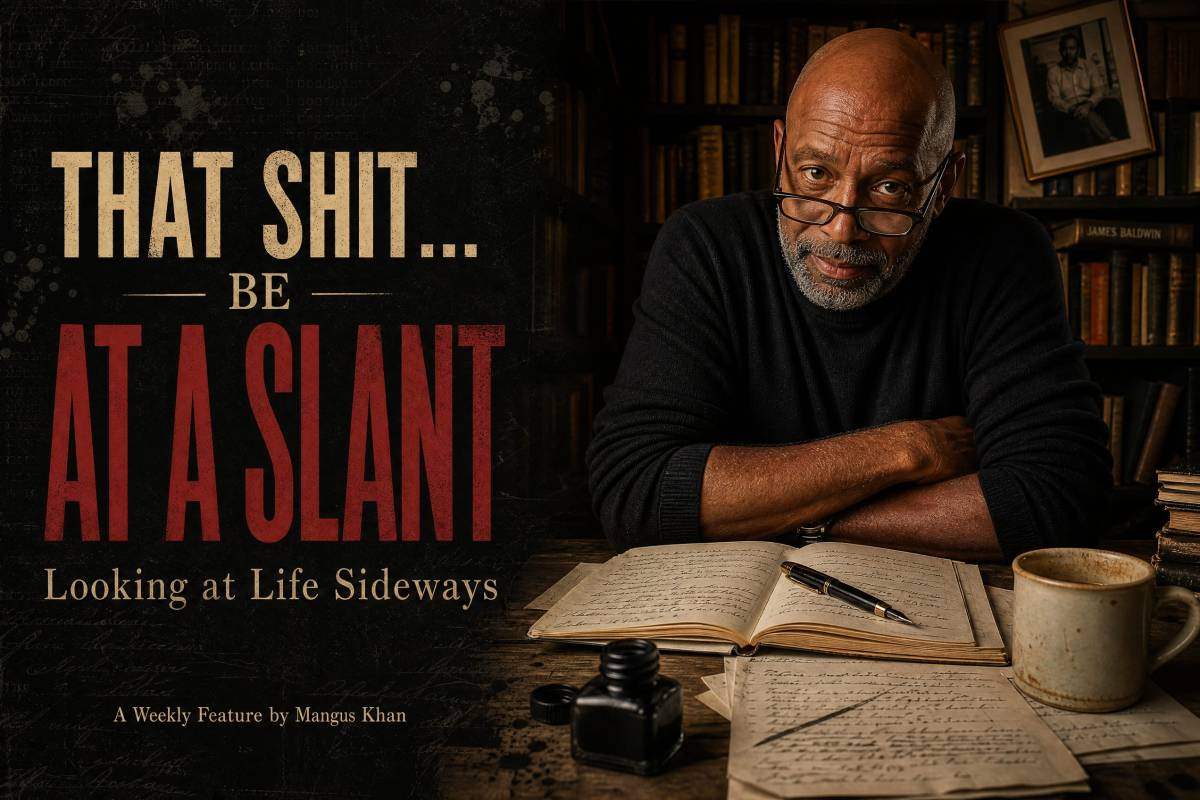
That Shit … Be at a Slant – Episode 6
Hello, I’m Mangus Khan, and for the next few minutes, I encourage you to walk into Madness with me.
Come on in, Brave Souls.
Today, we’re visiting a government office.
I know.
Nothing says adventure quite like fluorescent lighting, uncomfortable chairs, and a civil servant who looks as though he would rather be undergoing a root canal.
But this particular office handles something considerably more complicated than driver’s licenses, property taxes, or explaining why your Social Security number apparently isn’t sufficient proof that you exist.
Today, we’re visiting the Department of Unfinished Business.
Please take a number.
And don’t lose it.
They charge twenty-seven dollars for replacements.
Naturally, they don’t accept cash.
The Department of Unfinished Business occupied the basement of a building nobody remembered constructing, on a street that appeared on maps only when someone desperately needed to find it. Its entrance was wedged between a defunct insurance agency and a locksmith who had gone out of business after accidentally locking himself inside his own shop. The building smelled of damp plaster, floor wax, stale coffee, and the accumulated disappointment of several generations. Somewhere behind the walls, ancient pipes rattled with the determination of a dying locomotive, while overhead fluorescent lights hummed a monotonous tune that seemed designed to discourage independent thought.
A brass plaque beside the entrance announced that the department had been established in 1947, although nobody could explain what humanity had been doing with its unfinished business before then. Presumably, people had simply carried it around themselves, which, according to the department’s annual reports, remained the preferred method despite nearly eighty years of government intervention.
Inside, a row of uncomfortable wooden chairs faced a counter protected by thick glass. A red digital display flickered above the service window, announcing that the department was currently serving number 0047. The elderly woman nearest the counter held ticket 0048 and had apparently been waiting since the Eisenhower administration. Her handbag contained three peppermints, a photograph of a man she had never forgiven, and a handwritten apology she had spent forty-two years refusing to mail.
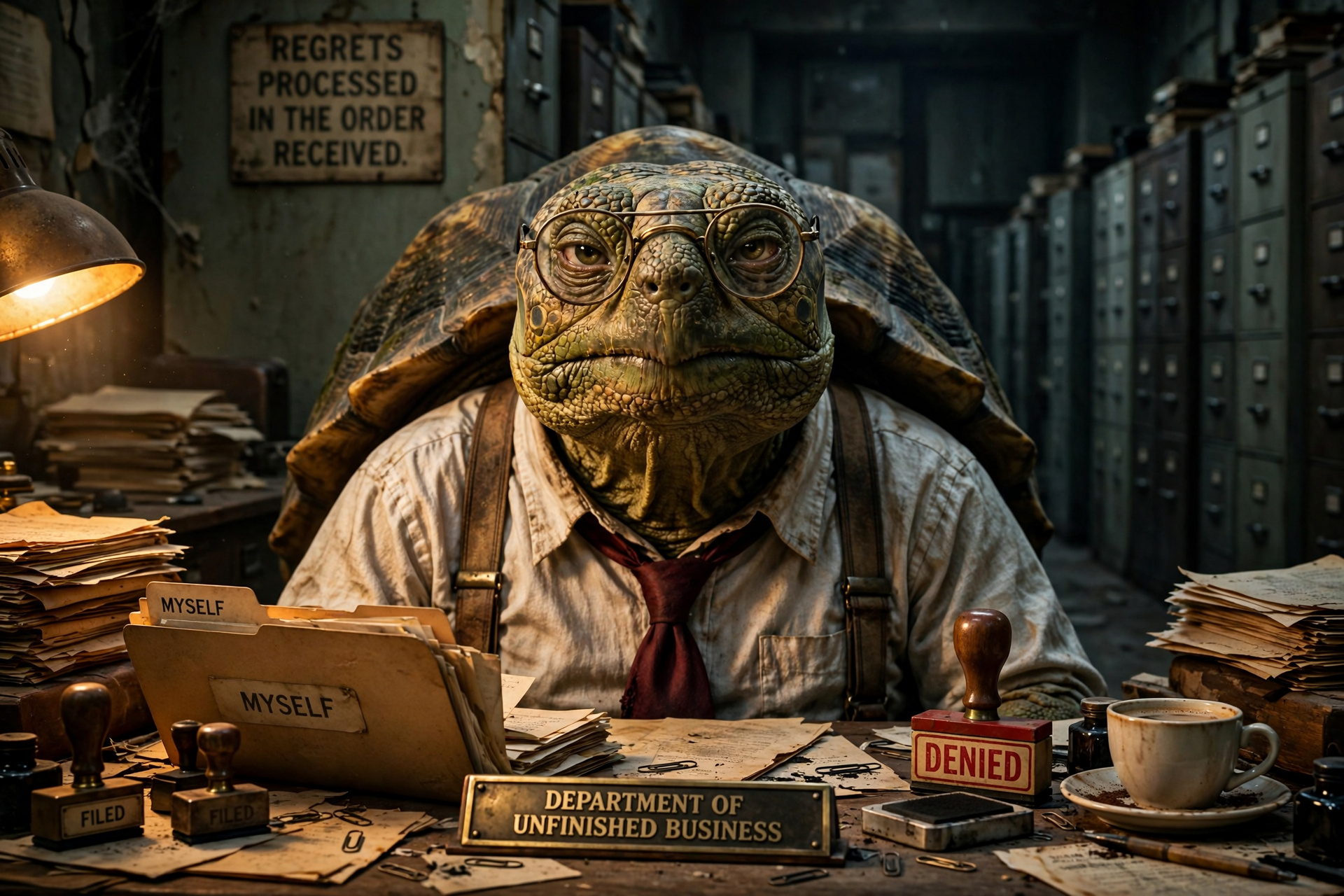
Behind the counter sat Mr. Bartholomew Thaddeus Shellworth III, Senior Processing Clerk, Grade Seven, Department of Unfinished Business, Division of Regrets, Resentments, and Other Persistent Nonsense. He was an elderly tortoise with a shell the color of weathered stone, deeply creased olive-green skin, and enormous spectacles that had been repaired with adhesive tape so many times they qualified as a structural engineering project. His white shirt had surrendered to permanent yellowing somewhere around 1982, and his burgundy tie hung beneath his chin like a defeated flag.
Bartholomew had worked for the department for seventy-three years. He had processed divorces, betrayals, missed opportunities, unanswered letters, forgotten birthdays, ruined friendships, and approximately eleven million instances of people wishing they had thought of a better comeback during an argument. He had also processed fourteen separate complaints concerning the invention of karaoke, although those had eventually been transferred to the Department of Crimes Against Humanity.
His desk was buried beneath mountains of paperwork. Yellowed folders leaned against towers of applications, rubber stamps occupied every available surface, and a chipped ceramic mug contained coffee so old it had begun developing political opinions. Behind him, filing cabinets stretched into darkness, their metal drawers filled with the emotional debris of people who had mistaken remembering something for being obligated to keep suffering over it.
A crooked sign on the wall read:
REGRETS PROCESSED IN THE ORDER RECEIVED.
Directly beneath it, someone had added a smaller handwritten notice.
PLEASE REFRAIN FROM CRYING ON THE FORMS. INK DAMAGE WILL RESULT IN ADDITIONAL FEES.
Bartholomew adjusted his spectacles, cleared his throat, and pressed the button beneath his desk.
“Number forty-eight.”
The elderly woman approached the counter, clutching her handbag against her chest.
“Good morning,” she said.
Bartholomew glanced at the clock. “It’s four seventeen.”
“Oh. Well, good afternoon.”
“That remains to be determined. Nature of your unfinished business?”
The woman hesitated before removing a folded piece of paper from her handbag. “I need to forgive my sister.”
Bartholomew sighed, reached beneath the counter, and produced a stack of forms approximately the thickness of a telephone directory.
“Living or deceased?”
“Deceased.”
“How long?”
“Twenty-six years.”
“Reason for grievance?”
“She borrowed my favorite casserole dish in 1973 and never returned it.”
Bartholomew stopped writing.
He looked over his spectacles.
“Your sister has been dead for twenty-six years, and you’re still angry about a casserole dish?”
“It was Pyrex.”
“Naturally.”
“With the little blue flowers.”
“Of course.”
“And she chipped the lid.”
Bartholomew closed his eyes. He had learned long ago that the smallest grievances were often the most durable. Wars eventually ended. Governments collapsed. Entire civilizations disappeared beneath the soil. But damage somebody’s favorite casserole dish, and apparently the matter remained open until the heat death of the universe.
“Madam, you’ll need Form R-17, Declaration of Lingering Resentment, accompanied by Form F-22, Application for Posthumous Forgiveness. Since the original incident occurred before 1980, you’ll also need a Historical Grievance Verification.”
“Where do I get that?”
“Third floor.”
“There’s a third floor?”
“Unfortunately.”
“And after that?”
“Department of Forgiveness.”
“Where is that?”
“Second basement.”
The woman frowned. “But we’re already in the basement.”
“Precisely.”
She gathered her papers and shuffled toward the elevator, muttering something about the government and its apparent inability to accomplish anything without first killing several trees.
Bartholomew stamped her application.
PENDING.
He pressed the button again.
“Number forty-nine.”
A middle-aged man approached wearing an expensive suit, polished shoes, and the expression of someone who had spent the past fifteen years rehearsing an argument in the shower.
“I need to settle something with my former business partner.”
“Nature of dispute?”
“He stole my idea.”
“When?”
“2009.”
“Have you pursued legal action?”
“No.”
“Attempted mediation?”
“No.”
“Contacted the individual?”
“No.”
Bartholomew looked up. “Then what exactly have you been doing?”
“Thinking about it.”
“For seventeen years?”
“Every day.”
“Impressive commitment to accomplishing absolutely nothing.”
The man bristled. “You don’t understand. He became successful because of my idea.”
“And what have you become?”
The man opened his mouth.
Closed it.
Then opened it again.
Bartholomew waited.
The clock ticked.
Somewhere in the building, a toilet flushed with the mournful resignation of an animal being led to slaughter.
Finally, the man said, “Bitter.”
“Excellent. Self-awareness. We don’t get much of that around here.”
Bartholomew slid a form beneath the glass.
“Application for Release of Unproductive Resentment. Complete sections one through fourteen. Skip section nine unless you’re planning revenge.”
“What happens if I am?”
“Different department. Fourth floor. Ask for Mildred.”
The man stared at the paperwork.
“Will this make me feel better?”
Bartholomew considered the question.
“Probably not. But you’ll have something to do besides thinking about 2009.”
PENDING.
By five o’clock, Bartholomew had processed a woman who regretted naming her son Braxton, a retired schoolteacher still furious about a spelling bee she lost in 1962, and a gentleman seeking compensation for thirty-eight years of emotional distress caused by an unfortunate haircut.
The haircut case required additional documentation.
Apparently, there were photographs.
Bartholomew declined to examine them.
Some things were better left unresolved.
The department’s workload had increased dramatically over the years. People arrived with grievances against former spouses, employers, neighbors, relatives, politicians, and occasionally themselves. They wanted closure, vindication, forgiveness, explanations, apologies, and the occasional opportunity to slap someone without legal consequences.
Unfortunately, the department possessed no authority to grant most of these requests.
This had been discovered during an internal audit in 1986, when a junior clerk noticed that every approved application was immediately forwarded to another department for additional review. The Department of Forgiveness required confirmation from the Office of Accountability, which demanded supporting documentation from the Division of Circumstances Beyond Your Control. That division routinely referred applicants to the Bureau of Personal Responsibility, whose director insisted that all decisions required preliminary approval from the Department of Forgiveness.
The resulting administrative loop had been operating uninterrupted for forty years.
Several committees had investigated the problem.
Three reports had been issued.
Two commissioners had retired.
One had disappeared.
The system remained unchanged.
Government efficiency at its finest.
Bartholomew knew all this. He had known it for decades. He also knew that most applicants didn’t actually require government assistance. They wanted permission. Permission to stop being angry. Permission to forgive. Permission to abandon an argument nobody else remembered. Permission to admit that something terrible had happened without spending the remainder of their lives standing beside the wreckage.
What fascinated him was how frequently people arrived carrying grievances that no longer had anyone left to answer them.
The dead couldn’t apologize.
The past couldn’t testify.
And time, despite its considerable experience, had never once agreed to appear before a review board.
Yet people continued filing applications.
They wanted the paperwork to make the pain official, as though suffering required certification before it could be released.
Bartholomew understood the impulse better than he cared to admit.
After all, he’d been doing exactly the same thing.
At six thirty, the last applicant departed. The fluorescent lights dimmed, the elevator groaned somewhere in the distance, and the building settled into the peculiar silence of institutions that had spent the day accomplishing very little at considerable expense. Bartholomew removed his spectacles and rubbed the bridge of his nose. His joints ached. His shell felt heavier than usual, and the coffee beside his elbow had developed a surface texture suggesting it might soon require its own office.
He began organizing the day’s applications, placing each into the appropriate outgoing tray.
Forgiveness.
Accountability.
Circumstances Beyond Your Control.
Personal Responsibility.
The usual destinations.
Then his eyes settled upon a folder resting near the edge of his desk.
It was older than the others.
Its corners were soft from handling, the cardboard darkened by years of dust and fingerprints. A small handwritten label had been attached to the front.
MYSELF.
Bartholomew stared at it.
He had carried that folder from desk to desk through seven departmental reorganizations, four changes in government, and one unfortunate incident involving a deputy commissioner who had attempted to modernize the filing system by introducing colored paper clips.
He had never opened it.
Not once.
He knew what was inside, of course. Or believed he did.
There were mistakes he’d made when he was younger. People he’d disappointed. Opportunities he’d abandoned because he was afraid. Words he’d spoken carelessly and others he’d swallowed when they desperately needed saying. There were friendships he had allowed to wither, apologies he’d postponed until there was nobody left to receive them, and one particular afternoon in 1961 that returned to him whenever the building became quiet.
He had spent seventy-three years helping other people organize their unfinished business while carefully avoiding his own.
The irony wasn’t lost on him.
He simply hadn’t found the appropriate form.
For a long while, Bartholomew sat motionless beneath the amber desk lamp, listening to the faint electrical hum of the building. Dust drifted through the light. Somewhere beyond the office walls, rain began tapping against the narrow basement windows, its irregular rhythm reminding him of distant footsteps.
Finally, he reached for the folder.
His hands trembled slightly.
He told himself it was age.
He opened it.
Inside was a single sheet of paper.
Nothing else.
No accusations.
No evidence.
No inventory of failures.
No carefully documented history of disappointment.
Just one question, written in his own handwriting.
Who told you that you needed permission?
Bartholomew stared at the words.
For the first time in seventy-three years, he didn’t know which department should receive the application.
He considered sending it to Forgiveness.
Then Accountability.
Perhaps Personal Responsibility.
He even contemplated creating a new division, although the paperwork involved in establishing one would probably outlive him.
Instead, he sat quietly.
The rain continued.
The clock ticked.
The coffee remained undrinkable.
And somewhere in the enormous machinery of his mind, a very small gear finally slipped free.
He had spent his entire career believing unfinished business required resolution. Every grievance needed a ruling. Every mistake required examination. Every regret demanded processing. If something remained unresolved, surely there must be another form, another signature, another office somewhere capable of making the whole miserable business official.
But what if that assumption was wrong?
What if some things remained unfinished simply because people refused to stop working on them?
What if the argument had ended twenty years ago, and the only person still participating was the one replaying it?
What if forgiveness wasn’t a certificate issued by someone else?
What if closure wasn’t something delivered in an envelope?
What if the past had already closed its office, turned off the lights, and gone home while the rest of us continued standing in line?
Bartholomew looked toward the filing cabinets stretching into darkness. Thousands upon thousands of drawers, each containing some variation of the same human struggle. People trying to change what had already happened. People waiting for explanations that might never come. People seeking permission to release burdens nobody had officially required them to carry.
He wondered how many had been waiting for a signature that didn’t exist.
Then he wondered how many years he had wasted waiting for his own.
There was no dramatic revelation. No heavenly choir. No sudden burst of sunlight through the basement windows. The building didn’t tremble, and the fluorescent lights didn’t flicker in acknowledgment of his emotional breakthrough.
He was still an elderly tortoise sitting behind a government desk.
His back hurt.
His coffee was terrible.
And he still had several thousand applications to process tomorrow.
But something had changed.
He reached for the red rubber stamp.
The one marked DENIED.
He held it above the folder.
Paused.
Then set it aside.
For once, he wasn’t going to reject himself.
Instead, he took a pen from his shirt pocket, turned the page over, and wrote a single sentence.
I think I’ve punished myself long enough.
He read it twice.
There were arguments he could have made against it. Supporting evidence. Circumstances requiring additional review. Entire decades of testimony he could have summoned to prove that he wasn’t entitled to such a simple conclusion.
He knew the procedure.
He’d written parts of it.
But tonight, he was tired.
And perhaps being tired of carrying something was reason enough to put it down.
Bartholomew closed the folder, placed it in the bottom drawer of his desk, and turned the key.
Not destroyed.
Not forgotten.
Simply no longer under active investigation.
He switched off the lamp.
The office disappeared into darkness, leaving only the faint green glow of the digital display above the service window.
0047.
Bartholomew stopped.
He stared at the number.
Then, after seventy-three years of faithful service, he reached beneath the counter and unplugged the damn thing.
And there it is, Brave Souls.
A government department devoted to processing unfinished business, staffed by a tortoise who spent seventy-three years waiting for permission to forgive himself.
Ridiculous?
Absolutely.
But think about how often we do the same thing.
We revisit old mistakes, rehearse arguments that ended decades ago, and keep reopening cases the rest of the world has forgotten. Sometimes we’re waiting for an apology. Sometimes an explanation. Sometimes we want someone to tell us we’ve suffered enough.
And sometimes the only person still demanding punishment is the one staring back at us in the mirror.
Now, don’t misunderstand me.
Accountability matters.
Some wrongs require restitution.
Some apologies need to be made.
Some relationships cannot be repaired.
And forgiveness doesn’t magically erase consequences.
But there’s a difference between taking responsibility for something and sentencing yourself to life without the possibility of parole.
Maybe you’ve already served enough time.
Maybe the paperwork was never necessary.
Maybe the person authorized to close the file has been sitting behind your own eyes all along.
We’re on a journey through the ordinary and mundane, taking off the rose-colored glasses and looking for a different side of Madness.
And sometimes, Brave Souls, the strangest thing about unfinished business is discovering that nobody was actually requiring you to finish it.
You’ve just been standing in line.
Waiting for your number.
In a department that doesn’t have the authority to approve a damn thing.
Because sometimes…
That Shit … Be at a Slant.
Discover more from Memoirs of Madness
Subscribe to get the latest posts sent to your email.


I absolutely loved this! What a brilliant way of expressing how often, too often, we carry things that should have been dropped long long ago. Not always out of resentment, but out of need for self-forgiveness…the not holding ourselves accountable for things we had no control over, didn’t ask for, but carried forever. LOVED THIS! so much!
LikeLike