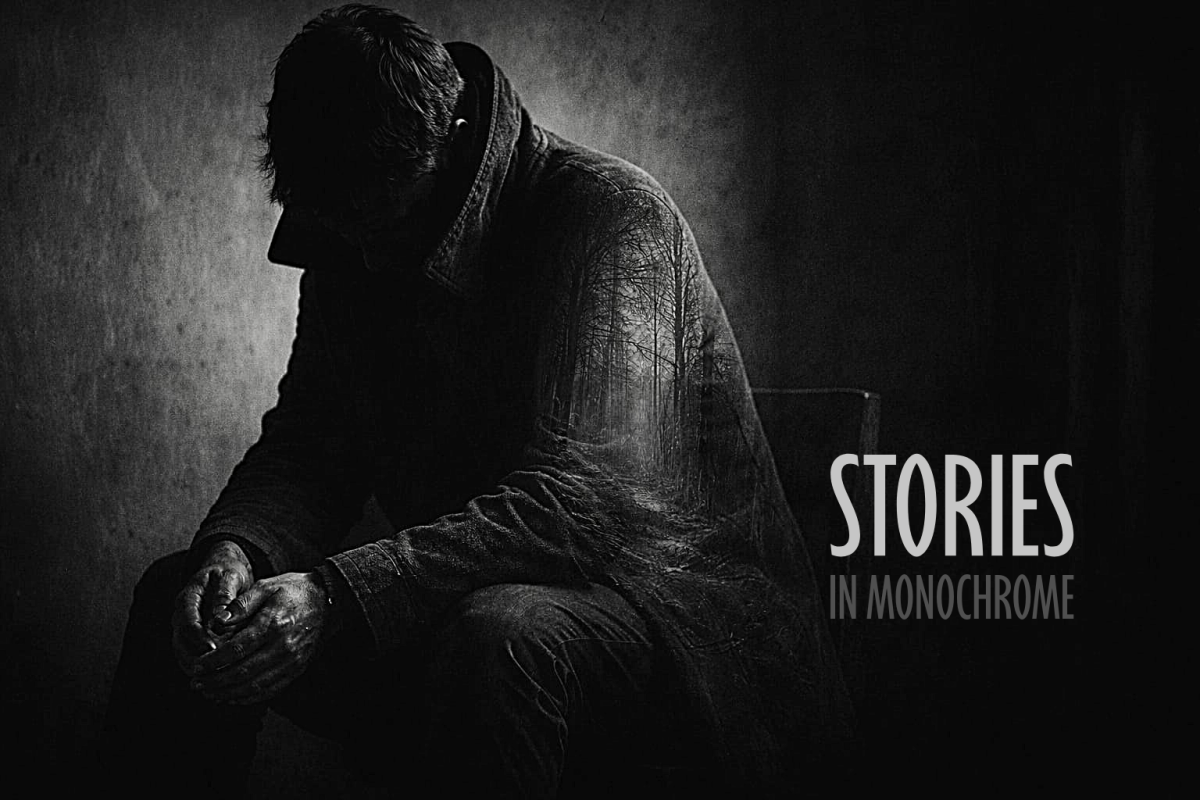

A Stories in Monochrome Tale
Deidre Morton had lived in apartment 3B for thirty-two years, seven months, and eleven days without ever unpacking her suitcases. She hadn’t intended to stay that long. In fact, when she first arrived, she paid the landlord for two weeks, explaining that she was waiting for certain matters back home to settle themselves. The landlord, a stout woman named Mrs. Bellamy, had accepted the money without asking questions. In those days, a woman arriving alone with two battered suitcases and an expression suggesting she’d rather not discuss her circumstances was hardly unusual. People came to the city for all manner of reasons, and most of them preferred to invent better ones when asked. Mrs. Bellamy had seen enough of life to understand that a person’s business was best left to the person conducting it.
Thirty-two years later, the suitcases remained beneath the window, their leather darkened by age, their brass clasps dulled by time, and their contents as carefully arranged as they had been on the morning Deidre left Bellwether.
She was sixty-eight now. Her hair, once a rich chestnut brown, had surrendered to silver in uneven strands that she gathered loosely behind her head. The years had softened her shoulders and deepened the lines around her eyes, but they had done little to diminish the quiet dignity with which she carried herself. She had worked twenty-six years in the records department of St. Agnes Hospital, retired without ceremony, and spent the years since cultivating a life so deliberately ordinary that even her neighbors struggled to remember much about her beyond the fact that she was polite, paid her rent on time, and occasionally left homemade biscuits outside the door of the elderly gentleman across the hall.
There had been no husband, no children, and no visitors who stayed long enough to leave an impression. Deidre had friends, or at least people with whom she exchanged pleasantries, but friendship required a certain willingness to be known, and she had spent most of her adult life avoiding precisely that.
Every morning she rose at six, made tea, opened the curtains, and watched the city wake beyond the rain-streaked glass. She enjoyed the small rituals of domestic life: the warmth of a ceramic cup between her palms, the smell of bread toasting, the distant rumble of delivery trucks, and the muffled conversations drifting upward from the sidewalk. She had purchased furniture, replaced curtains, painted walls, and even acquired a respectable collection of books, though she never allowed herself to buy anything she couldn’t bear to leave behind.
The suitcases were another matter.
They remained closed.
Not because she had forgotten what they contained.
Because she remembered.
The first postcard arrived eleven months after she left Bellwether. It was addressed in a handwriting she recognized immediately, though she spent nearly an hour convincing herself she was mistaken. The card showed a photograph of the town’s old railway station, its red brick walls glowing beneath the summer sky. Deirdre remembered that station. She remembered the cracked green benches, the smell of coal dust, and the enormous clock above the ticket window that had been seven minutes slow for as long as anyone could remember.
On the reverse, beneath a faded postmark, someone had written five words.
You can come home now.
There was no signature.
Deidre burned the postcard in the kitchen sink.
The following October, another arrived.
Then another.
And another.
Thirty-two years. Thirty-two postcards.
Each bearing a different photograph of Bellwether, and each carrying the same message.
She had stopped burning them after the fourth year. Destruction, she’d discovered, accomplished very little when the thing one wished to destroy existed primarily inside one’s own head. Instead, she tied the cards together with cotton string and placed them on the kitchen table, where they accumulated like unpaid debts.
This October’s postcard arrived on a Thursday afternoon, carried upstairs by a young postal worker whose name Deidre had never bothered to learn.
“Another one from your hometown, Miss Morton?”
Deidre looked at the card in his hand.
The photograph showed Bellwether’s main street.
A bakery stood on the corner, its striped awning extending over the sidewalk. Beyond it, the white steeple of St. Bartholomew’s rose above the rooftops. A man in a dark suit stood beside a parked automobile, his face turned away from the camera.
The image was unmistakable.
So was the problem.
Bellwether had been destroyed thirty-two years earlier.
Not abandoned.
Not evacuated.
Destroyed.
The official explanation had been a catastrophic subsidence event following decades of underground mining. A section of the valley had collapsed shortly after midnight, swallowing roads, homes, businesses, and nearly the entire population before emergency crews could reach the town. The newspapers called it one of the worst industrial disasters in the state’s history. There had been investigations, congressional hearings, lawsuits, and compensation funds. Families had buried empty coffins. Engineers had produced diagrams explaining how geological pressures, unstable shafts, and decades of negligence had conspired to erase a community.
Deidre had read every report.
She knew the names of the dead.
She knew how many bodies had been recovered.
She knew how many had not.
What she had never told anyone was that Bellwether had not collapsed at midnight.
It had begun disappearing three hours earlier.
And she had watched it happen.
The rain started shortly before dusk.
Deidre sat at the kitchen table with the postcard lying before her, its corners softened by handling. The apartment smelled faintly of steeped tea and furniture polish. Outside, water collected along the window ledge before spilling down the glass in narrow, wavering streams. The old wall clock ticked above the dresser, marking time with the patient indifference of something that had never been asked to regret anything.
She turned the postcard over.
You can come home now.
The handwriting belonged to her younger sister, Margaret.
There could be no mistake about that.
Margaret had always formed the letter h with an exaggerated loop, a habit their mother tried unsuccessfully to correct throughout her childhood. The final stroke of the word now curved upward, as though the writer had been interrupted before lifting the pen.
Deidre traced the letters with one finger.
Margaret had been nineteen when Bellwether disappeared.
Deidre was thirty-six.
For years, Deidre had told herself that what happened that evening was the product of exhaustion, fear, and a mind struggling to comprehend an event too terrible to accept. Trauma could distort memory. She knew that. She had read enough about it to understand that the brain sometimes rearranged the unbearable into something more manageable.
But there were details she could never explain away.
The silence, for one.
Bellwether had been a noisy town. Even after the factories closed for the evening, the streets carried the familiar sounds of radios, automobiles, barking dogs, and neighbors calling to one another across porches. On summer nights, music drifted from open windows, and the railroad crossing bells rang so often that residents eventually stopped noticing them.
That evening, at precisely 8:47, every sound stopped.
Not gradually.
Not as though the town had settled into sleep.
Everything ceased at once.
Deidre had been standing in her mother’s kitchen, washing supper dishes while Margaret sat at the table reading a magazine. Their mother was upstairs, complaining about a headache. A pot of coffee simmered on the stove, and somewhere in the house a radio played a song Deidre could no longer remember.
Then the radio fell silent.
The refrigerator stopped humming.
The clock above the stove stopped ticking.
Margaret looked up.
“Did the power go out?”
Deidre glanced toward the ceiling fixture.
The light was still burning.
Outside, the streetlamps remained illuminated.
She opened the kitchen window.
The night beyond it seemed unusually still.
A man stood on the opposite sidewalk beside his bicycle. Deidre recognized him as Mr. Harlan, who delivered groceries for the market on Thursdays. He was looking toward the intersection, one hand resting on the handlebars.
He wasn’t moving.
Neither was the bicycle.
Deidre watched him for several seconds before realizing something was terribly wrong.
The cigarette smoke hanging above his head had stopped rising.
It remained suspended in the air, a thin gray ribbon curling toward nothing.
“Margaret,” she whispered.
Her sister joined her at the window.
They stood together, looking out at a world that had apparently forgotten how to continue.
Then the man disappeared.
There was no flash, no movement, no dramatic disturbance of the air.
He was simply no longer there.
The bicycle remained.
Margaret screamed.
And somewhere beneath the house, something answered.
Deidre had spent thirty-two years trying to forget the sound.
It hadn’t been a roar or an explosion. Those would have been easier to understand. It was something lower, deeper, a vibration that seemed to travel through the bones rather than the ears. The kitchen floor trembled beneath her feet, and every glass in the cupboard began ringing against its neighbor.
Their mother came downstairs.
“What in God’s name is happening?”
Deidre didn’t answer.
She was staring at the kitchen doorway.
Beyond it, the hallway appeared longer than it should have been.
The front door, ordinarily less than twenty feet away, stood at the far end of a passage stretching into darkness.
Margaret grabbed her arm.
“Dee?”
Deidre remembered the feel of her sister’s fingers digging into her skin.
She remembered the smell of burned coffee.
She remembered her mother saying something about the telephone.
Then the hallway began to narrow.
Not collapse.
Narrow.
The walls moved inward with a slow, deliberate patience that suggested they were being adjusted by hands too large to comprehend.
Their mother stepped toward the hallway.
Deidre caught her wrist.
“Don’t.”
Her mother looked at her with an expression Deidre would remember for the rest of her life.
Not fear.
Recognition.
As though something she’d spent years expecting had finally arrived.
“Take your sister,” she said.
“Mother—”
“Get your things and go.”
Margaret began crying.
Their mother pulled away from Deidre’s grip and crossed to the kitchen window. Outside, houses were disappearing one by one, leaving empty spaces where porches, trees, and familiar doorways had stood moments earlier.
There was no debris.
No dust.
Nothing to suggest that anything had ever occupied those places.
Their mother closed her eyes.
“I thought we’d have more time.”
Deidre stared at her.
“What are you talking about?”
But her mother had already turned away.
“Your grandfather’s suitcases,” she said. “They’re upstairs. Take them.”
Deidre didn’t understand.
There were a thousand questions she wanted to ask, and she would spend the next thirty-two years regretting that she hadn’t asked a single one.
Instead, she obeyed.
She climbed the stairs, found the two battered leather suitcases beneath the bed in the spare room, and carried them downstairs.
They were heavier than she expected.
When she returned, Margaret was gone.
Their mother stood alone beside the kitchen table.
“Where is she?”
Her mother didn’t answer.
“Where’s Margaret?”
The older woman looked toward the window.
Across the street, the bicycle had disappeared.
Then the sidewalk.
Then the houses beyond it.
“She wouldn’t leave,” her mother said quietly.
Deidre dropped the suitcases.
“What do you mean she wouldn’t leave?”
“She went looking for your father.”
Their father had been dead for eleven years.
Deidre remembered that clearly.
She also remembered the sound of his voice coming from somewhere upstairs.
Calling Margaret’s name.
The clock struck seven.
Deidre blinked and found herself back in apartment 3B, the postcard beneath her fingertips and the rain continuing its patient assault on the window.
She had never understood how she’d escaped Bellwether.
Her last clear memory was of standing in the kitchen while her mother pushed the suitcases toward her.
Then there had been a road.
A dark highway beneath a moonless sky.
Deidre stood on the shoulder holding both suitcases, her shoes muddy, her hands bleeding from gripping the leather handles.
Behind her, the valley was gone.
She walked until a truck driver found her shortly before dawn.
The newspapers later reported that the town had collapsed shortly after midnight.
Deidre never corrected them.
How could she?
What would she have said?
That the houses disappeared before the ground gave way? That her dead father had called her sister upstairs? That her mother appeared to understand what was happening?
People would have listened politely.
Then someone would have recommended a doctor.
So she said nothing.
And eventually, silence became the only part of her life she trusted.
At half past eight, someone knocked on her apartment door.
Deidre rarely received visitors after dark.
She sat motionless, listening.
Three knocks.
A pause.
Then two more.
Her heart began beating harder.
It was the same rhythm Margaret used when they were girls, tapping against their shared bedroom wall whenever she wanted to talk after their mother had ordered them to sleep.
Deidre rose slowly.
The floorboards complained beneath her slippers.
“Who is it?”
No answer.
She approached the door.
“Who’s there?”
A woman’s voice spoke from the hallway.
“Dee?”
Deidre closed her eyes.
The voice was young.
Nineteen years old.
Exactly as she remembered it.
“Margaret?”
A soft laugh came through the door.
“You always did take forever.”
Deidre pressed one hand against the wood.
Thirty-two years of birthdays, Christmas mornings, hospital corridors, lonely dinners, and sleepless nights seemed to gather behind her ribs.
She wanted to open the door.
God help her, she wanted it more than anything.
But something was wrong.
Margaret had never called her Dee.
Not once.
Their mother had.
Their father had.
Everyone else had.
Margaret, stubborn even as a little girl, had always insisted on calling her Deidre.
She said shortening someone’s name was like cutting the ending off a story.
Deidre stepped backward.
The voice came again.
“Open the door, Dee.”
Her fingers went cold.
“You’re not my sister.”
Silence.
Then, from the other side of the door, a different voice answered.
Her mother’s.
“Of course she isn’t, sweetheart.”
Deidre stumbled against the table.
The postcards scattered across the floor.
“You should have come home years ago,” her mother continued. “We couldn’t keep waiting forever.”
The wall clock stopped.
Outside, the rain ceased.
Not gradually.
Not as a storm passing.
Every drop hanging against the window remained suspended where it was.
Deidre stared at the glass.
Then she looked toward the suitcases.
For thirty-two years, she had believed they contained the ordinary possessions her mother had insisted she take: clothing, documents, family photographs, perhaps a little money.
She had never opened them because doing so felt like surrendering the last possibility that she might someday return everything to its proper place.
But her mother hadn’t told her to pack.
She had told her to take her grandfather’s suitcases.
And Deidre had never once questioned why.
Behind the door, something shifted.
A sound like a thousand sheets of paper being dragged across concrete.
The voice spoke again.
“Open them, Deidre.”
This time it was Margaret.
Her real voice.
The one that had never shortened her name.
Deidre turned toward the luggage.
Her hands trembled as she knelt beside the first suitcase. The brass clasps resisted, stiff from decades of neglect, before finally yielding with two sharp clicks.
Inside lay a folded wool blanket, a small leather-bound notebook, and a photograph.
She lifted the photograph.
It showed her grandfather standing in front of the Bellwether railway station.
Beside him stood a woman Deidre didn’t recognize.
Between them, holding a small leather suitcase, was a girl who looked exactly like Margaret.
The photograph was dated 1911.
Margaret hadn’t been born until 1975.
Deidre opened the notebook.
The first page contained a single sentence written in her grandfather’s careful handwriting.
The town does not disappear. It moves.
Beneath it, another sentence had been added in a different hand.
Her mother’s.
Someone must remain outside to remember where it was.
Deidre sat back on her heels.
For thirty-two years, she had believed herself a survivor.
A woman who had escaped a terrible disaster.
But perhaps escape had never been the point.
Perhaps her mother had sent her away for a reason.
Perhaps the suitcases were not possessions.
Perhaps they were instructions.
The knocking stopped.
A moment later, the wall clock resumed ticking.
Outside, the rain began falling again.
Deidre remained on the floor for a long time, the photograph resting in her lap and the notebook open beside her.
Then she reached for the second suitcase.
Its clasps opened easily.
Inside were thirty-two postcards.
All addressed to Deidre Morton.
All bearing photographs of Bellwether.
All written in Margaret’s unmistakable handwriting.
And beneath them lay a railway ticket.
One-way.
Destination: Bellwether.
Departure: October 9.
The date was today.
Deidre looked toward the clock.
9:17 p.m.
The ticket listed a departure time of 11:45.
For the first time in thirty-two years, she understood why her mother had insisted she take the suitcases.
They hadn’t been packed for the journey away from Bellwether.
They had been packed for the journey back.
At eleven-thirty, Deidre Morton left apartment 3B carrying two battered leather suitcases.
She wore her old charcoal coat and sensible shoes. Her silver-streaked hair was pinned neatly behind her head, and in her pocket rested a photograph, a railway ticket, and the small notebook she’d spent thirty-two years refusing to open.
The rain had stopped.
The streets were nearly empty.
She walked toward the railway station, passing shuttered storefronts and darkened windows, her footsteps echoing against the pavement.
She was frightened.
More frightened than she’d been in years.
But beneath the fear was something else.
Not hope, exactly.
Hope was too generous a word for what she felt.
It was the uncomfortable recognition that a person could spend an entire lifetime mistaking survival for living.
Deidre had survived Bellwether.
She had survived the years afterward.
She had survived birthdays without her sister, holidays without her mother, and countless evenings spent wondering whether she had imagined everything.
What she had never done was discover why she had been allowed to leave.
At the station, she found the platform nearly deserted.
The departure board displayed no train scheduled for Bellwether.
She checked her ticket again.
11:45.
A cold breeze moved through the station.
Then, somewhere beyond the platform, a whistle sounded.
It was an old-fashioned steam whistle, deep and mournful, the kind she remembered hearing as a child when freight trains passed through the valley after midnight.
A light appeared in the darkness.
Deidre tightened her grip on the suitcase handles.
As the train emerged from the tunnel, she saw that its windows glowed with a soft amber light.
Behind the glass sat passengers dressed in clothing from different decades.
A man in a bowler hat.
A woman wearing a fur-collared coat.
Two children in school uniforms.
And near the rear of the carriage, a young woman with dark hair sat beside an empty seat.
Margaret.
Nineteen years old.
Exactly as Deidre remembered her.
The train slowed.
The doors opened.
Margaret looked up.
For a moment, neither sister moved.
Then Margaret smiled.
“Deidre.”
The sound of her full name nearly broke something inside her.
Deidre stepped toward the train.
And stopped.
Because behind Margaret, seated beneath the carriage window, was their mother.
Older than Deidre remembered.
Much older.
Her hair was white, her face deeply lined, and her hands trembled slightly as she lifted them in greeting.
Thirty-two years had passed for her, too.
Deidre felt the weight of the suitcases pulling against her arms.
The train conductor appeared in the doorway.
He was an elderly man with a neatly trimmed beard and a silver watch chain hanging from his vest.
“Ticket, madam?”
Deidre handed it to him.
He examined it carefully.
Then he looked at the suitcases.
“Ah,” he said.
His expression softened.
“We’ve been waiting for those.”
Deidre glanced toward Margaret.
“Where does this train go?”
The conductor studied her for a moment.
Then he stepped aside.
“Home, Miss Morton.”
She looked once more toward the empty station behind her.
Thirty-two years.
Seven months.
Eleven days.
A lifetime spent waiting for permission to belong somewhere.
Deidre lifted the suitcases and stepped aboard.
The doors closed behind her.
And for the first time since leaving Bellwether, she finally began to unpack.
Discover more from Memoirs of Madness
Subscribe to get the latest posts sent to your email.

