A Roberta “Bobbie” Packard Mystery
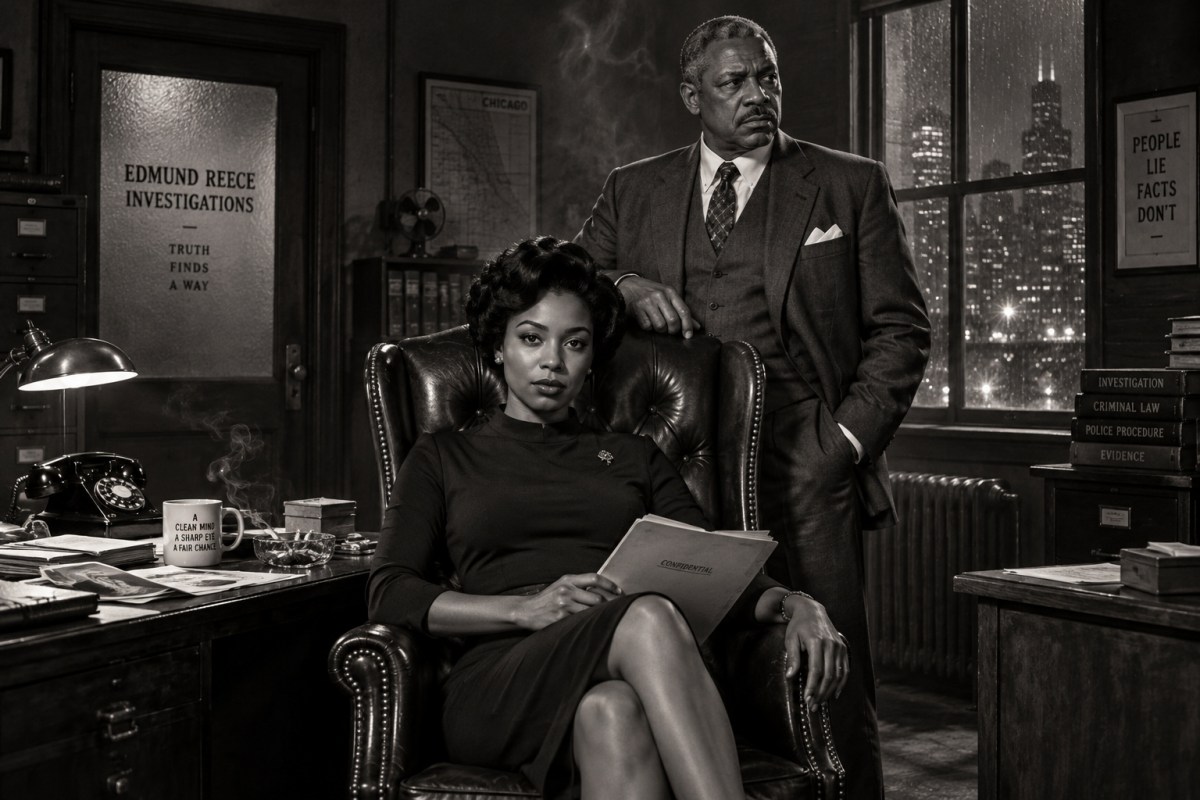
Edmund Reece Investigations | Chicago, 1956
The trouble with working for Edmund Reece was that the man had an extraordinary talent for finding trouble, an equally extraordinary talent for making it worse, and absolutely no talent whatsoever for remembering where he had left his cigarettes.
Roberta Packard had spent the better part of three years explaining this to him, usually while searching through the pockets of his overcoat, beneath the cushions of his office chair, or inside the battered filing cabinet where he kept an assortment of unpaid bills, old photographs, and a loaded .38 Special that had not seen daylight since the summer of 1954.
At twenty-nine, Roberta, whom everyone except her mother called Bobbie, had learned that patience was a commodity best reserved for people who deserved it. Edmund Reece, private investigator, former Chicago police detective, and proprietor of one of the few Black-owned detective agencies in the city, had exhausted his allotment sometime around last Christmas.
Nevertheless, she liked the old bastard.
Most days.
Tonight was proving to be an exception.
The clock above the office door read eleven seventeen, although Bobbie suspected it was running slow again. Beyond the rain-streaked windows, Chicago had settled into that peculiar condition where the respectable people had gone home, the disreputable ones were just getting started, and everyone else was trying to avoid becoming acquainted with either.
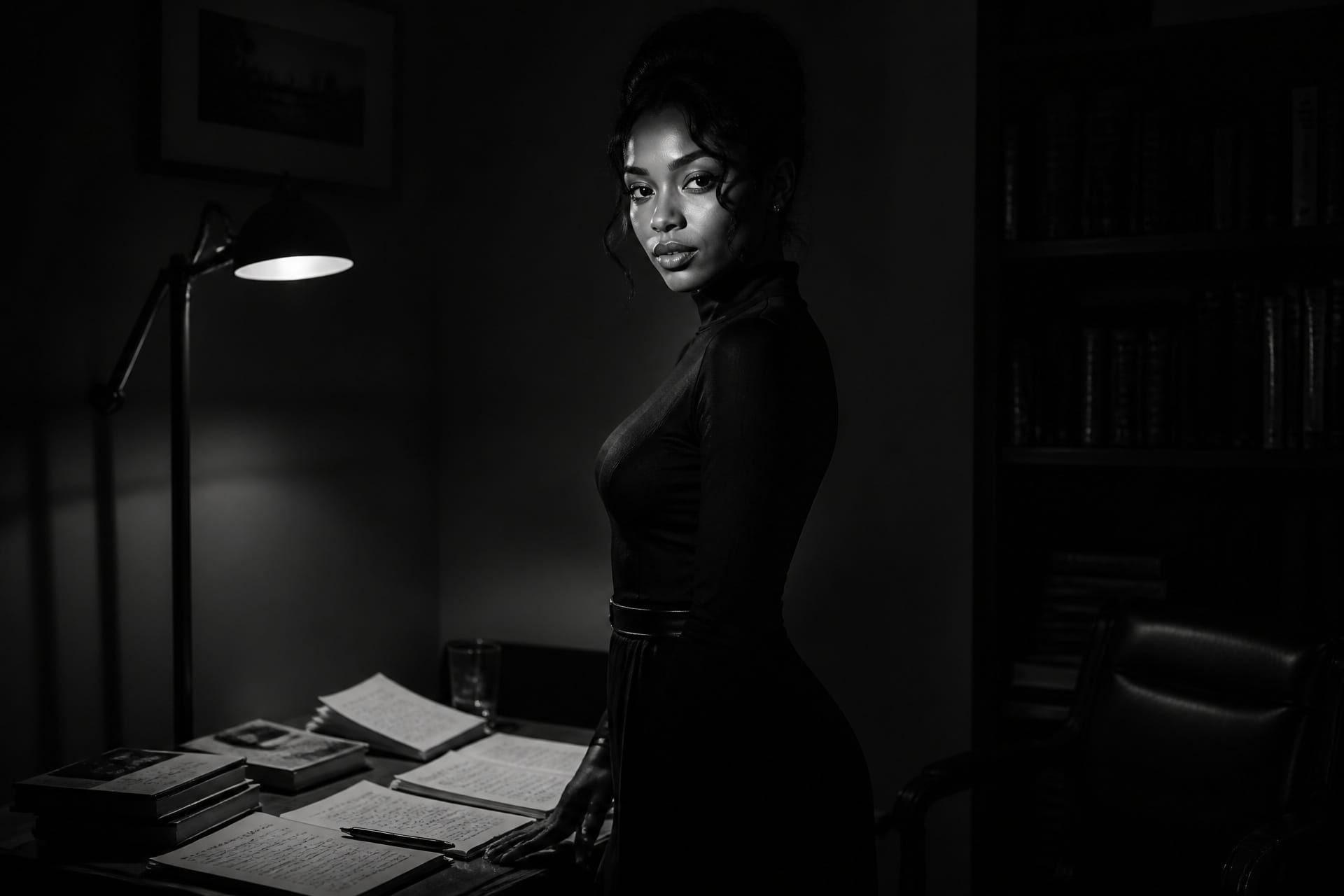
She stood beside Reece’s desk, studying a collection of photographs beneath the yellow light of a brass reading lamp. The pictures had arrived that afternoon in an unmarked envelope, accompanied by a hundred-dollar bill and a handwritten message consisting of seven words.
Find out what happened to my husband.
No name. No return address. No explanation.
Just the photographs, the money, and a faint perfume that reminded Bobbie of gardenias left too long in a warm room.
The photographs were peculiar enough. Four pictures of the same man, apparently taken over several years. In the first, he stood outside a nightclub wearing a cream-colored dinner jacket, his arm wrapped around a woman whose face had been carefully removed with a razor blade. In the second, he sat behind the wheel of a Cadillac. The third showed him entering a building on South Michigan Avenue.
The fourth photograph bothered her.
It showed the man lying in a coffin.
Except the date stamped on the back was tomorrow.
Bobbie had checked it three times.
She wasn’t particularly superstitious, but she believed that when someone went to the trouble of photographing a corpse before the poor son of a bitch had the decency to die, there was probably a reasonable explanation.
Unfortunately, reasonable explanations were in short supply at Edmund Reece Investigations.
The telephone rang.
Bobbie glanced at it without moving.
It rang again.
“Edmund Reece Investigations,” she answered, lifting the receiver. “Roberta Packard speaking.”
A man’s voice came through the line, low and unpleasantly familiar.
“Where’s Reece?”
“That depends on who’s asking.”
“Tell him it’s Fletcher.”
“Mr. Fletcher, if you’re calling about the money Mr. Reece owes you, I can assure you—”
“I ain’t calling about money, sweetheart.”
Bobbie closed her eyes.
She hated that word.
Not because there was anything inherently wrong with it, but because men like Fletcher employed it the way other people used a blackjack. A little familiarity to soften the victim before delivering the blow.
“Then perhaps you’d care to explain why you’re calling my office at this hour.”
There was a pause.
“Your office?”
“That’s what I said.”
“Since when?”
“Since I started paying half the rent.”
Another pause, considerably longer than the first.
“Just tell Reece that Mickey Doyle is dead.”
Bobbie straightened.
“Mickey Doyle?”
“You heard me.”
“How?”
“That’s the funny part.”
“Mr. Fletcher, I’m not particularly interested in your appreciation of comedy.”
“He drowned.”
Bobbie looked toward the photographs.
“And?”
“In his bathtub.”
“People have been known to do that.”
“Not when the bathtub’s empty.”
The line went dead.
For several seconds, Bobbie remained motionless, the receiver pressed against her ear while the soft electrical hiss of the disconnected line filled the room.
Then she slowly replaced it.
“Well,” she murmured, “ain’t that some shit.”
Edmund Reece returned twenty minutes later, carrying a paper sack stained with grease and wearing the expression of a man who had recently won an argument with someone considerably less intelligent than himself.
He was fifty-three, broad through the shoulders, with a thick mustache and a permanent crease between his eyebrows that suggested the world had disappointed him at an early age and had been working overtime to maintain the distinction ever since.
His hat was wet, his shoes were muddy, and the left sleeve of his overcoat bore a suspicious smear of lipstick.
Bobbie noticed.
She always noticed.
“Before you start,” Reece said, removing his hat, “I got an explanation.”
“I’m sure you do.”
“It ain’t what you think.”
“I haven’t told you what I think.”
“That’s what worries me.”
He placed the sack on the desk.
“Brought you something.”
Bobbie peered inside.
“A sandwich?”
“Roast beef. From Goldstein’s.”
“With mustard?”
“Extra.”
She considered this.
There were few things in Chicago capable of improving her disposition after eleven o’clock at night, but a tasty roast beef sandwich from Goldstein’s Delicatessen was certainly among them.
“You’re forgiven,” she said.
“Didn’t know I was in trouble.”
“You usually don’t.”
Reece removed his coat and settled into his chair, which complained beneath his weight.
“Anything interesting happen while I was gone?”
“Mickey Doyle’s dead.”
Reece stopped unwrapping his sandwich.
For the first time that evening, the amusement disappeared from his face.
“Who told you?”
“Fletcher.”
“When?”
“Twenty minutes ago.”
“How’d he die?”
“Drowned in an empty bathtub.”
Reece stared at her.
“That’s not funny, Bobbie.”
“I didn’t laugh.”
He pushed the sandwich aside.
“Son of a bitch.”
Bobbie reached for the photographs.
“Would you care to explain why the news of Mr. Doyle’s unfortunate bathing accident has suddenly ruined your appetite?”
Reece rubbed his jaw.
“Mickey Doyle was supposed to be dead already.”
Bobbie raised an eyebrow.
“That seems to be going around.”
“Three years ago. Warehouse fire down by the river. They found two bodies. One was supposed to be Doyle.”
“Supposed to be?”
“Identification was made by his wife.”
“Who was she?”
Reece looked toward the photographs.
“Her name was Evelyn.”
Bobbie slid the first picture across the desk.
“Would that happen to be Evelyn Doyle?”
Reece picked it up.
His expression changed.
It wasn’t fear exactly. Bobbie had seen him frightened before, although he would sooner swallow broken glass than admit it. This was something different, something that seemed to reach through the years and place a cold hand against the back of his neck.
“Where’d you get this?”
“Delivered this afternoon.”
“By who?”
“Messenger boy.”
“Description?”
“About twelve. Skinny. Missing a front tooth. Said a lady gave him fifty cents to bring it upstairs.”
Reece examined the remaining photographs.
When he reached the fourth, he went very still.
“Jesus Christ.”
“That’s what I said, although I used considerably more colorful language.”
“Did you look at the date?”
“Three times.”
He turned the photograph over again.
October 11, 1956.
“Could be somebody’s idea of a joke,” he said.
“An expensive one.”
Bobbie placed the hundred-dollar bill beside his elbow.
Reece looked at it.
“That’s real?”
“Unless the Treasury Department has started printing counterfeit currency.”
He leaned back.
“Something stinks.”
“Besides your coat?”
Reece gave her a testy look.
“Can you be serious for five minutes?”
“I’ve been serious for three years, Edmund. You’re the one who keeps bringing me sandwiches and dead men.”
He almost smiled.
Almost.
Then he picked up the telephone.
By midnight, they had established three things.
Mickey Doyle had indeed been found dead in a bathtub at the Hotel Wexler on South State Street. The attending physician had refused to sign the death certificate, and the police had already removed the body.
The second discovery was considerably more troubling.
According to a contact at the county morgue, the dead man had been identified as Michael Patrick Doyle, age forty-seven, formerly of Cicero, Illinois.
The same Michael Patrick Doyle who had supposedly perished in the warehouse fire three years earlier.
The third discovery came from Bobbie.
And it was the one that bothered Reece most.
“Look at his hands,” she said.
They had moved the photographs beneath the desk lamp. Reece leaned forward, squinting at the image of Doyle standing outside the nightclub.
“What about them?”
“His left hand.”
“He’s wearing a ring.”
“Not the ring. His fingers.”
Reece looked closer.
“Son of a bitch.”
“That’s becoming a popular expression tonight.”
The man in the first photograph was missing the tip of his left little finger.
The man in the coffin had all ten.
Reece took the picture from her.
“Could be the angle.”
“It isn’t.”
“Could be somebody touched up the photograph.”
“Why?”
“I don’t know.”
“Then stop making excuses for what your eyes are telling you.”
Reece looked at her.
Bobbie folded her arms.
It was a familiar exchange between them. Edmund Reece had been a detective for nearly twenty-five years, and he had spent much of that time learning that the truth rarely arrived dressed appropriately for the occasion. Bobbie, on the other hand, had developed a rather irritating habit of recognizing it before he did.
He had hired her in 1953 after she walked into his office looking for work.
When he asked whether she could type, she informed him that she could, but that she hadn’t come there to spend her life taking dictation from a man who couldn’t spell surveillance.
He asked whether she had any experience investigating crimes.
She told him she had spent six months working as a clerk in the county records office, where she had discovered that a dead alderman was still collecting a salary and that three supposedly unrelated construction companies shared the same bank account.
When Reece asked what she had done with the information, she told him she had kept copies.
He hired her that afternoon.
She had been correcting his spelling ever since.
“There’s something else,” Bobbie said.
“Of course there is.”
“The photographs weren’t taken in the order you think.”
She arranged them across the desk.
“The nightclub photograph is the oldest. Look at the cars in the background. The Cadillac picture came later. The Michigan Avenue photograph is more recent.”
“And the coffin?”
“That’s where it gets interesting.”
She pointed to the lapel of the dead man’s suit.
“See that?”
Reece leaned closer.
A small pin was fastened to the fabric, barely visible beneath the flower in the buttonhole.
“Looks like some kind of club insignia.”
“Not a club.”
“Then what?”
Bobbie crossed the room to the bookshelf and removed a battered volume of Chicago historical trivia she had purchased at a secondhand shop on Maxwell Street.
Reece watched her.
“You telling me the answer’s in that thing?”
“I’m telling you that occasionally a person benefits from reading something other than the racing results.”
She opened the book near the middle.
“Here.”
Reece studied the illustration.
The insignia was a small silver key crossed by a black feather.
Beneath it was a paragraph describing the Black Feather Society, a private organization established during Prohibition whose membership reportedly included politicians, businessmen, police officials, and several prominent figures in Chicago’s criminal underworld.
The society had supposedly dissolved in 1938.
“Never heard of them,” Reece said.
“That’s rather the point of a secret society, isn’t it?”
He ignored her.
“What’s this got to do with Doyle?”
“I don’t know yet.”
Bobbie returned to the desk and examined the coffin photograph once more.
Then she noticed something she had missed.
A reflection.
In the polished surface of the coffin, barely distinguishable from the surrounding shadows, stood the figure of a woman.
She wore a dark hat with a narrow veil.
Bobbie moved the photograph closer to the lamp.
“Edmund.”
“What?”
“Who identified Mickey Doyle after the warehouse fire?”
“His wife.”
“And where is she now?”
Reece hesitated.
“Far as I know, she left town.”
“When?”
“Right after the funeral.”
“Did you ever meet her?”
“Once.”
“What did she look like?”
Reece frowned.
“Why?”
Bobbie turned the photograph toward him.
“Because I think she came back.”
The knock came at twelve thirty-seven.
Three measured taps against the frosted glass of the office door.
Reece reached beneath his desk.
Bobbie watched him remove the .38 Special from its drawer.
“Put that away,” she said quietly.
“Why?”
“Because if somebody wanted us dead, they wouldn’t knock.”
“That’s not necessarily true.”
“No, but it’s a comforting thought.”
The knock came again.
Reece nodded toward the door.
Bobbie crossed the office, her heels making almost no sound against the worn carpet. Through the frosted glass, she could distinguish the outline of a woman wearing a hat.
“Edmund Reece Investigations,” Bobbie called. “Can I help you?”
A woman’s voice answered.
“I believe you have something that belongs to me.”
Bobbie glanced over her shoulder.
Reece had gone pale.
“Your name, please?”
“Evelyn Doyle.”
The office seemed to grow colder.
Bobbie rested one hand against the doorframe.
“Mrs. Doyle, it’s rather late.”
“I know.”
“Perhaps you’d care to return in the morning.”
“I’m afraid that won’t be possible.”
“Why not?”
A pause.
Then the woman spoke again.
“Because by morning, Mr. Reece will be dead.”
Bobbie looked at Edmund.
His revolver was pointed toward the floor, but his hand had begun to tremble.
For the first time since she had known him, he looked like a man who had finally encountered something he could neither outthink nor outrun.
Bobbie turned back toward the door.
“Mrs. Doyle,” she said, keeping her voice steady, “I believe you’d better come inside.”
The woman on the other side laughed softly.
It was not a pleasant sound.
“Oh, Miss Packard. I don’t think you understand.”
“Understand what?”
“I didn’t come here to warn him.”
A metallic click sounded from the hallway.
Bobbie recognized it immediately.
The unmistakable sound of a revolver being cocked.
“I came to collect.”
And somewhere behind her, Edmund Reece whispered a name Bobbie had never heard before.
“Josephine.”
Discover more from Memoirs of Madness
Subscribe to get the latest posts sent to your email.

