
Quiet Fire — Entry 29:
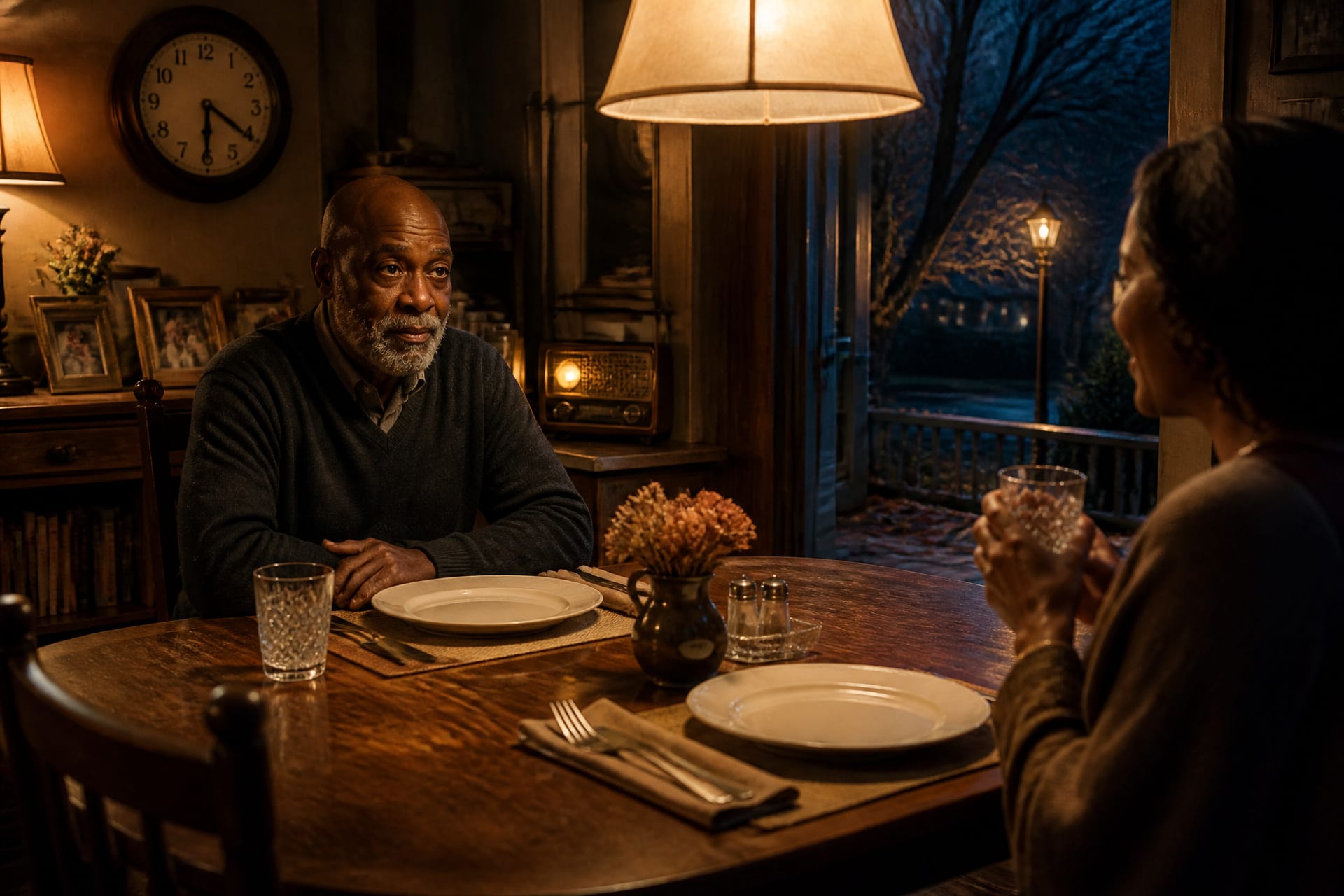
At exactly 6:17 every evening, he set a second place at the table.
Never 6:15. Never 6:20.
The ritual had long since escaped conscious thought. His hands simply knew what was expected of them. The fork rested a finger’s width from the plate. The water glass was filled halfway. The linen napkin was folded into the same crisp rectangle she had always managed with effortless precision, each crease sharp enough to suggest that dignity could survive even the smallest routines. He still cooked enough for two. Habit measured ingredients more faithfully than memory ever could. The oak tabletop bore a faint ring where the second glass had rested night after night, year after year. He had polished every inch of that table except the circle beneath the empty place setting. Some marks deserved preserving.
The chair across from him had been empty for so long that the emptiness itself had become another resident of the house. Dust settled around it differently. Evening light always reached it first before slowly finding him. More than once he had laughed at something crackling over the old kitchen radio and instinctively turned toward the vacant seat, already halfway to sharing the joke before remembering there was no one left to hear it. Grief, he had discovered, did not announce itself with tears nearly as often as it revealed itself through interrupted habits.
The neighbors noticed, of course.
People always noticed grief once it learned to keep a schedule.
Some called it devotion. Others called it loneliness wearing good manners. They lowered their voices whenever they walked past his house around supper, as though sorrow might overhear them through the windows. No one ever suggested he stop. Rituals, however peculiar, were easier for the living to accept than the silence left behind when they disappeared.
Late one Tuesday in autumn, while the last maple leaves scraped softly across the porch like dry fingertips searching for a way inside, there came a knock.
Not loud.
Just two patient taps.
His hand paused above the second glass.
The clock ticked once.
6:17.
When he opened the door, a woman stood quietly beneath the porch light.
She wasn’t young, nor was she old. Time had settled into her face the way evening settles into an empty room—without hurry and without apology. She wore no coat despite the November chill, yet the wind seemed uncertain what to do with her. It curled gently around her instead of through her, lifting a loose strand of silver-threaded hair before surrendering it back to her shoulder.
Her eyes met his with the strange familiarity of someone who had arrived exactly when she intended.
She smiled.
“Is the seat still open?”
He frowned.
“I’m sorry… I don’t believe we’ve met.”
“No,” she answered softly. “Not yet.”
Before he could decide whether to invite her inside, she stepped across the threshold with the quiet confidence of someone entering a place where she had always been welcome. The old floorboards answered beneath her feet with their familiar creaks, sounding less like warnings than greetings. For reasons he couldn’t explain, he wasn’t frightened. Surprised, certainly. Curious, undeniably. But fear never found a place to settle.
She stopped beside the table.
For a long moment she simply looked at the second place setting.
Then, almost absentmindedly, she unfolded the linen napkin, smoothed it gently with her fingertips, and folded it again with the same neat precision his wife had possessed. It wasn’t identical. Nothing ever could be. Yet watching her perform the small, ordinary act sent something quietly aching through his chest.
“You’ve kept this ready,” she said.
His eyes drifted toward the untouched plate.
“I wasn’t sure when to stop.”
She rested her hand lightly on the back of the chair before lowering herself into it.
The room changed.
Not dramatically.
Only in the subtle way an old house settles after the first fire has been lit on a cold evening. The refrigerator hummed softly in the kitchen. A pipe clicked somewhere inside the wall. Outside, another breeze swept a handful of leaves across the porch.
He realized the room no longer felt as though it were waiting.
It simply felt occupied.
He sat opposite her.
Neither of them hurried to speak.
The silence between them carried no awkwardness. It possessed the quiet ease of two people watching rain from opposite ends of the same porch, each understanding the other without demanding conversation.
Finally, he asked, “Who are you?”
She tilted her head ever so slightly.
“Does it matter?”
He searched her face for recognition and found none. Yet something about her presence stirred a memory too old to name. She didn’t resemble his wife. She resembled the possibility that loneliness had finally grown tired of introducing itself.
“I’ve been expecting someone,” he admitted.
“I know.”
“Who sent you?”
She smiled again, though this time there was unmistakable sadness resting behind it.
“Would the answer change what happens next?”
He looked down at the table.
The worn ring beneath the second glass caught the light from the dining room lamp, its pale outline resembling the ghost of countless evenings. For years he had believed he was preserving a place for someone who could never return.
Now he wondered whether he had simply been keeping a place inside himself from closing.
Slowly, almost reluctantly, he wrapped trembling fingers around the untouched glass.
The crystal felt cool against his palm.
He slid it across the oak table.
Neither of them spoke while it moved.
The faint whisper of glass across polished wood seemed impossibly loud inside the quiet house, carrying through every room like the final note of a song refusing to disappear.
She accepted it with both hands.
“Thank you,” she whispered.
Not because she had been offered water.
Because she had been welcomed.
The old clock ticked again.
6:18.
Outside, the last maple leaves surrendered to the wind and disappeared into the darkness.
She lifted the glass and took a single sip.
Then she smiled—not at him, but at the empty chair beside the table, as though acknowledging someone neither of them needed to name.
When he looked back a moment later, the chair across from him no longer seemed empty.
It simply looked ready for whatever life chose to place there next.
Discover more from Memoirs of Madness
Subscribe to get the latest posts sent to your email.


Beautiful Mangus 😭😭😭😭😭😭😭
LikeLiked by 2 people
thank you
LikeLike
Loved this Mangus.
LikeLiked by 2 people
thanks, Di
LikeLike
The chair across from him had been empty for so long that the emptiness itself had become another resident of the house. How exquisite! Beginning to end! Your writing is so beautiful and moving, entrancing even.
LikeLiked by 2 people
thank you
LikeLike