The street wasn’t dry.
Even when the rain stopped, the cobblestones held the memory of storms the way old men hold grudges. Water clung to the cracks, gathering in thin silver seams that reflected neon signs trembling overhead. The night smelled of wet brick, cheap whiskey, and the kind of loneliness that didn’t bother announcing itself anymore.
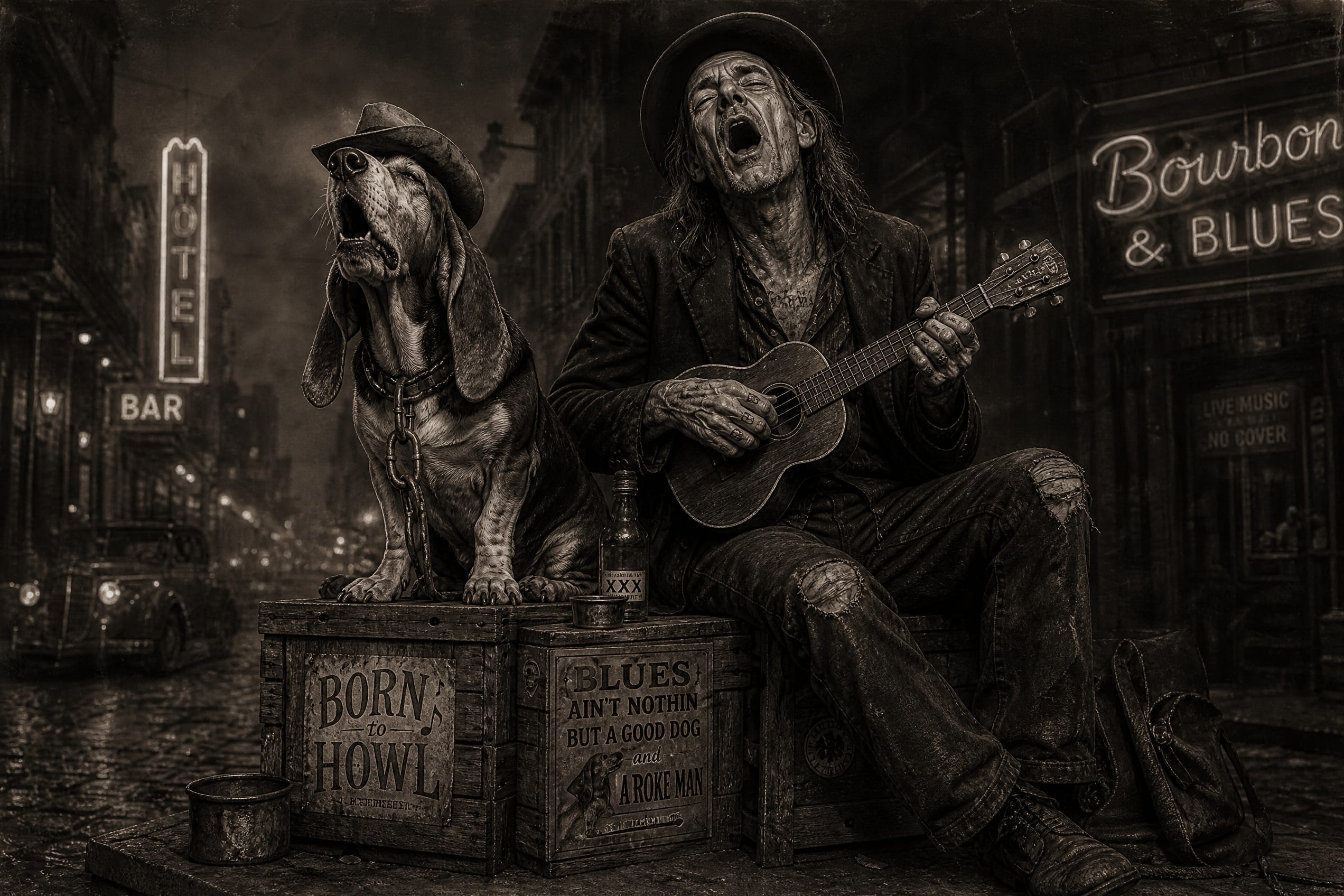
He sat on a wooden crate beneath the flickering HOTEL sign, guitar resting against his knee like a tired friend. The strings were worn, the wood scarred, the sound hollow in a way that felt honest. His voice carried through the alley in rough, uneven waves — not singing exactly, more like confessing.
Beside him, the dog howled.
A basset hound with a cowboy hat tilted just slightly off-center, as if even the hat had given up trying to sit straight in this city. The dog’s voice rose and fell with his, two creatures harmonizing out of instinct rather than talent. People passing by didn’t know whether to laugh or listen.
Most didn’t do either.
The crate beneath the dog read: BORN TO HOWL.
The one beneath the man read: BLUES AIN’T NOTHIN BUT A GOOD DOG AND A BROKE MAN.
He didn’t disagree.
The neon from Bourbon & Blues bled across the wet street, turning the puddles into trembling pools of red and gold. A sign in the window promised LIVE MUSIC — NO COVER, but he never went inside. He preferred the outside of things. The edges. The places where people only lingered when they had nowhere else to be.
He strummed once, twice, letting the notes settle into the night like they were looking for a place to sleep.
The dog howled again.
“Easy, Boone,” he murmured.
Boone didn’t listen.
Dogs rarely do when they’re singing.
A couple walked past, their coats pulled tight, their eyes fixed on the promise of warmth somewhere down the block. They didn’t look at him. They didn’t look at Boone. They didn’t look at the crates or the bottle marked XXX sitting beside his boot.
People in this city learned early not to look directly at sorrow.
It had a way of looking back.
He shifted on the crate, feeling the ache in his spine settle deeper. The guitar felt heavier tonight, though he knew it wasn’t the wood. Weight didn’t always come from things you could touch.
Sometimes it came from years.
Years of playing for people who never stayed long enough to hear the end of a song. Years of carrying stories no one asked him to tell. Years of watching the city swallow dreams whole and spit out the bones.
Boone nudged his hand with a wet nose.
“You hungry?” he asked.
The dog didn’t answer.
Not with words.
But the silence said enough.
He reached into his coat pocket and pulled out a small piece of jerky. Boone took it gently, chewing slow, eyes half‑closed like he was savoring more than food — maybe the moment, maybe the company, maybe the fact that some nights didn’t hurt as much as others.
A car rolled past, tires slicing through the wet street. The headlights stretched their shadows long across the pavement, turning them into two figures walking away from themselves.
He watched the reflection in the puddle.
Two ghosts.
One man.
One dog.
Both staying in a city that had forgotten how to keep people whole.
He strummed again, softer this time. The notes drifted upward, brushing against the neon, slipping into the cracks of the buildings, settling into the quiet places where stories go when they don’t have endings.
Boone lifted his head and howled — not loud, not desperate, just steady. A sound that felt like memory trying to find its way home.
The man smiled.
“Yeah,” he whispered. “I hear it too.”
Rain began again — not hard, just enough to remind the night what it was made of. The drops tapped against the crates, the guitar, the brim of Boone’s hat. The city breathed around them, slow and tired.
He kept playing.
Boone kept howling.
And for a moment — a small, fragile moment — the alley felt less empty.
Not because the music filled it.
But because two creatures, worn thin by years and weather, refused to let the quiet win.
In this city, that counted as survival.
And sometimes, in the monochrome between storms, survival was enough.
Discover more from Memoirs of Madness
Subscribe to get the latest posts sent to your email.

