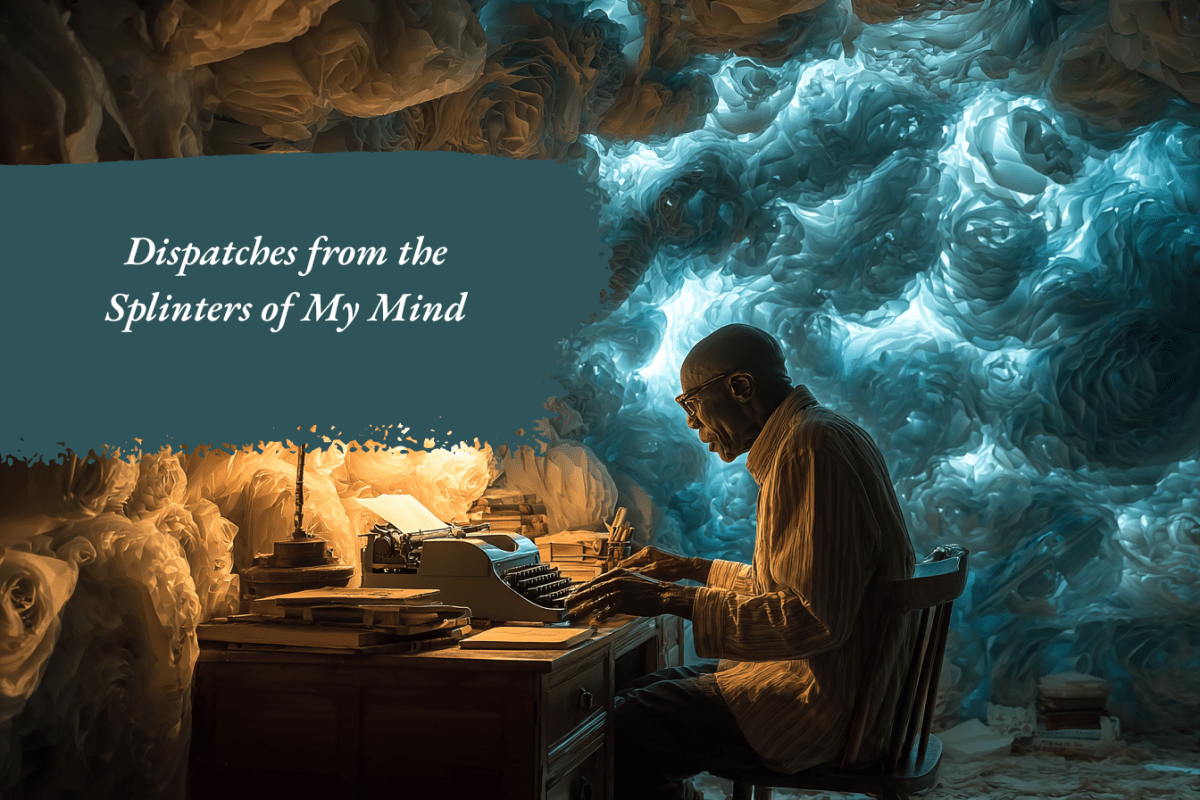

Dispatches Of Splinters Of My Mind Entry 24:
The city looked different after midnight.
Not emptier.
Honest.
Daylight hid too much beneath movement. Traffic disguised desperation. Conversations blurred into harmless noise. Storefront lights created the illusion that civilization was functioning normally, that people were still connected to one another in ways that mattered. But after midnight, the performance weakened. The streets exhaled. Buildings stood exposed in their exhaustion. Every cracked stairwell, every flooded alley, every darkened window became impossible to ignore.
That was when she loved the city most.
Not because it was beautiful.
Because it stopped lying.
Rainwater collected in broken sections of pavement, reflecting fractured neon in trembling blue streaks. The air smelled of wet concrete, rust, cigarette smoke, and distant electrical fires—the scent cities develop after surviving too many years without rest. Somewhere far below her apartment window, a siren dragged itself through the streets and disappeared again, swallowed by the architecture.
The silence afterward felt bruised.
She sat motionless beside the window, knees drawn close to her chest, watching condensation crawl slowly down the glass. The apartment behind her remained dark except for the weak blue glow leaking in from outside. In that light, the room barely looked inhabited. Just outlines. A mattress. A sink full of dishes she no longer remembered dirtying. Books stacked like unfinished conversations against the wall.
Evidence of survival.
Nothing more.
There are people who believe trauma arrives like an explosion.
Loud.
Immediate.
Visible.
But real damage is usually architectural. Slow structural failure hidden beneath functioning surfaces. Hairline fractures spreading through the foundation while everything above continues pretending stability. By the time collapse becomes visible, the deterioration has already been living there for years.
She understood that now.
The city taught her.
Every building outside carried scars disguised as design choices. Fire escapes hanging crooked from brick walls. Windows patched after riots no one discussed anymore. Entire neighborhoods rebuilt so quickly after violence that the fresh paint itself felt suspicious. The city did not heal. It adapted.
Human beings call adaptation healing because the truth sounds uglier.
She touched her cheek absentmindedly and felt the rough texture there—the faint unevenness left behind from stress, exhaustion, nights without sleep. Her skin carried its own geography now. Tiny ruins hidden beneath makeup and low lighting. The body archives everything eventually. Smoke. Grief. Fear. Isolation. Even silence leaves residue if it lingers long enough.
Especially silence.
The apartment radiator hissed violently for a few seconds before settling again into low metallic clicks. The sound startled her harder than it should have. That kept happening lately. Small noises triggering disproportionate reactions. Nervous system fatigue. Hypervigilance. Whatever clinical language people preferred using to describe what prolonged emotional strain does to a person.
Labels never impressed her much.
A burning house does not care what you name the fire.
Outside, clouds moved low across the skyline like bruises spreading beneath skin. Blue light bled through them unevenly, turning the entire city into something submerged and dreamlike. Some nights she imagined the streets beneath her apartment were underwater already. People drifting through routines like deep-sea creatures evolved for pressure rather than happiness.
Move.
Consume.
Endure.
Repeat.
The city rewarded endurance more than joy.
So did most people inside it.
That realization arrived slowly over the years. She began noticing how exhaustion had become social currency. Everyone comparing damage casually over coffee. Sleep deprivation worn like ambition. Emotional numbness mistaken for maturity. People speaking proudly about how much they could tolerate instead of questioning why so much suffering had become normalized in the first place.
No one wanted healing.
Healing interrupts economies.
Broken people purchase distractions more efficiently.
The thought should have felt paranoid.
Instead, it felt obvious.
She leaned her forehead against the cold windowpane. Outside, a flickering sign buzzed faintly in the rain, throwing weak pulses of electric blue across the room. For a moment her reflection merged with the city beyond the glass. Her face dissolving into stairwells, rooftops, broken corridors flooded with shadow.
The effect disturbed her less than it should have.
Maybe because she no longer knew where the city ended and she began.
There are places that slowly colonize your interior life. Cities especially. You absorb their rhythms without consent. Their anxieties become yours. Their velocity rewires your nervous system. Their loneliness teaches you new forms of emotional distance disguised as independence.
After enough years, you stop carrying the city.
The city carries you.
That was the real horror.
Not the violence.
Not the decay.
The intimacy of it.
She remembered arriving here years ago believing cities transformed people into sharper, stronger versions of themselves. Reinvention. Freedom. Motion. That old mythology. But cities do not reinvent people. They expose whatever fractures already existed and then monetize the aftermath.
The lonely become anonymous.
The ambitious become exhausted.
The grieving become invisible.
And invisible people can disappear for years without interruption.
Rain struck the window harder now, streaking the skyline into abstract smears of blue and black. Somewhere in the apartment building, someone began arguing faintly through thin walls. A man’s voice. Then silence. Then muffled crying quickly suppressed.
Even sorrow learned to stay quiet here.
Especially sorrow.
She closed her eyes briefly and saw the streets again—not as they were now, but layered with memory. Ambulance lights flashing against wet pavement. Lovers kissing beneath train tracks. A homeless man laughing alone at three in the morning. Blood washed into gutters by summer storms. Teenagers smoking on rooftops pretending invincibility. Thousands of isolated lives stacked vertically beside one another, separated by drywall and exhaustion.
Everyone carrying private collapses through public spaces.
Everyone pretending not to notice the others breaking.
The city depended on that agreement.
Look away.
Keep moving.
Do not stare too long at suffering unless it becomes profitable or entertaining.
There was a cruelty in that realization, but also a strange tenderness. Because despite everything—despite the decay, despite the emotional erosion, despite the endless machinery grinding people into tired versions of themselves—the city still held evidence of resistance.
A woman watering flowers from a fire escape.
A stranger helping another carry groceries through the rain.
Music drifting from open windows at impossible hours.
Tiny acts of humanity surviving inside systems designed to exhaust it.
Maybe that was why she stayed.
Not hope exactly.
Recognition.
The city was wounded in the same way she was.
Functional from a distance.
Flooded underneath.
And perhaps that was the secret connection between ruined places and ruined people: neither asks for perfection from the other. They simply coexist inside the damage, learning how to breathe around collapsed structures without pretending the collapse never happened.
The blue light shifted again across her reflection.
For a moment, her face disappeared completely into the skyline.
Just streets.
Windows.
Smoke.
Rain.
And beneath all of it, something still burning quietly where no one could see it.
Not enough to destroy the city.
Not enough to save it either.
Just enough
to keep it alive
through another night.
Discover more from Memoirs of Madness
Subscribe to get the latest posts sent to your email.


Beautifully written
LikeLike
THE CITY C. P. Cavafy
You tell yourself: I’ll be gone
To some other land, some other sea,
To a city lovelier far than this
Could ever have been or hoped to be—
Where every step now tightens the noose:
A heart in a body buried and out of use:
How long, how long must I be here
Confined among these dreary purlieus
Of the common mind? Wherever now I look
Black ruins of my life rise into view.
So many years have I been here
Spending and squandering, and nothing gained.
There’s no new land, my friend, no
New sea; for the city will follow you,
In the same streets you’ll wander endlessly,
The same mental suburbs slip from youth to age,
In the same house go white at last—
The city is a cage
No other places, always this
Your earthly landfall, and no ship exists
To take you from yourself. Ah! Don’t you see
Just as you’ve ruined your life in this
One plot of ground you’ve ruined its worth
Everywhere now—over the whole earth?
This English translation (or as Durrell called it ‘transplant’) is from the original poem in Greek. Lawrence Durrell rewrote it for his novel of Alexandria, Egypt, JUSTINE, in which C. P. Cavafy is a minor character.
LikeLike