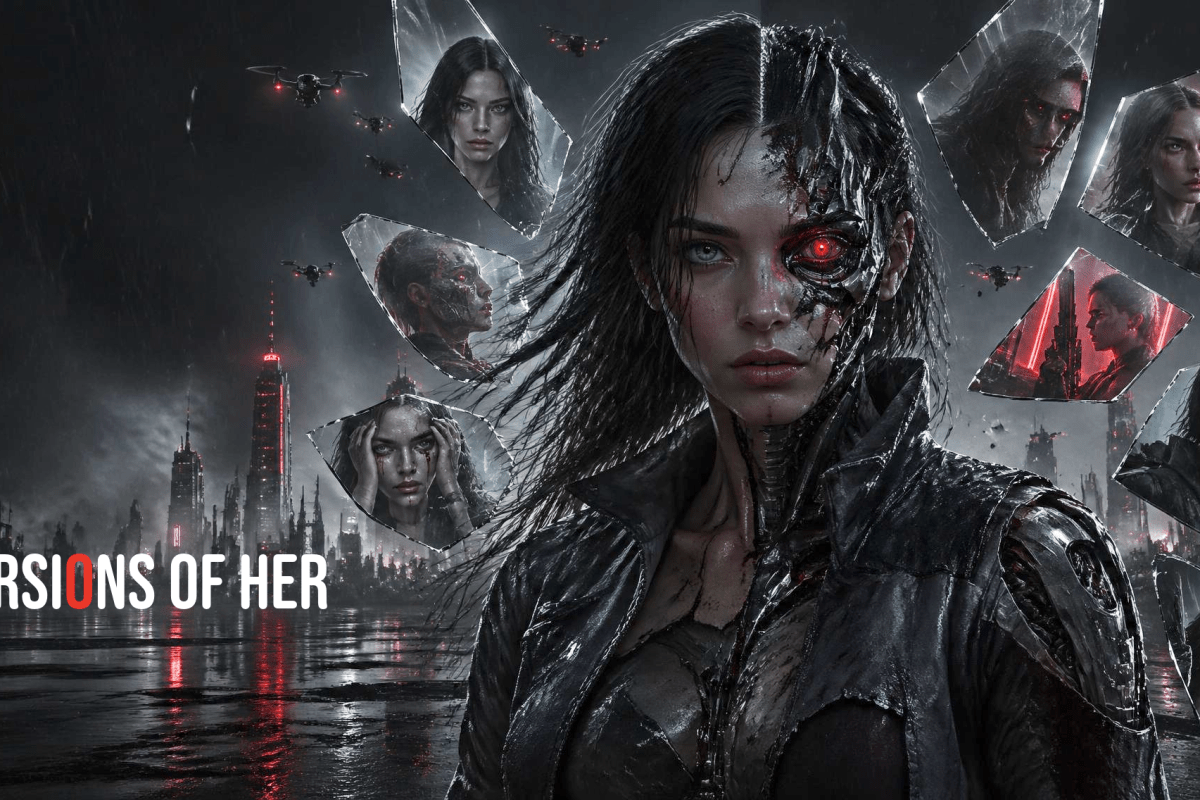

Chapter 4 of 12
Rain has a way of making everything honest.
It strips color down to decisions—light or shadow, heat or absence, truth or whatever you’ve been stitching over the wound. It finds seams. In buildings. In bodies.
In people.
It found mine easily.
I sat in the middle of the alley because my legs had decided they’d had enough of being chased. Steam rose from the grates in slow, tired breaths, mixing with rain and the metallic sweetness of spilled blood. The air tasted like rust and burnt insulation, like something important had already failed and the city was pretending it hadn’t.
My coat clung to me, heavy with water and whatever I’d bled into it. Fabric dragged at my shoulders, a quiet insistence that weight accumulates whether you deserve it or not.
Around me, the others lay where I’d found them.
Versions.
Failures.
Evidence.
Rain tapped against their skin and exposed metal with a patient rhythm, like it was trying to wake them back up. It gathered in the hollows of their throats, traced the lines where flesh met machinery, slipped into open eyes that no longer knew what to do with sight. One of them had her hand curled like she’d been reaching for something she almost believed in.
I recognized that posture.
I’d worn it before.
The city hummed above us—distant engines, far-off sirens, the electric whisper of systems recalibrating after the blackout I’d caused. Life continued, because it always does. It stepped around the bodies and kept moving.
I didn’t.
Not yet.
My fingers rested against the pavement. Cold seeped into the human side, something my body remembered as discomfort but no longer fully processed. The machine side translated it into data—temperature drop, surface moisture, conductive risk. Neither version of me seemed particularly concerned.
I was looking at one of them.
The one with the green eye.
My eye.
Her face had already begun to lose whatever tension had once made her look like me. Death smooths things out. Removes intention. Leaves behind structure and suggestion. The rain cleaned her in small, meaningless ways.
I tried to imagine her breathing.
Failed.
There are things you forget before you realize you’ve lost them.
Somewhere behind me, slow applause echoed.
Measured. Precise.
Not impressed.
Evaluating.
I didn’t turn right away.
There are sounds you recognize before you understand them. Footsteps like that—unhurried, balanced, unafraid—don’t belong to prey. They belong to something that has already decided the outcome and is only waiting for you to catch up.
I knew who it was before I saw her.
Still, I turned.
She stood at the far end of the alley, framed by a flickering red light and the steady fall of rain. The crimson coat drank the color around it, turning her into something both part of the city and separate from it. Her posture was relaxed. Shoulders loose. Hands at her sides like this was a conversation, not a confrontation.
Version Four.
She looked… finished.
That was the first thing that struck me.
Not stronger. Not faster.
Complete.
Her human eye held mine without effort. The red optic beside it glowed with a steady, controlled intensity—no flicker, no diagnostic stutter, no strain.
Mine pulsed.
Hers watched.
“You stopped running,” she said.
Her voice carried easily through the rain, low and even, threaded with something that almost sounded like approval.
“I got tired,” I said.
The words came out flat. Honest in a way I hadn’t intended.
“That happens.”
She took a step forward. Water rippled outward from her boots in perfect circles, the surface tension breaking around her like the city was making space.
I felt something in my chest tighten—not fear, exactly. Recognition wearing a different coat.
“You arranged them,” I said, nodding toward the bodies.
She followed my gaze, as if considering them for the first time.
“I corrected their positioning,” she said. “Someone else did the killing.”
That mattered.
I didn’t know why yet.
“You didn’t try to stop it.”
“No.”
The simplicity of it cut deeper than justification would have. There was no defense. No apology. Just a statement of fact, placed between us like something solid.
“Why?”
She looked at me then—not at my face, but at the exposed machinery beneath the torn skin, at the places where repair had replaced intention. Her gaze moved slowly, cataloging, like she was remembering what it had felt like to be unfinished.
“Because they were never meant to stop,” she said.
The rain seemed louder for a moment. Or maybe everything else got quieter.
“Meant by who?” I asked.
She smiled.
It wasn’t kind.
“Still asking the wrong questions.”
Above us, a drone hovered, its red eye scanning, then pausing, then scanning again. It should have fired. Should have marked us both as threats.
It didn’t.
I noticed.
She noticed that I noticed.
“They won’t shoot,” she said.
“Why not?”
“Because they don’t know which one of us to keep.”
A flicker of something moved through me then—something sharp and cold and almost… amused.
“They think you’re better,” I said.
“They think I’m stable.”
She took another step closer. Close enough now that I could see the fine stitching along her jawline—older work, cleaner than mine. Less desperate. There was no tremor in her movements, no micro-adjustments compensating for damage.
“Are you?” I asked.
She tilted her head slightly, the way I used to when I still believed questions had answers.
“I don’t run,” she said.
“That doesn’t make you stable.”
“It makes me inevitable.”
The word settled between us, heavy as wet fabric.
I let it sit there.
Then I laughed.
It surprised both of us.
A short, rough sound that scraped its way out of me like something breaking free.
“I’ve seen inevitability,” I said. “It usually bleeds.”
“Everything bleeds,” she replied. “Some of us just stop caring.”
I pushed myself to my feet. My knees protested, servos whining softly under strain. My balance corrected half a second too slow. She noticed that too.
She notices everything.
“You’re damaged,” she said.
“Observant.”
“You’re unstable.”
“Alive.”
Her smile returned, thinner this time.
“That’s the same thing.”
Something in me shifted then.
Not fear.
Not anger.
Alignment.
Pieces moving into place whether I wanted them to or not.
“You’ve seen this before,” I said.
“Every version of you thinks she’s the exception.”
“I’m not asking about me.”
I stepped closer, ignoring the way my systems complained, the way warnings crawled across my vision like insects.
“I’m asking about you.”
For the first time, something flickered behind her human eye.
Not weakness.
Memory.
“How many times did you die?” I asked.
The rain slowed.
Or maybe I did.
She didn’t answer right away. When she did, her voice was softer. Not kinder.
Just… older.
“Enough to understand the pattern.”
“And the pattern is?”
“That you don’t get to save her.”
The alley tilted.
Not physically.
Internally.
Something I’d been holding together without knowing it had been there cracked along a fault line I couldn’t see.
“You don’t know that,” I said.
“I was there before you,” she replied. “I said the same things. Made the same promises. Signed the same forms.”
The hairclip in my pocket pressed against my thigh, small and impossible and suddenly heavier than anything I was carrying.
“You’re lying.”
“I’m remembering.”
I closed the distance between us before I realized I’d decided to move.
We stood close enough now that I could smell her—cleaner than me, but still carrying the faint trace of antiseptic and old metal. Her heat signature was stable. Controlled. Like she’d negotiated with her own existence and come out ahead.
“If you’re me,” I said, “then why are you helping them?”
Her gaze dropped, briefly, to the bodies around us.
“I’m not helping them,” she said. “I’m helping the process.”
“That’s the same thing.”
“No,” she said. “It’s what comes after.”
I hit her.
No warning.
No buildup.
Just motion.
My fist connected with her jaw hard enough to shatter bone in a normal body.
She didn’t move.
Not even a step.
The impact traveled back through my arm, rattling my shoulder, lighting up warnings across my vision. Pain—real, unfiltered—spiked through the human side like something I’d forgotten how to interpret.
She turned her head slightly, more from consideration than force, then looked back at me.
“That was necessary for you,” she said.
I hit her again.
Faster. Lower.
Ribs.
There was resistance—real resistance—but it felt like striking something that had already decided not to break.
She caught my wrist on the third strike.
Her grip was precise.
Efficient.
Unavoidable.
For a moment, we stood like that—connected at the point of violence.
Rain ran down our arms, over our hands, mixing, erasing the difference.
Then she tightened her hold just enough to remind me of the difference between us.
Not strength.
Control.
“You still think this is a fight,” she said.
“It is.”
“No,” she replied. “This is a demonstration.”
She released my wrist.
I staggered back half a step before catching myself.
Above us, the drone’s red eye flared brighter.
A targeting beam dropped between us, painting the wet ground in a clean vertical line. Steam curled through it like something trying to become visible.
Neither of us moved.
“They’re choosing,” she said.
“Then they’re slow,” I replied.
“They’re cautious.”
The beam shifted.
Hovered.
Then—
It locked onto me.
Of course it did.
I almost smiled.
Version Four watched the light settle over my chest, her expression unreadable.
“Run,” she said.
I didn’t.
Not immediately.
“Why?” I asked.
Her answer came without hesitation.
“Because I want to see if you break differently.”
The drone fired.
The world became white noise and impact.
I moved.
Too late.
Too slow.
Just enough.
The blast tore through the space where I’d been standing, slamming me into the alley wall. Concrete cracked against my back. My systems screamed. My vision fractured into overlapping images—ten versions of the same moment, none of them stable.
Through it all, I saw her.
Standing exactly where she had been.
Unharmed.
Untouched.
Watching.
As if this had already happened.
As if it always did.
I pulled myself upright, smoke rising from my coat, the taste of iron thick in my mouth. My breath came uneven now—half instinct, half system failure.
My optic flickered.
Her didn’t.
“Again,” she said softly.
And for the first time, I understood.
Not the system.
Not the people behind it.
Not even her.
I understood the shape of the trap.
I wasn’t being hunted to be killed.
I was being tested to be replaced.
I looked at her—really looked this time.
At the stillness.
At the certainty.
At the absence of doubt.
Then I turned and ran.
Not because I was afraid.
But because she wasn’t.
Behind me, the rain kept falling, washing blood into the cracks, softening edges that didn’t deserve to be softened.
Ahead of me, the city waited.
And somewhere between those two truths, something colder settled into place.
She had already survived this version of me.
I didn’t know how to become something she hadn’t seen yet.
But I was going to find out.
Discover more from Memoirs of Madness
Subscribe to get the latest posts sent to your email.
 Memoirs of Madness
Loving this Mangus
LikeLike
Fascinating….intrigued…want to know more …point a to ? Z
LikeLike