


DAILY PROMPT RESPONSE
When I was younger, I made two lists. One was famous people I would have a conversation with over a cup of coffee. The other list of historical people that I thought needed to be throat punched. Now, my wife wasn’t a fan of either list. In fact, every time she caught me making an entry, she gave me something to do. Sighs, the misplaced passion of youth. Where would we be without it?
As a track & field athlete, this photo meant a great deal to me.
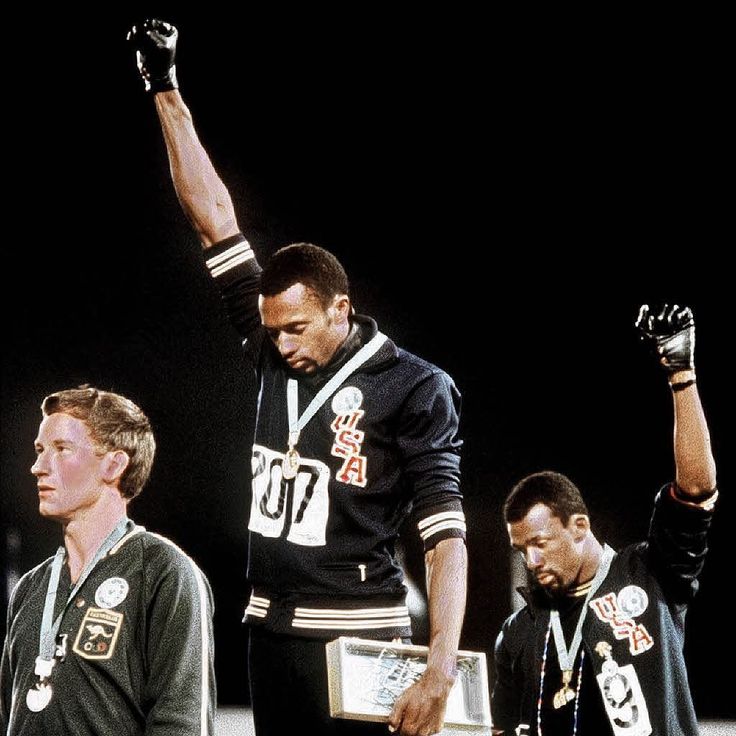
The establishment of my era still turned their noses up each time they saw this photo. This photo and others were considered taboo, or if I use the phrase I heard the most, they were “troublemakers.” Martin Luther King, Jesus, or “The Last Supper” in most of my friends’ homes. However, I spent most of my time reading about people who stood against injustice. This was the beginning of the coffee list.
Recently, I had the pleasure of rehashing the glory days with some old friends. The above came up. We all were athletes, and it was important to us. However, I didn’t care much for it, but I understood its significance in the movement. We discussed the civil rights movement at length that day, even though none of us were alive to participate during critical periods. We talked about what we were doing to fulfill MLK’s dream. We questioned whether how our sacrifices would benefit our children and grandchildren. As you can imagine, this was a very long conversation and was getting heavier by the second. So, I decided to lighten the mood.
I held up my phone with the above photo and asked, “Who’s the white guy?” None of us knew, but of course, we had the guy that sputters
“Oh man, I can’t remember his name…Damn!”
We have two of these individuals in our group, and they take turns uttering that phrase. Once, I wanted to see which one said it the most. After several months of observing, it was a tie, and I figured the game was rigged just to skew my data. Yes, I’m the guy who always gathers data.
Well, the gentleman’s name was Peter Norman. Here are a few facts about him.
Peter George Norman was an Australian track athlete born in Melbourne, Australia, on June 15, 1942. He grew up in a devout Salvation Army family and worked as an apprentice butcher before becoming a physical education teacher.
Norman’s athletic career began when he joined the Melbourne Harriers, and he won his first major title, the Victoria junior 200m championship, in 1960. He excelled in sprinting, becoming a five-time national 200-meter champion and representing Australia at the 1966 Commonwealth Games in Jamaica, where he won bronze medals in the 220-yard and 4×110-yard relay.
The defining moment of Norman’s career came at the 1968 Summer Olympics in Mexico City. In the 200-metre final, he stunned everyone by claiming the silver medal with a personal best time of 20.06 seconds, setting an Oceanic record that still stands today. However, the events that followed on the medal podium would forever change Norman’s life and cement his place in history.
As Norman stood on the podium alongside gold medalist Tommie Smith and bronze medalist John Carlos, the two American athletes raised their black-gloved fists in a Black Power salute while playing the U.S. national anthem. This powerful gesture was intended to highlight systemic segregation and racism in the United States. Though not raising his fist, Norman chose to stand in solidarity with Smith and Carlos by wearing an Olympic Project for Human Rights badge on his jacket.
Norman’s decision to support the protest was not without consequences. Upon returning to Australia, he faced unofficial sanctions and was ridiculed as the “forgotten man” of the Black Power salute. Despite qualifying for the 1972 Munich Olympics, Norman was not selected to represent Australia and never competed in the Olympics again.
Throughout his life, Norman remained committed to his beliefs in human rights and never regretted his actions on the podium. He continued to be involved in athletics administration and Olympic fundraising and even worked on organizing the 2000 Sydney Olympics.
Norman passed away on October 3, 2006, at the age of 64, due to a heart attack. In a poignant tribute, Smith and Carlos served as pallbearers at his funeral.
In the years following his death, Norman’s role in the historic protest has gained increased recognition. In 2012, the Australian Parliament formally apologized for the treatment he received after the 1968 Olympics. In 2019, a statue of Norman was unveiled in Albert Park, Melbourne, honoring his athletic achievements and his stand for human rights.
Peter Norman’s legacy extends far beyond his athletic accomplishments. His courageous decision to stand in solidarity with Smith and Carlos during a pivotal moment in the civil rights movement demonstrates the power of allyship and the importance of standing up for one’s beliefs, even in the face of adversity. Norman’s story serves as a reminder that sometimes, the most significant acts of bravery occur not in the spotlight but in quiet moments of support and solidarity.
After reading articles about Mr. Norman, I wondered how I missed him. Better yet, why was his namen’t mentioned like everyone else’s? At any rate, Peter Norman makes The Coffee List.
Discover more from Memoirs of Madness
Subscribe to get the latest posts sent to your email.
 Memoirs of Madness
Well put.
LikeLiked by 1 person
thank you
LikeLike