The Price of Knowing


Episode Four — The Price of Knowing

Chicago, Illinois — October 1956

The first thing Roberta Packard noticed was that the man standing outside Apartment 3B had Edmund Reece’s voice.

The second was that he didn’t have Edmund Reece’s patience.

“Bobbie, open the goddamn door.”

She stood against the wall, her Colt Detective Special held low against her thigh. Beyond the frosted glass, a man’s shadow shifted beneath the weak hallway light.

“Edmund?”

“Who the hell else would it be?”

“That’s an interesting question.”

“Bobbie, I’m not in the mood.”

“Neither am I. I’ve spent the better part of my evening climbing stairs, talking to people who don’t want to talk, and discovering that my employer has been paying rent on an apartment belonging to a dead woman. So you’ll forgive me if I’m not particularly accommodating.”

A pause.

Then the man sighed.

“Christ Almighty.”

Bobbie frowned.

Edmund rarely invoked the Almighty unless he’d lost money at the track or discovered she’d thrown away one of his favorite cigars.

“What’s the name of the woman who cleans our office?”

“What?”

“The cleaning woman. What’s her name?”

“Mrs. Jackson.”

“Wrong.”

“Bobbie—”

“What’s her name?”

Silence.

Then the man laughed.

“You’re a clever little thing, aren’t you?”

Bobbie raised the revolver.

“Not nearly as clever as I’m about to become if you don’t step away from that door.”

The doorknob turned.

She fired.

The shot struck the wooden frame inches above the lock, showering the hallway with splinters.

A man cursed.

Footsteps thundered toward the staircase.

Bobbie waited three seconds before pulling the door open.

The hallway was empty.

She heard someone stumbling down the stairs, followed by the heavy slam of the building’s front entrance.

By the time she reached the third-floor landing, the Buick’s engine was already roaring to life.

She watched its headlights sweep across the wet pavement before disappearing into the night.

“Well,” she muttered, “that answers one question.”

Unfortunately, it left her with about a dozen more.


Edmund Reece was sitting behind his desk when Bobbie returned to the agency shortly after two in the morning.

His injured arm rested in a sling, his tie hung loose around his neck, and a half-empty bottle of bourbon stood beside an untouched cup of coffee.

He looked like hell.

Bobbie considered telling him so.

Instead, she removed her coat, hung it beside the door, and crossed to her desk.

“You’re late,” Edmund said.

She stopped.

Slowly, she turned toward him.

“Excuse me?”

“I said you’re late.”

Bobbie regarded him for several seconds.

Then she smiled.

It was the sort of smile that had caused grown men to reconsider their decisions.

“Edmund, I want you to think very carefully about the next words that come out of your mouth.”

He looked up.

“What’s that supposed to mean?”

“It means I’ve had a particularly unpleasant evening, and I’m trying very hard not to make yours worse.”

He leaned back.

“Where’ve you been?”

“Out.”

“Out where?”

“Chicago.”

“Bobbie.”

“Edmund.”

They stared at one another.

Finally, Reece sighed.

“You planning on telling me anything?”

“Funny. I was about to ask you the same question.”

She opened her handbag and removed a folded piece of paper.

The rent receipt.

She placed it on his desk.

Edmund glanced at it.

His expression changed.

Not dramatically. Edmund Reece had spent too many years interrogating suspects to surrender his emotions without a fight.

But Bobbie knew him.

She recognized the slight tightening around his eyes, the way his jaw shifted, and the almost imperceptible movement of his hand toward the bourbon.

“Where’d you get this?”

“South Park Apartments.”

He closed his eyes.

“Goddammit, Bobbie.”

“That seems to be everybody’s favorite expression lately.”

“I told you to stay away from that place.”

“And I told you I don’t take orders particularly well.”

“There’s a reason I wanted you to stay away.”

“Then perhaps you should’ve explained it.”

He reached for the receipt.

Bobbie placed her hand over it.

“No.”

He looked up.

“We’re going to have ourselves a conversation, Edmund. And for once, you’re going to do most of the talking.”


For several minutes, neither spoke.

Outside, rain whispered against the windows. Somewhere in the building, a telephone rang twice before falling silent.

Edmund finally reached for his bourbon.

Bobbie took the bottle away.

“Not tonight.”

“Since when did you become my mother?”

“Your mother would’ve slapped you by now.”

He almost smiled.

Almost.

Then he looked at the receipt again.

“Josephine Carter died in November 1953.”

“I know.”

“She was forty-two.”

“I know that too.”

“She was a good woman.”

Bobbie waited.

Edmund rubbed his forehead.

“I met Josephine in 1948. She worked for a law firm downtown. Smart woman. Smarter than most of the attorneys she worked for.”

“That sounds familiar.”

“She had a sister. Evelyn.”

Bobbie leaned forward.

“Evelyn Doyle?”

“Eventually. Back then, she was Evelyn Carter.”

“And Mickey Doyle?”

“Married her in 1950.”

Bobbie considered this.

“So the woman who came to our office was Evelyn Doyle.”

Edmund nodded.

“Then why did you call her Josephine?”

He looked away.

“Because that’s what she wanted.”

“That’s not an answer.”

“It’s the only one I’ve got.”

Bobbie folded her arms.

“Try again.”

Edmund sighed.

“After Josephine died, Evelyn started using her name. At first, I thought it was grief. The sisters were close. Then I realized she was using Josephine’s identity to get information.”

“What information?”

“Things connected to the warehouse fire.”

“Such as?”

He hesitated.

“Names. Dates. People who were there.”

“And you helped her?”

“Sometimes.”

“Why?”

Edmund looked toward the window.

“Because she knew something about Sarah.”

Bobbie felt the conversation shift.

There it was.

The name that had haunted the office since the previous evening.

Sarah Reece.

The daughter Edmund had never mentioned.

“Tell me about her,” Bobbie said.

He remained silent.

“Edmund.”

He looked at her.

“She was nineteen.”

“Was?”

His jaw tightened.

“Is. She’d be twenty-two now.”

Bobbie said nothing.

“Sarah was studying nursing. Wanted to work at Provident Hospital. Smart girl. Stubborn as hell.”

“Sounds like somebody I know.”

He gave her a tired smile.

“She had her mother’s eyes.”

Bobbie watched him.

For the first time, Edmund Reece looked older than his fifty-three years.

“What happened?”

He took a breath.

“November fifth, 1953. Sarah called me from a telephone booth near the river. Said she needed help. Said she’d seen something she wasn’t supposed to see.”

“What?”

“She wouldn’t tell me over the telephone.”

“Did you go to her?”

“Of course.”

“And?”

He stared at his hands.

“By the time I got there, she was gone.”

Bobbie waited.

“Next morning, the warehouse burned.”

“And Josephine?”

“Found dead afterward. Smoke inhalation. They said she’d been inside.”

“Who identified her?”

“Evelyn.”

Bobbie leaned back.

“Just like Mickey Doyle.”

Edmund nodded.

For several seconds, the only sound was the rain.

Then Bobbie asked the question she’d been avoiding.

“Did you ever find Sarah?”

“No.”

“Not even a trace?”

“Nothing I could prove.”

She looked at the rent receipt.

“Then explain this.”


Edmund stared at the paper for a long time.

Finally, he spoke.

“About six months after the fire, I got a letter.”

“From who?”

“Didn’t say.”

“What did it say?”

“That Sarah was alive.”

Bobbie felt something tighten in her chest.

“And you believed it?”

“I wanted to.”

“That’s not the same thing.”

“I know.”

He rubbed his face.

“The letter told me to keep Josephine’s apartment rented. Sixty-five dollars a month. Cash. No questions.”

“And you did?”

“Every month.”

“For three years?”

He nodded.

Bobbie stared at him.

“Edmund, that’s more than two thousand dollars.”

“I can count.”

“Then you understand how ridiculous this sounds.”

His expression hardened.

“Careful, Bobbie.”

“No. You don’t get to do that.”

“Do what?”

“Hide behind your temper every time somebody asks a question you don’t like.”

He looked away.

She leaned forward.

“Did they ever give you proof?”

“Sometimes.”

“What kind?”

“Photographs. Notes. Places she’d supposedly been seen.”

“Did you verify any of it?”

“I tried.”

“That’s not what I asked.”

Edmund’s voice rose.

“Goddammit, Bobbie, she was my daughter!”

The words filled the office.

Bobbie sat motionless.

Edmund looked at her, breathing heavily.

Then the anger drained from his face.

He lowered his head.

“I’m sorry.”

She waited.

“I know how it sounds.”

“No,” Bobbie said quietly. “I don’t think you do.”

He looked up.

“Edmund, you’ve spent twenty-five years telling people not to let their feelings interfere with the facts. You’ve taught me to question everything, trust nothing without evidence, and never let somebody else decide what I’m supposed to believe.”

“I know.”

“And you’ve spent three years doing exactly the opposite.”

He said nothing.

Bobbie softened her voice.

“I understand why you wanted to believe Sarah was alive. I do. But somebody knew that, Edmund. Somebody knew exactly how to use it.”

He stared at the receipt.

“Yeah.”

“Who?”

“I don’t know.”

“Then we’re going to find out.”

He looked at her.

“We?”

Bobbie leaned back.

“Don’t get sentimental. I’m still mad at you.”

For the first time that evening, Edmund smiled.

It didn’t last.


Bobbie retrieved the letter she’d discovered in Apartment 3B and placed it beside the rent receipt.

Edmund read it slowly.

His face changed.

“Where’d you find this?”

“Under a dresser.”

“Josephine’s apartment?”

“Unless you’ve got another dead woman renting property somewhere.”

He ignored the remark.

When he finished reading, he placed the letter carefully on the desk.

“Sarah was alive when they took her.”

“That’s what it says.”

“Josephine knew.”

“Apparently.”

Edmund looked toward the window.

“Jesus.”

Bobbie watched him.

“Do you recognize the handwriting?”

He examined the letter again.

“Looks like Josephine’s.”

“You’re certain?”

“No.”

“Then we don’t know who wrote it.”

He looked at her.

“Bobbie—”

“Edmund, I am not going to spend the next three years chasing ghosts because somebody knows how to write a convincing letter.”

He sighed.

“You’re right.”

She raised an eyebrow.

“Would you mind repeating that?”

“Don’t push your luck.”

Bobbie smiled faintly.

Then she grew serious.

“There’s something else.”

Edmund looked up.

“Someone followed me to the apartment.”

“Who?”

“Don’t know. Big fellow. Drove a Buick.”

“Description?”

“Didn’t get a good look.”

“What happened?”

“He came upstairs. Tried to convince me he was you.”

Edmund frowned.

“What?”

“Had your voice. Your mannerisms. Even knew a few things about the agency.”

“Did you see his face?”

“No.”

“Then how do you know it wasn’t me?”

Bobbie stared at him.

“Because I shot at him.”

Edmund sat upright.

“You what?”

“Relax. I missed.”

“Bobbie!”

“On purpose.”

He looked horrified.

She shrugged.

“Mostly.”

Edmund rubbed his forehead.

“Lord, give me strength.”

“While you’re asking, see if He can spare some patience. We’re running low.”


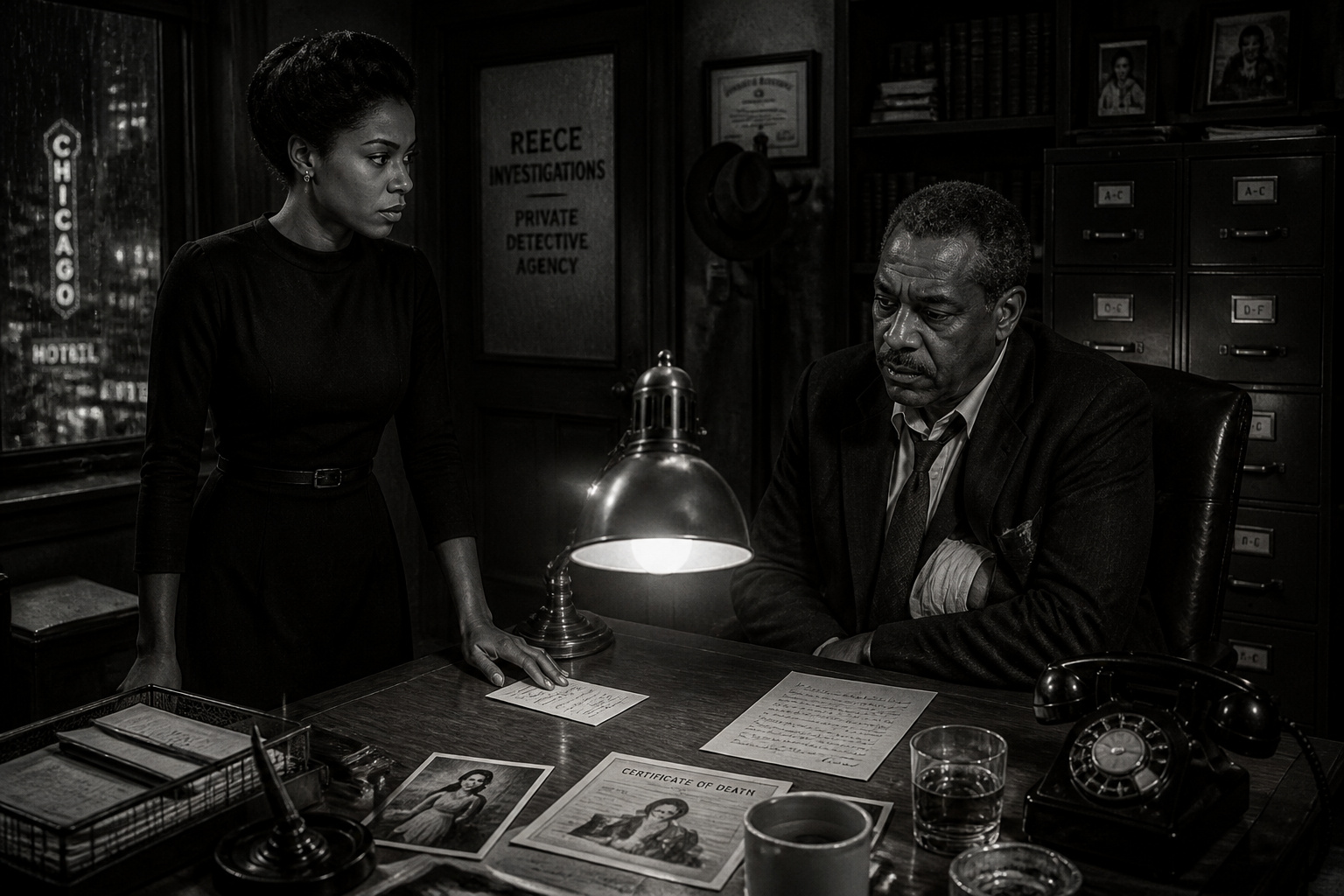
It was nearly four when they finished reviewing the evidence.

The photographs lay scattered across the desk, alongside the death certificate, rent receipt, and handwritten letter.

Bobbie had arranged them chronologically.

November 3, 1953.

Five men outside a warehouse.

November 5.

Sarah Reece disappeared.

November 6.

The warehouse burned.

Josephine Carter was declared dead.

Mickey Doyle was supposedly killed in the same fire.

Three years later, a man identified as Mickey Doyle turned up dead in an empty bathtub.

And someone was still using Josephine Carter’s name.

Bobbie studied the sequence.

“Something’s wrong.”

Edmund looked up.

“Besides everything?”

“The dates.”

“What about them?”

“Sarah disappeared on the fifth. The warehouse burned on the sixth. Josephine supposedly died in the fire.”

“That’s right.”

“But you said Josephine was already dead when Evelyn identified the body.”

“She was.”

“How do you know?”

Edmund hesitated.

Bobbie looked at him.

“Did you see her?”

“No.”

“Did you attend the funeral?”

“No.”

“Did you ever see a body?”

He shook his head.

Bobbie leaned back.

“Then how do you know Josephine Carter died?”

“Because the police said she did.”

“And who told the police?”

Edmund stared at her.

Bobbie tapped the death certificate.

“Evelyn Doyle.”

The silence stretched between them.

Finally, Edmund spoke.

“You think Josephine’s alive.”

“I think we have a death certificate, a woman using her sister’s name, and a man who supposedly died twice.”

She gathered the photographs.

“At this point, Edmund, I’m not particularly impressed with anybody’s ability to stay dead.”

He gave a short laugh.

Then Bobbie noticed something.

The photograph of the five men.

She held it beneath the desk lamp.

“Edmund.”

“What?”

“Who took this picture?”

He frowned.

“Don’t know.”

“Think.”

He studied it.

“Could’ve been anybody.”

“Five men standing outside a warehouse. All looking directly at the camera. Somebody wanted that picture taken.”

“Probably.”

“Then why?”

Edmund leaned forward.

Bobbie turned the photograph over.

There, near the bottom edge, was a faint impression in the paper.

Not handwriting.

A stamp.

She angled it toward the light.

A small key.

Crossed by a feather.

Edmund went still.

Bobbie looked at him.

“You recognize that?”

He said nothing.

“Edmund?”

His face had lost its color.

“Where’d you see that before?”

He swallowed.

“Bobbie, put that photograph away.”

She stared at him.

“Why?”

“Because some things are better left buried.”

Bobbie looked down at the insignia.

Then back at Edmund.

For three years, she had trusted the man sitting across from her.

She still trusted his instincts.

She still respected his experience.

But she was beginning to understand that Edmund Reece had spent so long protecting the past that he no longer recognized the danger it presented.

She placed the photograph carefully on the desk.

“No, Edmund.”

He looked at her.

“Not this time.”

Outside, Chicago was beginning to stir.

The first streetcars rattled through the darkness. Delivery trucks rolled along wet pavement, and somewhere in the distance, a factory whistle announced the beginning of another working day.

Bobbie stood, collected her coat, and reached for her handbag.

“Where are you going?” Edmund asked.

“Home.”

“Good. Get some sleep.”

She paused at the door.

“Edmund?”

“Yeah?”

“Tomorrow, we’re going to talk about that little bird.”

He looked at the photograph.

Then he looked at her.

“Bobbie—”

She opened the door.

“And this time,” she said, “I expect the truth.”

She stepped into the hallway before he could answer.

Behind her, Edmund Reece remained seated beneath the yellow glow of the desk lamp, staring at a photograph taken three years earlier.

Five men.

A warehouse.

And a symbol that should have disappeared nearly twenty years ago.

For the first time in a long while, he wished he had never become a detective.

To be continued.
The Address on the Death Certificate


Episode Three:

EDMUND REECE INVESTIGATIONS

Chicago, Illinois — October 1956

Roberta Packard had always maintained that the dead were considerably more reliable than the living. They rarely changed their stories, never complained about the weather, and, provided the undertaker had done his job properly, generally stayed where someone put them. Unfortunately, Josephine Carter appeared determined to make a liar out of her.

The death certificate had cost Bobbie three dollars, two cigarettes, and a promise to have dinner with a clerk at the Cook County records office who had been trying to get her attention since the previous Christmas. She considered the three dollars a reasonable expense, the cigarettes a regrettable necessity, and the dinner an obligation she intended to forget at the earliest opportunity.

According to the document, Josephine Marie Carter had died on November 6, 1953, at the age of forty-two. The cause of death was listed as acute respiratory failure resulting from smoke inhalation. Her body had been identified by a relative, and burial arrangements had been handled by a funeral establishment on the South Side. There was nothing particularly unusual about the paperwork, except that Bobbie had spent the previous evening speaking to a woman who claimed to be Josephine Carter, and that woman had demonstrated an alarming familiarity with Edmund Reece’s past.

Then there was the address.

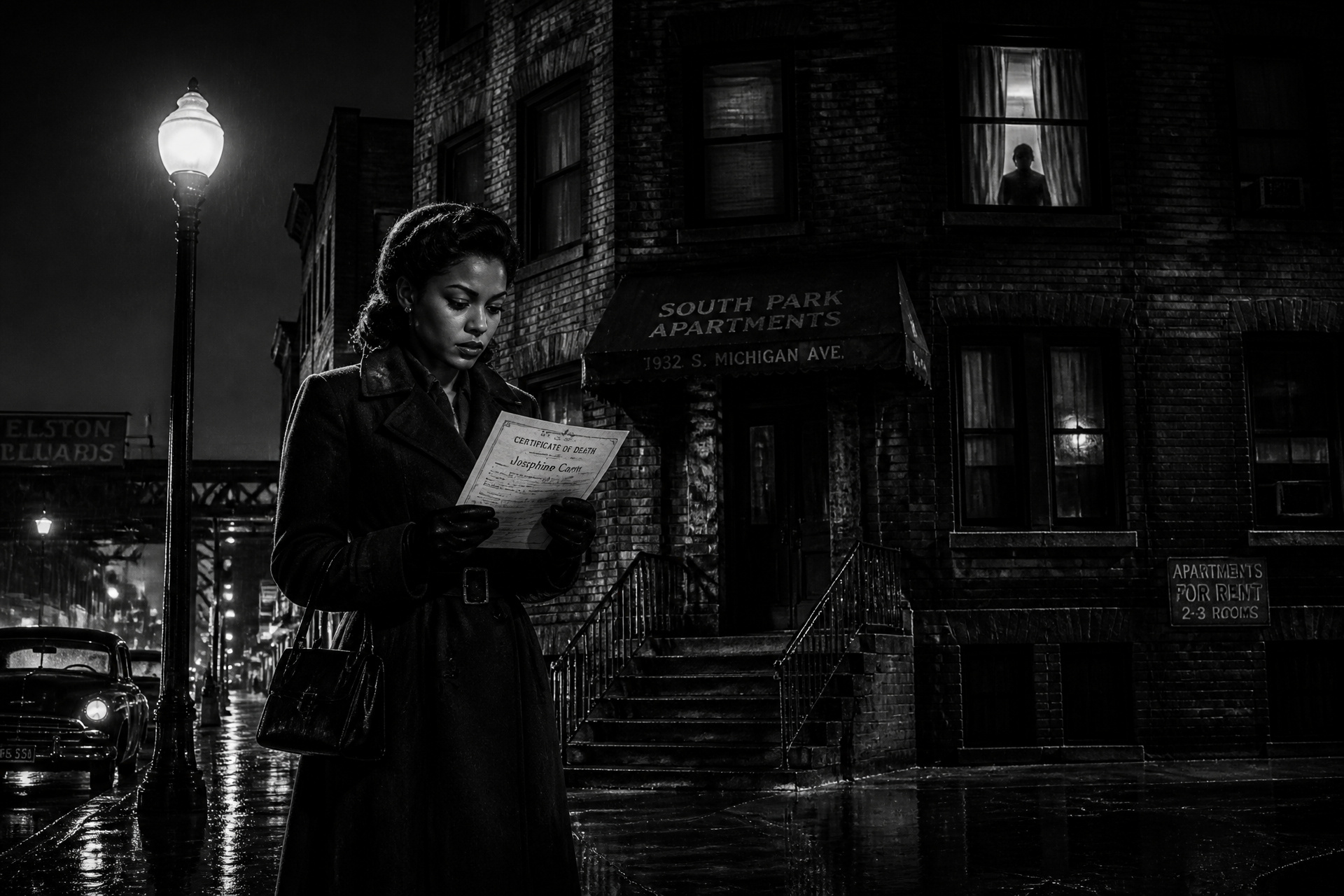
1932 South Michigan Avenue.

South Park Apartments.

Bobbie stood beneath a streetlamp across from the building, holding the certificate between her gloved fingers while the October rain settled into the kind of miserable drizzle that seemed to penetrate wool, leather, and human determination with equal enthusiasm. Her dark overcoat had begun to absorb the dampness, and the leather handbag hanging from her shoulder was becoming heavier by the minute.

She folded the document and slipped it into her coat pocket.

“Well, Josephine,” she murmured, looking toward the building, “let’s see how dead you really are.”

The South Park Apartments occupied three stories of aging brickwork on a stretch of Michigan Avenue that had once entertained ambitions of respectability. The stone steps were chipped, the iron railings rusted, and a faded awning hung above the entrance like a tired old man refusing to remove his hat. A sign beside the doorway advertised two- and three-room apartments, although Bobbie suspected the landlord’s definition of a room was considerably more generous than most people’s.

A black Chevrolet sat along the curb, its windows fogged from the rain. Farther down the street, the elevated railway rattled through the darkness, briefly drowning out the sounds of traffic before disappearing toward the Loop.

Bobbie glanced at the third floor.

A light burned behind a pair of thin curtains.

Someone stood at the window.

She couldn’t distinguish the person’s features, but the silhouette remained motionless long enough to suggest that whoever occupied the apartment had been watching her for some time.

Bobbie lowered her eyes to the death certificate again, pretending to examine it while studying the building through her peripheral vision.

When she looked up, the figure was gone.

“Now, ain’t that interesting.”

She crossed the street.


The building’s front door opened into a narrow vestibule smelling of boiled cabbage, furniture polish, and the lingering consequences of several generations of inadequate ventilation. A row of dented brass mailboxes lined one wall, their labels displaying an assortment of handwritten names, faded numbers, and the occasional empty space where a tenant had apparently departed without leaving forwarding instructions.

Bobbie examined them.

Apartment 3B bore the name CARTER.

The label was newer than the others.

She ran one gloved finger across its surface, noting the clean edges and the absence of discoloration beneath the plastic cover.

Someone had replaced it recently.

A door opened behind her.

“You looking for somebody?”

Bobbie turned.

A heavyset woman in a faded housecoat stood at the entrance to the ground-floor hallway. She was perhaps sixty, with graying hair pulled into a tight bun and the suspicious expression of someone who had spent a lifetime discovering that strangers generally wanted something.

“Good evening,” Bobbie said. “I’m looking for the building manager.”

“You’re looking at her.”

“Mrs.—?”

“Washington. Lillian Washington.”

“Roberta Packard.”

The woman looked her over.

“That supposed to mean something?”

“Not unless you’ve heard of me.”

“Can’t say I have.”

“Then we’re starting fresh.”

Mrs. Washington folded her arms.

“What do you want?”

Bobbie removed a business card from her handbag.

“Edmund Reece Investigations. I’m conducting an inquiry concerning a former tenant.”

Mrs. Washington accepted the card, studying it beneath the weak hallway light.

“Private detective?”

“Something like that.”

“What’s that supposed to mean?”

“It means I’m the person who does most of the investigating while Mr. Reece gets his name printed on the stationery.”

The older woman regarded her for a moment.

Then she laughed.

It was a deep, unexpected sound that seemed to emerge from somewhere beneath her considerable bosom.

“Well, honey, at least you know how the world works.”

“Some days better than others.”

Mrs. Washington handed back the card.

“Who you looking for?”

“Josephine Carter.”

The laughter stopped.

Bobbie noticed the change immediately.

Mrs. Washington’s expression hardened, and her eyes moved toward the staircase.

“Don’t know nobody by that name.”

“That’s unfortunate.”

“Why?”

“Because her name is on your mailbox.”

The older woman said nothing.

Bobbie waited.

One of the first things Edmund had taught her was that silence made people uncomfortable. Most people would eventually fill it with something, and whatever they offered was frequently more useful than the answer to the original question.

Mrs. Washington proved no exception.

“That apartment ain’t rented.”

“Then why does it have a name?”

“Old tenant.”

“How old?”

“Long time.”

“Three years?”

The woman looked sharply at her.

Bobbie smiled.

“Mrs. Washington, I’m not here to cause trouble. I’m trying to establish whether a woman who supposedly died three years ago might still be receiving visitors.”

“Dead people don’t receive visitors.”

“That’s generally been my experience.”

“Then what’s your business here?”

Bobbie reached into her coat pocket and withdrew the death certificate.

“This woman died in November 1953. Her last known address was this building. Yet her name is still on the mailbox, and there’s a light burning in her apartment.”

Mrs. Washington examined the document without taking it.

“People leave lights on.”

“In vacant apartments?”

“Sometimes.”

“With the curtains closed?”

“Especially then.”

Bobbie considered the answer.

Mrs. Washington was either an accomplished liar or a woman who had spent enough years managing rental property to develop an explanation for absolutely everything.

“Who pays the rent?”

The older woman stiffened.

“That’s private business.”

“Of course.”

“Landlord don’t discuss tenants with strangers.”

“Even dead ones?”

“Especially dead ones.”

Bobbie slipped the certificate back into her pocket.

“Well, I suppose I’ll have to speak with the landlord.”

“You already are.”

That stopped her.

Mrs. Washington smiled, revealing a small gold tooth.

“Building belongs to me and my brother. Been in the family since 1931.”

Bobbie studied her.

“Then perhaps you’d be willing to tell me why you’re collecting rent on an apartment nobody occupies.”

Mrs. Washington’s smile faded.

“Who said I was collecting rent?”

“You did.”

“I most certainly did not.”

“You said the apartment wasn’t rented. You didn’t say nobody was paying for it.”

The older woman stared at her for several seconds.

Then she sighed.

“Lord have mercy. You one of them.”

“One of what?”

“Women who listen too damn carefully.”

Bobbie smiled.

“My mother used to say the same thing.”


Mrs. Washington’s apartment was warmer than the hallway and smelled pleasantly of coffee, cinnamon, and something baking in the oven. A framed photograph of a young soldier occupied the mantelpiece, and a large wooden radio stood beside an armchair covered with crocheted blankets.

Bobbie accepted a cup of coffee, declining the offer of sugar.

“Josephine Carter lived here before the war,” Mrs. Washington began. “Moved into 3B in 1941. Quiet woman. Worked nights sometimes. Never caused trouble.”

“What kind of work?”

“Don’t know exactly. Office work, I suppose. She dressed nice. Always had money for the rent.”

“Visitors?”

“Some.”

“Men?”

“Mostly.”

Bobbie waited.

Mrs. Washington stirred her coffee.

“Wasn’t that kind of arrangement, if that’s what you’re thinking. They came carrying briefcases, wearing expensive suits. Sometimes they stayed an hour. Sometimes five minutes. Never heard any arguing.”

“Did you recognize any of them?”

“One or two.”

“Names?”

The older woman shook her head.

“Didn’t ask.”

“Mrs. Washington, you strike me as a woman who knows precisely what happens in her building.”

“Knowing and discussing are two different things, Miss Packard.”

Bobbie couldn’t argue with that.

“When did Josephine leave?”

“November of ’53.”

“Before or after the warehouse fire?”

Mrs. Washington’s spoon stopped moving.

Bobbie watched her.

“You know about the fire.”

“Everybody knew about that fire.”

“Did you know Josephine was supposed to have died in it?”

The older woman looked toward the window.

“That’s what they said.”

“Did you believe them?”

Mrs. Washington remained silent.

Bobbie leaned forward.

“Did you ever see her body?”

“No.”

“Attend the funeral?”

“No.”

“Did anyone come for her belongings?”

“Yes.”

“Who?”

“A man.”

“Can you describe him?”

Mrs. Washington hesitated.

“Big fellow. Colored. Wore a dark suit. Had a mustache.”

Bobbie felt her stomach tighten.

“How old?”

“Forty, maybe forty-five. Hard to say.”

“Did he give you a name?”

The older woman nodded.

“Reece.”

For a moment, Bobbie heard nothing except the ticking of the clock above the mantel.

“Edmund Reece?”

“That’s him.”

Bobbie placed her coffee cup on the table.

“What did he take?”

“Two suitcases. Some papers. A little wooden box.”

“Anything else?”

Mrs. Washington looked uncomfortable.

“He asked me not to rent the apartment.”

“For how long?”

“Didn’t say.”

“And you’ve kept it vacant for three years?”

“Not exactly.”

Bobbie leaned forward.

“What does that mean?”

The older woman stared into her coffee.

“Somebody comes by every month.”

“Who?”

“Different people.”

“To pay the rent?”

“Yes.”

“In cash?”

“Always.”

“Do they go upstairs?”

“Sometimes.”

Bobbie considered this.

“Have you ever been inside since Josephine disappeared?”

“Once.”

“When?”

“Last winter. Pipe froze. Had to send my brother up.”

“What did he find?”

Mrs. Washington’s face changed.

For the first time, Bobbie saw genuine fear.

“He said somebody had been living there.”

“Who?”

“Didn’t see nobody.”

“What made him think someone was living there?”

“Fresh food in the icebox. Clothes in the closet. Bed made up.”

Bobbie looked toward the ceiling.

“And you never reported it?”

“Report what? Somebody paying rent and keeping an apartment clean?”

“Mrs. Washington—”

“Listen here, young lady. I own this building. My brother and me worked twenty-five years to keep it. I don’t need police coming around asking questions about people who pay their bills and don’t bother nobody.”

Bobbie understood.

A Black woman owning property in Chicago had enough difficulties without inviting the attention of the police.

She wasn’t going to condemn Mrs. Washington for protecting what she’d built.

“Fair enough,” Bobbie said.

The older woman relaxed slightly.

“Can I see the apartment?”

“No.”

“Mrs. Washington—”

“No.”

Bobbie sighed.

“Then perhaps you can answer one more question.”

“What?”

“Who paid the rent this month?”

Mrs. Washington looked at her.

For several seconds, she appeared to be deciding whether the truth was worth the trouble it might bring.

Finally, she rose from her chair and crossed to a small writing desk.

She opened a drawer, removed a receipt book, and flipped through several pages.

Then she placed it before Bobbie.

October 1, 1956.

Apartment 3B.

Rent received: $65.00.

Paid by: E. Reece.

Bobbie stared at the handwriting.

The signature was unmistakable.

She had seen it on hundreds of checks, contracts, and letters.

Edmund Reece.

Her employer.

Her mentor.

The man who had spent the previous evening pretending he knew nothing about Josephine Carter’s whereabouts.

Bobbie slowly closed the receipt book.

“Well,” she said quietly, “isn’t that something.”


Mrs. Washington eventually agreed to let her inspect the apartment, although she insisted on remaining downstairs.

Bobbie climbed the narrow staircase alone.

The third-floor hallway was dimly illuminated by a single overhead bulb. The wallpaper had begun peeling near the ceiling, and the floorboards complained beneath her shoes.

Apartment 3B stood at the far end.

She knocked.

No answer.

She waited.

Then knocked again.

Still nothing.

Bobbie removed the key Mrs. Washington had reluctantly surrendered and slipped it into the lock.

It turned easily.

Too easily.

She pushed the door inward.

The apartment smelled faintly of cigarette smoke and lavender.

A small table stood beside the window, its polished surface holding an ashtray, a porcelain cup, and a folded newspaper.

The furniture was old but clean.

The curtains were drawn.

Bobbie crossed the room, careful not to disturb anything.

The newspaper was dated October 10.

Yesterday.

She touched the cup.

Cold.

Then examined the ashtray.

Two cigarette butts rested inside.

One had been crushed against the glass with considerable force.

The other had burned almost completely down.

Someone had been waiting.

And someone else had been nervous.

Bobbie moved toward the bedroom.

The bed was neatly made, a dark wool coat hung inside the closet, and a pair of women’s shoes stood beneath a chair.

On the dresser sat a framed photograph.

Bobbie picked it up.

A young woman stood beside a man wearing a dark suit.

The woman was unmistakably Josephine Carter.

The man was Edmund Reece.

They stood close together, his hand resting lightly against her waist.

Bobbie studied the photograph.

Edmund looked younger, perhaps forty, and Josephine wore an expression Bobbie had never seen on the woman who visited the agency.

Happiness.

Genuine, unguarded happiness.

She turned the photograph over.

Written in blue ink were three words.

Before everything changed.

No date.

No signature.

Bobbie replaced it carefully.

Then she noticed the envelope beneath the dresser.

It had been pushed partially underneath, as though someone had dropped it while searching through the room.

She knelt and retrieved it.

Inside was a single sheet of paper.

A letter.

The handwriting was hurried, uneven, and unmistakably feminine.

Edmund,

I know what they told you about Sarah. I know what you believe happened that night. But they lied to you, and I helped them.

I have spent three years trying to decide whether telling you the truth would make things better or simply get us both killed.

I can’t keep doing this.

Sarah was alive when they took her from the warehouse.

And I know who ordered it.

There was no signature.

Bobbie read the letter twice.

Then a third time.

She folded it carefully and placed it inside her coat.

For three years, Edmund Reece had been paying the rent on an apartment belonging to a woman supposedly dead.

For three years, he had kept the arrangement secret.

And somewhere in the middle of it all was a daughter he claimed had disappeared.

Bobbie looked toward the window.

The curtains shifted slightly in the draft.

She crossed the room and pulled them aside.

From the third floor, she could see the streetlamp where she had stood earlier, the parked Chevrolet, and the wet pavement stretching toward the intersection.

Then she noticed something else.

The Chevrolet was gone.

In its place stood a dark Buick.

Its engine was running.

A man sat behind the wheel.

Even from three stories above, Bobbie recognized the broad shoulders and familiar profile.

Edmund Reece.

She stared.

He was supposed to be recovering from a gunshot wound.

He was supposed to be at home.

And he had specifically told her to stay away from Josephine Carter’s apartment.

Bobbie stepped back from the window.

“Well, I’ll be damned.”

The telephone rang.

She turned.

A black rotary telephone sat on a small table beside the sofa.

It rang again.

Bobbie approached slowly.

A third ring.

She lifted the receiver.

“Hello?”

A woman’s voice answered.

“Miss Packard?”

Bobbie recognized it immediately.

Josephine.

“Where are you?”

“That isn’t important.”

“It is to me.”

“Did you find the letter?”

Bobbie looked toward the window.

“Yes.”

“Then you know.”

“Know what?”

A pause.

“That Edmund has been lying to you.”

Bobbie glanced at the photograph on the dresser.

“That much I’ve figured out.”

“There’s something else.”

“Of course there is.”

“Don’t let him into the apartment.”

Bobbie frowned.

“Why?”

“Because the man sitting in that Buick isn’t Edmund Reece.”

The line went dead.

Bobbie remained motionless.

Outside, the Buick’s headlights went dark.

A car door opened.

Then closed.

Footsteps sounded on the pavement.

Bobbie slowly replaced the receiver.

She crossed the room and switched off the lamp.

The apartment fell into darkness.

For several seconds, she stood beside the window, watching the street below.

The man from the Buick entered the building.

A moment later, the front door slammed.

Bobbie heard footsteps on the staircase.

Slow.

Deliberate.

Coming upward.

She reached beneath her coat and withdrew her Colt Detective Special.

The footsteps reached the second-floor landing.

Then continued.

Bobbie moved beside the apartment door, keeping herself clear of the narrow strip of light beneath it.

She had come looking for answers.

Instead, she had discovered that a dead woman might still be alive, a missing girl might have survived, and the man who had taught her everything she knew about investigating crimes had been paying to preserve a secret for three years.

Now someone was climbing the stairs.

Someone who looked like Edmund Reece.

Someone who apparently wasn’t.

Bobbie checked the cylinder of her revolver.

Six rounds.

She closed it quietly.

The footsteps stopped outside Apartment 3B.

A shadow passed beneath the door.

Then came three soft knocks.

“Bobbie?”

The voice was Edmund’s.

She didn’t answer.

“Bobbie, I know you’re in there.”

She tightened her grip on the revolver.

The doorknob turned.

And for the first time since joining Edmund Reece Investigations, Roberta Packard found herself wondering whether the man on the other side of the door was someone she should trust.

Or someone she might have to kill.

To be continued.

The Dead Have Long Memories


Chapter Two

A Roberta “Bobbie” Packard Mystery
Chicago, Illinois — October 11, 1956

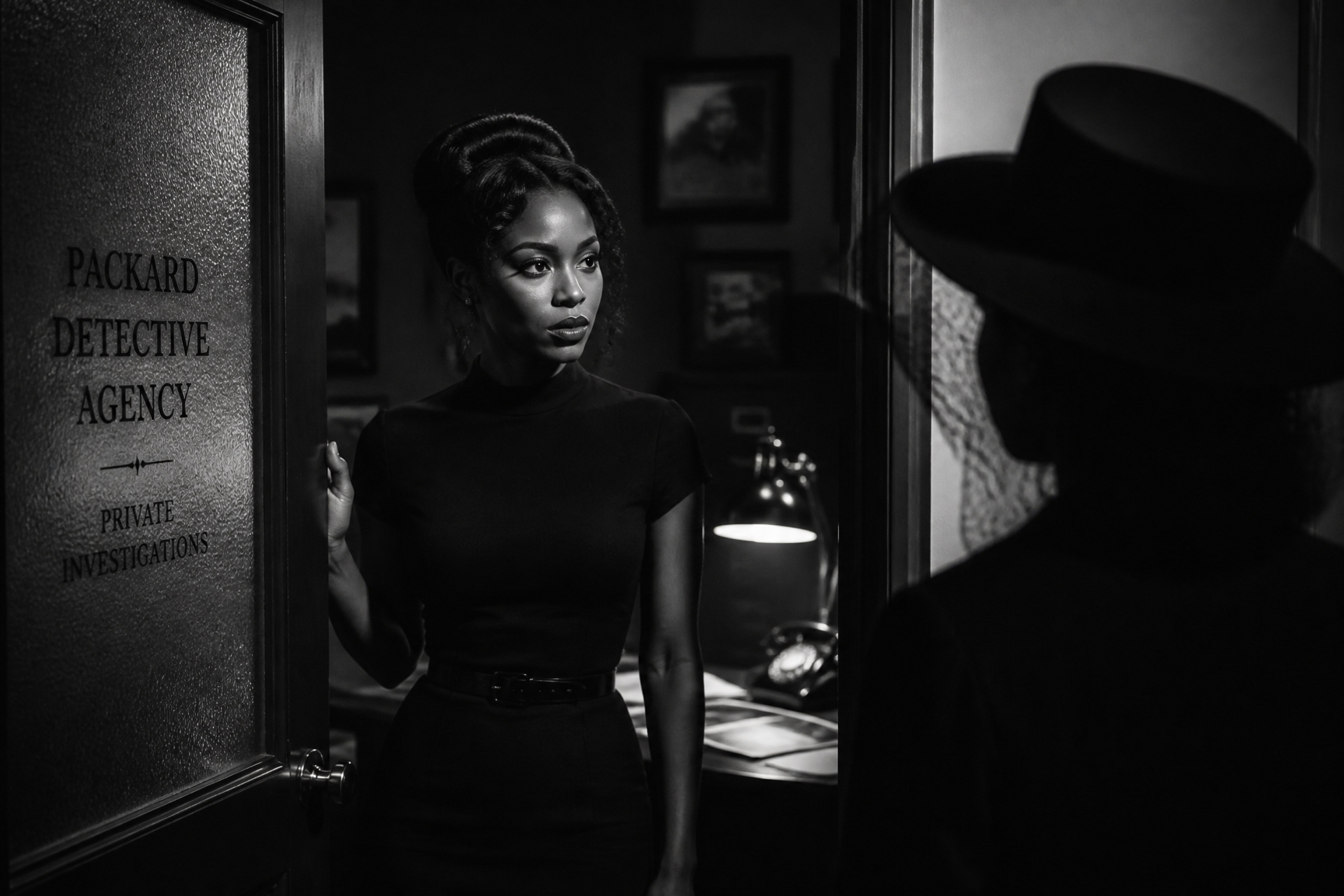
Roberta Packard had encountered enough unpleasant people in her twenty-nine years to recognize that the most dangerous ones rarely bothered raising their voices. They spoke softly, smiled when the occasion demanded it, and generally conducted themselves with the sort of impeccable manners that made their eventual arrest something of a disappointment to their neighbors. The woman standing on the other side of the frosted-glass door appeared to belong to that particular breed, although Bobbie had never before encountered one who announced her intention to commit murder quite so politely.

The hallway smelled of damp plaster, old tobacco, and the faint medicinal odor of the disinfectant Mr. Kowalski, the building superintendent, insisted on using every Thursday evening. Somewhere downstairs, a radiator knocked against its pipes with the persistence of a drunk demanding another drink, while the rain continued its steady assault against the windows overlooking South Wabash Avenue.

Bobbie kept her hand against the doorframe, studying the visitor through the narrow opening. The woman wore a broad-brimmed black hat with a veil that concealed most of her face, and beneath a tailored wool coat, the suggestion of an expensive dress was visible whenever she shifted her weight. Her gloves were black leather, her shoes immaculate despite the weather, and a small handbag hung from her left wrist.

It was the handbag that concerned Bobbie.

A woman who arrived after midnight threatening to kill someone generally carried more than lipstick and a powder compact.

“Mrs. Doyle,” Bobbie said, allowing her gaze to settle briefly on the woman’s gloved hands, “I believe we have ourselves a misunderstanding.”

“Do we?”

“Well, I certainly hope so, because I haven’t had my sandwich yet, and I’d hate to see a perfectly good roast beef go to waste on account of a homicide.”

The woman tilted her head.

“You’re Roberta Packard.”

“Depends who’s asking.”

“I know who you are.”

“Then we’ve already established something useful.”

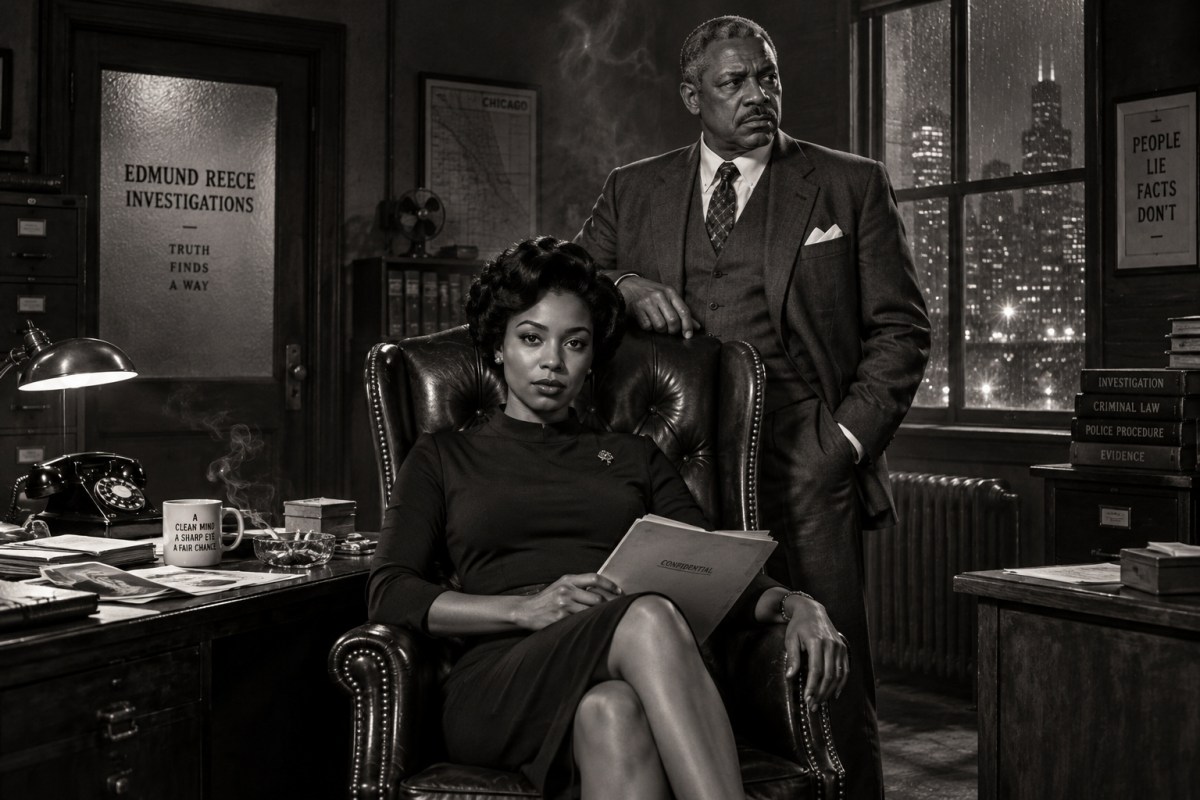
Behind her, Edmund Reece remained seated at his desk, the revolver resting against his thigh. Bobbie could see him in the reflection of the glass, his face pale beneath the yellow glow of the desk lamp. He had not moved since whispering the name Josephine, and that troubled her considerably more than the possibility of a pistol concealed in the visitor’s handbag.

Edmund Reece was not a man easily frightened. He had spent seventeen years with the Chicago Police Department before resigning under circumstances he described as a difference of professional opinion, although Bobbie suspected the difference had involved considerably more than opinion. He had worked homicide, vice, and occasionally the sort of assignments nobody wanted recorded in an official ledger. She had seen him confront armed men, crooked politicians, and a particularly disagreeable bookmaker who once threatened to remove his kneecaps with a carpenter’s hammer.

Through all of it, Reece had maintained the same expression of weary irritation.

Tonight, he looked as though someone had opened a grave and invited him to inspect the contents.

“Edmund,” Bobbie said without turning around, “would you care to explain why our guest seems to know you better than I do?”

Reece swallowed.

“Close the door, Bobbie.”

“That’s rather difficult when there’s a woman standing in it.”

“Close the goddamn door.”

The sharpness in his voice surprised her.

The visitor laughed softly.

“Still giving orders, Edmund? Some things never change.”

Bobbie looked from the woman to Reece.

“Well, isn’t this cozy.”

“Bobbie—”

“No, Edmund. You don’t get to start issuing instructions now. Not after somebody walks into my office threatening to kill you.”

“Your office?” the woman asked.

“Half the rent,” Bobbie replied. “It’s a complicated arrangement.”

For the first time, the visitor appeared genuinely amused.

Then she raised her right hand.

Bobbie tensed.

But instead of producing a weapon, the woman slowly lifted her veil.

She was older than Bobbie had expected, perhaps forty-five, with a handsome face that retained traces of considerable beauty. Fine lines framed her eyes, and there was a small scar near the corner of her mouth, the kind that might have resulted from an accident or an argument that had gone terribly wrong. Her complexion was warm brown, her lipstick dark, and her expression carried the exhaustion of someone who had spent too many years remembering something she desperately wanted to forget.

“Josephine Carter,” the woman said. “Although I suppose you know me as Evelyn Doyle.”

Bobbie studied her.

“Which name do you prefer?”

“Neither.”

“That’s unfortunate. I generally like to know what to call people before they start shooting.”

Josephine’s smile disappeared.

“I’m not here to shoot anyone, Miss Packard.”

“That’s encouraging.”

“Not tonight.”

“Less encouraging.”

Behind them, Reece exhaled.

“Let her in, Bobbie.”

She stepped aside, although she did not remove her hand from the door until Josephine had crossed the threshold. The woman entered without hesitation, surveying the cramped office with the detached interest of someone inspecting a property she had once owned.

Her eyes passed over the filing cabinets, the photographs scattered across the desk, and the battered leather chair where Reece conducted most of his interviews. When she noticed the hundred-dollar bill, she stopped.

“So you received my package.”

Bobbie closed the door.

“That depends. Are you responsible for the photographs or the hundred dollars?”

“Both.”

“Then yes, we received your package. Although I must say, your choice of delivery service leaves something to be desired.”

Josephine turned toward her.

“The boy was reliable.”

“He was twelve.”

“Thirteen.”

“That makes all the difference.”

Reece placed his revolver inside the desk drawer.

“Enough, Bobbie.”

She looked at him.

“Edmund, if you tell me to be quiet one more time, I’m going to start charging you for the privilege.”

Josephine laughed.

It was a genuine laugh this time, brief but unexpected, and something in her expression softened as she regarded Bobbie.

“I like her.”

“She’s an acquired taste,” Reece muttered.

“Funny,” Bobbie said. “That’s what your second wife told me.”

Reece gave her a murderous look.

Josephine’s amusement vanished as quickly as it had appeared.

“Edmund, we don’t have much time.”

“Then you’d better start talking.”

She removed her gloves, folding them carefully before placing them on the desk. Bobbie noticed a pale indentation around the fourth finger of her left hand, where a wedding ring had recently been removed.

“My husband is dead.”

“So we’ve heard,” Reece said.

“No, Edmund. You haven’t.”

Josephine looked toward the photographs.

“The man they found at the Wexler wasn’t Michael Doyle.”

Bobbie moved closer to the desk.

“Then who was he?”

Josephine hesitated.

“His name was Thomas Bell.”

Reece closed his eyes.

Bobbie noticed.

There it was again, that peculiar reaction whenever the conversation wandered too close to something buried in his past.

“Thomas Bell,” she repeated. “Should that name mean something to me?”

“No,” Reece answered.

Josephine looked at him.

“It should mean something to you.”

“Josephine.”

“Don’t.”

The single word carried enough bitterness to silence him.

Bobbie pulled a chair away from the wall and placed it opposite Reece’s desk.

“Mrs. Doyle, why don’t you sit down and tell me what happened?”

Josephine remained standing.

“Because if I sit down, Miss Packard, I might not get up again.”

Bobbie studied her more carefully.

The woman’s composure was beginning to fracture. Her hands trembled slightly, and the color had drained from her face. Beneath the expensive coat, she appeared exhausted, almost ill.

“Are you hurt?”

“No.”

“Are you certain?”

Josephine looked at her.

“Not all wounds bleed, Miss Packard.”

Bobbie disliked statements like that. They sounded impressive, but generally concealed information that would have been considerably more useful stated plainly.

“Well, the ones that do tend to make a mess of my carpet, so I’d appreciate knowing whether we’re dealing with something that requires a doctor.”

Josephine smiled faintly.

Then she reached into her handbag.

Reece moved.

“Don’t!”

The word cracked through the office.

Josephine froze.

For several seconds, nobody spoke.

Bobbie watched Reece’s hand hovering above the desk drawer.

“Edmund,” she said quietly, “I believe our guest is trying to show us something.”

“Keep your hands where I can see them, Josephine.”

The woman looked at him with an expression of profound disappointment.

“You really haven’t changed.”

Slowly, she withdrew a small envelope from her handbag and placed it on the desk.

It was yellowed with age, its edges softened by handling, and the flap had been sealed with dark red wax.

Bobbie leaned forward.

Pressed into the wax was a familiar symbol.

A key crossed by a feather.

The Black Feather Society.

She looked toward Reece.

His face had gone completely still.

“Where did you get that?” he asked.

Josephine did not answer.

Instead, she turned toward Bobbie.

“How long have you worked for him?”

“Three years.”

“And in all that time, has he ever told you why he left the police department?”

Bobbie glanced at Reece.

“He told me there was a disagreement.”

Josephine smiled without humor.

“That’s one way of describing it.”

“Josephine,” Reece warned.

“Did he tell you about the warehouse fire?”

Bobbie folded her arms.

“Only that your husband was supposed to have died in it.”

“Did he tell you about the other body?”

“No.”

“Or the missing evidence?”

“No.”

“Or the six men who disappeared afterward?”

Bobbie turned toward Reece.

“Six?”

He said nothing.

Josephine stepped closer.

“Did he tell you that he was the last person seen entering that warehouse before it burned?”

The silence that followed seemed to swallow every sound in the room.

Even the radiator had stopped knocking.

Bobbie looked at Edmund Reece, searching his face for the familiar irritation, the dismissive wave of his hand, or one of those colorful explanations he employed whenever circumstances became inconvenient.

There was nothing.

He sat motionless, staring at the envelope.

“Edmund?”

He rubbed his face.

“Things weren’t that simple.”

“They never are,” Josephine replied.

Bobbie pulled the chair toward herself and sat down.

“Well, somebody had better start making them simple, because I’m beginning to suspect that the two of you have been conducting a conversation for the last ten minutes without bothering to include me.”

Reece looked at her.

“Bobbie, there are things you don’t understand.”

“Then explain them.”

“I can’t.”

“Can’t or won’t?”

He looked away.

That answered her question.

For three years, Bobbie had worked beside Edmund Reece, trusting him with her livelihood, her reputation, and occasionally her life. She knew his habits, his weaknesses, and the particular expression he wore when attempting to conceal a losing hand. She had defended him against policemen who regarded a Black detective agency as an affront to their authority, and against clients who assumed that the woman answering the telephone could not possibly understand the business being conducted.

She had believed their partnership was built upon mutual respect.

Now she was beginning to wonder whether Edmund had simply found someone intelligent enough to do the work and sufficiently trusting not to ask the wrong questions.

The thought angered her more than she cared to admit.

Josephine watched the exchange with quiet interest.

“You’re beginning to understand, Miss Packard.”

Bobbie turned toward her.

“No, Mrs. Doyle. I’m beginning to get irritated. There’s a difference.”

She reached for the envelope.

Reece caught her wrist.

“Don’t open that.”

Bobbie looked down at his hand.

Then she looked at him.

“Take your hand off me, Edmund.”

He released her immediately.

She opened the envelope.

Inside was a single photograph, considerably older than the others. Its corners were curled, and the image had faded to a muddy gray.

Five men stood outside a brick warehouse, dressed in dark suits and overcoats. Behind them, a delivery truck waited beneath a loading platform.

Bobbie recognized one of the men immediately.

Edmund Reece.

Younger, thinner, and wearing the unmistakable expression of someone who had not yet learned how expensive certain decisions could become.

Beside him stood Michael Doyle.

The third man was unfamiliar, as were the fourth and fifth.

But someone had drawn a circle around the face of the man standing at the far right.

Beneath the photograph, written in blue ink, were four words.

He knows where she is.

Bobbie turned the photograph over.

A date had been stamped on the back.

November 3, 1953.

She frowned.

“That’s three years ago.”

Josephine nodded.

“Two days before the fire.”

Bobbie examined the photograph again.

“Who is she?”

Neither answered.

“Edmund?”

Reece stared at the floor.

Josephine moved toward the window, pulling aside the curtain just enough to look into the street below.

“Her name was Sarah.”

Bobbie waited.

“Sarah who?”

Josephine turned around.

“Sarah Reece.”

Bobbie looked toward Edmund.

He had lowered his head into his hands.

For the first time that evening, she understood that the fear she had seen in his face was not simply fear of dying.

It was the fear of remembering.

“Your daughter?” she asked.

Reece nodded.

Bobbie felt something tighten in her chest.

In three years, Edmund had never mentioned having a daughter.

Not once.

“Where is she?”

He looked up.

His eyes were wet.

“I don’t know.”

Josephine approached the desk.

“That’s why I’m here.”

Bobbie stared at her.

“You said you came to collect.”

“I did.”

“Collect what?”

Josephine looked at Reece.

“A debt.”

The telephone rang.

All three turned toward it.

The sound was startling in the silence, its metallic insistence cutting through the room like an accusation.

Bobbie reached for the receiver.

“Edmund Reece Investigations.”

For a moment, there was nothing but static.

Then a man’s voice spoke.

“Miss Packard?”

“Speaking.”

“You don’t know me.”

“That seems to be a popular condition tonight.”

The man ignored her.

“Tell Edmund that Josephine Carter isn’t who she says she is.”

Bobbie slowly turned toward the woman standing beside the desk.

Josephine had gone rigid.

“Who is this?”

“That doesn’t matter.”

“It matters to me.”

“Then listen carefully.”

The voice lowered.

“The woman standing in your office died in 1953.”

Bobbie looked at Josephine.

The woman was staring at the telephone with an expression of unmistakable terror.

“That’s impossible,” Bobbie said.

“Is it?”

A faint clicking sounded over the line, followed by what might have been a match being struck.

“Ask Edmund what happened to the real Josephine Carter.”

The line went dead.

Bobbie remained seated, holding the receiver against her ear.

She could hear her own breathing.

Outside, somewhere along Wabash Avenue, an automobile horn sounded twice before fading into the rain.

She replaced the receiver.

Then she looked at Reece.

“Edmund.”

He didn’t answer.

“Edmund, I need you to look at me.”

Slowly, he raised his head.

Bobbie glanced toward Josephine, who had begun backing toward the office door.

“Someone just called,” she said.

Reece swallowed.

“And?”

“They said Josephine Carter died three years ago.”

His expression changed.

Not surprise.

Recognition.

Bobbie stood.

“Edmund, who the hell is this woman?”

Josephine reached for the doorknob.

Reece opened his mouth, but whatever he intended to say was lost beneath the sudden explosion of breaking glass.

The office window shattered inward.

Bobbie felt something strike the wall beside her head, showering her with plaster and fragments of glass.

Reece shouted.

She dropped behind the desk as another shot tore through the room, splintering the wooden frame of the office door.

Josephine screamed.

The desk lamp toppled, plunging half the office into darkness.

Bobbie reached beneath her jacket.

Her fingers closed around the small Colt Detective Special she carried in a shoulder holster.

She had never particularly liked guns.

She liked being shot at considerably less.

“Edmund!” she shouted.

“I’m here!”

“Where’s Josephine?”

No answer.

Bobbie risked a glance toward the door.

It stood open.

The hallway beyond was empty.

Josephine Carter, Evelyn Doyle, or whoever the hell she happened to be had disappeared.

Bobbie looked toward the shattered window.

Across the street, a dark automobile pulled away from the curb, its tires hissing against the rain-soaked pavement.

She caught a glimpse of the rear license plate.

Illinois.

The first three characters were 4K7.

Then the car turned the corner and vanished.

Bobbie remained crouched behind the desk for several seconds, listening for another shot.

None came.

Finally, she stood.

Reece was sitting against the wall, one hand pressed against his shoulder.

Blood seeped between his fingers.

“Jesus, Edmund.”

“It’s nothing.”

“Of course it isn’t. You’re only bleeding all over my carpet.”

She hurried toward him, pulling a clean handkerchief from her pocket.

“Let me see.”

He tried to wave her away.

“Bobbie—”

“Don’t start.”

She pulled his hand aside and examined the wound.

The bullet had grazed his upper arm, tearing through the sleeve of his shirt and leaving an ugly furrow in the flesh.

Painful, certainly.

But survivable.

She pressed the handkerchief against it.

“Hold that.”

He obeyed.

For several moments, neither spoke.

Then Reece looked up at her.

“Bobbie, there’s something I need to tell you.”

She stared at him.

“Edmund, at this point, I believe there’s a considerable amount you need to tell me.”

He nodded.

She helped him into his chair.

Then she crossed the office, retrieved the fallen photograph, and placed it carefully on the desk.

Five men.

A warehouse.

A missing daughter.

And a woman who might have been dead for three years.

Bobbie looked toward the broken window, where the rain had begun creeping across the sill.

Somewhere in Chicago, someone had decided that Edmund Reece knew too much.

Someone else believed he knew too little.

And Bobbie Packard had the distinct impression that both parties were prepared to kill him before either discovered the difference.

She picked up the telephone and began dialing for help.

“Edmund?”

“Yeah?”

“When we get you patched up, we’re going to have ourselves a conversation.”

He sighed.

“About what?”

Bobbie looked at the bloodstained handkerchief, the shattered window, and the photographs scattered across the floor.

Then she smiled.

It was not a particularly pleasant smile.

“About why the hell I’m still working for you.”

Outside, the rain continued falling over Chicago, washing the streets clean of everything except the things that mattered.

And somewhere beyond the reach of the streetlights, a woman who had been dead for three years was running for her life.

To be continued.