Episode Four — The Price of Knowing
Chicago, Illinois — October 1956
The first thing Roberta Packard noticed was that the man standing outside Apartment 3B had Edmund Reece’s voice.
The second was that he didn’t have Edmund Reece’s patience.
“Bobbie, open the goddamn door.”
She stood against the wall, her Colt Detective Special held low against her thigh. Beyond the frosted glass, a man’s shadow shifted beneath the weak hallway light.
“Edmund?”
“Who the hell else would it be?”
“That’s an interesting question.”
“Bobbie, I’m not in the mood.”
“Neither am I. I’ve spent the better part of my evening climbing stairs, talking to people who don’t want to talk, and discovering that my employer has been paying rent on an apartment belonging to a dead woman. So you’ll forgive me if I’m not particularly accommodating.”
A pause.
Then the man sighed.
“Christ Almighty.”
Bobbie frowned.
Edmund rarely invoked the Almighty unless he’d lost money at the track or discovered she’d thrown away one of his favorite cigars.
“What’s the name of the woman who cleans our office?”
“What?”
“The cleaning woman. What’s her name?”
“Mrs. Jackson.”
“Wrong.”
“Bobbie—”
“What’s her name?”
Silence.
Then the man laughed.
“You’re a clever little thing, aren’t you?”
Bobbie raised the revolver.
“Not nearly as clever as I’m about to become if you don’t step away from that door.”
The doorknob turned.
She fired.
The shot struck the wooden frame inches above the lock, showering the hallway with splinters.
A man cursed.
Footsteps thundered toward the staircase.
Bobbie waited three seconds before pulling the door open.
The hallway was empty.
She heard someone stumbling down the stairs, followed by the heavy slam of the building’s front entrance.
By the time she reached the third-floor landing, the Buick’s engine was already roaring to life.
She watched its headlights sweep across the wet pavement before disappearing into the night.
“Well,” she muttered, “that answers one question.”
Unfortunately, it left her with about a dozen more.
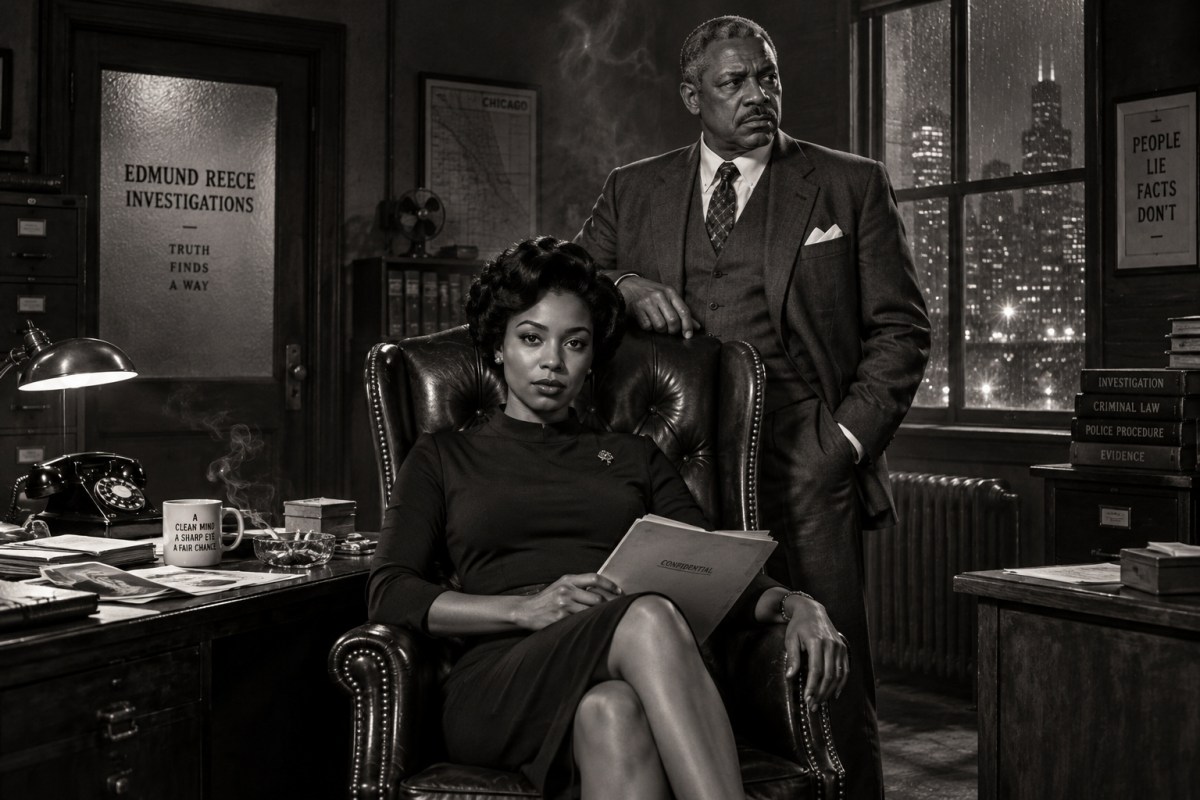
Edmund Reece was sitting behind his desk when Bobbie returned to the agency shortly after two in the morning.
His injured arm rested in a sling, his tie hung loose around his neck, and a half-empty bottle of bourbon stood beside an untouched cup of coffee.
He looked like hell.
Bobbie considered telling him so.
Instead, she removed her coat, hung it beside the door, and crossed to her desk.
“You’re late,” Edmund said.
She stopped.
Slowly, she turned toward him.
“Excuse me?”
“I said you’re late.”
Bobbie regarded him for several seconds.
Then she smiled.
It was the sort of smile that had caused grown men to reconsider their decisions.
“Edmund, I want you to think very carefully about the next words that come out of your mouth.”
He looked up.
“What’s that supposed to mean?”
“It means I’ve had a particularly unpleasant evening, and I’m trying very hard not to make yours worse.”
He leaned back.
“Where’ve you been?”
“Out.”
“Out where?”
“Chicago.”
“Bobbie.”
“Edmund.”
They stared at one another.
Finally, Reece sighed.
“You planning on telling me anything?”
“Funny. I was about to ask you the same question.”
She opened her handbag and removed a folded piece of paper.
The rent receipt.
She placed it on his desk.
Edmund glanced at it.
His expression changed.
Not dramatically. Edmund Reece had spent too many years interrogating suspects to surrender his emotions without a fight.
But Bobbie knew him.
She recognized the slight tightening around his eyes, the way his jaw shifted, and the almost imperceptible movement of his hand toward the bourbon.
“Where’d you get this?”
“South Park Apartments.”
He closed his eyes.
“Goddammit, Bobbie.”
“That seems to be everybody’s favorite expression lately.”
“I told you to stay away from that place.”
“And I told you I don’t take orders particularly well.”
“There’s a reason I wanted you to stay away.”
“Then perhaps you should’ve explained it.”
He reached for the receipt.
Bobbie placed her hand over it.
“No.”
He looked up.
“We’re going to have ourselves a conversation, Edmund. And for once, you’re going to do most of the talking.”
For several minutes, neither spoke.
Outside, rain whispered against the windows. Somewhere in the building, a telephone rang twice before falling silent.
Edmund finally reached for his bourbon.
Bobbie took the bottle away.
“Not tonight.”
“Since when did you become my mother?”
“Your mother would’ve slapped you by now.”
He almost smiled.
Almost.
Then he looked at the receipt again.
“Josephine Carter died in November 1953.”
“I know.”
“She was forty-two.”
“I know that too.”
“She was a good woman.”
Bobbie waited.
Edmund rubbed his forehead.
“I met Josephine in 1948. She worked for a law firm downtown. Smart woman. Smarter than most of the attorneys she worked for.”
“That sounds familiar.”
“She had a sister. Evelyn.”
Bobbie leaned forward.
“Evelyn Doyle?”
“Eventually. Back then, she was Evelyn Carter.”
“And Mickey Doyle?”
“Married her in 1950.”
Bobbie considered this.
“So the woman who came to our office was Evelyn Doyle.”
Edmund nodded.
“Then why did you call her Josephine?”
He looked away.
“Because that’s what she wanted.”
“That’s not an answer.”
“It’s the only one I’ve got.”
Bobbie folded her arms.
“Try again.”
Edmund sighed.
“After Josephine died, Evelyn started using her name. At first, I thought it was grief. The sisters were close. Then I realized she was using Josephine’s identity to get information.”
“What information?”
“Things connected to the warehouse fire.”
“Such as?”
He hesitated.
“Names. Dates. People who were there.”
“And you helped her?”
“Sometimes.”
“Why?”
Edmund looked toward the window.
“Because she knew something about Sarah.”
Bobbie felt the conversation shift.
There it was.
The name that had haunted the office since the previous evening.
Sarah Reece.
The daughter Edmund had never mentioned.
“Tell me about her,” Bobbie said.
He remained silent.
“Edmund.”
He looked at her.
“She was nineteen.”
“Was?”
His jaw tightened.
“Is. She’d be twenty-two now.”
Bobbie said nothing.
“Sarah was studying nursing. Wanted to work at Provident Hospital. Smart girl. Stubborn as hell.”
“Sounds like somebody I know.”
He gave her a tired smile.
“She had her mother’s eyes.”
Bobbie watched him.
For the first time, Edmund Reece looked older than his fifty-three years.
“What happened?”
He took a breath.
“November fifth, 1953. Sarah called me from a telephone booth near the river. Said she needed help. Said she’d seen something she wasn’t supposed to see.”
“What?”
“She wouldn’t tell me over the telephone.”
“Did you go to her?”
“Of course.”
“And?”
He stared at his hands.
“By the time I got there, she was gone.”
Bobbie waited.
“Next morning, the warehouse burned.”
“And Josephine?”
“Found dead afterward. Smoke inhalation. They said she’d been inside.”
“Who identified her?”
“Evelyn.”
Bobbie leaned back.
“Just like Mickey Doyle.”
Edmund nodded.
For several seconds, the only sound was the rain.
Then Bobbie asked the question she’d been avoiding.
“Did you ever find Sarah?”
“No.”
“Not even a trace?”
“Nothing I could prove.”
She looked at the rent receipt.
“Then explain this.”
Edmund stared at the paper for a long time.
Finally, he spoke.
“About six months after the fire, I got a letter.”
“From who?”
“Didn’t say.”
“What did it say?”
“That Sarah was alive.”
Bobbie felt something tighten in her chest.
“And you believed it?”
“I wanted to.”
“That’s not the same thing.”
“I know.”
He rubbed his face.
“The letter told me to keep Josephine’s apartment rented. Sixty-five dollars a month. Cash. No questions.”
“And you did?”
“Every month.”
“For three years?”
He nodded.
Bobbie stared at him.
“Edmund, that’s more than two thousand dollars.”
“I can count.”
“Then you understand how ridiculous this sounds.”
His expression hardened.
“Careful, Bobbie.”
“No. You don’t get to do that.”
“Do what?”
“Hide behind your temper every time somebody asks a question you don’t like.”
He looked away.
She leaned forward.
“Did they ever give you proof?”
“Sometimes.”
“What kind?”
“Photographs. Notes. Places she’d supposedly been seen.”
“Did you verify any of it?”
“I tried.”
“That’s not what I asked.”
Edmund’s voice rose.
“Goddammit, Bobbie, she was my daughter!”
The words filled the office.
Bobbie sat motionless.
Edmund looked at her, breathing heavily.
Then the anger drained from his face.
He lowered his head.
“I’m sorry.”
She waited.
“I know how it sounds.”
“No,” Bobbie said quietly. “I don’t think you do.”
He looked up.
“Edmund, you’ve spent twenty-five years telling people not to let their feelings interfere with the facts. You’ve taught me to question everything, trust nothing without evidence, and never let somebody else decide what I’m supposed to believe.”
“I know.”
“And you’ve spent three years doing exactly the opposite.”
He said nothing.
Bobbie softened her voice.
“I understand why you wanted to believe Sarah was alive. I do. But somebody knew that, Edmund. Somebody knew exactly how to use it.”
He stared at the receipt.
“Yeah.”
“Who?”
“I don’t know.”
“Then we’re going to find out.”
He looked at her.
“We?”
Bobbie leaned back.
“Don’t get sentimental. I’m still mad at you.”
For the first time that evening, Edmund smiled.
It didn’t last.
Bobbie retrieved the letter she’d discovered in Apartment 3B and placed it beside the rent receipt.
Edmund read it slowly.
His face changed.
“Where’d you find this?”
“Under a dresser.”
“Josephine’s apartment?”
“Unless you’ve got another dead woman renting property somewhere.”
He ignored the remark.
When he finished reading, he placed the letter carefully on the desk.
“Sarah was alive when they took her.”
“That’s what it says.”
“Josephine knew.”
“Apparently.”
Edmund looked toward the window.
“Jesus.”
Bobbie watched him.
“Do you recognize the handwriting?”
He examined the letter again.
“Looks like Josephine’s.”
“You’re certain?”
“No.”
“Then we don’t know who wrote it.”
He looked at her.
“Bobbie—”
“Edmund, I am not going to spend the next three years chasing ghosts because somebody knows how to write a convincing letter.”
He sighed.
“You’re right.”
She raised an eyebrow.
“Would you mind repeating that?”
“Don’t push your luck.”
Bobbie smiled faintly.
Then she grew serious.
“There’s something else.”
Edmund looked up.
“Someone followed me to the apartment.”
“Who?”
“Don’t know. Big fellow. Drove a Buick.”
“Description?”
“Didn’t get a good look.”
“What happened?”
“He came upstairs. Tried to convince me he was you.”
Edmund frowned.
“What?”
“Had your voice. Your mannerisms. Even knew a few things about the agency.”
“Did you see his face?”
“No.”
“Then how do you know it wasn’t me?”
Bobbie stared at him.
“Because I shot at him.”
Edmund sat upright.
“You what?”
“Relax. I missed.”
“Bobbie!”
“On purpose.”
He looked horrified.
She shrugged.
“Mostly.”
Edmund rubbed his forehead.
“Lord, give me strength.”
“While you’re asking, see if He can spare some patience. We’re running low.”
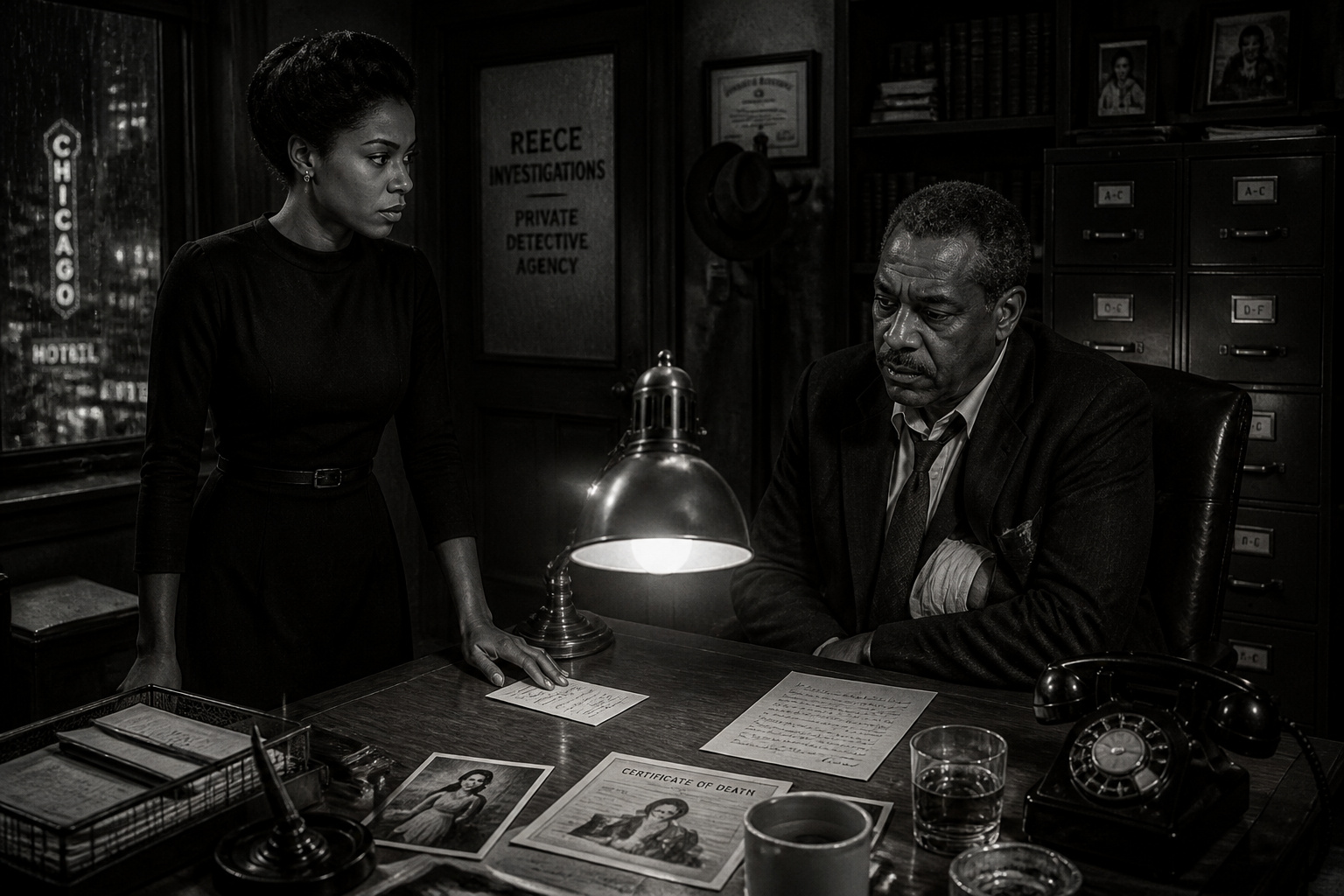
It was nearly four when they finished reviewing the evidence.
The photographs lay scattered across the desk, alongside the death certificate, rent receipt, and handwritten letter.
Bobbie had arranged them chronologically.
November 3, 1953.
Five men outside a warehouse.
November 5.
Sarah Reece disappeared.
November 6.
The warehouse burned.
Josephine Carter was declared dead.
Mickey Doyle was supposedly killed in the same fire.
Three years later, a man identified as Mickey Doyle turned up dead in an empty bathtub.
And someone was still using Josephine Carter’s name.
Bobbie studied the sequence.
“Something’s wrong.”
Edmund looked up.
“Besides everything?”
“The dates.”
“What about them?”
“Sarah disappeared on the fifth. The warehouse burned on the sixth. Josephine supposedly died in the fire.”
“That’s right.”
“But you said Josephine was already dead when Evelyn identified the body.”
“She was.”
“How do you know?”
Edmund hesitated.
Bobbie looked at him.
“Did you see her?”
“No.”
“Did you attend the funeral?”
“No.”
“Did you ever see a body?”
He shook his head.
Bobbie leaned back.
“Then how do you know Josephine Carter died?”
“Because the police said she did.”
“And who told the police?”
Edmund stared at her.
Bobbie tapped the death certificate.
“Evelyn Doyle.”
The silence stretched between them.
Finally, Edmund spoke.
“You think Josephine’s alive.”
“I think we have a death certificate, a woman using her sister’s name, and a man who supposedly died twice.”
She gathered the photographs.
“At this point, Edmund, I’m not particularly impressed with anybody’s ability to stay dead.”
He gave a short laugh.
Then Bobbie noticed something.
The photograph of the five men.
She held it beneath the desk lamp.
“Edmund.”
“What?”
“Who took this picture?”
He frowned.
“Don’t know.”
“Think.”
He studied it.
“Could’ve been anybody.”
“Five men standing outside a warehouse. All looking directly at the camera. Somebody wanted that picture taken.”
“Probably.”
“Then why?”
Edmund leaned forward.
Bobbie turned the photograph over.
There, near the bottom edge, was a faint impression in the paper.
Not handwriting.
A stamp.
She angled it toward the light.
A small key.
Crossed by a feather.
Edmund went still.
Bobbie looked at him.
“You recognize that?”
He said nothing.
“Edmund?”
His face had lost its color.
“Where’d you see that before?”
He swallowed.
“Bobbie, put that photograph away.”
She stared at him.
“Why?”
“Because some things are better left buried.”
Bobbie looked down at the insignia.
Then back at Edmund.
For three years, she had trusted the man sitting across from her.
She still trusted his instincts.
She still respected his experience.
But she was beginning to understand that Edmund Reece had spent so long protecting the past that he no longer recognized the danger it presented.
She placed the photograph carefully on the desk.
“No, Edmund.”
He looked at her.
“Not this time.”
Outside, Chicago was beginning to stir.
The first streetcars rattled through the darkness. Delivery trucks rolled along wet pavement, and somewhere in the distance, a factory whistle announced the beginning of another working day.
Bobbie stood, collected her coat, and reached for her handbag.
“Where are you going?” Edmund asked.
“Home.”
“Good. Get some sleep.”
She paused at the door.
“Edmund?”
“Yeah?”
“Tomorrow, we’re going to talk about that little bird.”
He looked at the photograph.
Then he looked at her.
“Bobbie—”
She opened the door.
“And this time,” she said, “I expect the truth.”
She stepped into the hallway before he could answer.
Behind her, Edmund Reece remained seated beneath the yellow glow of the desk lamp, staring at a photograph taken three years earlier.
Five men.
A warehouse.
And a symbol that should have disappeared nearly twenty years ago.
For the first time in a long while, he wished he had never become a detective.
To be continued.
Discover more from Memoirs of Madness
Subscribe to get the latest posts sent to your email.

