Macro Monday | The Beauty of What Remains
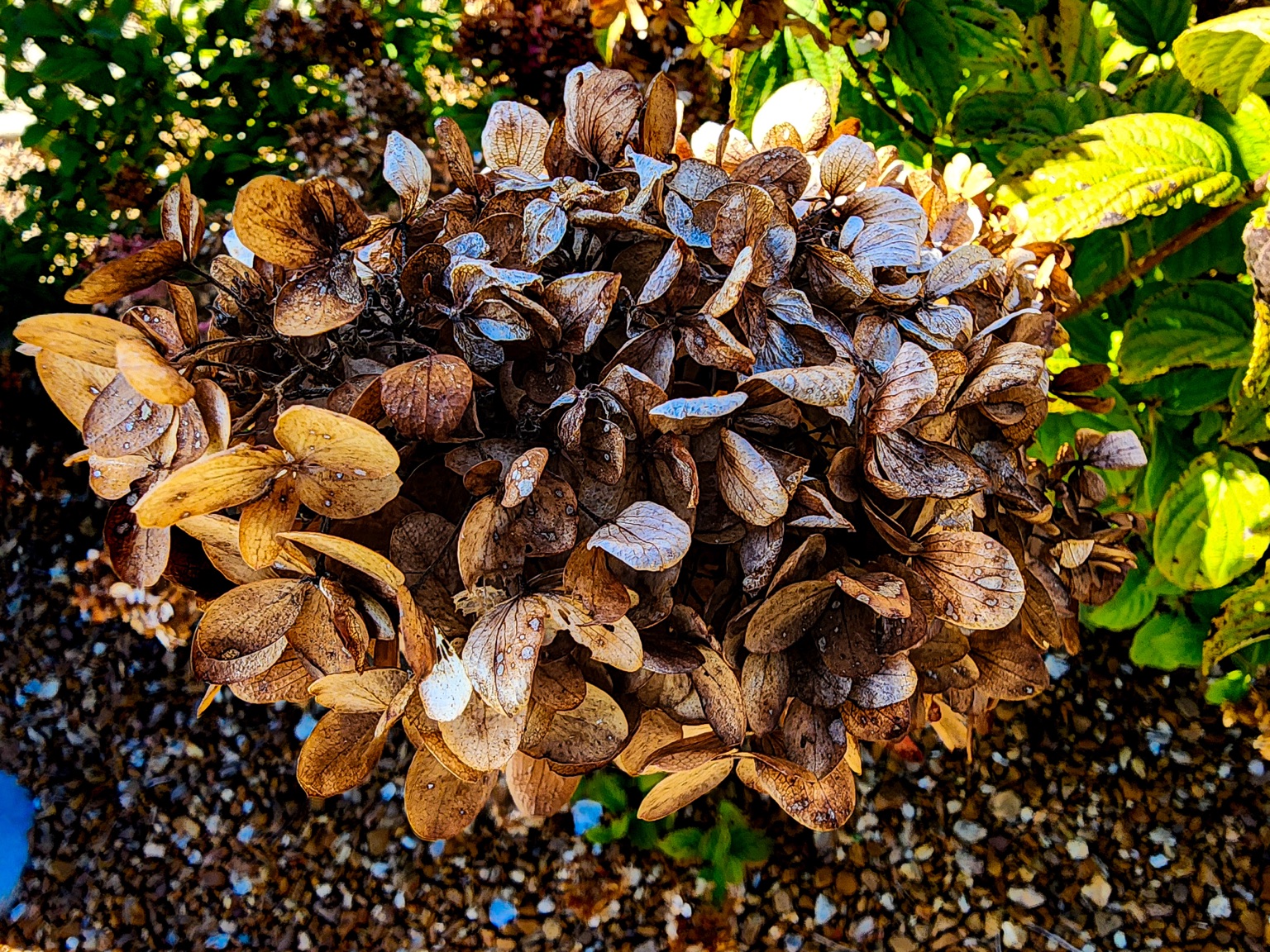
There is something rather stubborn about a flower that refuses to disappear simply because its season has ended. Long after the vibrant colors have surrendered to the changing weather, after the bees have moved on to more promising neighborhoods and the butterflies have abandoned their summer romances, these hydrangeas remain. Their petals have curled, their colors have faded into shades of bronze and weathered parchment, and the soft elegance that once defined them has given way to something considerably more rugged. Yet, standing there beneath the autumn sunlight, they possess a character that their younger selves could never have imagined.
I have always found it interesting how quickly we dismiss something once it no longer resembles what we believe it should be. A flower is supposed to bloom, a tree is supposed to provide shade, and people, apparently, are supposed to spend their entire lives pretending they haven’t aged a day beyond thirty-five. We have developed an extraordinary talent for celebrating beginnings while treating everything that follows as a slow march toward irrelevance. There are entire industries dedicated to convincing us that growing older is some sort of personal failure. Wrinkles must be erased, gray hair concealed, and every visible indication of a life actually lived treated as an unfortunate manufacturing defect.
Meanwhile, nature appears entirely unconcerned with our ridiculous expectations.
These hydrangeas have no intention of apologizing for their appearance. Their petals bear the marks of sunlight, wind, and changing temperatures. Some have folded inward, others have developed tiny imperfections, and a few appear to be hanging on through sheer determination. The delicate veins running through their papery surfaces have become more pronounced, revealing details that were less noticeable when the blossoms were younger and their colors more vibrant. What was once soft has become textured. What was once delicate has developed a certain rough dignity.
And I find that rather beautiful.
Perhaps it has something to do with getting older myself. There comes a point in life when you begin to appreciate things differently. The shine of something new becomes less impressive than the character of something that has endured. You begin to understand that perfection is often a temporary condition, assuming it ever existed in the first place. A weathered wooden bench, an old leather jacket, the creases surrounding someone’s eyes when they laugh—these things carry stories. They have been somewhere, survived something, and returned with evidence of the journey.
Of course, I wouldn’t mind if my knees would occasionally stop reminding me of every questionable decision I’ve made since the age of twelve. Apparently, the human body maintains a remarkably detailed accounting system, and the collection department has no interest in negotiating.
But I digress.
Looking closely at these dried blossoms, I was struck by how much detail remained after their most celebrated qualities had disappeared. The colors may have changed, but the intricate structure of each petal was still there. The overlapping layers created pockets of shadow, while the sunlight caught the curled edges and illuminated their delicate veins. Against the surrounding green leaves, the faded blossoms seemed almost defiant, as though they were making one final argument against the notion that beauty belongs exclusively to spring and summer.
Photography has a way of revealing these quiet contradictions. Through the lens, things we might ordinarily dismiss become worthy of examination. The cracked surface of an old wall, the weathered hands of someone who has worked for decades, or a cluster of blossoms that most gardeners would have removed weeks ago. Each contains a kind of honesty that polished perfection often lacks. There is no pretense in the texture of something that has endured the elements. It simply exists as it has become.
I suppose that is what makes autumn such an interesting season. Spring arrives with promises, summer spends them extravagantly, and autumn comes along to examine what remains. It is a season of reckoning, but not necessarily one of sorrow. There is generosity in its fading light, richness in its subdued colors, and a peculiar sort of freedom in the realization that not everything must remain as it once was.
We sometimes confuse change with loss because we are so attached to familiar appearances. We remember the blossom at its brightest and assume everything afterward must be a lesser version of the same thing. Yet these flowers are not attempting to recreate their summer glory. They have entered another stage of their existence, one with its own textures, colors, and quiet significance.
There is a lesson somewhere in that, although I hesitate to suggest that every flower, fallen leaf, and crooked branch is secretly waiting to deliver a philosophical lecture. Sometimes a dried flower is simply a dried flower, and the universe has no obligation to provide commentary.
Still, I cannot help wondering how much of life we overlook because we have already decided its finest moments are behind it.
We do this with places, with possessions, and sometimes, rather cruelly, with people. We assign value according to usefulness, appearance, or the promise of what something might become. Once those expectations are no longer met, our attention wanders elsewhere. We forget that usefulness is not the same as worth, that beauty can exist without an audience, and that a thing does not become meaningless simply because its purpose has changed.
These hydrangeas will eventually crumble. The wind will carry away their fragile petals, the stems will weaken, and winter will finish what autumn has begun. There is no avoiding that conclusion, nor would I particularly want to. Nature does not preserve everything indefinitely, and perhaps that is part of what makes these moments worth noticing. Their impermanence gives them a certain urgency. We have this morning, this patch of sunlight, these weathered petals, and the opportunity to look before the scene changes again.
I raised my camera because something about those faded blossoms caught my attention. Not because they were perfect, not because they were particularly colorful, and certainly not because they were trying to impress anyone. They had simply remained long enough for me to notice what time had written upon them.
And perhaps that is enough.
Autumn does not keep the brilliance of summer, nor does it promise to restore what has already passed. What it keeps is the evidence—the textures, the scars, the quiet dignity of things that have lived through their season and become something different.
There is beauty in that transformation, even when we are reluctant to recognize it.
Especially then.