Where the Ache Learns to Sit


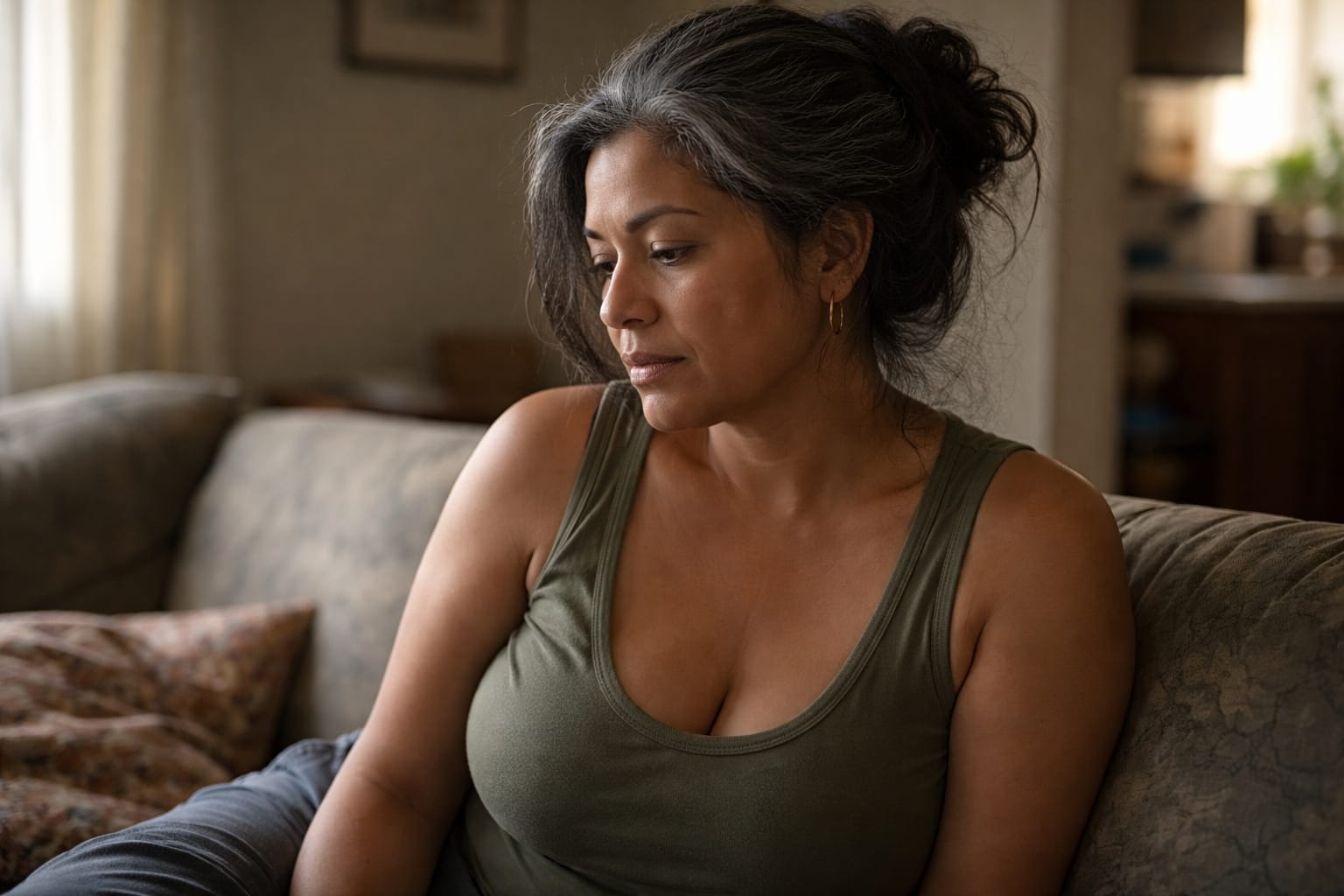
She sits the way people do when they’ve finally stopped pretending the day went according to plan.

The couch gives beneath her, a slow surrender, fabric creasing where her body has learned to rest without asking permission. It remembers her shape better than most people ever have. Afternoon light slips in through the window—thin, dust-heavy, undecided—catching on the silver threaded through her hair, the soft pull of skin at her shoulders, the evidence of years spent carrying weight that never showed up on a scale.

This is not rest.
This is what comes after holding yourself together too long.

Her tank top clings faintly to warmth, the ghost of the day still trapped in the cotton. Skin exposed, unguarded. No armor left. No performance required. She looks down at her hands and feels the familiar flicker of accusation. These hands have signed things they shouldn’t have. Held on when leaving would have hurt less. Let go when staying might have saved something. They tremble now—not from weakness, but from memory.

There is a wound you earn through endurance.
It doesn’t bleed.
It tightens.

It lives in the shoulders, in the jaw, in the space behind the eyes where thoughts go when they’re too tired to form words. She feels it settle there, heavy as wet cloth. This is the pain that learned to be quiet. The kind that stops asking for attention because it knows better.

She thinks about the versions of herself she was promised—by magazines, by love, by the softer lies people tell when they mean well. Stronger. Lighter. Forgiven. They stand like uninvited witnesses in the corners of the room, these almost-selves, careful not to meet her eyes. She doesn’t chase them anymore. Chasing taught her how expensive hope can be.

The room smells like yesterday. Cold coffee. Worn fabric. The faint mineral trace of skin that’s been still too long. Somewhere behind her, the world insists on urgency—phones buzzing, engines passing, time tapping its foot. In here, time slumps into a chair across from her and says nothing at all.

This is where the ache goes when it’s done screaming.
This is where survival finally exhales.

She is not broken. She knows that much.
But she is open in places that never healed cleanly.

Ink would catch this better than blood. A line pressed too hard into paper. A pause left uncorrected. The kind of mark you don’t explain away because explanation would cheapen it. This is not a story with a lesson. It’s a record. A witness.

She lets herself stay there—inside the weight, inside the truth—because she’s learned something no one bothered to teach her:

Healing doesn’t begin with hope.
It begins the moment you stop lying about how much it hurt.
The City That Kept Time


The watch stopped at dawn.

Not the gentle kind—the kind that slips in like forgiveness—but the gray, flooded dawn that arrives already tired of you. The kind that stains the sky a murky color that refuses to decide whether it’s night or morning, as if time itself has begun to disapprove of forward motion.

I noticed it when the ticking failed to meet me halfway.

For years, that sound had been my anchor. A soft, mechanical breath in the hollow of my chest pocket. Tick. Pause. Tick. A reminder that something, somewhere, still obeyed order. Still moved forward in increments small enough to survive.

Now there was only water.

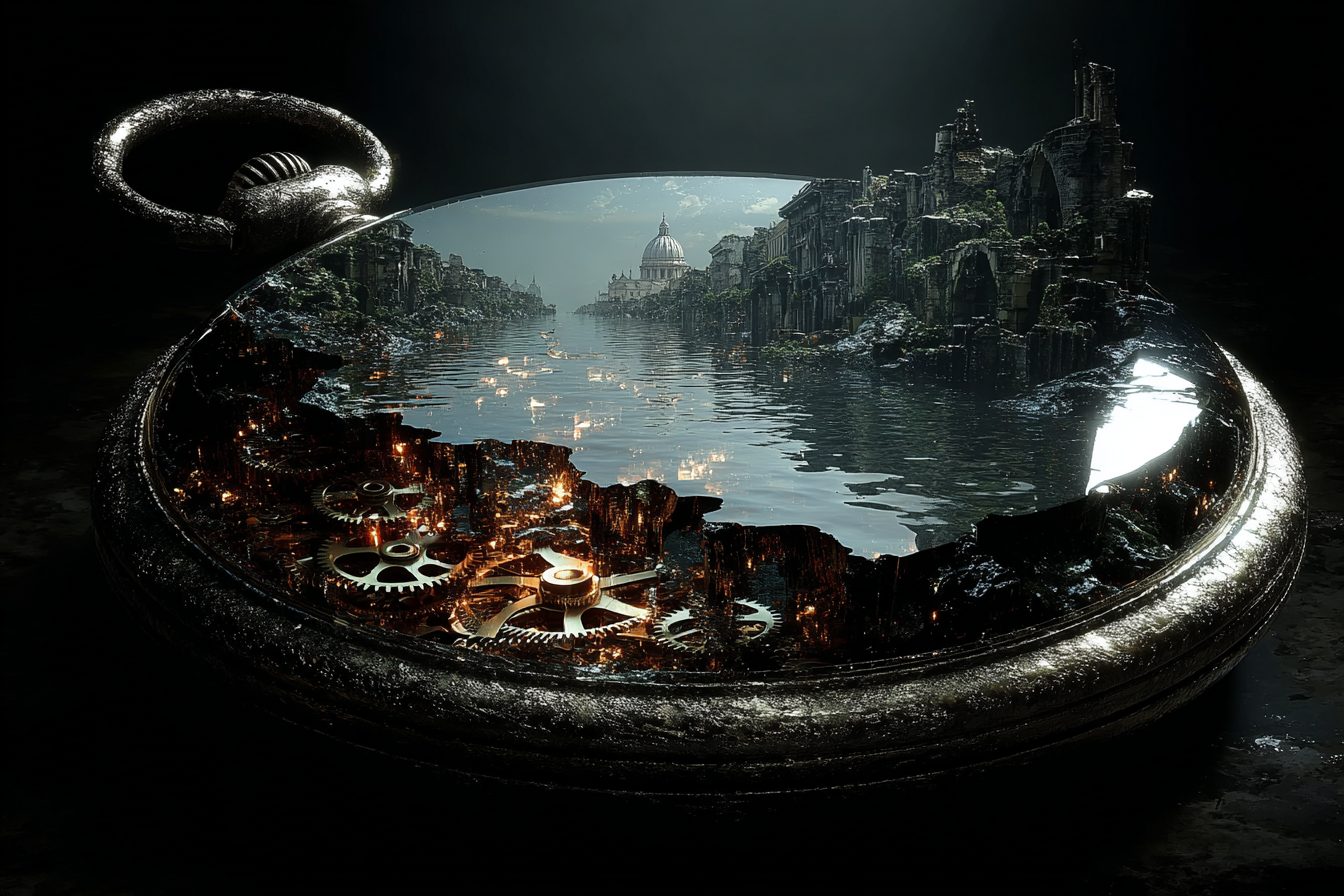
The glass face of the pocket watch had cracked sometime during the night, a hairline fracture running from two o’clock to nowhere. Inside, the city floated—half-submerged streets, collapsed facades, moss choking the bones of once-important buildings. Windows gaped like mouths that had finally given up trying to warn anyone. At the center, a domed cathedral rose from the flood like an accusation that refused to sink.

It was still captivating, in the way ruins sometimes are. Beauty sharpened by consequence. Grandeur stripped of purpose.

Beneath the waterline, the gears burned.

Gold teeth turned against blackened brass, grinding despite the damage, throwing sparks like dying stars. The machinery didn’t care that the watch had failed. It kept working out of habit. Out of loyalty to a purpose that no longer mattered.

I understood that better than I wanted to.

I stood at the edge of the canal that used to be a boulevard, boots half-submerged, coat heavy with the smell of damp wool and old decisions. The city had been abandoned for years, but it still whispered at night—stones settling, water licking the edges of memory, echoes that sounded uncomfortably like names I never said out loud.

I remembered a morning before the flood. Before the watch felt heavy.

We sat at a narrow table near the window, steam curling from chipped cups of tea, the kind brewed too long because neither of us wanted to be the first to speak. She stirred hers slowly, counting rotations like they meant something, then slid a coin across the table.

“A tuppence for your thoughts,” she said.

She didn’t smile.

I should have laughed. Should have told her the truth. Instead, I pocketed the coin like a coward’s joke and said nothing worth keeping.

I promised her I’d leave before the waters rose.

I always said that part softly, as if volume could erase delay.

“You have time,” I told her.
I believed it. Or worse—I needed to.

The watch had been hers first. A gift from her father, salvaged from a world that still believed time could be trusted. She gave it to me the night I chose to stay. Pressed it into my palm like a pardon I hadn’t earned.

“So you don’t forget,” she said.

I didn’t forget.

That was the cruel part.

The floods came fast after that. Streets drowned, then buildings, then names. People scattered or vanished. Promises calcified into artifacts. I stayed long enough to become part of the ruin—another figure haunting the edges of what refused to die.

When the betrayal finally surfaced, it wasn’t loud.

It never is.

It arrived as understanding.

The realization that the city hadn’t fallen because of the water, but because of what I didn’t say when it mattered. Because of every moment I stood still while she carried the weight of forward motion. Because love deferred long enough begins to rot, and rot attracts floods.

I had thrown silence where honesty should have been.
Thrown comfort at a wound that needed truth.
Thrown time away as if it were renewable.

I opened the watch fully, prying the glass away with numb fingers. Water spilled out, carrying reflections with it—her face once, briefly, before dissolving into ripples. Beneath it all, the gears slowed.

Tick.
Pause.
Nothing.

For the first time, the city inside the watch went quiet.

No sparks. No movement. Just submerged streets and a cathedral that had finally learned how to bow.

I closed the watch and let it sink into the canal.

The water swallowed it without ceremony.

I stood there long after the ripples faded, hands empty, pockets lighter, time finally finished with me. The city remained—not as punishment, not as mercy—but as evidence.

Some things don’t break when you betray them.

They simply stop keeping time for you.

Author’s Note

This piece was shaped in conversation with constraint, and I’m grateful for it. Thank you to Di for hosting 3TC, and to Ragtag Daily Prompt for consistently offering challenge words that don’t feel ornamental, but invitational—words that ask to be earned on the page.

These prompts didn’t dictate the story; they pressured it, forcing choices, memory, and consequence to surface where they might otherwise have stayed submerged. Sometimes that tension is exactly what a piece needs to tell the truth it’s been circling.

I appreciate the space to wrestle with language rather than decorate it.

The Loneliest Sound


I hear slumber calling—
a distant, lonely sound,
perhaps the loneliest I have ever known.
It carries empty promises of peace,
visions of places we have been
and realms we never earned the right to imagine.

Sleep assembles us like a kit
with missing instructions,
parts rattling loose in the dark.
Whatever it forges does not cool cleanly—
it leaves us fired and cracked,
pulled from the kiln too soon.

When it is over,
when the dust finally settles,
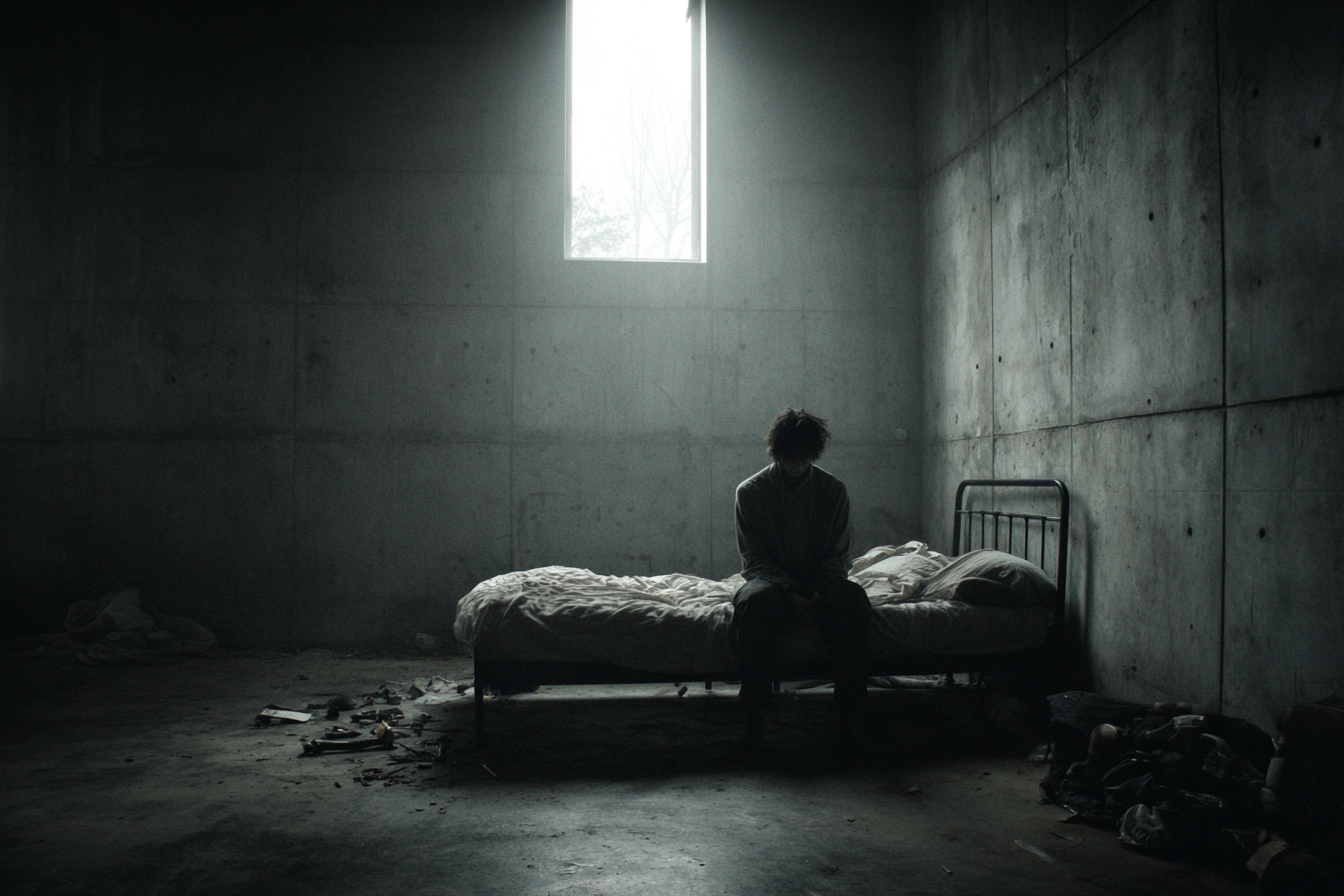
we sit on the edge of the bed,
spines bent at an old kink
we forgot we learned,
waiting for something to return—

something to tell us
how this works again,
how it is
to breathe.

Author’s Note

My thanks to Di for hosting the #MM301 challenge. These prompts don’t arrive gently—they sit with you, press a little, and ask what’s still unresolved. This piece grew out of that quiet pressure, out of what lingers after the noise fades. I’m grateful for the space to explore that edge, and for the invitation to listen closely to what remains unsaid.

Forged from an Old Soul


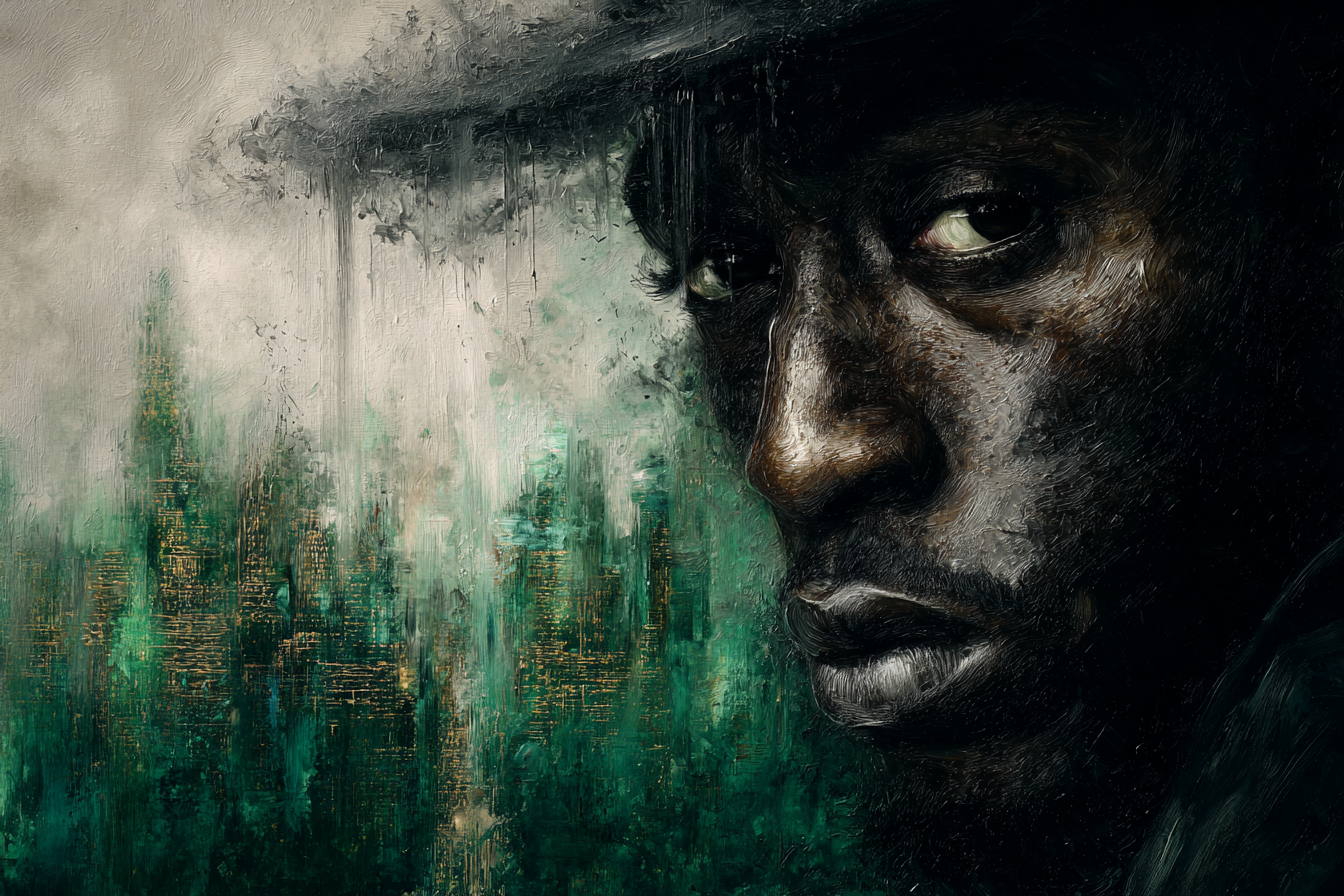
He wasn’t born lucky. Nobody handed him a map.
He learned early that some of us come into this world half-built, and the rest is on us.
So he carved his name into time, steady and deliberate — a slow rebellion written in scars.

The city didn’t raise him. It tolerated him.
Concrete and glass can’t teach you much, but they’ll listen if you bleed honest enough.
He made peace with that kind of silence — the kind that hums between streetlights and memory.

There was a facility once — a place that smelled like rust, regret, and second chances.
He wasn’t supposed to be there, but he stayed.
Sometimes, a man doesn’t need comfort — he needs a place where the noise inside his head finally echoes back.
In that echo, he found rhythm. In rhythm, he found himself.
No blueprints. No saviors. Just repetition.
Each motion a prayer, each mistake a gospel of survival.

He doesn’t worship. He works.
He doesn’t beg. He endures.
And if you ask what drives him, he’ll tell you the truth —
it’s not pride or anger, not anymore. It’s the memory of a boy who promised a broken world he’d walk out standing.

Half in shadow.
Half in light.
All his.

Skin Against the Wall


The wall split open at the hairline crack, and she came through screaming. Not with sound, but with vibration—the kind you feel crawling in your teeth, rattling in your bones. Her hair—roots alive with autumn rot and evergreen hunger—whipped outward like roots searching for soil.

Where’d you go?
She’s alive, but barely. She stood out, so loud, so bright, you could see. Her silence sings to me, as if she belted out a primal scream. She was so loud, it’s wrong—she was strong. Where did we go? Tonight, the Sun will hum its final hymn.

She tastes the blood from her hidden, unhealed wounds. The plaster burns her skin; it’s slowly melting her spirit. There’s an itch under the surface she can’t stop clawing at, something crawling deep in the marrow, carving names she doesn’t want to remember.

Blood streaks her cheek, though she hadn’t been struck. It seeps from a single dark spot beneath her left eye, like the wall itself was leaking into her.

The air around her trembles. Not with rage, not with fear, but with the ache of a body caught between two worlds—one solid, one unfinished.

And still she screamed.
And still, I listened.
Because sometimes a scream is the only way a wound remembers it’s alive.


Author’s Note:
This piece was written for Di’s Three Things Challenge — today’s words: hairline, itch, spot. Much appreciation to Di for keeping the ink restless and the imagination cornered. I’ll be back to flash fiction once I iron out the kinks of Narrative Forge. Thanks for hanging with me — telling stories is my happy place, having you enjoy them is just the perks of the gig.

Tarab & Bone

Prose – 3TC


I’m not afraid.
I’m not afraid.
I’m not allowed to be.

Where I come from, fear is a luxury we were born too broke to afford. Vulnerability wasn’t something we dismissed—it was something we were denied. It was kept behind locked doors, like heirlooms we didn’t inherit.

My grandfather didn’t teach with words. He taught with what he didn’t say. He taught me how to keep the jaw tight, how to pray in silence, how to hold grief like a second spine. He had crafty ways of navigating rooms where he was expected to be invisible, but somehow always left a shadow. He taught me not how to cry—but how to endure the crying of others without blinking.

They told us to walk tall, but not too tall. To speak, but not loudly. To lead, but never forget we’re replaceable. Strong—always. Seen—rarely. Heard—only when invited.

I learned to carry myself like a verdict. The years didn’t soften me—they carved me. And somewhere between funeral suits and morning trains, I mistook resilience for religion.

I’m not afraid.
I’m not afraid.
I’m not allowed to be.

Because they’re still watching.
Because weakness stains in places bleach can’t reach.
Because I carry names no one etched into stone, but I wear them anyway—in the bend of my back and in the tightening of my breath whenever the world grows quiet enough to remember.

I’ve loved with fists.
I’ve buried more brothers than birthdays.
I’ve stared into mirrors and seen ghosts blink back.

And I’m still here.
Which means I’m still dangerous.

Some days, I hear the voices—low and layered, like drums beneath concrete. Whispers at a distance. Ancestral static tuning itself in the back of my skull.

Who is speaking?

My father, maybe—never said “I love you,” but left it folded into a clean shirt and the sound of a deadbolt clicking after midnight.

Or the ones who never made it past eighteen, who hover behind my ribs like secrets I’ll never tell.

Some of them speak in riddles. Some in warnings.
And some just laugh—cheeky, almost cruel:
“Look at this one, still trying to turn ghosts into gospel.”

I remember the nippy mornings, before light. Cold air that slapped you awake. The kind that taught you pain was just a temperature shift you’d survive if you didn’t flinch. Those days made your bones ache—but they made your will sharper, too.

And now, standing here, with all of that folded inside me like a fire I never asked to carry, I wonder:

What have I done with all I’ve been given?
Have I honored the ones before me?
Or just mirrored their silence?

What have I left for the ones next?
A trail of smoke?
A shut door?
A story they won’t want to finish?

What if the bravest thing
isn’t being unafraid—
but being seen?

Not as legend.
Not as weapon.
Not as sacrifice.
But as person
messy, aching, unfinished.

What if legacy
isn’t built on who endured the most,
but who dared to feel
what others refused to name?

Maybe I’ve been strong too long.
Maybe strength
ain’t the absence of fear,
but the courage to admit
you needed saving too.


Not a statue.
Not a sermon.
Not a ghost.
Just a man—
…and maybe that’s where the healing begins. And the trouble ends with me.


Authors Note:

This piece was sparked by Di’s 3TC challenge—and yes, I stole a line from Stacey Johnson’s poem order. Is it still stealing if I tell you up front? (Shrugs.) Anyway, as usual, I’m grateful to be inspired by friends who make me write better, feel deeper, and laugh louder. You know who you are.

I Scream Every Time I’m Asked to Compromise


I scream every time I’m asked to compromise who I am, what I believe.
There are days I walk through this like a ghost—quiet, invisible, barely tethered to the world. I’ve worn this skin too long to pretend anymore. I’ve learned that silence is never neutral. It collects. It bruises. It builds a coffin for the self.

How long did I expect integrity to outweigh ignorance?

The shame cuts deepest when I remember the things I was asked to do to be accepted. Asked to perform, asked to mute the fire, asked to shrink for the comfort of others who never deserved my story in the first place. And like a fool, I tried. I polished my voice. I spoke in softened syllables. I tiptoed like I was walking on eggshells—not to protect myself, but to protect their illusion of safety.

But here’s the truth:
Their comfort was never my duty.

This world has corrupted too much, taken too many of us who had something real to say. It props up empty vessels and paints them gold, calls it culture, calls it “marketable.” Meanwhile, those of us who bleed truth are told we’re too much, too raw, too difficult to brand.

They wanted me to smile like some hollow doll—something quiet, something that won’t fight back when they put words in my mouth. But I’m not plastic. I’m not hollow. I don’t bend like that anymore.

I carry my scars with intention now.

Let them call it anger. Let them call it ungrateful. I call it knowing. Knowing that every time I was asked to “adjust,” they weren’t asking for kindness—they were asking for obedience.

I’m done apologizing for the shape my soul takes.


Author’s Note

This piece was inspired in part by prompts from FOWC, RDP, and WOTD. Thank you all for the sparks you give. Your work matters.

Lessons in Disappearance


for those who know what it’s like to be visible but not believed

Every day is another lesson in invisibility.
Not the kind you choose, not the soft fade of a disappearing act.
This is the kind handed down in glances that slide past you.
In doors that stay closed just a second longer when you’re approaching.
In the space you leave behind when you’re gone, and no one notices the shape of your absence.

You become fluent in the language of indifference.
You learn the weight of unasked questions.
You memorize the way people say “I didn’t see you there” like it’s a kindness,
instead of an indictment.

There is a peculiar violence in being overlooked.
Not bruised. Not broken. Just… reduced.
Down to skin, down to stereotype, down to background noise.
They don’t mean to erase you—
and somehow, that makes it worse.

They’ll say you’re quiet.
You’ll wonder if they’ve ever actually listened.

You wear shame like a second skin.
Not because you earned it,
but because somewhere along the way,
someone handed it to you like inheritance
and you forgot how to put it down.

You stand still in a world built to move around you—
fast, loud, full of curated meaning.
And you begin to question:

Is there something wrong with me, or is there something wrong with this lens that always finds me blurred?

You’ve learned to map your pain in silence.
Each breath is a kind of protest.
Each blink a refusal to disappear entirely.

There are veins beneath your skin that look like lightning—
not because you are struck,
but because you are always just about to burn.

And yet you don’t.
Not fully.

You endure.
Not in glory. Not with applause.
But with defiance.
The quiet kind.
The kind that goes unnoticed until someone says:

“I didn’t realize you were carrying that much.”

And you smile without smiling,
because you know the truth:

You were always carrying that much.
They just never asked to know.

A Half-Burned Gospel

Another psalm from the quiet fire.


Can you howl when there is no one there to hear you?
Is your passion only for public consumption?
I’m frostbitten by your whispers.

There was a time I needed your touch.
I needed your attention.
Not all of it—just enough to matter.
Not to me.
I needed it to matter to you.

But you blinked, and I shattered.
You turned, and I calcified into someone else’s silence.
They say the world ends in fire or ice—
I know both.
Your heat was conditional.
Your absence, absolute.

Some men beg for war to distract from the wound.
Me?
I just wear the hood tighter,
pull it close like a secret I still want to believe in.

I walk through your memory like a half-burned gospel,
rubbing ash on my skin like anointing oil.
There’s still a spark behind my teeth,
but no one’s left to kiss the smoke.

And even now—
when I speak,
my voice curls like steam
off a pot no one stayed to stir.
…and silence never needed an audience.