Today was her first day at her new job and she thought she was prepared.
They had given her instructions. Rituals. Words that felt like passwords more than prayers. But no one told her about the chest. No one warned her it would breathe.
It rose from the stone floor like a relic of a forgotten age, its surface alive with shifting constellations that seemed to map a sky she had never seen. The air around it vibrated, as though the chest itself was holding back a storm.
When she touched the lid, her pulse staggered. Not from fear. From recognition.
The chest opened and she saw herself — not as she was, but as she would be. Hooded. Infinite. A figure draped in shadows stitched with starlight. Galaxies smoldered in her skin as though she were made of the night sky itself.
“You thought you were prepared,” the figure said. The voice was hers, but unfinished, jagged, as if carved in haste. “The job isn’t to open the chest. It’s to be the chest. To carry what others cannot.”
And suddenly, she understood: this was not just a job. This was release. She had been trapped too long in the shadows — between this world and the next, bound to silence, bound to waiting. She never imagined becoming free. Free to walk the streets, to breathe among the living, to leave footprints that didn’t vanish at dawn.
Because of her time in the shadows, she had learned something the living never could: how to exist in both worlds.
She sat in her room, watching the picture box, and it was wonderful and scary all at once. The moving images reminded her of the endless worlds she had observed from the shadows while she was in the chest — glimpses of lives she could never touch, stories she could never enter. Now, they flickered in front of her as if daring her to join.
She studied the pattern of speech. She mimicked smiles, frowns, laughter, and silence.
On Wednesdays, Monica arrived. She was never just Monica — not really. Her questions were too sharp, her gaze too steady. She tested, corrected, reminded. Showed her how to pass unnoticed. How to apply what she had learned. Monica’s voice was kind, but her eyes never betrayed surprise. It was as if she had seen countless others crawl from the chest before.
This time, as Monica adjusted the blinds and set her notes down, she paused. “Remember,” she said softly, “freedom doesn’t mean you’re unbound. It only means you’ve been given longer chains.”
Every lesson pressed her further into this world, though the shadows still whispered her name.
Her hands trembled, but she didn’t step back. She stepped closer.
The figure smiled.
The lid slammed shut.
The room fell silent, except for the faint glow bleeding from the chest’s seams — a light that pulsed like a heartbeat, or a warning.
Author’s Note This piece grew out of Esther’s Writing Prompt andFandango’s Story Starter— a simple line about being prepared for the first day at a new job. On the surface, that sounds ordinary, but in my head it twisted into something mythic: a chest that breathes, shadows that teach survival, and a figure learning how to pass in a world that was never built for her.
As always, thank you for reading, for wandering into these strange corners with me. Stories like this sit between myth and memory, control and survival. Your presence reminds me the lantern light isn’t wasted — even when the chest closes and the room goes dark.
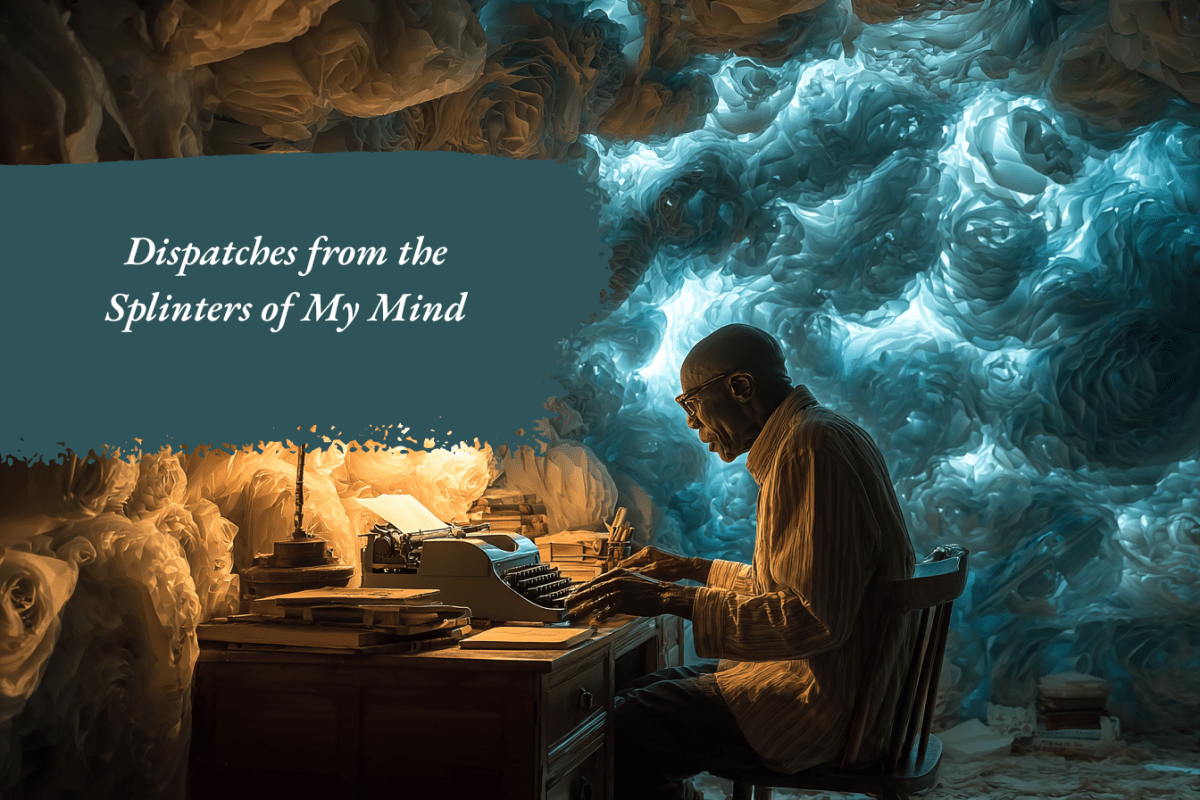
Dispatches from the Splinters of My Mind — Entry 5
For years, the suitcase had slouched against the wall, olive canvas faded to the color of dead grass, as if weighed down by secrets. Mara learned to live around it. She told herself it wasn’t hers, not really—it was just another flaw inherited with the apartment, like the warped floorboards or the mildew that bloomed no matter how much bleach she poured. She built routines that ignored it: shuffling past on her way to the kitchen, bruising her shin on its bent wheel while juggling laundry, pretending its mute presence wasn’t following her from room to room.
By day, she worked in the customer service cubicle of a company that sold things no one really needed. Her headset buzzed with angry voices demanding refunds for trivialities: scratched coffee tables, missing screws, colors that didn’t match the brochure. She smiled at her monitor, mouthed apologies she didn’t feel, and counted the hours until she could slip away unnoticed. At night, she returned to her apartment and straightened it into submission—folding towels, smoothing the duvet, coaxing life from a wilting philodendron. Every act was an attempt to prove she still had control.
Her phone rarely lit up with messages. Friends had drifted off in the slow erosion of years, worn away by canceled plans and her tendency to withdraw. Lovers, when they existed, didn’t stay long; Mara always sensed the moment they realized her silences weren’t mysterious, just empty.
The suitcase became her only constant. Not with menace, exactly, but with the patient gravity of an old dog who refused to die. On the loneliest nights, when the city’s noise thinned to a faint hum and her reflection in the window looked more like a stranger than herself, Mara sometimes found comfort in its presence. A terrible comfort, born from the knowledge that if she disappeared tomorrow, someone would find the suitcase and wonder what it meant.
—
She told herself she would never open it. Whatever was inside belonged to some version of herself she had no interest in meeting. Better to let the past rot in peace.
Still, she caught herself circling it. Some nights she’d stand over it with a hand suspended above the clasps, her palm tingling as if braced for a static shock. She imagined sweaters matted with moths, photo albums swollen from rain, useless junk that had once mattered. But beneath those guesses lurked something heavier—the suspicion that the suitcase held not just things, but explanations.
On this December evening, the city outside hushed itself beneath its first snow, and the cold seeped inward until even the air felt brittle. Mara sat on the warped parquet floor, knees tucked tight, her breath fogging the space between her and the suitcase. The silence didn’t feel empty anymore; it pressed against her ribs, insistent, like a held note waiting to be released.
Her fingers found the clasps. She hesitated, pulse drumming in her ears, then pressed. The latch gave with a soft click—an exhalation, almost grateful. The suitcase opened with a muted thump against the wall.
Mara braced for the familiar debris of memory. Instead, the air thickened, sweetened, and began to move.
—
Out of the suitcase spilled green. Not color, but substance: vines, moss, leaves tumbling out in a delirious torrent, as if a dam had burst inside the canvas walls. The vines reached first for Mara’s wrists, curling with the intimacy of a lover’s grip, then crept up her sleeves before she could recoil.
The apartment began to betray her in increments. Carpet fizzed into moss, threads unraveling into living rootlets that burrowed deep into the warped floorboards. Table legs thickened, cracking as bark split through lacquer. Fungal blooms erupted from the bookshelves, pale caps pushing aside dog-eared paperbacks. The ceiling melted into sky—a blue so raw and immense it swallowed the dingy plaster whole.
The air grew dense, wetter, and alive with perfumes that should not coexist: loamy soil, crushed mint, the sweetness of rot, the ozone edge of lightning about to strike. Mara staggered as the scents layered, dizzy with the intoxication of it.
Then came the blossoms. Petals bloomed in fractal explosions—saffron edged in black, violet spirals furred like animal hides, blossoms so red they seemed to bleed. Some pulsed faintly, as if with heartbeats of their own.
Butterflies burst from the vines in a fever of wings, thousands lacquered in jewel tones. They whirled so thick they became a storm, each frantic flutter a whisper against her skin. A dozen landed at once—on her hands, her shoulders, her lips. One perched on her eyelid, its wings opening and closing with the slow rhythm of breathing.
She should have screamed. Instead, her breath came shallow, more awe than terror. For every heartbeat, the wild reached deeper.
Each leaf brushing her skin delivered not scratches but memories—her grandmother’s dough-soft hands kneading bread, her brother’s laughter ricocheting through a sunlit field, her father’s cough echoing down a sterile hospital corridor. The wilderness was rewriting her, splicing joy into wounds, editing her grief with gentler hands.
But wonder had teeth. In the corner of her vision, flowers gaped open to reveal centers ringed not with pollen but with minute, gnashing mouths. A patch of thistles dripped with sap the color of blood. A butterfly passed close enough for her to see one wing stitched together with spider silk, trembling under the effort of flight.
Above, something moved. Too heavy to be a bird, too fluid to be human—a colossal shifting presence that bent the canopy like a wave. She froze, pulse hammering, as the unseen thing exhaled a breath that rattled branches and sent shivers down her spine.
The vines around her ankles tightened, not cruel but unyielding, as if claiming her. The suitcase pulsed behind her like a second heart, no longer a container but a wound, hemorrhaging wilderness into the sterile apartment.
Mara drew in a breath thick with ozone and soil. For a moment, she could not tell whether she was breathing the wild in—or whether the wild was breathing her out.
—
Out of the suitcase unfurled green. Not just the color, but the thing itself: vines, moss, leaves in reckless abundance. They spilled from the hollowed interior with the momentum of a breached dam, clinging to her wrists, crawling up the sleeves of her sweater before she could react.
The rupture startled her so hard her body jolted, heart hammering in her throat as if the apartment itself had split at the seams. Vines surged, leaves and petals clawing into the stale air with a force that left her scrambling backward. For a moment, she could hardly breathe, the world too sudden, too alive.
But then the panic ebbed, steadied, and something else seeped in—calm, foreign yet familiar, like slipping into warm water after a long winter. The butterflies poured from the green in a thousand frantic flutters, their wings catching light that didn’t belong to her apartment, guiding her deeper into this breach. They circled her in loose spirals, herding without force, their chaos carrying a strange order.
One landed on her finger. Its wings pulsed open and shut, slow as breath. Mara froze, remembering the way she’d once cupped fireflies in her childhood palms, the glow painting her skin in fleeting constellations. Her mother had warned her not to hold them too tightly—fragile things needed room to breathe, to live. The memory stung and soothed at once, as if the butterfly itself had dredged it up to remind her: not everything she touched had to die in her hands.
The unease that had clung to her loosened, thread by thread, until what remained was something close to wonder.
Above her, the ceiling vanished, replaced by a canopy of impossible blue and the shimmer of a sun she’d never felt on her face. Somewhere in the new sky, birds cawed and something colossal moved just out of sight.
—
She considered her choices. She could claw her way back through that window, return to her apartment and its parade of quiet defeats—the warped floorboards, the mildew, the muted hum of survival. Or she could stay, let the wildness claim her entirely. For the first time in her life, she felt the weight of true agency. The knowledge that whatever she chose would shape not just her own story, but the world that had so unexpectedly chosen her in return.
The butterflies lifted from her skin, all at once, a living tide of color and motion, as if waiting for her verdict. Their wings beat like a thousand clocks, a patient chorus urging her to decide before time thinned and slipped away.
Mara drew a breath, the air thick with the scent of earth and unnamed flowers, as sweet and dangerous as desire itself. She closed her eyes, pressed the cold, smooth stone to her chest, and felt its weight resonate with every scar she’d carried.
Then she stepped forward into the meadow.
Behind her, the suitcase yawned wider, its frame trembling, the window flickering like a wound in the air—open for now, but unstable, its edges shivering as though the world itself strained to keep it alive. If she turned back too late, it would vanish, sealing her choice forever.
Still, Mara did not look over her shoulder. The suitcase, the apartment, the small life she’d managed to arrange from scraps—they belonged to a different woman, one who no longer existed.
The butterflies parted, clearing her path. The meadow stretched ahead in impossible bloom, humming with promise and peril alike. Somewhere beyond the trees, she thought she heard her true name whispered again, as if the realm itself was ready to receive her.
Mara kept walking.
—
The butterflies steadied her, their wings shimmering in fractured light. For every moment of unease—the vines clutching her ankles, the thorns whispering promises of pain—there came an answering wave of wonder. Her breathing slowed, steadier now, as if the air itself coaxed her into calm.
One butterfly, larger than the rest, descended with a gravity that felt almost deliberate. It landed on her finger, wings fanning like a heartbeat, fragile but certain. Mara stared, unable to look away. The soft pulse of its wings seemed to travel into her bones, reminding her that fragility and strength were not opposites but mirrors.
The unease inside her chest loosened, thread by thread, dissolving into awe. She lifted her hand, the butterfly clinging lightly, and for a heartbeat she forgot the apartment, the years of exhaustion, the muted repetition of survival. This was something else—something she’d longed for without ever naming.
She let the moment stretch. Around her, the wild hummed with unseen life, shadows flickering at the edge of vision, leaves trembling though there was no wind. The fear hadn’t vanished completely—it lingered like a low note beneath the music—but it was no longer in control.
Wonder was.
—
The meadow pulsed around her, as if the earth itself breathed beneath her feet. Butterflies circled in a golden storm, their wings beating in harmony with her racing heart. For a fleeting moment, Mara believed this was what she’d been waiting for all along—this impossible window into a world untouched by failure, regret, or the slow erosion of ordinary days. Here, every wound seemed rewritten in softer ink, every sorrow transfigured into beauty.
And yet, a tug—faint at first, then insistent—pulled her back. A thread wound tight through her chest, reminding her of the apartment that still held her life: the stubborn philodendron in its chipped pot, the stack of unpaid bills on the counter, the silence of rooms that did not breathe without her. She clutched the stone tighter, its cool weight pressing against her ribs like a verdict.
The butterflies parted, as if in recognition, opening a clear path back to the suitcase. The vines swayed, reluctant, but no longer holding her fast. She felt the ache of two worlds pulling at her—one shimmering with wonder, the other rooted in the grit of reality.
Her knees trembled. She thought of her mother’s voice, of promises she’d made to herself on nights when loneliness seemed like an endless horizon. She wanted to stay, to vanish into this dream that felt more like home than anything she’d ever known. But she also knew that surrendering here meant abandoning the fragile, stubborn parts of herself that had fought so hard to survive in the first place.
With a slow exhale, she stepped backward. The meadow dimmed, colors blurring at the edges. The butterflies scattered, frantic, then dissolved into motes of light. The vines loosened and retreated into the suitcase’s hollow, folding the wildness back into silence. For an instant, she thought she heard the trees sigh—disappointed, but not condemning.
Then it was gone. The apartment reasserted itself, grimy and familiar. The warped floorboards, the mildew’s sour tang, the cheap radiator knocking in protest. The suitcase sat slouched against the wall again, its clasps shut as though it had never opened.
Mara sank onto the floorboards, the stone still cradled in her palm. But when she opened her hand, she found nothing—only the imprint of its weight lingering on her skin. She closed her eyes, breathing in the stale air, and whispered to no one, “I’ll remember.”
It wasn’t surrender, not entirely. It was a compromise: to live in this reality, but to carry that meadow inside her, as proof that beauty—even dangerous, untamed beauty—could exist.
Author’s Note: I wanted to step sideways with this Dispatch—into a dream that feels like a window cracked open onto somewhere else. This one was sparked by Esther’s Writing Prompt, and I let the word window become a motif, threading itself through the story. Some pieces you write because the words won’t leave you alone. Others you write because you want to get lost in them and hope the world forgets your rent’s due. This was the latter. I needed a reminder that even the strangest worlds can feel like home for a little while. And maybe—just maybe—that’s the point: the magic’s not in whether it’s “real,” it’s in whether it leaves you blinking when you come back.
Outside, the air shimmered with warmth, carrying the scent of lavender and marigold as bees drifted like thoughts between blooms.
Etta stood in the doorway, hands wrapped around a chipped ceramic mug. The steam curled up and vanished into the orange-honey light. She hadn’t spoken to anyone in three days, and she hadn’t meant to stretch the silence that long. But once the quiet settled in, it became harder to disturb.
The world had grown so noisy before she left. Phones. Sirens. Apologies that sounded like ads. So she drove until the signal dropped, then parked and walked the rest of the way up the dirt trail that had nearly disappeared under time and moss.
She bought the cottage from a woman who left nothing behind but a note in the mailbox: Keep the flowers alive. They’re stubborn, but they listen.
Outside, the petals turned as the sun dipped behind the hills, shadows lengthening like slow exhalations across the stone path.
Each morning, Etta weeded the garden, whispered to the lavender, and warned the marigolds not to get too proud. She swore they responded, the way cats do—indifferent but not unaware.
This evening, though, something felt different. Maybe it was the breeze, cooler than it had been in weeks. Or maybe it was the way the birds had gone quiet all at once.
She stepped barefoot onto the stones, feeling their warmth seep into her skin. Her breath slowed. She could smell the rain before it arrived—earthy, electric.
Then she saw it.
A single black feather, drifting down from a sky too empty for birds. It landed near the foxglove, unnoticed by the bees. She bent to pick it up and felt a prick on her palm, sharp and electric, like touching a live wire.
The wind shifted.
Behind her, the cottage light flickered.
“Not now,” she whispered, holding the feather tight.
Outside, the garden stilled, every leaf and petal frozen in half-motion. Even the bees hovered, motionless mid-air, as if time itself had paused to inhale.
Etta closed her eyes. She hadn’t wanted this to find her. Not here. Not after everything.
But the feather pulsed in her hand, and she knew: something had crossed through. A boundary breached.
She turned slowly.
The cottage door creaked open, though she hadn’t touched it.
A figure stood just inside the threshold—tall, robed, faceless, the scent of wet stone trailing behind it. No words came. None were needed.
“I’m not ready,” she said quietly.
The figure didn’t move. It never did.
She looked down at the feather, now glowing faintly in the deepening dusk. A key, a trigger, a reminder.
“I’ll come,” she said. “But let me say goodbye.”
The figure nodded once.
Outside, the garden began to stir again. Bees resumed their dance. The wind softened. The sun, reluctant but patient, kissed the last of the hilltops before vanishing.
She walked the path one final time, touching every flower, whispering names only she had given them. Then, without looking back, she stepped inside.
And the door closed.
Author’s Note:
This story and its accompanying animation were created for Esther Clinton’s Weekly Writing Prompt. It’s been a while since I dipped back into video work—long enough that I definitely felt a bit rusty. But the moment I saw the prompt, something sparked. The scene that unfolded—a quiet cottage, a garden blooming at golden hour, something strange just beneath the peace—felt like the perfect blend of stillness and mystery.
Reconnecting words with visuals reminded me why I love storytelling in this form. Sometimes it takes a gentle nudge to get the creative gears turning again. I’m grateful for that nudge, and for the space to explore this quiet, eerie little moment in the hills.
Thank you for watching, reading, or simply letting the garden settle in your imagination.
It moved differently now—slow and strange, like the exhale of something buried deep beneath the ground. It pulled at the corners of her tent, lifting canvas in little fits and snaps, always seeming to tuck itself into cracks where it didn’t belong.
That was what woke her. Not sound, not light. Just pressure.
And then, the artifact cracked again.
Carla snapped upright, breath caught in her throat, the sound sharp and final like a neck breaking in the dark. Her hand flew to her satchel. The clasp was ice-cold. She fumbled it open, fingers stiff with sleep or fear—she couldn’t tell which.
Inside, the artifact pulsed softly. Not glowing, exactly. Breathing. The black stone was veined with dim silver, like capillaries beneath bruised skin. It was cold. It shouldn’t have been. It had gone silent days ago, after the lightning storm and the screaming.
But now, it pulsed.
She stared too long. Her jaw ached. Something inside the artifact wanted her to touch it again. To grip it the way she had before.
Wind scraped across the broken plain, carrying ash and the copper tang of blood. The sky above never returned to its blue hue. It hung overhead like a wound that refused to scab, pulsing faintly in red and violet. Birds no longer came near. Their calls had been replaced by clicking sounds, sharp and unnatural, like someone cracking knuckles in rhythm.
She stepped outside.
The land where the fortress once stood remained warped—trees curved inward like giant hooks, soil blistered like molten glass. Some places she avoided instinctively, though she didn’t remember why. Her body knew what her mind refused: something still lived here.
And it was moving.
On the ridge, something gleamed—symbols etched into a rock face that hadn’t existed a day ago. She climbed toward it. The air thickened with every step, heavy as steam, vibrating with low pressure in her ears.
The glyphs weren’t carved. They were pinned. Slivers of hide, nailed into the stone with bones. Symbols like those from the tomb, but bent, broken, misremembered—like a child trying to copy a nightmare. They wept a thin, translucent fluid. Fresh.
She reached out. The surface twitched.
A breath behind her. A footstep.
She turned.
A figure limped into view. Hooded. Shifting. Its form shimmered like heat off scorched pavement. The voice came in pieces, static and rust: “You… turned the key… wrong.”
Carla stepped back, clutching the artifact.
“I sealed it,” she said, though her voice betrayed her.
The figure tilted its head. The hood slipped just enough to reveal a hint of a face—misplaced features, teeth where they shouldn’t be, eyes stitched halfway shut. “You sealed one. But they were never meant to be alone.”
A chill ran up her spine.
There are more.
The artifact pulsed again. A new groove had appeared—smaller, deeper, purposeful. Not a fracture. A design. It was evolving.
Above, the sky flickered again. Not lightning cracks. Fractures like glass under pressure, thin and spreading. The heavens are trying and failing to hold their shape.
The creature she sealed had not been alone.
The world was a vault. Each seal is a cell. Each twist of the artifact, a new calculation. Her choice had shifted the weight. Something else was pressing through.
Her grip tightened around the artifact, the edges biting into her palm. She was breathing hard, chest aching. Her thoughts raced: Where was the next seal? How many were left? Could she fix what she had started?
She was lost again, not just in the land, but in her role. She had thought herself a savior. Now she feared she had only shuffled the locks.
And she wasn’t alone.
Others would feel the pulse.
Some would fight. Others would cower. And a few… would answer the call.




 Memoirs of Madness