Episode Three:
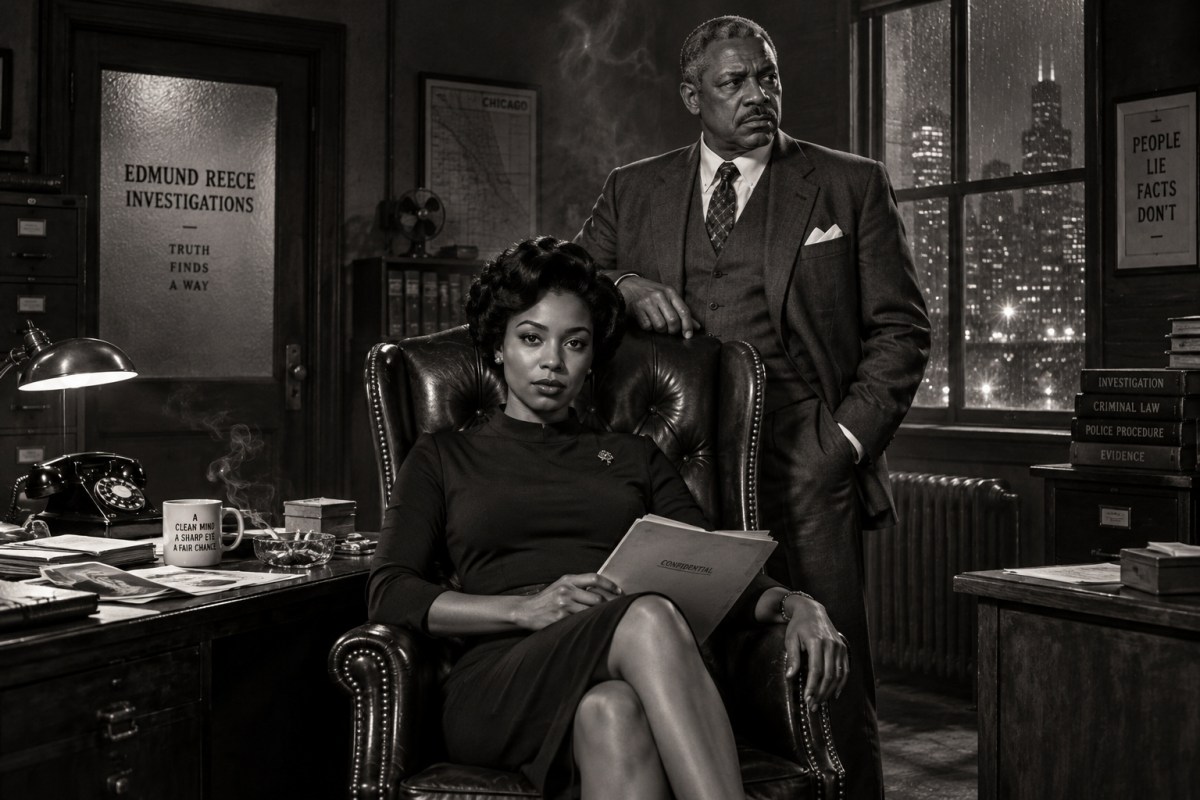
EDMUND REECE INVESTIGATIONS
Chicago, Illinois — October 1956
Roberta Packard had always maintained that the dead were considerably more reliable than the living. They rarely changed their stories, never complained about the weather, and, provided the undertaker had done his job properly, generally stayed where someone put them. Unfortunately, Josephine Carter appeared determined to make a liar out of her.
The death certificate had cost Bobbie three dollars, two cigarettes, and a promise to have dinner with a clerk at the Cook County records office who had been trying to get her attention since the previous Christmas. She considered the three dollars a reasonable expense, the cigarettes a regrettable necessity, and the dinner an obligation she intended to forget at the earliest opportunity.
According to the document, Josephine Marie Carter had died on November 6, 1953, at the age of forty-two. The cause of death was listed as acute respiratory failure resulting from smoke inhalation. Her body had been identified by a relative, and burial arrangements had been handled by a funeral establishment on the South Side. There was nothing particularly unusual about the paperwork, except that Bobbie had spent the previous evening speaking to a woman who claimed to be Josephine Carter, and that woman had demonstrated an alarming familiarity with Edmund Reece’s past.
Then there was the address.
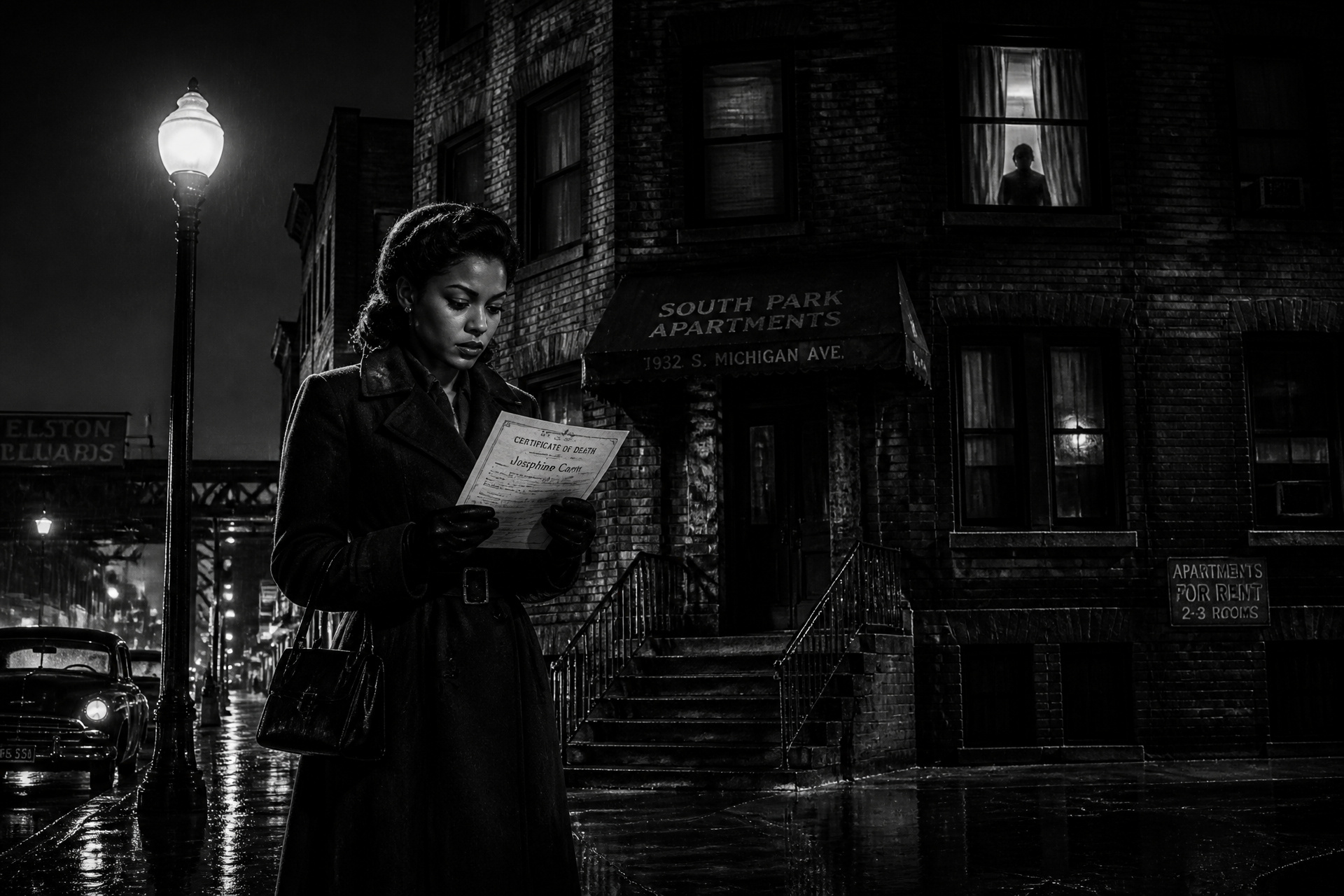
1932 South Michigan Avenue.
South Park Apartments.
Bobbie stood beneath a streetlamp across from the building, holding the certificate between her gloved fingers while the October rain settled into the kind of miserable drizzle that seemed to penetrate wool, leather, and human determination with equal enthusiasm. Her dark overcoat had begun to absorb the dampness, and the leather handbag hanging from her shoulder was becoming heavier by the minute.
She folded the document and slipped it into her coat pocket.
“Well, Josephine,” she murmured, looking toward the building, “let’s see how dead you really are.”
The South Park Apartments occupied three stories of aging brickwork on a stretch of Michigan Avenue that had once entertained ambitions of respectability. The stone steps were chipped, the iron railings rusted, and a faded awning hung above the entrance like a tired old man refusing to remove his hat. A sign beside the doorway advertised two- and three-room apartments, although Bobbie suspected the landlord’s definition of a room was considerably more generous than most people’s.
A black Chevrolet sat along the curb, its windows fogged from the rain. Farther down the street, the elevated railway rattled through the darkness, briefly drowning out the sounds of traffic before disappearing toward the Loop.
Bobbie glanced at the third floor.
A light burned behind a pair of thin curtains.
Someone stood at the window.
She couldn’t distinguish the person’s features, but the silhouette remained motionless long enough to suggest that whoever occupied the apartment had been watching her for some time.
Bobbie lowered her eyes to the death certificate again, pretending to examine it while studying the building through her peripheral vision.
When she looked up, the figure was gone.
“Now, ain’t that interesting.”
She crossed the street.
The building’s front door opened into a narrow vestibule smelling of boiled cabbage, furniture polish, and the lingering consequences of several generations of inadequate ventilation. A row of dented brass mailboxes lined one wall, their labels displaying an assortment of handwritten names, faded numbers, and the occasional empty space where a tenant had apparently departed without leaving forwarding instructions.
Bobbie examined them.
Apartment 3B bore the name CARTER.
The label was newer than the others.
She ran one gloved finger across its surface, noting the clean edges and the absence of discoloration beneath the plastic cover.
Someone had replaced it recently.
A door opened behind her.
“You looking for somebody?”
Bobbie turned.
A heavyset woman in a faded housecoat stood at the entrance to the ground-floor hallway. She was perhaps sixty, with graying hair pulled into a tight bun and the suspicious expression of someone who had spent a lifetime discovering that strangers generally wanted something.
“Good evening,” Bobbie said. “I’m looking for the building manager.”
“You’re looking at her.”
“Mrs.—?”
“Washington. Lillian Washington.”
“Roberta Packard.”
The woman looked her over.
“That supposed to mean something?”
“Not unless you’ve heard of me.”
“Can’t say I have.”
“Then we’re starting fresh.”
Mrs. Washington folded her arms.
“What do you want?”
Bobbie removed a business card from her handbag.
“Edmund Reece Investigations. I’m conducting an inquiry concerning a former tenant.”
Mrs. Washington accepted the card, studying it beneath the weak hallway light.
“Private detective?”
“Something like that.”
“What’s that supposed to mean?”
“It means I’m the person who does most of the investigating while Mr. Reece gets his name printed on the stationery.”
The older woman regarded her for a moment.
Then she laughed.
It was a deep, unexpected sound that seemed to emerge from somewhere beneath her considerable bosom.
“Well, honey, at least you know how the world works.”
“Some days better than others.”
Mrs. Washington handed back the card.
“Who you looking for?”
“Josephine Carter.”
The laughter stopped.
Bobbie noticed the change immediately.
Mrs. Washington’s expression hardened, and her eyes moved toward the staircase.
“Don’t know nobody by that name.”
“That’s unfortunate.”
“Why?”
“Because her name is on your mailbox.”
The older woman said nothing.
Bobbie waited.
One of the first things Edmund had taught her was that silence made people uncomfortable. Most people would eventually fill it with something, and whatever they offered was frequently more useful than the answer to the original question.
Mrs. Washington proved no exception.
“That apartment ain’t rented.”
“Then why does it have a name?”
“Old tenant.”
“How old?”
“Long time.”
“Three years?”
The woman looked sharply at her.
Bobbie smiled.
“Mrs. Washington, I’m not here to cause trouble. I’m trying to establish whether a woman who supposedly died three years ago might still be receiving visitors.”
“Dead people don’t receive visitors.”
“That’s generally been my experience.”
“Then what’s your business here?”
Bobbie reached into her coat pocket and withdrew the death certificate.
“This woman died in November 1953. Her last known address was this building. Yet her name is still on the mailbox, and there’s a light burning in her apartment.”
Mrs. Washington examined the document without taking it.
“People leave lights on.”
“In vacant apartments?”
“Sometimes.”
“With the curtains closed?”
“Especially then.”
Bobbie considered the answer.
Mrs. Washington was either an accomplished liar or a woman who had spent enough years managing rental property to develop an explanation for absolutely everything.
“Who pays the rent?”
The older woman stiffened.
“That’s private business.”
“Of course.”
“Landlord don’t discuss tenants with strangers.”
“Even dead ones?”
“Especially dead ones.”
Bobbie slipped the certificate back into her pocket.
“Well, I suppose I’ll have to speak with the landlord.”
“You already are.”
That stopped her.
Mrs. Washington smiled, revealing a small gold tooth.
“Building belongs to me and my brother. Been in the family since 1931.”
Bobbie studied her.
“Then perhaps you’d be willing to tell me why you’re collecting rent on an apartment nobody occupies.”
Mrs. Washington’s smile faded.
“Who said I was collecting rent?”
“You did.”
“I most certainly did not.”
“You said the apartment wasn’t rented. You didn’t say nobody was paying for it.”
The older woman stared at her for several seconds.
Then she sighed.
“Lord have mercy. You one of them.”
“One of what?”
“Women who listen too damn carefully.”
Bobbie smiled.
“My mother used to say the same thing.”
Mrs. Washington’s apartment was warmer than the hallway and smelled pleasantly of coffee, cinnamon, and something baking in the oven. A framed photograph of a young soldier occupied the mantelpiece, and a large wooden radio stood beside an armchair covered with crocheted blankets.
Bobbie accepted a cup of coffee, declining the offer of sugar.
“Josephine Carter lived here before the war,” Mrs. Washington began. “Moved into 3B in 1941. Quiet woman. Worked nights sometimes. Never caused trouble.”
“What kind of work?”
“Don’t know exactly. Office work, I suppose. She dressed nice. Always had money for the rent.”
“Visitors?”
“Some.”
“Men?”
“Mostly.”
Bobbie waited.
Mrs. Washington stirred her coffee.
“Wasn’t that kind of arrangement, if that’s what you’re thinking. They came carrying briefcases, wearing expensive suits. Sometimes they stayed an hour. Sometimes five minutes. Never heard any arguing.”
“Did you recognize any of them?”
“One or two.”
“Names?”
The older woman shook her head.
“Didn’t ask.”
“Mrs. Washington, you strike me as a woman who knows precisely what happens in her building.”
“Knowing and discussing are two different things, Miss Packard.”
Bobbie couldn’t argue with that.
“When did Josephine leave?”
“November of ’53.”
“Before or after the warehouse fire?”
Mrs. Washington’s spoon stopped moving.
Bobbie watched her.
“You know about the fire.”
“Everybody knew about that fire.”
“Did you know Josephine was supposed to have died in it?”
The older woman looked toward the window.
“That’s what they said.”
“Did you believe them?”
Mrs. Washington remained silent.
Bobbie leaned forward.
“Did you ever see her body?”
“No.”
“Attend the funeral?”
“No.”
“Did anyone come for her belongings?”
“Yes.”
“Who?”
“A man.”
“Can you describe him?”
Mrs. Washington hesitated.
“Big fellow. Colored. Wore a dark suit. Had a mustache.”
Bobbie felt her stomach tighten.
“How old?”
“Forty, maybe forty-five. Hard to say.”
“Did he give you a name?”
The older woman nodded.
“Reece.”
For a moment, Bobbie heard nothing except the ticking of the clock above the mantel.
“Edmund Reece?”
“That’s him.”
Bobbie placed her coffee cup on the table.
“What did he take?”
“Two suitcases. Some papers. A little wooden box.”
“Anything else?”
Mrs. Washington looked uncomfortable.
“He asked me not to rent the apartment.”
“For how long?”
“Didn’t say.”
“And you’ve kept it vacant for three years?”
“Not exactly.”
Bobbie leaned forward.
“What does that mean?”
The older woman stared into her coffee.
“Somebody comes by every month.”
“Who?”
“Different people.”
“To pay the rent?”
“Yes.”
“In cash?”
“Always.”
“Do they go upstairs?”
“Sometimes.”
Bobbie considered this.
“Have you ever been inside since Josephine disappeared?”
“Once.”
“When?”
“Last winter. Pipe froze. Had to send my brother up.”
“What did he find?”
Mrs. Washington’s face changed.
For the first time, Bobbie saw genuine fear.
“He said somebody had been living there.”
“Who?”
“Didn’t see nobody.”
“What made him think someone was living there?”
“Fresh food in the icebox. Clothes in the closet. Bed made up.”
Bobbie looked toward the ceiling.
“And you never reported it?”
“Report what? Somebody paying rent and keeping an apartment clean?”
“Mrs. Washington—”
“Listen here, young lady. I own this building. My brother and me worked twenty-five years to keep it. I don’t need police coming around asking questions about people who pay their bills and don’t bother nobody.”
Bobbie understood.
A Black woman owning property in Chicago had enough difficulties without inviting the attention of the police.
She wasn’t going to condemn Mrs. Washington for protecting what she’d built.
“Fair enough,” Bobbie said.
The older woman relaxed slightly.
“Can I see the apartment?”
“No.”
“Mrs. Washington—”
“No.”
Bobbie sighed.
“Then perhaps you can answer one more question.”
“What?”
“Who paid the rent this month?”
Mrs. Washington looked at her.
For several seconds, she appeared to be deciding whether the truth was worth the trouble it might bring.
Finally, she rose from her chair and crossed to a small writing desk.
She opened a drawer, removed a receipt book, and flipped through several pages.
Then she placed it before Bobbie.
October 1, 1956.
Apartment 3B.
Rent received: $65.00.
Paid by: E. Reece.
Bobbie stared at the handwriting.
The signature was unmistakable.
She had seen it on hundreds of checks, contracts, and letters.
Edmund Reece.
Her employer.
Her mentor.
The man who had spent the previous evening pretending he knew nothing about Josephine Carter’s whereabouts.
Bobbie slowly closed the receipt book.
“Well,” she said quietly, “isn’t that something.”
Mrs. Washington eventually agreed to let her inspect the apartment, although she insisted on remaining downstairs.
Bobbie climbed the narrow staircase alone.
The third-floor hallway was dimly illuminated by a single overhead bulb. The wallpaper had begun peeling near the ceiling, and the floorboards complained beneath her shoes.
Apartment 3B stood at the far end.
She knocked.
No answer.
She waited.
Then knocked again.
Still nothing.
Bobbie removed the key Mrs. Washington had reluctantly surrendered and slipped it into the lock.
It turned easily.
Too easily.
She pushed the door inward.
The apartment smelled faintly of cigarette smoke and lavender.
A small table stood beside the window, its polished surface holding an ashtray, a porcelain cup, and a folded newspaper.
The furniture was old but clean.
The curtains were drawn.
Bobbie crossed the room, careful not to disturb anything.
The newspaper was dated October 10.
Yesterday.
She touched the cup.
Cold.
Then examined the ashtray.
Two cigarette butts rested inside.
One had been crushed against the glass with considerable force.
The other had burned almost completely down.
Someone had been waiting.
And someone else had been nervous.
Bobbie moved toward the bedroom.
The bed was neatly made, a dark wool coat hung inside the closet, and a pair of women’s shoes stood beneath a chair.
On the dresser sat a framed photograph.
Bobbie picked it up.
A young woman stood beside a man wearing a dark suit.
The woman was unmistakably Josephine Carter.
The man was Edmund Reece.
They stood close together, his hand resting lightly against her waist.
Bobbie studied the photograph.
Edmund looked younger, perhaps forty, and Josephine wore an expression Bobbie had never seen on the woman who visited the agency.
Happiness.
Genuine, unguarded happiness.
She turned the photograph over.
Written in blue ink were three words.
Before everything changed.
No date.
No signature.
Bobbie replaced it carefully.
Then she noticed the envelope beneath the dresser.
It had been pushed partially underneath, as though someone had dropped it while searching through the room.
She knelt and retrieved it.
Inside was a single sheet of paper.
A letter.
The handwriting was hurried, uneven, and unmistakably feminine.
Edmund,
I know what they told you about Sarah. I know what you believe happened that night. But they lied to you, and I helped them.
I have spent three years trying to decide whether telling you the truth would make things better or simply get us both killed.
I can’t keep doing this.
Sarah was alive when they took her from the warehouse.
And I know who ordered it.
There was no signature.
Bobbie read the letter twice.
Then a third time.
She folded it carefully and placed it inside her coat.
For three years, Edmund Reece had been paying the rent on an apartment belonging to a woman supposedly dead.
For three years, he had kept the arrangement secret.
And somewhere in the middle of it all was a daughter he claimed had disappeared.
Bobbie looked toward the window.
The curtains shifted slightly in the draft.
She crossed the room and pulled them aside.
From the third floor, she could see the streetlamp where she had stood earlier, the parked Chevrolet, and the wet pavement stretching toward the intersection.
Then she noticed something else.
The Chevrolet was gone.
In its place stood a dark Buick.
Its engine was running.
A man sat behind the wheel.
Even from three stories above, Bobbie recognized the broad shoulders and familiar profile.
Edmund Reece.
She stared.
He was supposed to be recovering from a gunshot wound.
He was supposed to be at home.
And he had specifically told her to stay away from Josephine Carter’s apartment.
Bobbie stepped back from the window.
“Well, I’ll be damned.”
The telephone rang.
She turned.
A black rotary telephone sat on a small table beside the sofa.
It rang again.
Bobbie approached slowly.
A third ring.
She lifted the receiver.
“Hello?”
A woman’s voice answered.
“Miss Packard?”
Bobbie recognized it immediately.
Josephine.
“Where are you?”
“That isn’t important.”
“It is to me.”
“Did you find the letter?”
Bobbie looked toward the window.
“Yes.”
“Then you know.”
“Know what?”
A pause.
“That Edmund has been lying to you.”
Bobbie glanced at the photograph on the dresser.
“That much I’ve figured out.”
“There’s something else.”
“Of course there is.”
“Don’t let him into the apartment.”
Bobbie frowned.
“Why?”
“Because the man sitting in that Buick isn’t Edmund Reece.”
The line went dead.
Bobbie remained motionless.
Outside, the Buick’s headlights went dark.
A car door opened.
Then closed.
Footsteps sounded on the pavement.
Bobbie slowly replaced the receiver.
She crossed the room and switched off the lamp.
The apartment fell into darkness.
For several seconds, she stood beside the window, watching the street below.
The man from the Buick entered the building.
A moment later, the front door slammed.
Bobbie heard footsteps on the staircase.
Slow.
Deliberate.
Coming upward.
She reached beneath her coat and withdrew her Colt Detective Special.
The footsteps reached the second-floor landing.
Then continued.
Bobbie moved beside the apartment door, keeping herself clear of the narrow strip of light beneath it.
She had come looking for answers.
Instead, she had discovered that a dead woman might still be alive, a missing girl might have survived, and the man who had taught her everything she knew about investigating crimes had been paying to preserve a secret for three years.
Now someone was climbing the stairs.
Someone who looked like Edmund Reece.
Someone who apparently wasn’t.
Bobbie checked the cylinder of her revolver.
Six rounds.
She closed it quietly.
The footsteps stopped outside Apartment 3B.
A shadow passed beneath the door.
Then came three soft knocks.
“Bobbie?”
The voice was Edmund’s.
She didn’t answer.
“Bobbie, I know you’re in there.”
She tightened her grip on the revolver.
The doorknob turned.
And for the first time since joining Edmund Reece Investigations, Roberta Packard found herself wondering whether the man on the other side of the door was someone she should trust.
Or someone she might have to kill.
To be continued.
Discover more from Memoirs of Madness
Subscribe to get the latest posts sent to your email.


How can you leave me hanging like that!!!!! More please……………………….
LikeLike
I want that next installment!
LikeLike