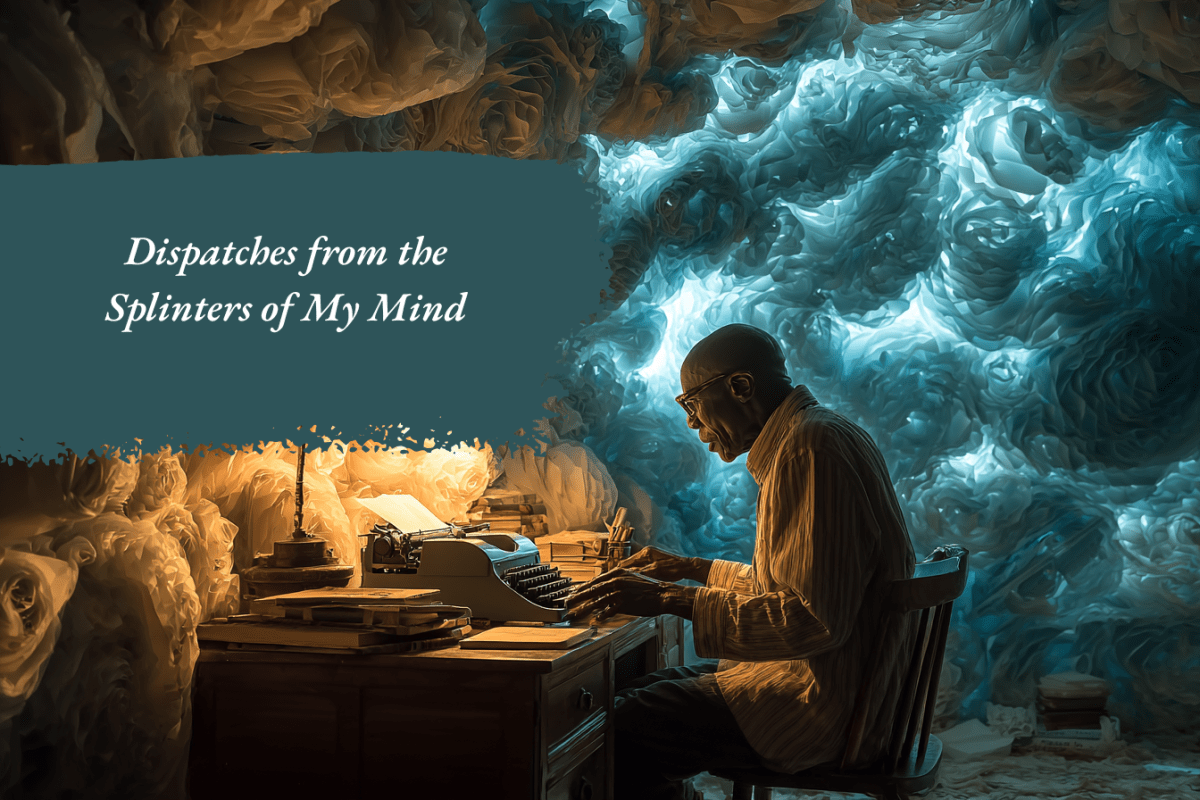
Dispatches from the Splinters of My Mind — Entry 39
The first thing I remembered was the smell of oranges.
Not the oranges themselves, although I could picture them well enough, piled in a chipped ceramic bowl beside a kitchen window overlooking a garden that had surrendered to winter. It was the smell of their peels, sharp and sweet, mingling with the faint bitterness of coffee and the peculiar warmth of a house that had been occupied by the same people for decades. Somewhere beyond the kitchen, a child was laughing. A floorboard complained beneath approaching footsteps. Someone called my name with the comfortable impatience of a person who had been calling it for years.
I opened my eyes.
There was no kitchen. No garden. No child.
Only the pale November light filtering through the blinds of my apartment, illuminating dust suspended above the dresser. The radiator hissed beneath the window, and somewhere in the building’s ancient plumbing, water hammered against a pipe with the persistence of an unwelcome visitor.
I lay there for several minutes, waiting for the memory to dissolve into the harmless nonsense of dreams.
It didn’t.
I could still smell the oranges.
By the time I reached the bathroom, I was crying.
The peculiar thing about grief is that it doesn’t always bother introducing itself. Sometimes it arrives already unpacked, takes possession of the furniture, and begins rearranging your life before you’ve had the opportunity to ask whom you’re supposed to be mourning.
I stood before the mirror, studying a face I had known for thirty-eight years. The small scar beneath my left eyebrow remained where a bicycle accident had placed it when I was eleven. The faint lines beside my mouth had deepened during the past winter. My hair, once stubbornly black, had begun surrendering individual strands to silver.
Everything was familiar.
Except the woman looking back at me seemed terribly young.
Not in appearance, but in some deeper, less negotiable sense. I felt as though I had already lived long enough to become someone else, and the face in the mirror belonged to a person I had abandoned decades earlier.
I pressed my fingers against the glass.
For one impossible instant, I remembered those fingers being smaller, darker with age, the knuckles swollen from arthritis. I remembered struggling to fasten a necklace behind my neck while someone waited downstairs. I remembered the peculiar embarrassment of needing assistance with things that had once required no thought at all.
Then the memory vanished, leaving behind an ache in my hands.
I turned on the faucet and held them beneath the cold water until the sensation passed.
The clocks began misbehaving on Thursday.
At first, I blamed the batteries. The kitchen clock stopped at 6:17, while the small brass carriage clock on my bookshelf insisted it was twenty minutes past eleven. My telephone displayed the correct time, or what I assumed was the correct time, although I had begun entertaining uncomfortable suspicions about the reliability of such things.
I replaced the kitchen clock’s battery.
Its second hand moved backward.
Not continuously. Just three small movements, like an insect reconsidering its direction, before resuming its ordinary progression.
I watched it for nearly an hour.
There are certain experiences that become considerably more disturbing when witnessed without interruption. A shadow moving across a wall can be dismissed as imagination. A whispered voice can be attributed to a neighbor. But when something impossible happens in front of you, and you remain long enough to watch it happen again, the mind begins searching for explanations that are frequently more frightening than the event itself.
At 7:42, I remembered my daughter’s seventh birthday.
Her name was Amelia.
She had worn a yellow dress with crooked white buttons and insisted upon chocolate cake despite being allergic to something in the frosting. I remembered arguing with her father about whether we should allow it. I remembered his laughter, the way he lifted her onto the kitchen counter, and the little crescent-shaped birthmark behind her right ear.
I remembered loving her with an intensity that made every other emotion seem like an unfinished rehearsal.
I had never been pregnant.
I had never married.
And I had certainly never known anyone named Amelia.
Nevertheless, I spent the remainder of Thursday searching through old photographs, examining the faces of children in the backgrounds, wondering whether I might recognize a daughter who had never existed.
By evening, I had developed a headache that seemed to originate somewhere behind my eyes. I could hear a clock ticking, although I had removed the batteries from every clock in the apartment.
At midnight, I whispered Amelia’s name into the darkness.
From somewhere beyond my bedroom door, a child whispered, “I’m here.”
I didn’t open it.
Friday brought the husband.
His name was Daniel, although I remembered calling him Danny when we were young and Daniel when I was angry. He had a narrow face, beautiful hands, and an irritating habit of leaving half-finished cups of tea throughout the house. He was a carpenter who could build almost anything except a convincing apology.
I remembered meeting him at a railway station during a thunderstorm.
I remembered the weight of his coat across my shoulders, the smell of wet wool, and the sound of his voice asking whether I believed in accidents.
I remembered answering that I believed in poor planning.
He laughed.
That laugh stayed with me throughout the morning, appearing unexpectedly between ordinary thoughts. I heard it while brushing my teeth, while waiting for the kettle, while standing in the grocery store trying to remember why I had gone there.
By afternoon, I remembered burying him.
The cemetery was small, bordered by iron fencing and a row of ancient sycamores. Rain had softened the earth around the grave, and the minister’s voice seemed to come from a considerable distance. Amelia stood beside me, no longer seven but a woman with tired eyes and her father’s stubborn mouth.
She held my hand.
I remembered the terrible absence of Daniel’s fingers.
And then I found myself standing in the grocery store, clutching a carton of milk so tightly that its cardboard sides had begun to buckle.
A young employee asked whether I needed assistance.
I told him my husband had died.
He apologized with the awkward sincerity of someone who had not yet learned that apologies are useless against death.
I almost thanked him.
Instead, I abandoned the milk and went home.
By Saturday, the memories had begun arriving without permission.
They came while I slept and while I was awake, interrupting conversations, invading familiar rooms, settling over ordinary objects until I could no longer distinguish between what I had experienced and what I merely remembered experiencing.
I recalled a summer spent beside the sea, although I had never lived near an ocean. I remembered a red bicycle, a dog named Bishop, a house fire that destroyed everything except a grandfather clock, and an argument with my sister that lasted eleven years.
I had no sister.
Yet I remembered the reconciliation.
We sat together beneath a hospital window, both of us too old and too exhausted to defend the grievances we had carried for so long. She smelled of lavender and cigarettes. I remembered forgiving her without ever deciding to do so.
When that memory passed, I found myself seated on the kitchen floor, holding a telephone against my ear.
I had dialed a number.
Someone was answering.
“Hello?”
The voice was elderly, thin with sleep.
I knew it.
Not because I had heard it before, but because something inside me recognized the particular rhythm of its breathing.
“Who is this?” I asked.
There was a long silence.
Then the woman said, “You shouldn’t remember me yet.”
The connection ended.
I remained on the floor until the room grew dark.
Sunday morning, I discovered the photograph.
It had been slipped beneath my apartment door sometime during the night. There was no envelope, no note, no explanation. Just a small black-and-white photograph with curled corners and a crease running diagonally through its center.
Three people stood before a modest house.
A man in shirtsleeves leaned against the porch railing. Beside him stood a little girl wearing a yellow dress. The third figure was a woman whose hair had been gathered into an untidy knot.
I recognized Daniel immediately.
Amelia was smiling.
And the woman was me.
Not someone who resembled me. Not a distant relative whose features had survived through generations. Me, unmistakably, although the woman in the photograph appeared to be at least sixty years old.
Her face was weathered, her posture slightly stooped, and one hand rested against the child’s shoulder.
The other hand was missing.
Not hidden behind her back or obscured by the angle.
Missing.
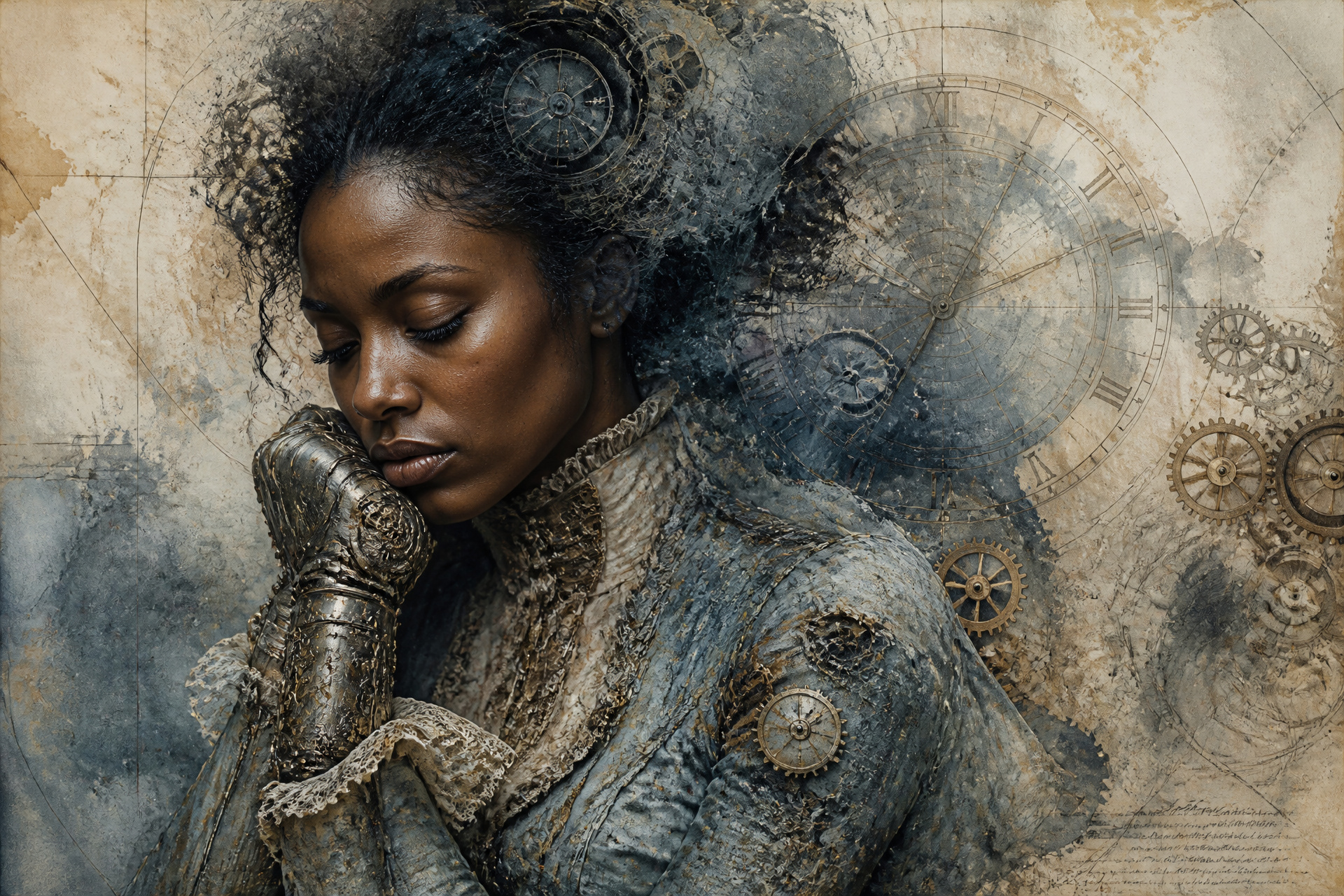
In its place was an elaborate mechanical construction of silver joints, brass fittings, and delicate interlocking gears. The fingers were slender and beautifully made, their surfaces engraved with patterns too intricate to distinguish without magnification.
I stared at that hand for a long time.
Then I looked at the date written on the back.
October 17, 1946.
Forty-two years before I was born.
Beneath the date, someone had written three words.
Before she remembers.
I turned the photograph over again.
The woman’s eyes were closed.
Her mechanical hand rested against her cheek.
And although the photograph was nearly eighty years old, I could see a small scar beneath her left eyebrow.
That evening, I began hearing the machinery.
It started as a faint clicking behind my right ear, barely distinguishable from the radiator’s familiar complaints. By midnight, the sound had developed a rhythm. Tiny metallic movements, measured and precise, accompanied by the occasional soft scrape of something turning against resistance.
I pressed my palm against the side of my head.
The clicking stopped.
When I removed my hand, it resumed.
I considered calling a doctor. I considered calling the police. I even considered calling the elderly woman whose number remained in my telephone’s recent history.
Instead, I sat before the bathroom mirror.
The woman looking back at me seemed exhausted. Her eyes were swollen, her lips dry, and the silver strands in her hair had multiplied considerably since Thursday.
I raised my right hand.
She raised hers.
I touched my cheek.
She did the same.
Then, very slowly, I closed my eyes.
I remembered a room filled with clocks.
Hundreds of them, perhaps thousands, suspended from walls that disappeared into darkness. Some were enormous, their hands moving with the solemn determination of astronomical instruments. Others were small enough to fit inside a child’s palm.
At the center of the room stood a chair.
Someone was sitting in it.
I couldn’t see her face, but I recognized the silver hair, the elaborate blue garment, and the delicate mechanical hand resting against her cheek.
She was crying.
Not loudly. There were no sobs, no trembling shoulders, no theatrical surrender to grief.
Just tears moving silently across a face that had grown accustomed to carrying things no one else could see.
I approached her.
The clocks began stopping.
One after another, their ticking surrendered to a silence so complete that I could hear the blood moving through my own body.
When I reached the chair, the woman opened her eyes.
They were mine.
But older.
Much older.
“Where is Amelia?” I asked.
She looked at me with an expression I couldn’t understand.
Pity, perhaps.
Or recognition.
“Which one?” she whispered.
I woke on the bathroom floor.
Morning light had begun filtering through the blinds. My cheek was pressed against the cold tile, and my right arm had gone numb beneath me.
For several minutes, I remained motionless, listening.
The machinery had stopped.
The clocks were silent.
Even the radiator seemed reluctant to disturb the morning.
I pushed myself upright and looked toward the mirror.
My reflection was waiting.
She was seated on the edge of the bathtub, wearing an elaborate blue garment I had never owned. Her silver hair had been gathered loosely above her head, and her right hand was a delicate arrangement of tarnished metal and intricate gears.
She appeared tired.
Terribly tired.
I touched my cheek.
She didn’t move.
Instead, she lowered her mechanical hand and looked toward the bathroom door.
From the hallway came the sound of small footsteps.
Then a child’s voice.
“Mommy?”
I turned.
The hallway was empty.
When I looked back, the mirror reflected only the bathroom.
I stood there until the sunlight moved across the floor.
Then I heard a clock ticking.
Not from the kitchen.
Not from the bedroom.
From somewhere inside my chest.
And with every measured movement, I remembered another hour.
Another room.
Another face.
Another life.
Somewhere among them, I remembered standing beside a hospital bed, watching a woman with silver hair struggle to breathe. Her mechanical hand lay motionless against the sheets. A little girl stood beside me, holding a bowl of oranges.
The woman opened her eyes.
She looked directly at me.
And with the last of her strength, she whispered something I had been trying to remember since Thursday.
I leaned closer.
The clock inside my chest missed a beat.
Then another.
And finally, I heard her.
“You were supposed to be the one who forgot.”
Until next Tuesday, when another splinter finds its way to the surface.
Discover more from Memoirs of Madness
Subscribe to get the latest posts sent to your email.

