Dispatches from the Splinters of My Mind — Entry 38
Marquis Brewer had been waiting for the number forty-seven for nearly twenty minutes when the old man informed him that the bus was nineteen years late.
He said it casually, as though discussing the weather or the disappointing quality of modern coffee, and Marquis might have laughed if the man hadn’t been looking at him with the peculiar familiarity of someone recognizing an old debt.
“Nineteen years?”
“Give or take.”
“Then why the hell is there still a bus stop?”
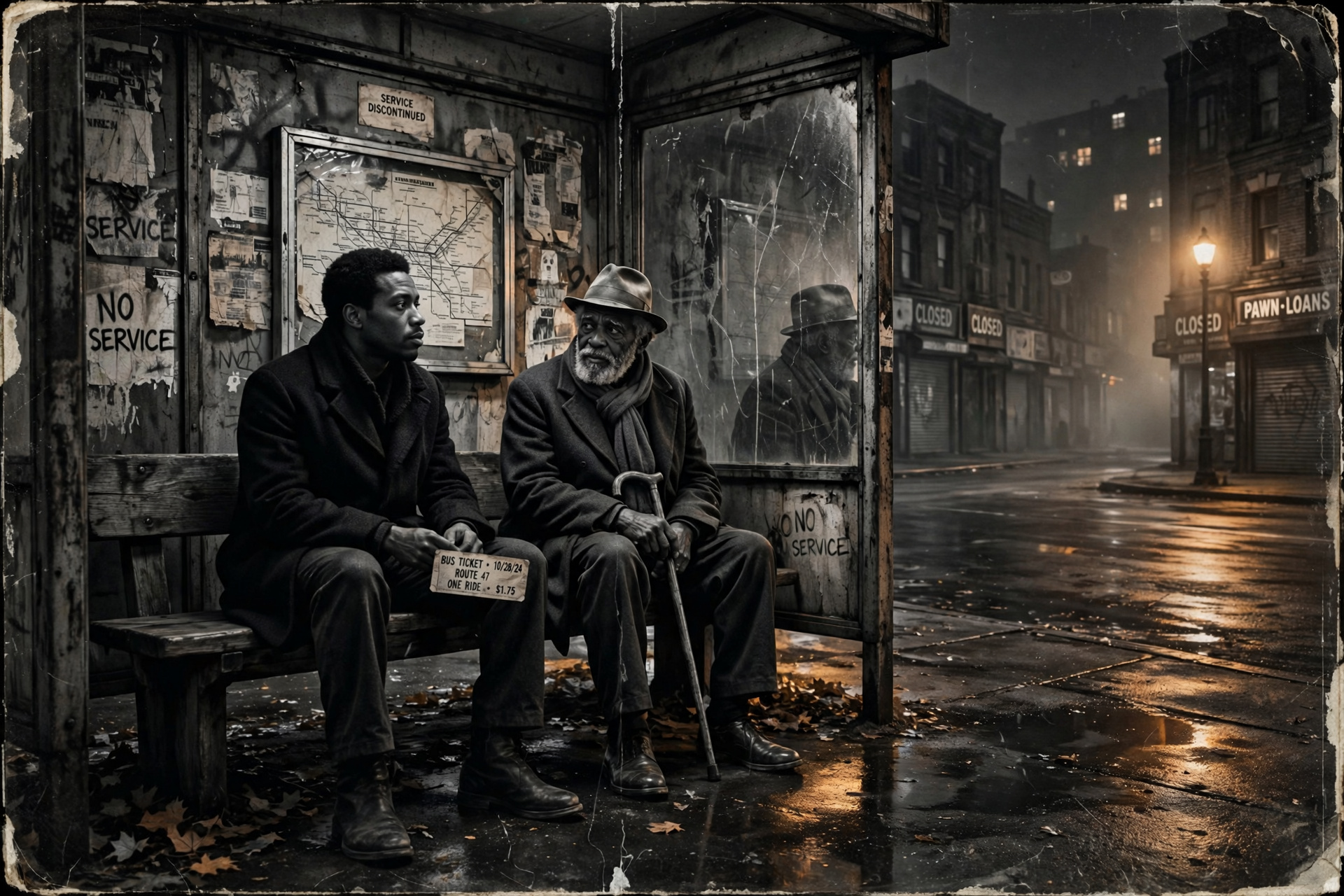
The old man adjusted his hat, a weathered gray fedora that had probably been fashionable when people still dressed properly to visit the grocery store. His beard was silver, his coat considerably older than it appeared, and his hands rested comfortably atop the curved handle of a wooden walking cane.
“Son, this city is full of things nobody bothered to take down after they stopped being useful.”
Marquis looked toward the shuttered storefronts across the street.
He couldn’t argue with that.
The neighborhood had the exhausted appearance of somewhere that had once mattered. Brick buildings stood shoulder to shoulder beneath a sky the color of dirty dishwater, their upper windows reflecting the occasional passing cloud while the ground floors surrendered to plywood, rusted security grates, and advertisements for businesses that no longer existed. A pawnshop occupied the corner, its faded lettering promising CASH FOR GOLD beneath a sign announcing it was CLOSED. Across the intersection, a streetlamp threw a weak amber circle onto wet pavement, illuminating autumn leaves that had collected along the curb like forgotten correspondence.
Rain had stopped sometime before midnight, leaving behind the smell of damp concrete, rotting leaves, and the metallic breath of a city cooling beneath its own weight. Somewhere beyond the buildings, a siren rose and fell, followed by the distant rumble of freight moving through the industrial district.
Marquis shifted on the wooden bench.
The shelter’s glass panels were scratched and clouded with years of neglect. Behind him, an old transit map displayed a complicated arrangement of colored lines, most of which had been crossed out or obscured by peeling notices. Above it, a small municipal sign read:
SERVICE DISCONTINUED.
He had noticed it when he arrived.
He had chosen not to believe it.
That, he supposed, was becoming something of a habit.
“How long you been sitting here?” Marquis asked.
The old man considered the question with unnecessary seriousness.
“Tonight?”
Marquis turned toward him.
“There’s another answer?”
“Usually is.”
The old man smiled, revealing a narrow gap between his front teeth. Something about the expression unsettled Marquis, although he couldn’t have explained why. It reminded him of somebody, perhaps an uncle or one of the older men who had occupied his childhood, sitting on porches and dispensing opinions nobody had requested.
“Name’s Jerrod,” the old man said.
“Marquis.”
“That’s a fine name.”
“My mother thought so.”
“Smart woman.”
“You don’t know my mother.”
Jerrod shrugged.
“Didn’t say I did.”
Marquis looked away.
He wasn’t in the mood for riddles.
He had spent the better part of six hours walking through neighborhoods he barely recognized, passing buildings that had changed ownership, streets that had acquired new names, and vacant lots where houses once stood. His shoes were damp, his stomach empty, and the cold had worked its way through his coat until his shoulders ached from holding themselves tight.
He had intended to go home.
That was the ridiculous part.
He knew the address.
Could have recited it backward if someone had offered him enough money.
He knew the cracked concrete steps, the loose porch railing, the narrow hallway that smelled of furniture polish and old cooking grease. He knew which floorboard complained outside the kitchen and how the front door required a firm lift before the lock would turn.
He knew the house better than he knew most people.
But somewhere between leaving his apartment and arriving at the bus shelter, he had begun wondering whether knowing a place was the same thing as belonging there.
The thought irritated him.
He had no patience for philosophical nonsense, particularly his own.
Jerrod tapped his cane against the pavement.
“You waiting on somebody?”
“Bus.”
“Already established that ain’t happening.”
“Then I guess I’m waiting on a miracle.”
“Those don’t usually run on a schedule.”
Marquis almost smiled.
Almost.
He reached into his coat pocket and removed a folded bus ticket. The paper had softened from repeated handling, its corners worn and slightly curled. He flattened it against his knee.
ROUTE 47 — OCTOBER 28, 2024.
Two years old.
He had bought it on a cold afternoon when the sky looked remarkably similar to tonight’s, intending to leave the city before sunset. He had packed one suitcase, withdrawn enough money to last several weeks, and stood at a terminal watching passengers board a bus headed west.
Then his phone rang.
He remembered the conversation.
Or enough of it.
Someone had needed him.
Someone always needed him.
By the time he finished talking, the bus had gone.
He had kept the ticket.
At first, because he intended to exchange it.
Later, because throwing it away felt like admitting something.
Jerrod leaned slightly toward him.
“That ticket looks like it’s been through a war.”
“Something like that.”
“Still good?”
“Probably not.”
“Then why you carrying it?”
Marquis folded the paper.
“Because I paid for it.”
Jerrod laughed, a low, gravelly sound that seemed to come from somewhere deep inside his chest.
“Well, hell. By that reasoning, I ought to still be driving a ’68 Buick.”
Marquis glanced at him.
“What happened to it?”
“Transmission went bad.”
“You get it fixed?”
“Nope.”
“Why not?”
“Cost more than the car was worth.”
Jerrod settled back against the shelter wall.
“Sometimes you got to know when something’s finished.”
Marquis stared at the ticket.
He disliked how easily the conversation had found its way into territory he had spent the evening avoiding.
The trouble had begun shortly after dinner.
Not with shouting.
That came later.
It began with an ordinary question delivered in an ordinary voice across an ordinary kitchen table.
What are you going to do?
Marquis had heard variations of that question for most of his adult life.
What was he going to do about his job?
His apartment?
His future?
His responsibilities?
His tendency to disappear into himself whenever life became complicated?
The questions weren’t unreasonable.
That made them worse.
He had answers, or at least explanations that sounded respectable when spoken with sufficient confidence. He worked. Paid his bills. Helped when he could. Called when he remembered. He wasn’t a criminal, a drunk, or some irresponsible fool waiting for the world to rescue him.
But none of those explanations addressed the thing nobody seemed willing to discuss.
He was tired.
Not the kind of tired that sleep corrected.
He was tired of entering rooms where everyone already knew who he was supposed to be. Tired of conversations that began with concern and ended with instructions. Tired of feeling that every decision he made required approval from people who would never have to live with its consequences.
And he was particularly tired of being reminded that he had choices by people who became offended whenever he exercised them.
He had said something about leaving.
Someone had laughed.
Not cruelly.
Almost affectionately.
You always say that.
He remembered the silence afterward.
Then the anger.
Then the door closing behind him.
He hadn’t intended to walk all night.
He simply hadn’t known where else to go.
“You look like somebody trying to remember where he parked his car,” Jerrod observed.
“Don’t have a car.”
“Well, that explains why you ain’t found it.”
Marquis laughed despite himself.
The old man smiled.
“There he is.”
“What?”
“Nothing.”
Jerrod looked toward the street.
For several minutes, they sat without speaking.
A loose piece of metal somewhere above the shelter clicked whenever the wind shifted. Water dripped from a damaged gutter, striking the pavement with the patient regularity of a clock nobody had bothered to wind. Across the street, a light appeared in an upstairs apartment window, illuminating the silhouette of someone moving behind a curtain.
Marquis wondered what sort of life existed inside that room.
Whether the person was happy.
Whether they were waiting for someone.
Whether they had ever considered leaving and discovered, as he had, that departure required considerably more than putting distance between yourself and an address.
“You ever leave somewhere you thought you’d spend your whole life?” he asked.
Jerrod rested both hands on his cane.
“Several times.”
“Regret it?”
“Some of it.”
“Which parts?”
“The leaving. The staying. Depends on the day.”
Marquis shook his head.
“You’re not much help.”
“Didn’t know I was being interviewed.”
The older man reached into his coat pocket and produced a small paper bag. He opened it, examined the contents, and offered it to Marquis.
“Peanuts?”
“No, thanks.”
“Suit yourself.”
Jerrod ate a handful.
Marquis watched him.
There was something oddly comforting about the man’s indifference. Jerrod didn’t seem particularly interested in fixing him, correcting him, or extracting some confession that would allow him to deliver a rehearsed piece of wisdom. He appeared content to sit beneath a broken transit sign eating peanuts while the rest of the city slept.
It was an admirable talent.
Marquis wished he possessed it.
“My father used to eat those,” he said.
“Peanuts?”
“Out of a paper bag. Always kept some in his coat.”
“Smart man.”
“You say that about everybody?”
“Only people who agree with me.”
Marquis smiled.
His father had died when he was seventeen. There were photographs, a handful of stories, and the stubborn fragments of memory that survived despite the years. He remembered large hands, a particular way of clearing his throat, and the smell of tobacco clinging to a wool coat.
There were entire branches of his family he knew almost nothing about.
Names mentioned once during holidays.
Arguments that stopped when children entered the room.
People who had disappeared from conversations long before they disappeared from photographs.
He had stopped asking questions years ago.
Adults possessed an extraordinary talent for making curiosity feel like disrespect.
Jerrod brushed salt from his fingers.
“Something funny?”
“No. Just remembering.”
“That can be dangerous.”
“So I’ve heard.”
“Memory’s a crooked bookkeeper. Always charging interest on things you thought were paid off.”
Marquis turned toward him.
For a moment, he had the peculiar sensation of hearing a familiar voice through a closed door.
He studied Jerrod’s face.
The heavy brows.
The deep lines around his mouth.
The narrow gap between his teeth.
Something tugged at the edge of recognition.
“Have we met before?”
Jerrod considered him.
“Don’t believe so.”
“You sure?”
“At my age? Hell, I’m barely sure what I had for breakfast.”
Marquis laughed.
Jerrod joined him.
For a brief moment, their laughter sounded remarkably alike.
Neither noticed.
A gust of wind pushed dead leaves beneath the bench.
Marquis looked toward the transit map.
“Why are you here?”
Jerrod followed his gaze.
“Bus stop.”
“Yeah, I figured that part out.”
“Then you’re making progress.”
“I’m serious.”
“So am I.”
Marquis leaned forward.
“The buses don’t run here anymore. You know that. You’ve probably known it longer than anybody. So what are you waiting for?”
Jerrod stopped smiling.
He studied Marquis for several seconds, his expression neither mysterious nor particularly solemn. It was the look of a man considering whether an honest answer would be worth the trouble of explaining.
Finally, he said, “You.”
Marquis stared at him.
“Me?”
“You’re the one sitting here, ain’t you?”
“That’s not an answer.”
“Wasn’t aware there was a test.”
“How’d you know I’d be here?”
Jerrod sighed.
“Son, I didn’t.”
He shifted his cane and looked toward the deserted intersection.
“I come down here sometimes. Sit a while. Remember things. Tonight you happened along, looking like somebody had stolen your last good reason to get out of bed. Figured I’d keep you company.”
Marquis considered that.
It was an ordinary explanation.
Perfectly reasonable.
Yet something about it left him strangely dissatisfied.
“Why this stop?”
Jerrod looked at the weathered route map.
“Used to be a good place to meet people.”
“Before they shut it down?”
“Long before.”
He smiled faintly.
“Met a woman here once. Prettiest thing I’d ever seen. Had a red coat and an attitude that could peel paint off a battleship.”
“What happened?”
“Life.”
“That’s all?”
“Usually is.”
Marquis waited.
Jerrod offered nothing more.
Across the street, the upstairs light went out.
The neighborhood settled deeper into darkness.
Marquis unfolded the old ticket again.
He thought about the suitcase he’d packed two years earlier. The money he’d saved. The destination he’d chosen because he knew absolutely nobody there.
He had imagined that leaving would transform him.
That somewhere beyond the city limits, he would become decisive, confident, unburdened by the expectations of people who had known him since childhood.
But he understood now that he would have carried himself along.
The uncertainty.
The anger.
The habit of explaining decisions before making them.
A different city wouldn’t automatically change any of that.
Neither would going home.
“Been going to the same house my whole life,” he said quietly.
Jerrod nodded.
“That so?”
“Different addresses over the years, but it always feels like the same house.”
“How’s that?”
“Same conversations. Same arguments. Same people telling me what I ought to do.”
“Maybe they’re worried.”
“They are.”
“Maybe they love you.”
“They do.”
“Maybe they’re right about some things.”
Marquis looked at him sharply.
“Whose side are you on?”
Jerrod raised an eyebrow.
“Didn’t know we were choosing teams.”
Marquis exhaled.
The old man continued.
“People can love you and still be wrong about what you need. You can love them and still be wrong about what they owe you. Ain’t much comfort in that, but there it is.”
Marquis stared toward the empty street.
He had wanted someone to tell him he was justified.
Someone to confirm that he had been misunderstood, mistreated, and unfairly burdened.
Jerrod refused to give him that satisfaction.
The irritating old bastard.
“You know,” Marquis said, “you’re not nearly as wise as you think you are.”
Jerrod chuckled.
“Never claimed to be wise. Just old. There’s a difference.”
For a while, neither spoke.
Then Jerrod pointed toward the ticket.
“You planning on using that?”
“Can’t.”
“Why not?”
“Expired.”
“Then why you keep checking it?”
Marquis looked down.
He had no answer.
The ticket had become a peculiar sort of permission slip, proof that once upon a time he had intended to do something different. As long as he carried it, he could tell himself the possibility remained. He could postpone the decision while preserving the illusion that he had already made it.
He had been waiting for a bus that no longer ran.
And somewhere along the way, he had mistaken waiting for movement.
Marquis folded the ticket carefully.
Then placed it in his pocket.
Not because he intended to use it.
Because he wasn’t ready to throw it away.
There was a difference.
Jerrod watched him rise.
“Heading out?”
“Think so.”
“Know where you’re going?”
Marquis looked toward the intersection.
One direction led toward the familiar house, the old arguments, and the people who loved him imperfectly. Another led toward the commercial district, where a twenty-four-hour diner still served coffee and breakfast to people whose nights had gone badly.
Beyond that, the city opened into streets he had never walked.
He could return home tomorrow.
He could call first.
He could apologize for the things he had said without surrendering the things he believed.
Or he could discover that the conversation waiting for him was one he no longer needed to have.
For once, he didn’t feel compelled to decide everything immediately.
“Not yet.”
Jerrod nodded.
“Good enough.”
Marquis stepped beyond the shelter.
The night air felt colder without its protection. He turned up his collar and looked back at the older man.
“You gonna be all right out here?”
Jerrod appeared offended.
“Been taking care of myself since before your daddy learned how to tie his shoes.”
Marquis laughed.
“All right, old man.”
“Watch who you’re calling old.”
“You got to admit you’re getting up there.”
“Boy, I’ve forgotten more birthdays than you’ve had.”
Marquis shook his head.
Then he hesitated.
“Jerrod?”
“Yeah?”
“Thanks.”
The older man waved a dismissive hand.
“Go on. Before I start charging you for conversation.”
Marquis walked toward the intersection.
At the corner, he stopped and looked back.
Jerrod remained seated beneath the shelter, his cane resting between his knees, the weak amber light outlining his hat and shoulders. Behind him, the scratched glass reflected the empty bench, the faded transit map, and the darkened storefronts across the street.
For an instant, Marquis thought he saw someone standing beside the old man.
A figure in a long coat.
Perhaps a trick of the light.
Perhaps another reflection.
He blinked.
There was nobody there.
Jerrod raised one hand.
Marquis returned the gesture.
Then he turned the corner.
He did not walk toward home.
He did not walk toward the bus terminal.
He walked toward a street he had never taken before, carrying an expired ticket and the uncomfortable understanding that he would eventually have to decide what came next.
For tonight, that was enough.
Behind him, the old neighborhood settled into its familiar silence.
Jerrod remained beneath the shelter.
He reached into his coat pocket, removed the paper bag of peanuts, and discovered it was empty.
“Well, hell.”
He crumpled the bag and tucked it away.
For several minutes, he watched the intersection where Marquis had disappeared.
There had been something familiar about the young man.
Not his face, exactly.
Something in the way he listened.
The way he held his shoulders when irritated.
The peculiar habit of pressing his thumb against the edge of his forefinger while thinking.
Jerrod had seen that gesture before.
A long time ago.
He tried to remember where.
The memory refused to cooperate.
He sighed.
“Getting old is a hell of a thing.”
Across the street, the pawnshop sign flickered once.
Then went dark.
Jerrod stood slowly, leaning on his cane until his knees agreed to support him. He adjusted his hat, buttoned his coat, and looked toward the faded transit map.
Nineteen years.
He could remember when the forty-seven ran every twenty minutes.
Remembered the drivers.
The passengers.
The arguments over exact change.
The woman in the red coat who had once stood beneath this very shelter, laughing at something he’d said.
He could almost hear her.
Almost.
Jerrod turned toward the street.
Then stopped.
Somewhere beyond the intersection, an engine rumbled.
Low.
Heavy.
Familiar.
The sound grew closer, accompanied by the faint metallic squeal of brakes and the soft hiss of compressed air.
Jerrod looked down the empty road.
A smile slowly crossed his face.
“Well,” he murmured, “would you look at that.”
The streetlamp flickered.
The engine idled.
And somewhere in the darkness, a bus door folded open.
Discover more from Memoirs of Madness
Subscribe to get the latest posts sent to your email.


Wonderful piece Mangus. Loved the way it unfolded.
LikeLike