
A story of forgotten lives, unfinished apologies, and the things that remain.
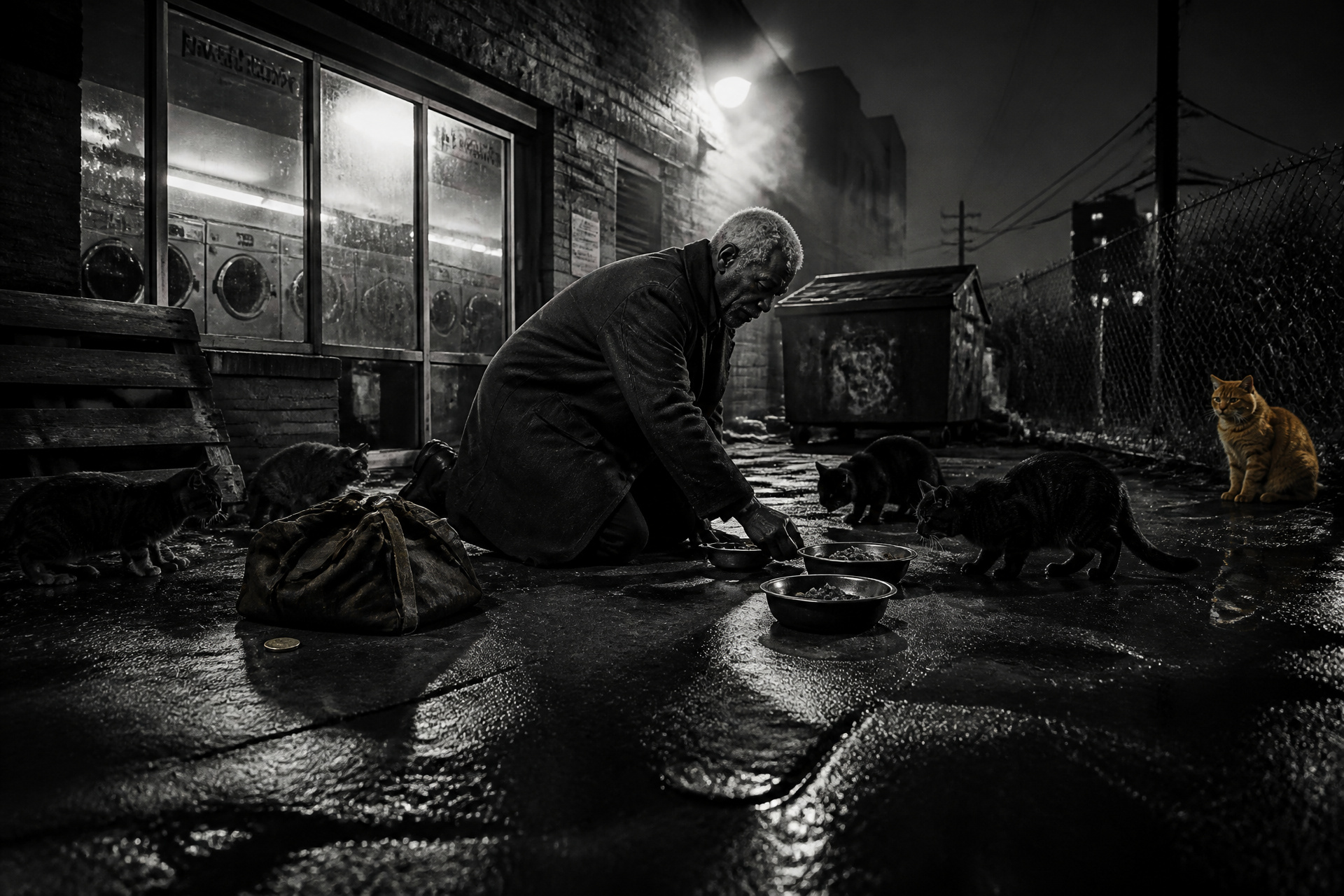
The old man arrived behind the laundromat every evening at precisely 9:14. Not nine o’clock, when the last of the evening customers began gathering their clothes, nor nine-thirty, when the night attendant usually stepped outside for a cigarette. Always 9:14, as though he had made an appointment with something that would not tolerate his being late. He came carrying a weathered canvas bag, its bottom darkened by years of grease and rainwater, and moved with the deliberate caution of someone whose knees had long ago begun negotiating the terms of every movement. The cats knew him. Before he reached the dumpster, shapes emerged from beneath abandoned pallets, behind the rusted utility boxes, and through the narrow opening in the chain-link fence. They gathered without ceremony, a mismatched congregation of torn ears, crooked tails, and suspicious yellow eyes, waiting while he arranged their supper on the concrete.
He spoke to them as he worked. Not the foolish nonsense people sometimes reserved for animals, but ordinary conversation, delivered in a low, gravelly voice that rarely carried beyond the brick walls. He asked after their health, complained about the weather, and occasionally offered observations about the peculiar habits of human beings. A gray female with one clouded eye received particular attention, while a broad-shouldered orange tomcat, whose face bore the accumulated evidence of a lifetime of poor decisions, kept his distance near the fence. The old man called him General. Every evening, he placed a separate bowl several feet away from the others. Every evening, General waited until the man retreated before approaching it.
The night attendant, a woman named Evelyn Mercer, had watched this performance for nearly four years. She knew little about the man beyond his routine. His name was Walter, or perhaps Wallace; she had heard someone call him Walt once, but never thought to ask. He wore the same brown coat through three seasons, carried an umbrella that appeared to have lost an argument with a passing truck, and always thanked her when she left the rear door unlocked during particularly bitter weather. Once, during a January storm, she had offered him coffee. He accepted, wrapping both hands around the paper cup as though warmth were something he had forgotten how to hold.
“Why cats?” she asked him.
He considered the question while watching General examine his supper with the suspicion of a restaurant critic.
“They don’t ask what you used to be,” he said.
Evelyn had expected something amusing. Instead, she found herself studying the deep lines around his mouth, the yellowed fingers curled around the cup, and the peculiar sadness that occasionally settled behind his eyes when he believed no one was watching. She thought about asking what he meant, but something in his expression persuaded her otherwise. Some questions, she had learned, were invitations. Others were trespassing.
He died in early November, although Evelyn wouldn’t learn of it until several days afterward.
The first evening he failed to appear, she assumed the cold had finally persuaded him to stay home. A hard rain had been falling since afternoon, turning the alley into a shallow river of oily reflections. At 9:14, the cats assembled beside the dumpster. They waited while water gathered along their backs and dripped from their whiskers. By ten, most had retreated beneath the pallets, but General remained near the fence, staring toward the mouth of the alley.
The following evening, they returned.
And the evening after that.
On the fourth day, Evelyn learned from a customer that an elderly man had been found dead in his apartment three blocks away. There had been no violence, no suspicious circumstances, and apparently no family immediately available to claim his belongings. The customer mentioned it while transferring towels into a dryer, then returned to discussing the rising cost of electricity. Evelyn listened without interrupting. Later, she stood behind the laundromat with a bag of cat food and wondered how a man could spend years appearing at the same place every evening and still leave so little evidence that he had existed.
She began feeding the cats herself.
They ate, although not with their usual enthusiasm. General refused to approach her, choosing instead to watch from beneath a delivery truck. She placed his bowl near the fence, where the old man had always left it, and went back inside.
The first object appeared the following morning.
It was a small brass key, darkened with age, lying precisely where the old man had usually knelt. Evelyn assumed someone had dropped it. She placed it on the windowsill beside the rear door and forgot about it until the next morning, when she discovered a photograph resting on the concrete.
The picture showed a younger man standing beside a woman outside a modest brick house. He was smiling broadly, one arm wrapped around her shoulders, while she leaned against him with the comfortable familiarity of someone who had not yet learned to expect disappointment. A little girl stood between them, holding a stuffed rabbit by one ear. The photograph had yellowed around the edges, and a crease ran diagonally across the woman’s face.
Evelyn recognized the man immediately.
He had been handsome once, with thick dark hair and a smile that seemed almost reckless in its confidence. She studied the photograph for several minutes before noticing the cats. They had gathered around her in an uneven circle, watching without making a sound.
“Where the hell did you find this?” she asked.
Naturally, none of them answered.
Over the next several days, more objects appeared. A broken wristwatch. A train ticket dated nearly thirty years earlier. A child’s drawing of a house beneath an enormous yellow sun. A single leather glove, stiff with age. Evelyn collected them in an empty biscuit tin she kept beneath the counter, telling herself there was probably a reasonable explanation. Someone was playing a joke. Perhaps the old man had hidden his belongings somewhere nearby, and the cats were dragging them out. Neither explanation satisfied her, particularly after she examined the security footage and discovered that the camera overlooking the rear lot had recorded nothing unusual. At 9:13, the concrete was empty. At 9:15, the watch was lying beside the dumpster. Between those moments, the recording showed only a brief distortion, a scattering of gray lines that lasted less than a second.
On Thursday, a coin appeared.
It was bronze-colored, worn smooth around the edges, with a triangle stamped into one side and an inscription Evelyn could barely read. She turned it beneath the fluorescent light until the words became visible.
One Day at a Time.
She understood enough to recognize what it represented, although she had never attended a meeting herself. Turning it over, she found a number engraved beneath the accumulated scratches.
Fifteen.
For reasons she couldn’t explain, she returned the coin to the tin more carefully than the others.
The woman arrived on Saturday evening.
She was somewhere in her forties, with tired brown eyes and dark hair threaded with premature gray. She entered the laundromat carrying a folded newspaper clipping and asked whether Evelyn remembered an older gentleman who sometimes fed the stray cats behind the building. Her voice was steady, almost businesslike, but her fingers worried the edges of the paper until it began to tear.
Evelyn nodded.
“I think I knew him,” she said.
The woman gave a humorless little laugh. “That’s more than I can say.”
Her name was Rebecca. Walter had been her father.
They sat near the front window while the dryers turned behind them, their mechanical rhythm filling the spaces neither woman seemed particularly eager to occupy. Rebecca explained that she had received a telephone call from the county medical examiner. Her father had died alone, and someone had eventually found her name among his papers. She hadn’t spoken to him in eleven years.
“He drank,” she said, looking toward the parking lot. “That sounds simple when you say it like that. Two words. Doesn’t begin to explain what it was like living with him.”
Evelyn said nothing.
Rebecca continued, perhaps because silence was easier to speak into than sympathy.
“He wasn’t always terrible. That’s the part people don’t understand. Sometimes he was wonderful. He could make you laugh until your stomach hurt. He remembered the names of every teacher I ever had, knew how to fix practically anything, and made pancakes shaped like animals on Sunday mornings.” She paused, rubbing her thumb across the folded newspaper. “Then there were the other days. Eventually, there were more of those.”
She described missed birthdays, promises that dissolved by morning, and the peculiar exhaustion of loving someone whose intentions were consistently better than his actions. Her mother had stayed longer than she should have, Rebecca said, and Rebecca herself had spent years believing that if she found the right words, the right argument, or the right reason, she could persuade her father to become the man he occasionally pretended to be.
“Then I got tired,” she said. “I think that’s what people forget about families like ours. You get tired of hoping.”
Evelyn rose without explanation and retrieved the biscuit tin.
Rebecca watched as she placed it on the table.
“These started appearing after he died,” Evelyn said. “I don’t know where they came from.”
Rebecca opened the lid.
For several moments, she didn’t move. Then she lifted the photograph, holding it by the edges as though afraid the image might crumble beneath her fingers.
“That’s my mother,” she whispered. “And me.”
She examined the drawing next. Her expression changed, becoming something Evelyn couldn’t quite identify.
“I made this when I was seven. He promised he’d hang it in his workshop.”
She turned the paper over. On the back, written in faded blue ink, were four words.
For Daddy. Love, Becky.
Rebecca pressed her lips together.
“He told me he’d lost it.”
She sat quietly for a long time before reaching for the coin. When she saw the number, her face tightened.
“Fifteen years?”
Evelyn nodded. “That’s what it says.”
Rebecca stared at the small piece of metal. Her father had been sober for fifteen years. She had known about the early attempts, the meetings, the apologies that sounded painfully familiar, but she hadn’t believed the change would last. By the time she stopped answering his calls, he had already been sober for four years. She remembered that now, and the realization seemed to trouble her more than anything else in the tin.
“He used to call on Sundays,” she said. “Same time every week. I stopped picking up.”
There was no accusation in her voice. Only the exhausted recognition of a decision she had made for reasons that remained valid, even now.
“He hurt us,” she said, almost defensively.
“I’m sure he did,” Evelyn answered.
Rebecca looked at her, perhaps expecting an argument, some well-meaning lecture about forgiveness or the importance of family. None came.
“He could’ve been sober for fifty years,” she said. “It wouldn’t change what happened.”
“No,” Evelyn replied. “I suppose it wouldn’t.”
Outside, the first cats began gathering beneath the security light. Rebecca watched them through the glass, their small bodies emerging from darkness with the cautious certainty of creatures accustomed to disappointment.
“Why did he feed them?”
Evelyn remembered the January storm, the paper cup trembling slightly between the old man’s hands, and the answer he had given her.
“He said they didn’t ask what he used to be.”
Rebecca lowered her eyes.
For the first time that evening, she cried.
Not loudly. Not dramatically. Her shoulders barely moved. She simply sat with the photograph in her lap while tears slipped down her cheeks, and Evelyn, who had learned long ago that grief rarely benefited from an audience, busied herself wiping down a counter that was already clean.
At 9:14, Rebecca carried the biscuit tin outside.
The alley smelled of wet cardboard, detergent, and the faint metallic odor rising from the storm drains. The cats waited near the dumpster, their eyes reflecting the security light. Rebecca knelt where her father had knelt so many evenings before and placed the tin beside her.
“I don’t know what you wanted from me,” she whispered.
Whether she was speaking to her father, the cats, or herself, Evelyn couldn’t tell.
Rebecca remained there for several minutes, studying the photograph and running one finger along the crease across her mother’s face. Then she returned the objects to the tin, stood, and brushed the grit from her knees.
“I don’t forgive him,” she told Evelyn.
The older woman nodded.
“But I’m glad he found something worth getting up for.”
They stood together a little longer before Rebecca thanked her and walked toward the street, carrying the small collection of things her father had apparently considered worth keeping.
The next evening, Evelyn returned to the alley with a fresh bag of food.
At 9:14, the cats gathered as usual. She filled their bowls, speaking softly as she worked, although she felt foolish trying to imitate the old man’s conversations. Most of them began eating immediately. The gray female rubbed against her ankle, demanding attention, while two younger cats argued over a bowl that contained precisely the same food as the one beside it.
General remained near the fence.
Evelyn placed his supper in the customary spot and stepped away. He studied the bowl, then looked toward the empty patch of concrete where Walter had always knelt.
For several moments, the old tomcat stood motionless.
Then, ignoring his supper, he crossed the alley.
He approached the place where the old man had spent so many evenings arranging bowls, speaking to creatures that had never asked him to explain himself. General sniffed the concrete, turned once, and settled his scarred body onto the cold pavement.
Evelyn watched from the doorway.
The cat closed his eyes.
And began to purr.
Somewhere beyond the buildings, a train sounded its horn. The dryers continued turning, traffic whispered along the wet streets, and the security light hummed above the alley.
Evelyn glanced at her watch.
9:14.
She looked back toward the old tomcat, who remained curled on the concrete, his breathing slow and peaceful.
For a moment, she thought she heard someone speaking.
A low, gravelly voice, almost lost beneath the machinery.
She stepped farther into the alley.
There was no one there.
Only the cats, their supper, and an old orange tom who had finally decided there was nothing left to be afraid of.
Discover more from Memoirs of Madness
Subscribe to get the latest posts sent to your email.

