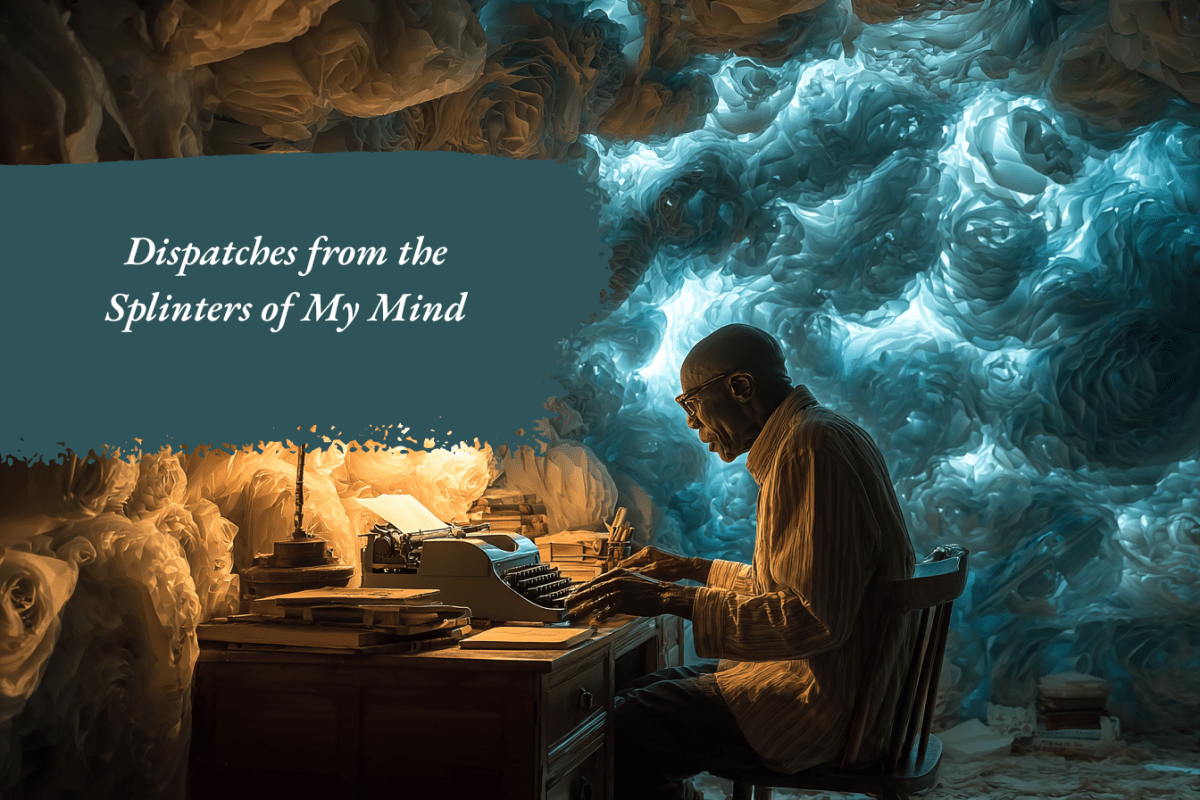
Dispatches from the Splinters of My Mind — Entry 36
The washing machine had stopped seventeen minutes ago, but Walter Bell could still hear it turning.
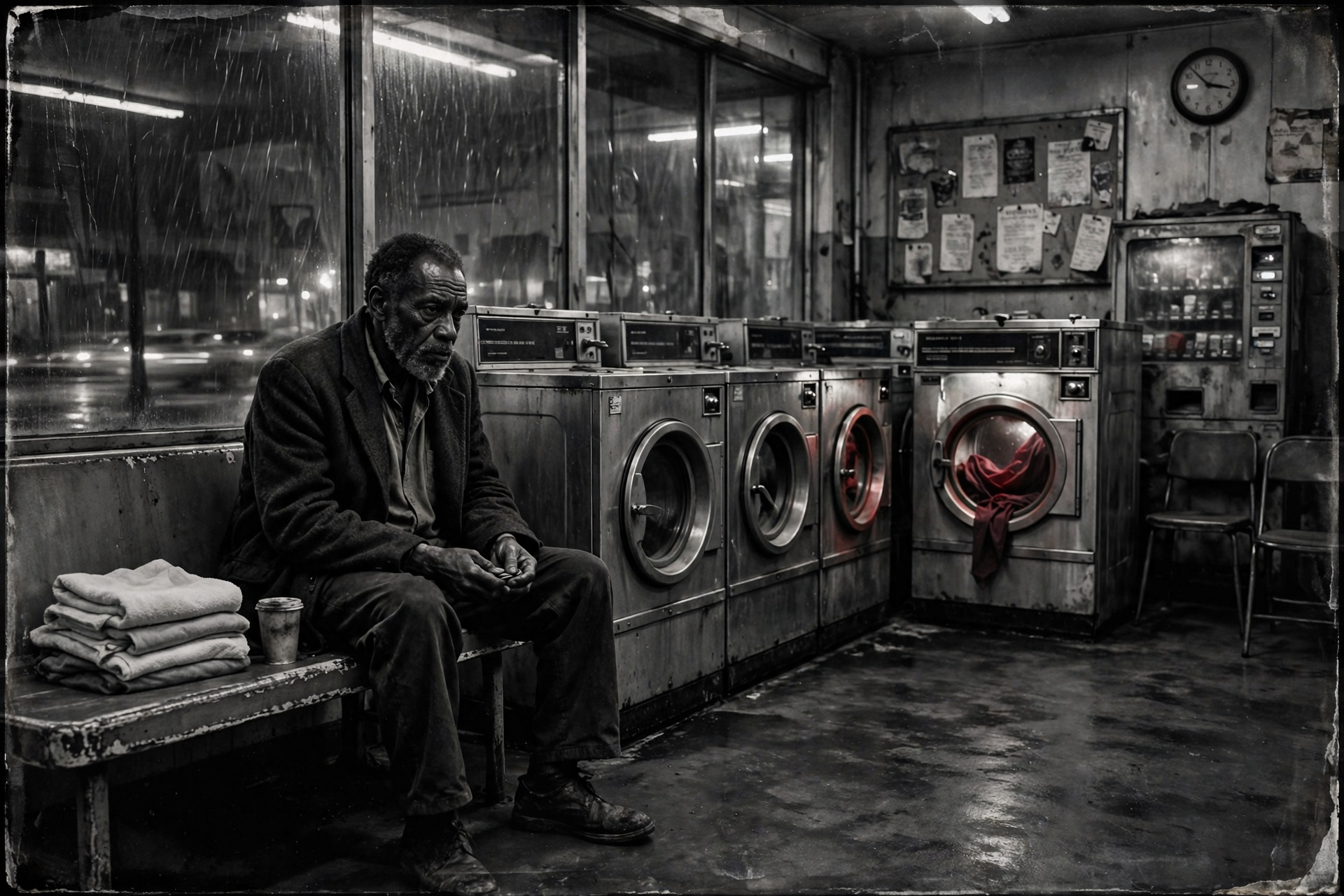
He sat on a narrow wooden bench beneath the fluorescent lights, rolling three quarters between fingers that had grown stiff with age and things he preferred not to remember. The coins were warm from his handling, their ridged edges pressing familiar grooves into his skin. Beside him, a neat stack of freshly laundered towels rested against a paper cup of coffee that had gone cold sometime before midnight. Everything was finished. Everything was clean. There was nothing left to do except gather his belongings and go home.
Walter had no intention of doing either.
Outside, rain dragged itself down the laundromat windows, turning the streetlights into long, trembling wounds of silver. Occasionally, a car passed, its tires whispering through standing water before disappearing into the darkness beyond the intersection. The building smelled of detergent, damp concrete, overheated electrical wiring, and the faint metallic bitterness that seemed to inhabit every establishment where people waited for something they couldn’t hurry. Above the vending machine, a clock with yellowed plastic hands insisted it was 3:17.
It had been 3:17 for eleven years.
Walter knew because he had been there when it stopped.
He had considered telling someone about it once, back when the difference between broken things and things worth repairing still seemed important. But the laundromat had changed owners twice, the neighborhood had surrendered three businesses to boarded windows, and nobody had ever appeared particularly troubled by the clock. People checked their phones now. Time had become something carried in pockets rather than something shared on walls.
Perhaps that was progress.
Walter had stopped keeping track.
At the far end of the room, washing machine number nine stood with its circular door hanging slightly open. A length of crimson fabric spilled across the chrome rim, its color startling against the tired machinery and gray walls. It was a woman’s scarf, long and soft, the kind that could be wrapped twice around a neck and still leave enough fabric to flutter behind its owner in a winter wind.
He had washed it forty-three times.
Not because it was dirty.
He knew that much.
The attendant knew it, too.
Eddie Marlow had worked nights at the laundromat for nearly six years, which Walter considered either a testament to the man’s patience or evidence of a deeply questionable relationship with ambition. Eddie was forty-something, narrow in the shoulders, with a perpetually irritated expression and a talent for making instant coffee taste like punishment. He spent most nights behind a scratched Formica counter reading paperback mysteries whose endings he complained about regardless of whether he had enjoyed them.
Tonight, Eddie was standing beside the vending machine, examining a packet of crackers as though it had personally offended him.
“You know,” he said without looking up, “sooner or later, you’re gonna have to take that thing home.”
Walter continued turning the quarters.
“That so?”
“That’s so.”
“Machine ain’t bothering nobody.”
“Machine ain’t the problem.”
Walter looked toward number nine.
The scarf hung motionless.
“Then I reckon we don’t have a problem.”
Eddie sighed with the weary resignation of a man who had wandered into an argument he’d already lost several dozen times. He returned to the counter, where his paperback waited beside an ashtray nobody was allowed to use anymore.
Walter listened to the rain.
There had been a time when he could remember the exact sound of her voice.
That bothered him more than he cared to admit. He could recall the peculiar way she pronounced certain words, the little hitch in her laughter when something genuinely amused her, even the impatient click of her tongue when he took too long answering a question. Yet the voice itself had begun slipping away, becoming something he recognized only in fragments. Sometimes he heard it in grocery stores or passing conversations, and his heart would stumble before his mind caught up with the mistake.
Memory was a peculiar bastard.
It preserved things you desperately wanted to forget and quietly stole the ones you would have given anything to keep.
He remembered the kitchen.
Not the whole kitchen, just the yellow light above the sink and the small puddle spreading beneath a grocery bag someone had set down carelessly. A winter evening. The smell of onions frying in butter. A radio playing something old enough to have been forgotten twice. He remembered standing near the refrigerator with his work jacket still on, holding a set of keys and feeling unreasonably irritated.
She had been talking.
He remembered that.
She had been trying to tell him something, and he had been thinking about everything except the words coming out of her mouth.
He remembered saying, “Not tonight.”
Then something about being tired.
Then the scarf.
Red against the back of a kitchen chair.
After that, the memory became unreliable.
Walter closed his eyes.
There were evenings when he could convince himself the conversation had ended differently. That he had turned around. That he had listened. That he had asked the question he should have asked instead of reaching for the door. He had reconstructed those few minutes so many times that the invented versions had begun wearing the same familiar clothes as the truth.
But there was one thing he knew with certainty.
He had left.
The rain grew heavier.
A young woman entered the laundromat carrying a plastic basket against her hip. Her hair was tucked beneath a knitted cap, and the shoulders of her coat glistened with rain. She stopped just inside the doorway, looked around at the empty machines, then approached the counter.
Eddie pointed toward the washers without raising his eyes from his book.
“Anything except nine.”
The woman glanced toward Walter.
“Broken?”
“Depends who you ask.”
Walter almost smiled.
She chose machine four.
He watched her sort clothes into separate piles, carefully examining each garment before placing it inside the drum. There was something familiar about the deliberation, the small domestic ceremony of deciding what belonged together and what might bleed into something else.
She held up a white blouse.
Considered it.
Placed it with the darker clothes anyway.
Walter wanted to warn her.
He didn’t.
He had spent enough years offering advice nobody requested.
The machine began turning, filling the room with the steady mechanical rhythm of water and fabric moving through steel. Walter felt the vibration through the bench. It traveled into his bones, settling somewhere beneath his ribs where an old ache had made itself comfortable.
He looked toward the clock.
3:17.
He remembered a telephone ringing.
That was new.
Or perhaps it wasn’t. Perhaps he had simply stopped allowing himself to remember it.
A telephone ringing in another room while he stood in the kitchen, staring at the scarf. The sound had seemed distant, almost polite, as though whoever was calling understood they were interrupting something important.
He remembered answering.
He remembered a man’s voice.
He could not remember what the man had said.
Walter opened his eyes.
The young woman was watching him.
“You okay, mister?”
He looked down at the quarters in his hand.
“Just thinking.”
She nodded, accepting the explanation with the easy courtesy strangers sometimes extended to people they would never see again.
“My grandmother used to say thinking was dangerous after midnight.”
“Smart woman.”
“She thought so.”
Walter smiled.
This time it stayed long enough to be noticed.
The woman returned to her laundry, and Walter found himself remembering another night, another room, another voice telling him he ought to get some sleep. He could see a hand resting against his chest, feel the weight of a body beside him, smell the faint sweetness of lavender soap.
Then the memory shifted.
The hand was gone.
The bed was cold.
And he was standing in a doorway with his coat on.
He couldn’t remember which part had happened first.
That frightened him.
Not the possibility that he had forgotten something important. He had grown accustomed to forgetting. Names, appointments, why he had entered a room, the location of his glasses when they were already resting on his head. Ordinary humiliations. Small betrayals committed by an aging mind.
What frightened him was the possibility that he had remembered something incorrectly for so long that the mistake had become the only truth he possessed.
Eddie approached carrying a fresh cup of coffee.
“Made too much.”
Walter accepted it.
“You’re a terrible liar.”
“Yeah, well. Coffee ain’t much better.”
Eddie sat at the opposite end of the bench.
For several minutes, neither spoke.
The younger man’s presence was an intrusion Walter had learned to tolerate. Eddie never asked questions about the scarf anymore. He never mentioned the forty-three wash cycles or the peculiar way Walter always arrived shortly before midnight and remained until the sky began turning gray.
He simply made coffee.
Sometimes that was enough.
“You remember that night?” Walter asked.
Eddie stared at the floor.
“Which night?”
Walter tilted his head toward the clock.
Eddie followed his gaze.
“Before my time.”
“Right.”
Walter nodded slowly.
“Before your time.”
He had forgotten that, too.
The clock had stopped years before Eddie began working there. Walter knew the date because he had written it on the back of a receipt he kept folded inside his wallet. The ink had faded almost beyond recognition, but the numbers remained.
3:17.
He had never written down what happened.
Eddie stood.
“Closing the counter for a bit. Gonna check the back.”
Walter nodded.
The younger man hesitated.
“Walter?”
“Yeah?”
“You know that scarf don’t need washing.”
Walter looked toward machine nine.
“I know.”
Eddie disappeared through the rear doorway.
The young woman’s machine finished its cycle. She transferred her clothes into a dryer, fed it several coins, and settled into a plastic chair with her phone. Blue light washed across her face. She smiled at something on the screen, typed a response, then smiled again.
Walter watched her for a moment.
He wondered whether she understood how much of a life could disappear between two ordinary conversations.
He hoped she didn’t.
Eventually, he rose.
His knees protested. His back offered an opinion nobody had requested. He gathered the quarters, slipped them into his pocket, and crossed the laundromat toward machine nine.
The scarf hung where he had left it.
Up close, he could see the delicate stitching along its edge, the small irregularities that suggested it had been made by hand rather than purchased from some department store. He remembered watching someone work a needle through the fabric, remembered complaining that the television was too loud, remembered being told he could always find another room.
He had laughed.
Hadn’t he?
Walter reached for the scarf.
The fabric was cool and slightly damp, softer than anything that had endured forty-three wash cycles had a right to be. He gathered it carefully, allowing the length to slide across his fingers. For a moment, he imagined wrapping it around someone’s shoulders, imagined the familiar gesture of straightening it beneath a chin.
He could almost remember her face.
Almost.
He drew the scarf from the machine.
Something remained inside.
A small envelope.
Yellowed paper, softened at the corners, resting against the bottom of the steel drum.
Walter stared.
He had checked the machine before loading it. He always checked. It was part of the ritual, as necessary as counting the quarters or choosing the same bench. There had been nothing inside except the scarf.
He looked toward the counter.
Empty.
The young woman was absorbed in her phone.
Rain whispered against the windows.
Walter reached into the machine.
The envelope was dry.
That was the first thing he noticed.
The second was his name.
Not Walter.
Not Mr. Bell.
Walt.
Written in a sloping hand he recognized before he understood why.
His fingers began trembling.
He turned the envelope over.
The flap was sealed.
There was no stamp, no address, no indication of where it had come from or how long it had been waiting. Only the name, written in blue ink that had faded toward gray.
He stood motionless beneath the fluorescent lights.
For eleven years, he had been trying to remember the last thing she said.
Now he was afraid he might find out.
The dryer behind him clicked.
The young woman rose to collect her clothes.
Somewhere in the back room, Eddie dropped something heavy and cursed.
Ordinary sounds.
An ordinary night.
Walter carried the envelope back to the bench.
He placed it beside the folded towels, sat down carefully, and stared at the handwriting.
He could open it.
There was nothing preventing him.
No locked door. No missing key. No impossible distance to cross. Just a thin strip of dried adhesive separating him from whatever waited inside.
His thumb rested against the flap.
He thought about the kitchen.
The yellow light.
The onions.
The scarf hanging over the chair.
He remembered her saying something as he reached for his coat.
Not don’t go.
Not please stay.
Something quieter.
Something he had dismissed because he had been tired, irritated, convinced there would be another evening and another opportunity to listen.
He closed his eyes.
And there it was.
Her voice.
Clearer than it had been in years.
“You never did ask me why.”
Walter opened his eyes.
The envelope remained unopened.
He looked toward the washing machines, their circular windows reflecting the fluorescent lights in pale, imperfect rings. Machine nine stood empty, its door still open.
He had spent eleven years believing he was waiting for an answer.
Now he wondered whether he had ever wanted one.
The clock above the vending machine read 3:17.
Walter folded the envelope carefully and slipped it into his coat pocket.
Then he gathered the red scarf into his lap.
For a long time, he sat without moving.
Outside, the rain began to ease. The first delivery trucks passed along the street, carrying bread, newspapers, and other necessities toward people preparing to begin another day.
Walter reached into his pocket and took out three quarters.
He rolled them between his fingers.
Once.
Twice.
Then he stood, crossed the laundromat, and placed the scarf back inside machine nine.
He closed the door.
Fed the quarters into the slot.
And waited for the water.
Behind him, the clock began ticking.
Walter didn’t turn around.
He was listening for something else.
Discover more from Memoirs of Madness
Subscribe to get the latest posts sent to your email.

