Dispatches from the Splinters of My Mind — Entry 35
She left before the song finished.
Not because of a fight. Nobody had grabbed her wrist, whispered something unforgivable into her ear, or appeared from some previous version of her life demanding payment. Nothing that convenient happened. There would be no villain to blame tomorrow morning, no dramatic story polished over coffee until leaving seemed inevitable. She had simply been standing beneath the red lights, surrounded by bodies surrendering themselves to the bass, when she looked around and realized she had absolutely no reason to be there.
The realization frightened her more than danger would have.
Danger gave you instructions.
Run.
Fight.
Scream.
Survive.
Emptiness merely handed you a mirror.
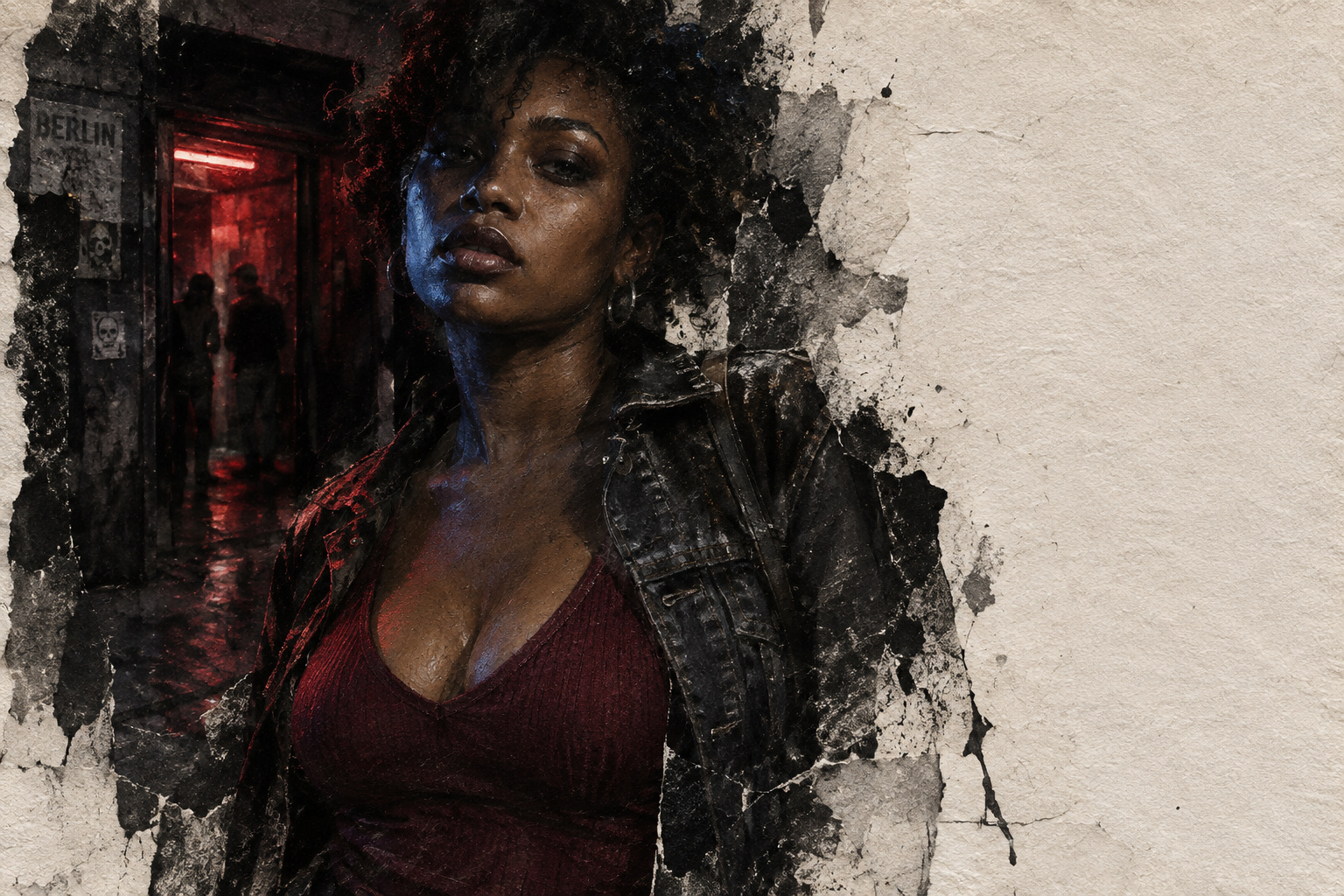
Outside, Berlin was wet without quite raining. The pavement carried the greasy shine of an old photograph, red neon stretching itself through puddles while blue light leaked from somewhere she couldn’t locate. She leaned against the wall beside the club entrance and pulled her jacket tighter, although she wasn’t cold. Behind her, the bass continued hammering through brick and concrete, softened now into something anatomical. A giant heart buried beneath the building. She could feel it between her shoulder blades.
People entered.
People left.
Nobody looked at her long enough to remember her.
She liked that.
For nearly eleven minutes, she stood beneath a broken piece of signage and pretended she was waiting for someone.
There was dignity in waiting. Waiting suggested intention. It told strangers there was a reason you were standing alone at two-thirty in the morning with your makeup beginning to surrender and your phone vibrating unanswered inside your jacket. Someone was coming. A taxi. A lover. A friend. Some necessary person delayed by traffic.
But nobody was coming.
She had made certain of that.
Her phone vibrated again.
She didn’t look.
Across the street, a man dragged a black garbage bag from a restaurant and threw it into a dumpster. Somewhere farther down the block, glass shattered, followed by laughter. A bicycle hissed across wet pavement. Cigarette smoke curled from the mouth of a woman beneath an awning and disappeared into the night as though even the air had somewhere else to be.
She pushed herself away from the wall.
Home was seventeen minutes away.
She walked in the opposite direction.
There are places we go when we don’t want to go home.
Nobody talks about them because most of them aren’t particularly beautiful. Nobody photographs the fluorescent aisle of a convenience store at three in the morning and calls it sanctuary. Nobody writes songs about laundromats where three machines are broken and somebody has abandoned a sock beneath a plastic chair. There are no postcards celebrating hospital cafeterias after visiting hours, twenty-four-hour pharmacies, train platforms, gas stations, hotel lobbies, bus shelters, parking garages, or diners where the coffee has been sitting long enough to qualify as an archaeological discovery.
But sometimes those places hold us.
Sometimes home asks questions.
These places don’t.
She found a convenience store four blocks away and wandered inside without needing anything. The fluorescent lights were brutal. They flattened everything beneath them: candy wrappers, cigarette advertisements, bottles of water, her face reflected in the refrigerator doors. There was nowhere for shadows to hide, which seemed unnecessarily cruel at that hour.
The clerk glanced up.
She picked up a bottle of water.
Put it back.
Picked up another identical bottle.
Apparently, this one had better qualifications.
She almost laughed.
That bothered her.
She hadn’t expected laughter to survive tonight.
At the register she bought the water, chewing gum she didn’t want, and a disposable lighter even though she hadn’t smoked in six years. The clerk placed everything into a thin plastic bag.
“Need cigarettes?”
She looked at the lighter in her hand.
“No.”
He waited half a second longer than necessary, perhaps expecting an explanation.
She gave him none.
Outside, she threw the lighter into the first trash bin she passed.
Then retrieved it.
She stood there with her hand inside a public trash can at three in the morning and finally laughed hard enough that tears came.
“Jesus Christ.”
A couple walking past gave her additional sidewalk.
Fair enough.
She wiped her eyes and kept moving.
She had spent the last seven years becoming someone she thought she was supposed to become. The dependable one. The reasonable one. The woman who answered messages. Remembered birthdays. Sent money. Showed up early. Forgave people before they apologized because carrying anger was supposedly unhealthy. She learned which parts of herself made other people uncomfortable and quietly sanded them down.
Too loud.
Too angry.
Too ambitious.
Too needy.
Too distant.
Too much.
Not enough.
Eventually, she had become wonderfully easy to love.
She just wasn’t entirely certain who everyone was loving.
That thought had come to her inside the club.
Not as language.
Language came later.
At first it had simply been the sight of herself in a mirror behind the bar. Red light. Blue light. Bodies moving around her. Her own face floating between bottles of gin and vodka. She had stared at the woman in the reflection and waited for recognition.
Nothing.
Then the woman smiled.
She hadn’t.
That was when she left.
She reached the train station without deciding to go there.
The platform was nearly empty. A young man slept sitting upright against a backpack. An older woman held a grocery bag between her shoes. Somewhere overhead, an electronic sign announced destinations in indifferent amber letters.
She sat.
The metal bench was cold through her jeans.
Her phone vibrated again.
This time she took it out.
Nine missed calls.
Eleven messages.
The most recent contained only three words.
Where are you?
She stared at them.
It was such a simple question.
She began typing.
I’m fine.
Deleted it.
I needed some air.
Deleted.
I’ll be home soon.
Deleted.
The cursor blinked.
Where are you?
She looked along the platform.
She could have answered geographically. Station. Street. District. Coordinates if she wanted to be particularly obnoxious. She could have sent a pin and reduced herself to a blinking dot on somebody else’s screen.
But that wasn’t what the question meant.
Not anymore.
A train arrived.
Doors opened.
The sleeping man woke and boarded without hesitation. The older woman gathered her groceries and followed him. Three other people emerged from the carriage and disappeared toward the stairs.
She remained seated.
The doors closed.
The train left.
Something inside her loosened.
Not healed.
She hated that word.
People talked about healing as though pain were a cut and time simply needed to knit the edges together. Some things didn’t close. Some things became architecture. You built rooms around them. Installed windows. Learned which floorboards complained beneath your weight.
Eventually you stopped calling it damage.
You called it home.
Maybe that was the problem.
She stood.
At the far end of the platform was a darkened window. Her reflection waited inside it.
She approached slowly.
There she was.
Smudged eyeliner.
Tired eyes.
Hair beginning to surrender to damp air.
Jacket hanging crooked from one shoulder.
No red light.
No blue.
No music.
No crowd.
Nothing beautiful enough to hide behind.
She looked terrible.
She looked familiar.
For the first time that night, she recognized herself.
“Well,” she whispered.
Her reflection offered no advice.
Good.
She was tired of advice.
Another train was coming in six minutes.
Home was now twenty-three minutes away.
She could still go.
She could climb the stairs, call a taxi, answer the messages, invent something believable, remove her makeup, crawl beneath familiar sheets and resume the life waiting patiently for her return.
Nothing had actually changed.
That was the terrifying part.
Nothing outside her had changed at all.
The city remained indifferent. The club kept breathing music into the pavement. Somewhere glasses were being filled. Someone was falling in love. Someone was lying. Someone was washing blood from their knuckles. Someone was standing in a kitchen wondering why another person hadn’t come home.
Her phone vibrated.
Please answer me.
She turned it off.
Not because she hated whoever was waiting.
Perhaps she loved them.
That complicated things.
Then she climbed the stairs from the platform and returned to the street.
Dawn hadn’t arrived, but somewhere beyond the buildings the darkness had begun thinning at the edges. The hour when night stopped feeling permanent.
She walked without deciding where.
Past a bakery beginning its morning.
Past two men arguing beside a taxi.
Past a woman sweeping broken glass from a doorway.
Past windows containing lives she would never know.
Eventually she found a small café with four tables and terrible lighting. A handwritten sign claimed it opened at four.
It was 4:07.
Close enough.
She went inside.
The man behind the counter didn’t ask why she was there.
He merely poured coffee.
She sat beside the window and wrapped both hands around the cup. Steam touched her face. Outside, the city slowly revealed itself: concrete, graffiti, delivery trucks, wet pavement, people carrying yesterday into tomorrow.
For the first time all night, she stopped moving.
She didn’t know whether she would go home.
She didn’t know whether there would still be a home when she did.
She didn’t know what she would say when she turned the phone back on.
For once, she allowed those questions to remain unanswered.
Across the glass, her reflection settled over the waking street.
She looked at it.
It looked back.
And somewhere beneath the exhaustion, beneath the woman everyone knew and the woman she had spent years constructing for them, something small and inconvenient stirred.
Not happiness.
Not courage.
Nothing worthy of a quote printed over a sunrise.
Recognition.
She lifted the coffee to her lips.
It was terrible.
She drank it anyway.
Outside, morning came without asking whether anyone was ready.
And for now, she decided, neither would she.
Discover more from Memoirs of Madness
Subscribe to get the latest posts sent to your email.


Another good write Mangus.
LikeLike
OMG this is so beautiful! It feels right, like every person in the world has face a day like this! That one moment in time that brought realization, truth, made you slow down. Not empty, not carefree, just in the moment!
LikeLike
Beautiful post!
LikeLike
“Past windows containing lives she would never know.”
This grabbed me. I always think of this as I drive past buildings in the city…thousands of souls that I will never meet. I wonder if they are as lonely as I am?
Thank you. Loved this piece. ❤️
LikeLike
Danger gives instructions; emptiness hands a mirror. I like it!
It’s always darkest before the dawn is a mistaken belief but an idiom depicting the doubt and uncertainty that can cripple us as we await the first ray of sunlight. Even though the story featured a woman, I kept hearing the opening line to the song “Boogie Wonderland.”
LikeLike