Leon Mercer had been cutting hair long enough to know that men lied most comfortably while looking directly at themselves. They lied about their wives, their drinking, their money, their children, the doctor appointments they had no intention of keeping, and the women they absolutely were not seeing despite arriving on Thursday afternoon smelling like somebody else’s expensive soap. Leon never challenged them because contradiction was bad for business and, besides, a barber’s chair occupied roughly the same social territory as a confessional, except the barber had clippers, charged less, and generally knew when to keep his mouth shut.
For fifty-one years, Leon had stood behind one chair or another inside Mercer & Son Barbershop, although the Son on the painted window had become something of a historical artifact after his father died. Leon had never changed it. Customers occasionally asked why, particularly younger men who believed every business required branding, optimization, social media, and some poor bastard dancing on the internet to convince strangers to purchase things they already needed. Leon would point toward the photograph of his father hanging beside the register and tell them the son was still working.
That usually shut them up.
The shop smelled the way barbershops were supposed to smell, which Leon considered increasingly rare in a world determined to make everything smell like eucalyptus. There was talc, aftershave, clipper oil, coffee that had been sitting on the burner approximately twenty minutes longer than any merciful God intended, and beneath everything the warm human smell of men who came through the door carrying weather on their coats and whatever troubles they hadn’t managed to leave outside. Hair accumulated beneath the chairs in soft crescents throughout the day, gray mixing with black, brown, blond, and the occasional blue or green experiment that caused Leon to reconsider civilization before remembering civilization had survived bell-bottoms.
The mirror had been there longer than he had.
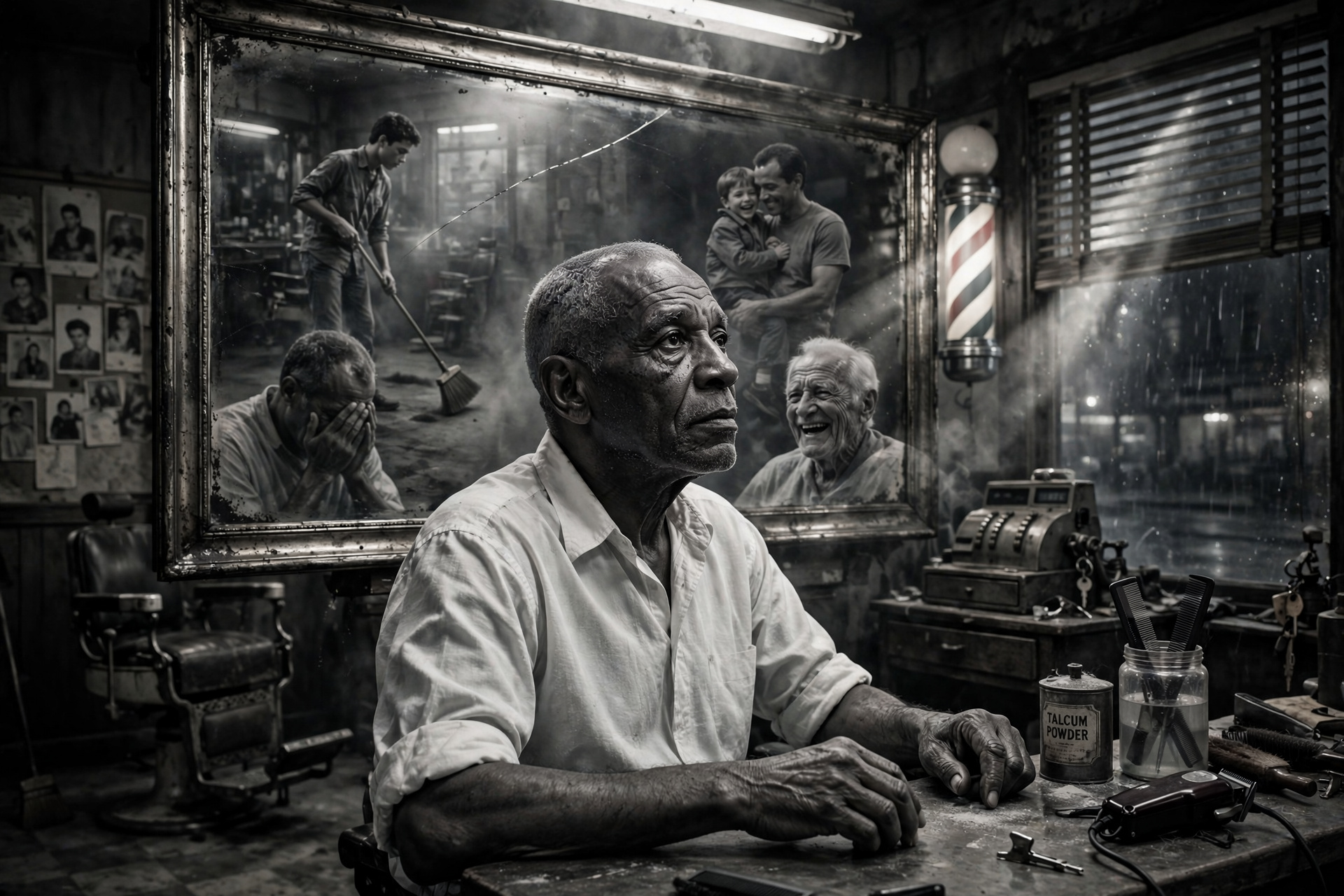
It stretched nearly the entire length of the wall behind the chairs, heavy silvered glass inside a dark wooden frame his father claimed had come from a hotel demolished sometime after the war. The silver had begun surrendering around the edges years ago, leaving little black constellations beneath the surface, and a thin crack climbed from the lower-right corner like a river searching for somewhere to go. Leon had considered replacing it exactly once. His father had stared at him until the idea died of embarrassment.
Now Leon was seventy, and everybody had apparently decided this constituted an emergency.
His daughter Camille had started it by mentioning retirement over Sunday dinner, employing the careful voice children used when they were about to explain life to the people responsible for theirs. His son Marcus joined the conspiracy shortly afterward, suggesting Leon could sell the building while property values were high, travel somewhere warm, sleep late, take up fishing, or discover one of the other activities apparently reserved for men whose alarm clocks had been confiscated.
Leon listened until they finished.
Then he asked who planned to cut their hair.
Neither had found that funny.
The irritating part was that Leon had already been thinking about closing. His right knee had developed opinions concerning prolonged standing, and the knuckles of his cutting hand sometimes stiffened overnight until hot water persuaded them to cooperate. There were mornings when he sat in his Buick across the street watching sunlight crawl across the shop window and wondered whether he wanted to unlock the door or simply drive somewhere else. He had spent more than half a century measuring days in quarter inches, tapers, necklines, conversations and the rhythmic opening and closing of scissors, and lately the future seemed less like an open road than a hallway whose lights were being switched off behind him.
On the first Monday in October, Leon placed a handwritten sign beside the register.
CLOSING DECEMBER 31.
He stared at it for several minutes before opening the shop.
By lunchtime, three customers had complained, two had accused him of betrayal, one had offered to buy the barber pole, and Mr. Henderson, who was eighty-six and had been coming to Mercer & Son since Leon’s father ran the place, announced that Leon was far too young to retire.
“You’re sixteen years older than me,” Leon reminded him.
“That ain’t the point.”
Leon decided this was the problem with getting old. Nobody could agree when you had actually accomplished it.
The mirror began misbehaving three nights later.
Leon had locked the front door, turned the sign to CLOSED and swept beneath the second chair when he glanced up and saw a seventeen-year-old boy staring back at him.
The broom stopped.
The boy was thin, narrow-shouldered and offensively blessed with hair. He wore a white T-shirt beneath an unbuttoned work shirt, and a battered push broom rested in his hands. Behind him was the same barbershop, although the walls were lighter, the chairs newer, and the calendar beside the register advertised 1973.
Leon stared.
The boy stared.
Leon stepped closer.
The boy did the same.
“Well, I’ll be damned.”
Seventeen-year-old Leon mouthed the words perfectly.
Leon raised one hand and touched his face, feeling the loose skin beneath his eyes and the coarse gray along his jaw while the boy in the mirror touched smooth brown skin untouched by seventy years of gravity, weather, disappointment and fried food.
Then the bell above the front door jingled.
Leon spun around.
Nobody was there.
When he looked back, the mirror contained an old barber standing alone with a broom.
Leon went home.
He told no one.
At seventy, a man learned there were experiences better examined privately before giving his children ammunition.
Three evenings later, the mirror showed him at thirty-two.
He was standing behind Chair One cutting the hair of a boy Leon recognized immediately as Marcus at nine years old. Young Marcus was talking with both hands, which he still did whenever he became excited, while thirty-two-year-old Leon kept turning his head toward the telephone on the counter. Leon remembered the afternoon. A customer had called wanting a last-minute appointment, and Leon had rushed his son’s haircut because money was tight and every dollar mattered.
That was how he remembered it.
The mirror remembered more.
Marcus had been telling him about a school play.
Leon watched his younger self nod without listening.
The boy explained that he had gotten the part he wanted, and his father said, “Hold still,” before turning again toward the telephone.
Present-day Leon felt something uncomfortable settle beneath his ribs.
“I went to that play.”
The mirror offered no defense.
“I was there.”
Thirty-two-year-old Leon continued cutting.
“I worked my ass off for those kids.”
The reflection remained silent because mirrors had apparently perfected the art of winning arguments by refusing to participate.
Leon left angry.
The following morning he discovered himself looking forward to closing time.
The mirror showed him forty-five, standing in the back room with his forehead against the wall after learning his father had cancer. Leon remembered himself handling that period well. He had told the family they would get through it, drove his father to treatments, kept the shop running and never allowed anybody to see him frightened.
The mirror showed him trembling.
Not dramatically. There had been no collapse, no great masculine howl against the injustice of mortality. Forty-five-year-old Leon simply stood with both palms against the wall while his shoulders shook, quietly and helplessly, for perhaps thirty seconds before he washed his face and returned to the shop.
Leon watched until the memory ended.
“Huh.”
He had forgotten that.
Somehow he had spent twenty-five years remembering courage and edited out the fear required to produce it.
After that, Leon stopped resisting.
He began arriving early and staying late, not because he expected the mirror to perform but because he had become curious about which version of himself might wander out of the silver next. Some nights nothing happened. He would stand there feeling ridiculous until his coffee went cold and eventually tell the mirror to kiss his ass before turning off the lights.
Other nights it opened him like a file cabinet.
He saw himself at twenty-six lying to his wife about why he had come home late and discovered, with considerable irritation, that the lie had been even less convincing than he remembered. He watched himself at fifty-three quietly paying for a customer’s haircut because the man had lost his job and was interviewing the next morning. He had forgotten doing that entirely. He saw an argument with Camille that he had preserved for years as evidence of his daughter’s unreasonable temper and discovered within approximately forty seconds that Camille had been reasonable, articulate and mostly correct.
Leon folded his arms.
“Well, shit.”
The mirror seemed pleased with itself.
He began laughing.
There was something profoundly liberating about discovering how unreliable his personal mythology had become. For seventy years Leon had been editing the story of Leon Mercer, cutting around embarrassing scenes, improving dialogue, adjusting motives and occasionally promoting himself from supporting asshole to misunderstood hero. The mirror restored the deleted footage.
Sometimes he wept.
Sometimes he gulped hard enough to hurt.
More often than he expected, he laughed.
The mirror showed him kindnesses he had forgotten and cruelties he had minimized, fears he had renamed caution and acts of courage he had dismissed as necessity. It showed him the young husband who believed paying bills was the same thing as being emotionally present and the middle-aged father who could listen patiently to a stranger describe a failing marriage while somehow missing the silence in his own house. It showed him apologizing when he remembered refusing to apologize, remaining silent when he remembered saying exactly the right thing, and occasionally doing something so unexpectedly decent that Leon found himself wondering who the hell that fellow had been.
There was no pattern he could discern, which eventually became the point.
The mirror wasn’t interested in punishment.
It was interested in accuracy.
Then, on a rainy Thursday evening in November, it showed him the future.
Leon had finished cleaning his clippers and was reaching for his coat when movement in the glass caught his attention. The shop reflected there was not the shop surrounding him. The walls had been repainted. The old fluorescent fixtures were gone. Three younger barbers moved between chairs while music played from somewhere Leon couldn’t see, and the place was crowded enough that two customers waited near the door.
In Chair One sat an old man.
Leon moved closer.
The man must have been ninety, perhaps older, his body narrower, shoulders slightly bent, scalp almost completely bald except for a stubborn white fringe above his ears. Deep lines crossed his face, and his hands rested upon the arms of the chair with the comfortable stillness of someone who had finally stopped needing to prove those hands could work.
Leon recognized himself.
Future Leon was laughing.
Not politely. The old fool had his head thrown back and his mouth open while a young barber stood behind him laughing too. Someone outside the reflection said something Leon couldn’t hear, and the entire shop erupted.
Leon touched the glass.
The vision disappeared.
For several days he thought about what it meant, which was unusual because Leon generally preferred conclusions that arrived promptly and behaved themselves. He assumed at first that the mirror was telling him not to retire, but that interpretation became increasingly stupid the longer he considered it. The old man in the chair wasn’t working.
He was simply there.
Leon looked at the closing sign beside the register.
Perhaps leaving the chair did not require leaving the room.
That realization should have satisfied him.
Instead, another question arrived.
Late one evening, with rain ticking softly against the front window and the neighborhood reduced to blurred headlights beyond the glass, Leon stood before the mirror and thought about his father.
“Show me Pops.”
Nothing happened.
Leon waited.
“I’ve seen enough of me.”
The mirror returned a seventy-year-old barber standing beneath tired fluorescent lights.
“Come on.”
Nothing.
Leon felt foolish and then angry for feeling foolish.
“You showed me everything else.”
Still nothing.
He placed both hands on the counter and stared into his own face.
Then something his father had said forty years earlier returned to him, not as words exactly, but as a sensation: his father’s hand resting briefly against the back of Leon’s neck after he had finished his first flawless taper. Leon had spent much of his life believing his father had never said he was proud of him.
Maybe he hadn’t.
Maybe Leon had simply spent too much time waiting for the sentence and not enough noticing everything surrounding it.
He looked again at the mirror.
Seventeen.
Thirty-two.
Forty-five.
Seventy.
Ninety.
His father had stood behind this same chair and watched every version beginning to form. The arrogant boy who wanted something bigger than the barbershop, the young husband pretending he understood marriage, the frightened father pretending he understood fatherhood, the middle-aged son learning that parents could die, and the old man beginning to mistake fatigue for completion.
Leon lowered his head.
The laugh came first, small and broken around the edges, followed by tears he made absolutely no effort to stop.
There wasn’t any use pretending anymore.
He was old enough to know better and too old to give a damn.
The surprising part was how good that felt.
For most of his life, Leon had assumed truth was something a person endured, a bitter medicine swallowed because adulthood demanded it. Nobody had bothered telling him that truth could also be funny, that seeing yourself clearly might reveal not some hidden monster but an ordinary fool who had occasionally been magnificent, frequently been ridiculous, sometimes been selfish, sometimes been generous, and somehow remained himself through every contradiction.
The stories Leon had told about himself were not lies exactly.
They were simply edited.
He had removed the scenes that complicated the plot.
The mirror put them back.
On December thirty-first, Leon removed the closing sign.
He replaced it with another.
UNDER NEW MANAGEMENT — JANUARY 2.
He sold the business to Darius Cole, who had worked the third chair for eleven years and complained that Leon’s asking price was suspiciously reasonable. Leon kept the building, retained a key, and informed Darius that he would probably come around on Tuesdays.
“Why Tuesdays?” Darius asked.
“None of your damn business.”
On January second, Leon arrived at nine-thirty carrying coffee.
Darius looked at the clock.
“You’re late.”
“I don’t work here.”
“Then why are you behind my counter?”
Leon considered this.
“Your coffee is terrible.”
“You made it.”
“That ain’t the point.”
Darius laughed and returned to his customer.
Leon wandered toward the old mirror.
For weeks it had shown him everything except the man standing immediately before it, but now the glass offered nothing unusual. There was no seventeen-year-old boy sweeping badly, no frightened forty-five-year-old hiding in the back room, no ninety-year-old laughing from a future that might never arrive.
There was only Leon Mercer.
Seventy years old.
Gray hair.
Wrinkled face.
Tired eyes.
Bad knee.
Barber’s hands.
A little heavier around the middle than he preferred, although at this stage of negotiations gravity appeared unwilling to compromise.
Leon waited.
The reflection waited.
He leaned closer.
Nothing changed.
For the first time since the mirror began telling the truth, Leon realized he didn’t need it to show him anything.
He knew the man in the glass.
Not completely, perhaps. A human life was too contradictory for that kind of certainty, and Leon had finally developed enough respect for truth to stop demanding simplicity from it. There were still stories he had told incorrectly, apologies he owed, kindnesses he had forgotten, failures he had exaggerated and victories he had polished until they gleamed brighter than they deserved.
Fine.
They belonged to him too.
Leon studied himself for another moment before a smile worked its way across his face.
“Hell,” he said. “Thought you’d be worse.”
The old man in the mirror laughed with him.
Discover more from Memoirs of Madness
Subscribe to get the latest posts sent to your email.


Wonderful piece Mangus.
LikeLike
A mirror is a universe within a universe. Some days it’s an albatross, other days a green pasture. We look to see if we deserve reward or punishment. Funny thing is that an aged face does a lot less reflecting and a lot more reminding.
LikeLike
He was old enough to know better and too old to give a damn.
LikeLike
LOVED this!
LikeLike