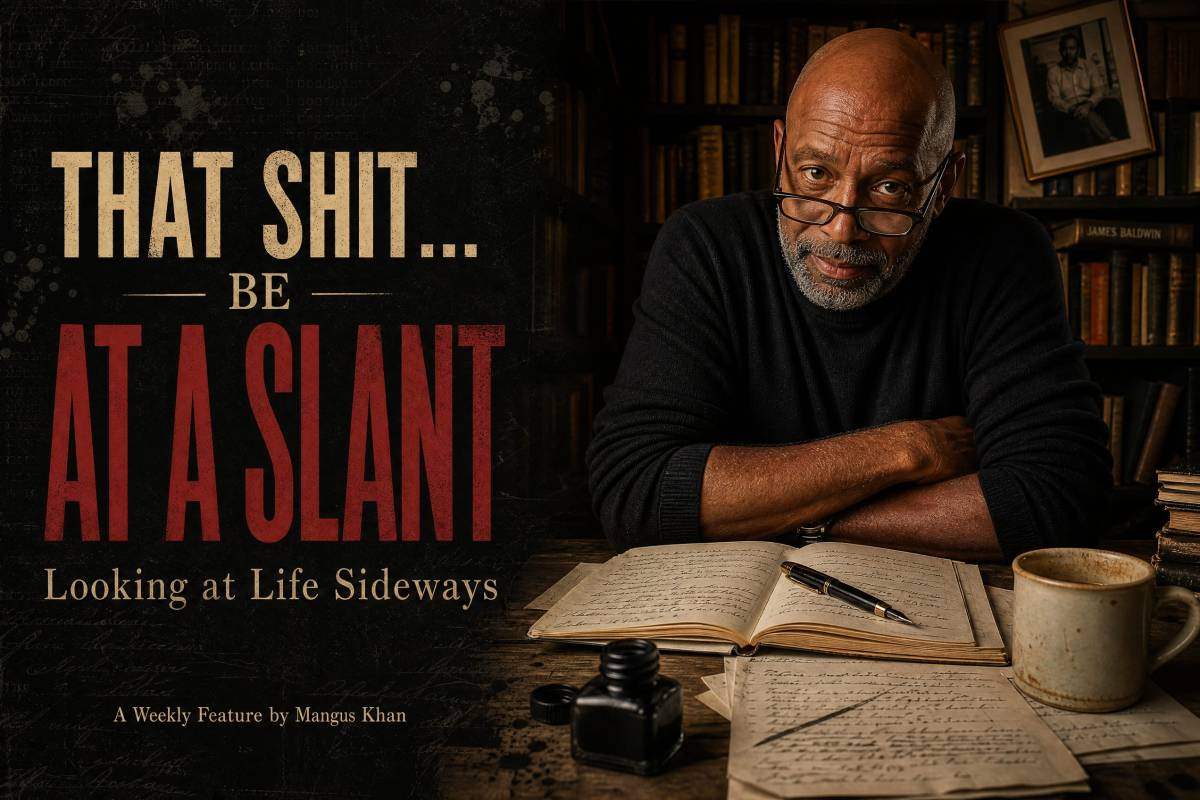
Hello, I’m Mangus Khan, and for the next few minutes, I encourage you to walk into Madness with me.
Come on in, Brave Souls.
Mind the papers.
And don’t touch anything.
Not because it’s evidence. I just haven’t figured out where the hell anything goes.
There is a peculiar arrogance in believing every question has an answer.
We are raised on that shit.
Two plus two equals four. Water boils at a certain temperature. The murderer gets caught somewhere around page 287. Somebody explains the whole mess before the credits roll, preferably while standing beside a fireplace with everybody responsible gathered conveniently in one room.
Order restored.
Truth revealed.
Everybody can go home.
Real life apparently missed that meeting.
Some things remain unresolved.
Not because we weren’t smart enough. Not because we didn’t look hard enough. Not because we failed to ask the right questions.
Sometimes the truth simply refuses to cooperate.
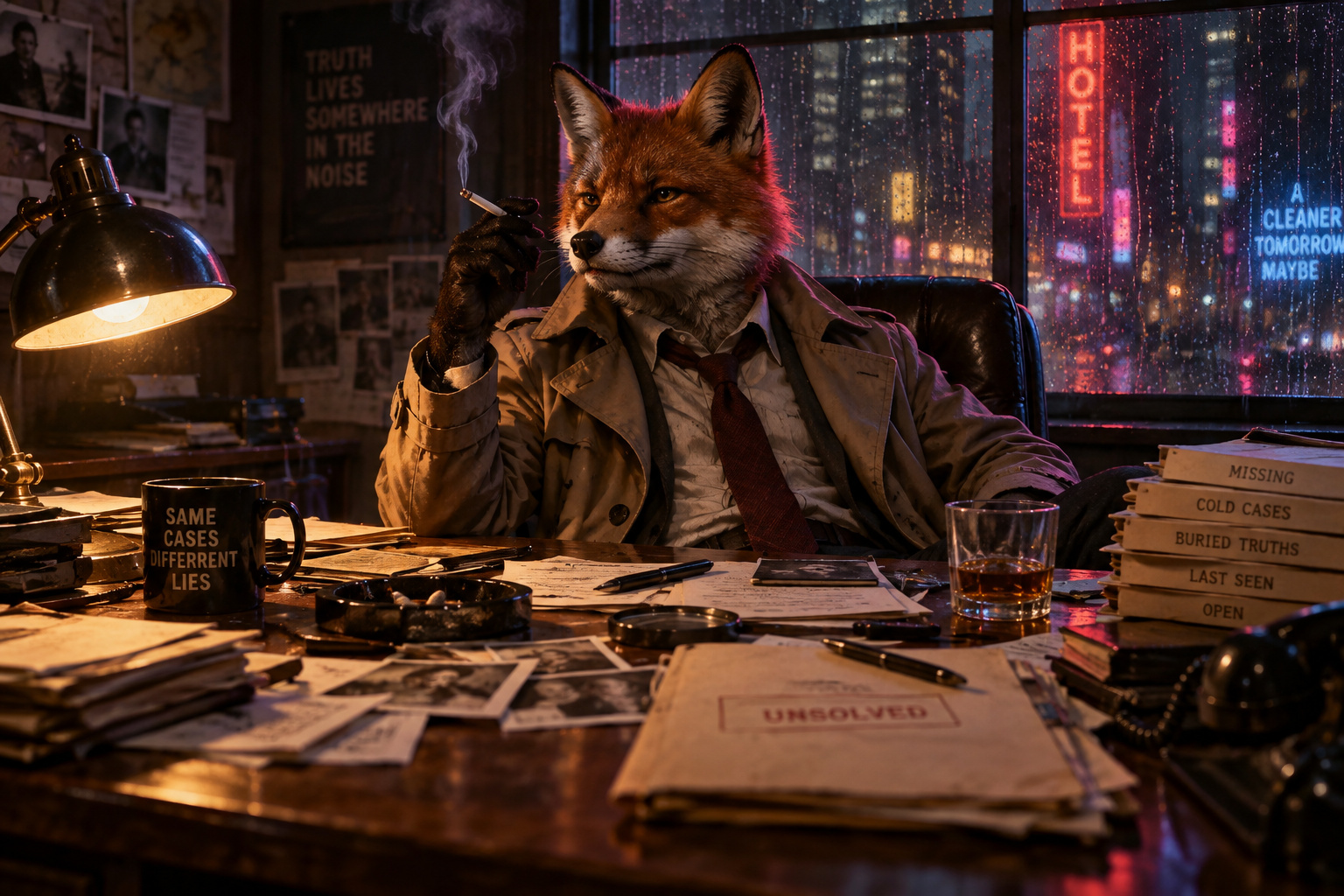
I imagine it sitting across the desk from me right now, legs crossed, smoking one of my cigarettes without asking, watching me shuffle through everything I think I know.
The room smells like wet wool, stale tobacco, old paper, and coffee that crossed the line from beverage to industrial solvent sometime before noon. Rain scratches against the window, soft at first, then harder when the wind turns. Every passing car throws another smear of reflected neon across the ceiling. Red. Blue. Dirty yellow. The colors crawl across the walls and disappear before I can decide what they remind me of.
The desk lamp throws a tired circle of amber over the mess.
Photographs.
Statements.
Names.
Dates.
Receipts with faded ink.
Notes written in margins by a version of me who apparently believed future me would know what the hell he meant.
Things people swore happened.
Things other people swore couldn’t have happened.
A glass sits near my elbow with two fingers of something brown catching the light. The ice has surrendered. Somewhere beneath the papers, the coffee has gone cold. The cigarette between my fingers burns unattended until the smoke curls into my eyes.
I squint through it.
And somewhere beneath all that paper is what actually happened.
Maybe.
That’s the trouble with truth.
We like to imagine it standing beneath a spotlight, clean and unmistakable, waiting patiently for somebody brave enough to look at it.
Most of the time, it’s hiding behind the filing cabinet wearing somebody else’s coat.
The older I get, the less certain I am that memory and truth have ever been properly introduced.
Human beings don’t remember events.
We remember versions.
Memory isn’t a security camera tucked safely in the corner recording everything exactly as it happened. It is a storyteller, and not always a reliable one. It edits. Rearranges. Crops inconvenient things out of the frame. It softens some edges and sharpens others. Sometimes it protects us. Sometimes it protects our ego. Sometimes it protects the people we love.
And occasionally it screws with us just because apparently the subconscious enjoys practical jokes.
Give ten people the same afternoon and you’ll get eleven stories.
Wait twenty years and ask again.
Now you’ve got fifteen.
And every damn one of them may be sincere.
That’s what bothers me.
A deliberate liar is almost comforting. Once you know somebody is lying, you’ve got something solid to work with. There is motive. Intent. Somewhere beneath the bullshit is a decision to conceal something.
But what do you do with somebody who believes their lie?
What do you do when that somebody is you?
That question has gotten heavier with age.
There are memories I would have sworn were carved in stone. I could tell you where everyone stood. What was said. The expression on someone’s face. The smell in the room. The temperature outside.
Then somebody else who was there remembers it differently.
At first, you argue.
No, that’s not what happened.
Funny how quickly certainty puts on boxing gloves.
Then comes the uncomfortable possibility that neither person is lying.
Maybe two people can stand three feet apart, live through the same moment, and walk away carrying completely different truths.
Maybe that’s why some arguments survive longer than the people who started them.
Nobody is fighting about what happened anymore.
They’re defending what it meant.
And meaning is stubborn.
A lie isn’t always something deliberately invented.
Sometimes it’s something repeated long enough to become furniture.
Nobody remembers who brought the ugly bastard into the house, but everybody walks around it.
Families do this.
Communities do it.
Countries certainly do it.
We inherit explanations the way we inherit old dishes and grudges.
That’s just how it happened.
According to whom?
Nobody knows anymore.
But we’ve been serving Thanksgiving dinner on that story for forty-seven years, so don’t start asking questions now.
Questions make people uncomfortable.
Good questions make them angry.
Because a question doesn’t merely challenge what somebody knows.
Sometimes it threatens who they had to become in order to believe it.
That’s a different kind of investigation.
You aren’t searching for fingerprints anymore.
You’re searching through identity.
Regret.
Shame.
Love.
Fear.
Grief.
Pride.
All those wonderfully unreliable witnesses we carry around inside ourselves.
Some of them have been rehearsing their testimony for decades.
And here comes the slant.
Maybe solving the mystery isn’t always the point.
Maybe learning why we need a particular answer matters more.
That’s the file sitting unopened at the bottom of the stack.
The one we keep finding reasons not to touch.
We spend years investigating other people.
Why did she leave?
Why did he betray me?
Why didn’t they understand?
Why didn’t somebody tell me?
Why did this happen?
Why wasn’t I enough?
Why didn’t I see it coming?
Those are legitimate questions. Some of them deserve answers.
But sometimes we aren’t looking for truth.
We’re looking for a verdict.
We want somebody declared guilty.
Somebody innocent.
Somebody responsible.
Maybe even ourselves.
Because blame, painful as it can be, provides structure. It gives suffering walls and a roof. It tells us where to put the furniture.
Uncertainty leaves us standing outside in the rain.
And eventually another question wanders into the room, takes off its wet coat, sits down without being invited, and ruins the whole damn evening:
What if I never know?
Shit.
Nobody likes that suspect.
I certainly don’t.
There are things in my own life I have interrogated long past the point where there was anything useful left to discover. Conversations replayed at three in the morning. Words examined from every possible angle. Silences given meanings they may never have possessed.
You know the ritual.
The house is quiet.
Too quiet.
The refrigerator hums somewhere down the hall. Pipes tick inside the walls. A clock you barely notice during daylight suddenly sounds like somebody hammering nails into the night.
Tick.
Tick.
Tick.
And your mind decides this is the perfect time to reopen a case from 1987.
You stare at the ceiling.
Reconstruct the scene.
Change one sentence.
Move somebody three feet to the left.
Give yourself the perfect response you didn’t think of until twelve years later.
Case solved.
Except it isn’t.
Because morning comes and nothing has changed.
The past remains stubbornly immune to editing.
I’ve spent enough nights in that interrogation room with myself to know the coffee is terrible.
Maybe you have too.
That’s where acceptance becomes something different from surrender.
Acceptance isn’t saying it didn’t matter.
It isn’t forgiveness.
It isn’t pretending you suddenly understand.
Sometimes acceptance is simply admitting that the evidence is exhausted.
There are no more witnesses to interview.
No hidden photograph waiting beneath the floorboards.
No final conversation coming to straighten everything out.
You know what you know.
You don’t know what you don’t.
And no amount of suffering is going to turn one into the other.
That realization can feel strangely physical.
Your shoulders drop.
Your jaw unclenches.
You notice you’ve been holding your breath.
Outside, the rain hasn’t stopped, but it sounds different somehow.
Not gentler.
Just farther away.
So maybe you close the folder.
Not because the mystery has been solved.
That’s important.
You close it because morning is coming.
Because there are other files on the desk.
Because there are people still here who deserve more of you than the ghosts do.
Because eventually searching for an answer can become another way of refusing to live without one.
The cigarette has burned almost to the filter.
The coffee is cold.
The neon hotel sign across the street flickers twice before settling back into its red glow. Tires hiss across wet pavement below. Somewhere down the block, somebody laughs beneath an awning, and for a second that ordinary little sound cuts through the rain.
Life continuing.
Without waiting for my conclusions.
There is something almost insulting about that.
And something merciful.
I’ve lived long enough to accumulate a few folders marked UNSOLVED.
I suspect most of us have.
People we misunderstood.
People who misunderstood us.
Doors we should have opened.
Doors we should have nailed shut.
Apologies that arrived too late.
Apologies that never arrived.
Questions whose answers went into the ground with the only people who could have given them.
And moments where, even decades later, we can still hear ourselves asking:
What the hell happened?
Maybe one day the answer comes.
Maybe it doesn’t.
There is a strange kind of maturity in learning to live beside the question without allowing it to own the house.
Knowing when you’ve investigated something long enough.
Knowing when another night staring at the evidence isn’t going to reveal a clue—it is only going to steal another night.
Some truths reveal themselves.
Some truths have to be dragged kicking and screaming into daylight.
Some change shape depending upon where you’re standing.
And some stubborn bastards remain somewhere in the noise.
Maybe that’s where they belong.
I reach across the desk and close the folder.
The sound is surprisingly small.
Just cardboard meeting cardboard.
No revelation.
No swelling music.
No voice from the heavens explaining what it all meant.
Just a closed file.
Rain.
Smoke.
A little red neon trembling against the glass.
And tomorrow waiting outside the window.
After all, Brave Souls, we’re not here to straighten everything out.
We’re on a journey through the ordinary and mundane, taking off the rose-colored glasses and looking for a different side of Madness. Sometimes that means finding answers.
Sometimes it means having enough sense to stop demanding them.
Tilt your head a few degrees.
Look again.
Because sometimes…
That Shit … Be at a Slant.
Discover more from Memoirs of Madness
Subscribe to get the latest posts sent to your email.
 Memoirs of Madness
Knowing when another night staring at the evidence isn’t going to reveal a clue—it is only going to steal another night. OMG OMG OMG This is one of THE most brilliant!!! pieces I believe you’ve written to date, or that I have had the distinct privilege of reading! One question? Why is it a lie? What makes it a lie? Why isn’t it a truth from one perspective???? I LOVE THAT be at a slant!!!!! Indeed! Brilliant brilliant I can’t say it enough. I dont’ have words eloquent enough to convey the depth of emotion and truth you evoke here!!! just Brava!!!
LikeLike
I’ll always rather have the TRUTH…
LikeLike
Great essay, Magnus. Love this reason: “Because there are people still here who deserve more of you than the ghosts do.”
LikeLike
Another good read Mangus.
LikeLike