People believed the cemetery marked where the dead rested.
They were wrong.
The dead rested wherever the living remembered them.
The cemetery existed for everyone else.
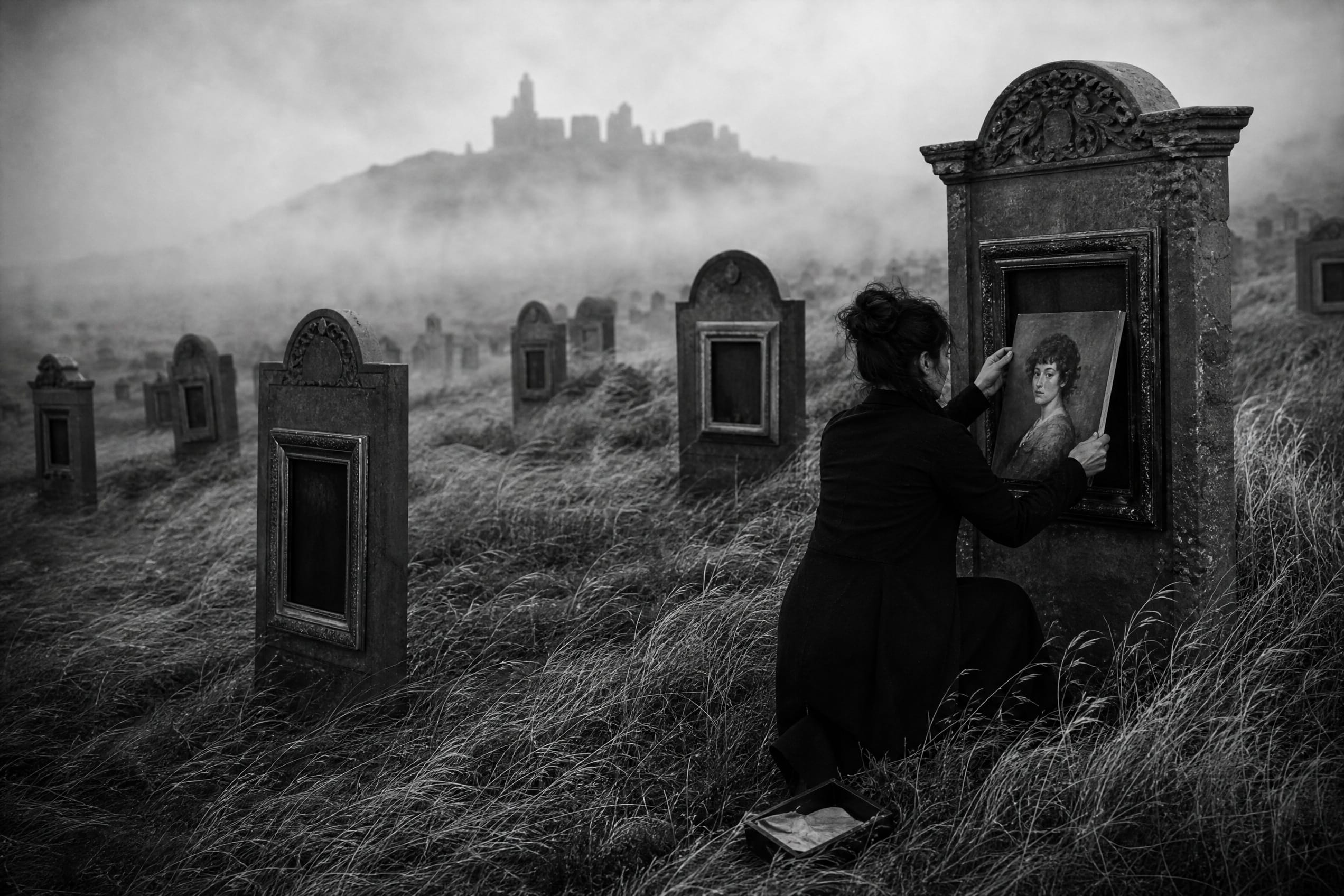
The hillside rolled beneath a sky the color of weathered linen, where fog drifted low across bent grass like slow-moving ghosts searching for names they had once answered to. Hundreds of stone monuments stood scattered among the swaying reeds, each carved with an empty frame instead of a name. No dates. No epitaphs. No angels with folded wings. Only silent rectangles waiting to receive a face. Travelers dismissed them as abandoned memorials from some forgotten plague. Historians filled books with theories about iconoclasm, lost traditions, and grave robbers. Priests blessed the road below but never climbed the hill itself. Only the wind seemed to know the truth, threading through the grass with whispers that sounded almost like conversations carried from another century.
By sunrise…
the whispers were gone.
Only the silence remained.
Every autumn, when the first frost silvered the earth and the valley surrendered to morning mist, a solitary woman climbed the hill carrying an old leather case worn smooth by decades of careful hands. No one knew her name. Children who glimpsed her from distant farmhouses called her the Portrait Keeper, though their parents insisted she was only another story invented to keep young feet from wandering too far after sunset.
Still…
No one ever followed her.
She walked with the deliberate patience of someone who understood that grief could not be hurried. Dew soaked the hem of her black coat. Cold wind slipped beneath the fabric and wrapped itself around her bones, yet she never seemed to notice. She stopped before each monument, brushing away moss and lichen with fingertips so gentle they resembled a daughter straightening her mother’s collar one last time. From the leather case she withdrew a portrait wrapped in yellowed linen—sometimes cracked oil paint that smelled faintly of linseed and smoke, sometimes charcoal whose edges blurred beneath the touch of time, sometimes tiny sepia photographs carrying the chemical scent of forgotten darkrooms.
She never rushed.
Memory deserved better than haste.
When she placed a portrait inside its waiting frame, the world changed.
Not dramatically.
Quietly.
The wind ceased as though the hillside itself had forgotten how to breathe. Every blade of grass stood perfectly still. Even the fog hesitated, suspended between one heartbeat and the next. For a single impossible moment, warmth returned to painted cheeks. Eyes regained their light. Lips softened into the beginning of a smile. Wrinkles ceased being evidence of age and became maps of laughter once freely given.
Then the moment passed.
The portrait became only paint once more.
The silence resumed.
She closed the leather case and continued walking.
No prayers.
No ceremony.
Only work.
Because remembrance, she believed, was never an emotion.
It was a responsibility.
Most people misunderstood death.
Death was merciful.
Oblivion was not.
A heartbeat ended only once.
Forgetting happened slowly.
It arrived in small betrayals so ordinary they escaped notice. A grandson struggled to remember the color of his grandfather’s eyes. A daughter forgot the cadence of her mother’s laughter. A husband woke one morning unable to recall which side of the bed his wife had preferred. The scent of tobacco lingering in an old coat disappeared. The melody someone always hummed while washing dishes faded into silence. Faces dissolved first around the edges, like watercolor left too long beneath rain, until one terrible day memory could no longer assemble them at all.
That was when the frames emptied.
Not when a person died.
When the final living soul lost the ability to picture their face.
The Portrait Keeper inherited thousands of likenesses gathered across centuries by those who had carried the burden before her. Every painting represented the final act of love performed by someone unwilling to surrender another human being to absolute nothingness. Somewhere, generations earlier, a trembling hand had mixed pigments, sharpened charcoal, or steadied a camera because they believed this face mattered.
Love had created every portrait.
Love alone kept them here.
As she knelt before another monument, damp earth released the rich scent of moss, wet stone, and roots that had spent decades embracing forgotten coffins beneath the hill. Rain from the previous evening still clung to the grass, soaking through the knees of her dress until cold seeped into her skin. Somewhere unseen, crows called to one another with voices rough as broken violins before falling abruptly silent, as though something older had demanded their attention.
She unwrapped the next portrait.
A young woman.
Dark curls gathered loosely at her neck.
Eyes steady enough to quiet storms.
Time had cracked the varnish across one cheek, yet the expression beneath remained untouched, carrying the faintest trace of hope despite the century separating her from anyone who had ever spoken her name aloud.
The Keeper smiled.
A small smile.
One earned through exhaustion rather than joy.
“You’re home,” she whispered.
The frame accepted the portrait with a soft wooden click.
The temperature changed.
Not enough for anyone else to notice.
Enough for her.
Warmth brushed against her face with the unmistakable tenderness of someone placing a gentle hand upon her cheek.
She closed her eyes.
There it was again.
The sensation she had known since childhood.
Not ghosts.
Recognition.
Then came the feeling she dreaded more than death itself.
Someone was watching.
She turned slowly.
Rows upon rows of monuments disappeared into the mist, every frame filled with faces gathered from forgotten centuries. Men whose names no language still carried. Women who had once sung children to sleep. Soldiers. Midwives. Bakers. Teachers. Strangers.
For the briefest heartbeat…
none of them were looking forward.
Every painted eye rested upon her.
There was no accusation.
No hunger.
Only gratitude so immense it settled over her shoulders like a weight she had carried for so long she no longer recognized it as heavy.
She lowered her gaze.
Some gifts were too intimate to witness twice.
By dawn the cemetery looked ordinary again. Fog retreated into the valley, revealing nothing more than weathered monuments scattered across lonely grass. Travelers passed without slowing, convinced they were looking upon abandoned memorials left to decay beneath indifferent skies. None noticed that several empty frames now held unfamiliar faces.
Fewer still realized those faces seemed strangely familiar.
Like someone waiting inside the oldest photograph tucked away in a grandmother’s attic.
Someone they almost remembered.
The Keeper closed her leather case.
Only one portrait remained.
She had carried it for forty-three years.
Its colors had faded until the woman’s features seemed suspended between memory and disappearance. Ink-stained fingertips rested gently in her lap. Silver threaded through dark hair. Her tired smile carried the quiet dignity of someone who had spent an entire lifetime remembering everyone else while slowly allowing herself to vanish.
The Keeper reached out to touch the canvas.
Her fingers stopped.
For the first time…
she could no longer remember whether the woman in the portrait had been her mother.
Or herself.
The wind died.
Every crow lifted silently from the trees.
Across the endless cemetery…
one empty frame waited.
Discover more from Memoirs of Madness
Subscribe to get the latest posts sent to your email.


Good story, Mangus.
LikeLiked by 1 person
Thank you, Li. This one came from thinking about how much of a person survives in the small things we remember about them—and what happens when those memories begin to fade. I’m glad you enjoyed it.
LikeLiked by 1 person
You’re welcome.
LikeLike
Wonderful story Mangus.
LikeLiked by 1 person
Thank you! This one stayed with me after I finished writing it. There’s something both beautiful and unsettling about the idea that remembering someone can become an act of keeping a small part of them alive. I’m glad the story connected with you.
LikeLiked by 1 person
Be corageous dear Mangus. Happy weekend to you!
LikeLiked by 1 person
Thank you, Milu. I appreciate the kind words. I hope you had a peaceful weekend as well.
LikeLiked by 1 person