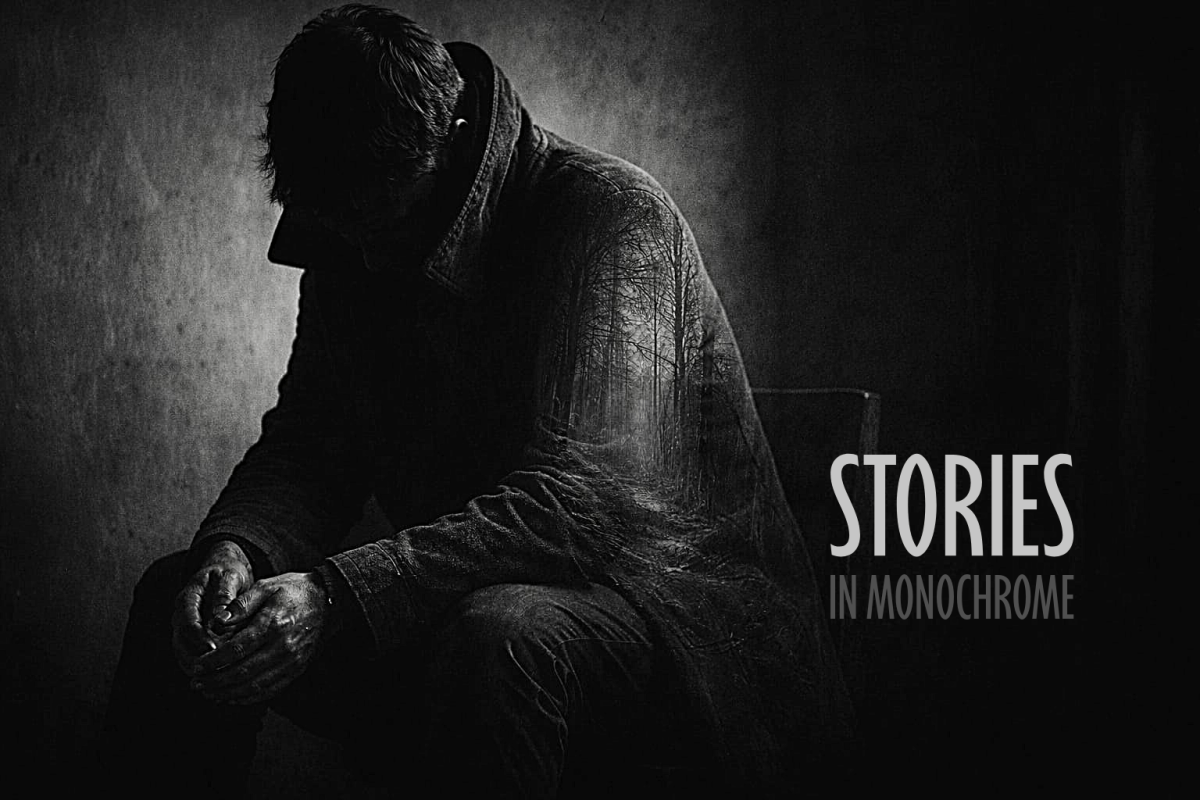
Everyone agreed the Ashcombe Library had burned to the ground in the autumn of 1931. Newspapers carried photographs of blackened arches collapsing into themselves beneath towers of smoke while firefighters stood exhausted among rivers of steaming ash. Insurance ledgers recorded every loss with bureaucratic precision—the carved oak shelves, the stained-glass windows imported from Prague, the handwritten manuscripts donated by families whose names no longer appeared on street signs. Within months, the city cleared away the ruins, scattered fresh soil across the scar, and planted grass where centuries of memory had once stood shoulder to shoulder. Seasons passed. Children laughed where scholars had once whispered. Lovers crossed the empty lot without ever glancing down, never suspecting they were walking across the bones of forgotten stories. Time did what fire could not. It convinced everyone that forgetting was the same thing as healing.
Only the oldest people in Ashcombe hesitated whenever the library was mentioned.
It wasn’t fear that settled behind their eyes.
It was recognition.
They never argued with the official story.
They simply refused to speak the final sentence.
“Yes,” they would say quietly. “The building burned.”
Then they would change the subject.
The first account arrived seventeen years later in a weathered journal donated anonymously to the Historical Society. A traveling salesman claimed he had wandered into the old district while escaping a violent thunderstorm. Rain had soaked his wool coat until it clung to his shoulders like wet canvas, and every breath tasted of cold iron and chimney smoke. He found an oak door standing alone beneath a weathered stone arch that shouldn’t have existed. Curious more than cautious, he stepped inside expecting little more than an abandoned chapel.
Instead, he found silence.
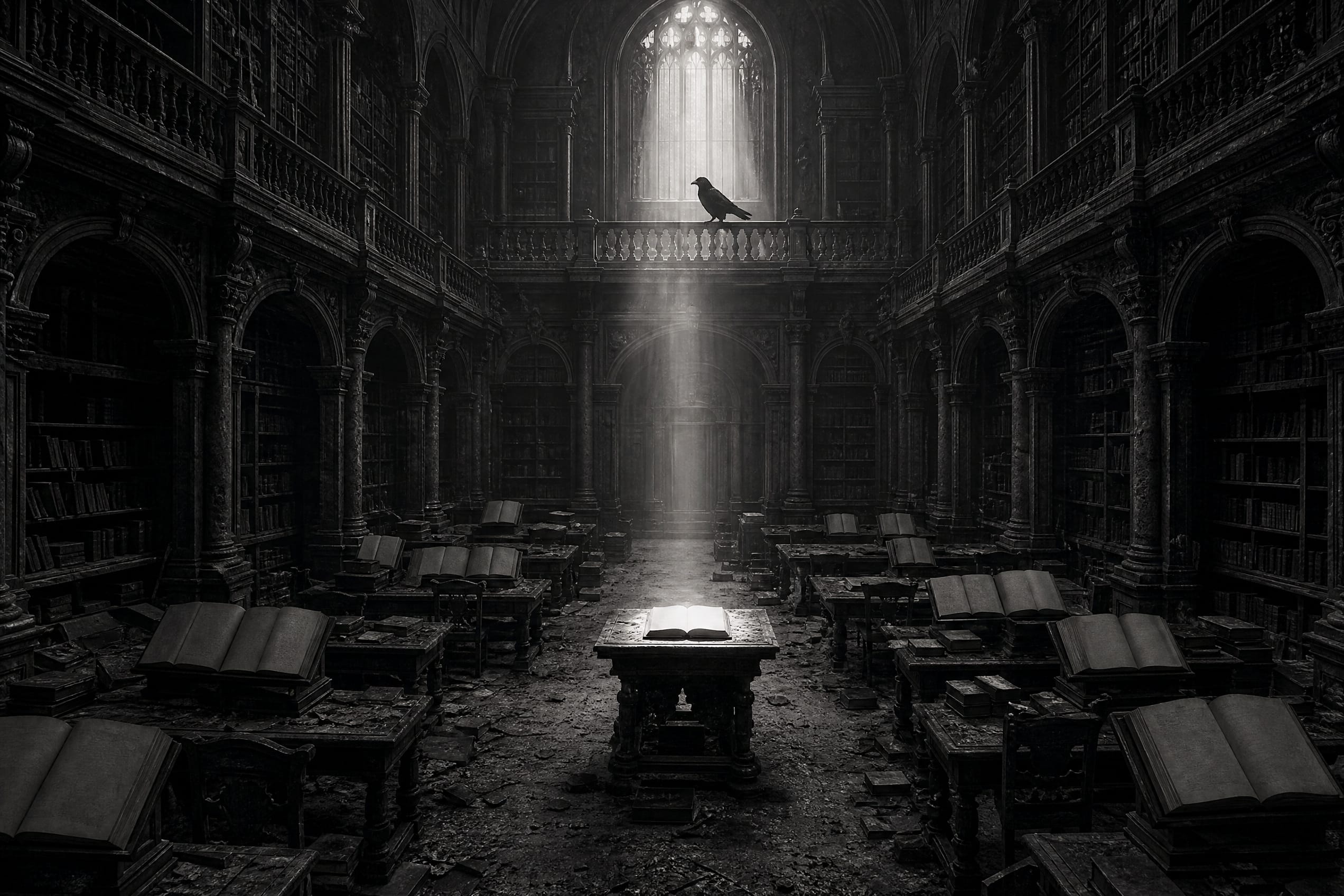
Not the ordinary silence of an empty room, but the immense stillness of a place that had spent generations teaching people to lower their voices. The air smelled of beeswax, cedar, damp limestone, and leather bindings that had absorbed a hundred years of quiet hands turning careful pages. Dust drifted through shafts of pale morning light like slow-falling snow, each tiny particle lingering as though reluctant to surrender to gravity. Towering shelves disappeared into darkness above him, giving the impossible impression that knowledge itself had no ceiling.
Then he noticed the raven.
It stood alone upon the upper balcony beneath the stained-glass window, perfectly still, feathers black enough to swallow the light collecting around them. It neither cawed nor moved. It simply watched with the patient curiosity of something that had witnessed far too many visitors to be surprised by another.
His journal devoted only a single sentence to the book waiting on the center table.
It already knew which lie I had come to defend.
That sentence unsettled historians far more than everything else he described.
No one questioned the architecture.
No one questioned the impossible library.
Everyone questioned the book.
Over the next seventy years, eleven more journals surfaced, each written by someone with no conceivable connection to the others. A schoolteacher. A detective. A widowed seamstress. A railway porter. A concert pianist. Their handwriting differed. Their lives differed. Their reasons for wandering into forgotten streets differed.
Their descriptions did not.
Each described the same impossible reading room.
The same solitary raven.
The same shaft of light falling upon the same weathered table.
The same open book waiting without impatience.
Stranger still, none ever described what they had read.
Only the lives they abandoned afterward.
One resigned from Parliament.
Another reunited with a brother he had blamed for forty years.
A woman who had spent three decades teaching literature quietly burned every manuscript she had written before planting roses in the countryside.
None of them became happier.
But every one of them became…
lighter.
As though they had finally stopped carrying something invisible.
For years I dismissed every account as folklore polished by repetition. History has a habit of sanding rough truths into comfortable legends, and I had devoted my career to separating romance from fact. I trusted documents because paper, unlike memory, rarely cared whether it comforted anyone.
Memory, I had learned, was a gifted novelist.
It rewrote endings.
Softened betrayals.
Edited conversations.
Removed our own cruelty while magnifying everyone else’s.
Perhaps that is how we survive ourselves.
Perhaps it is also how we lose ourselves.
I found the door on a gray November afternoon after rain had washed the city clean. Water trickled through cracked gutters and gathered in shallow puddles that reflected broken brick facades like fractured mirrors. The alley smelled of wet mortar, rust, and leaves surrendering to decay. At its end stood a weathered oak door framed by ancient stonework untouched by time. Moss clung to the mortar between its blocks, yet the brass handle gleamed with the quiet polish of countless unseen hands.
It felt warm beneath my fingertips.
Warmer than my own skin.
The hinges opened without complaint.
The silence beyond them seemed to inhale.
Crossing the threshold felt strangely intimate, as though entering someone else’s memory without permission. The library wrapped around me with the comforting scent of paper, dust, cedar shelves, extinguished candles, and old wool coats that had once dried beside forgotten fireplaces. Every breath carried the faint sweetness of aging parchment mixed with something almost impossible to identify…
Regret.
Not imagined.
Not symbolic.
Something tangible enough to taste.
My footsteps echoed once across the worn stone floor before disappearing into a silence so complete I could hear the slow rhythm of my own heartbeat inside my ears. Somewhere water dripped steadily into unseen darkness. The sound arrived several seconds late, as though the room itself had grown too vast for ordinary acoustics.
Thousands of books surrounded me.
None bore titles.
None appeared neglected.
Each waited with the quiet dignity of someone who understood patience better than time itself.
The raven remained upon the balcony exactly as the journals described.
Watching.
Never blinking.
Never judging.
Only waiting to discover whether I possessed enough courage to stop lying to myself.
The book rested alone beneath the shaft of pale light, its pages open as though I had merely stepped away moments earlier. The oak table surrounding it bore countless shallow impressions left by nervous fingertips pressing too hard into old wood. I rested my own trembling hand upon its surface.
The timber was warm.
Someone else had been there.
Recently.
The pages appeared blank until I leaned closer.
Then words emerged slowly beneath the paper’s surface like forgotten photographs developing inside chemical trays.
The first sentence stole the breath from my lungs.
Not because I recognized it.
Because I recognized the voice.
My mother’s.
Suddenly I was six years old again, hiding behind the cracked kitchen door while two adults whispered loudly enough for children to mistake whispers for secrets. I had carried that afternoon inside me for more than four decades, polishing its edges until it became the foundation upon which I built every disappointment that followed. I believed my father had chosen another family over ours because that story demanded only anger.
The truth demanded grief.
The book did not accuse me.
It simply removed the edits.
Every pause.
Every trembling hand.
Every sentence memory had quietly rewritten to protect a frightened little boy from a sorrow too large for his heart.
My father had not abandoned us.
He had been dying.
My mother had not lied out of bitterness.
She had lied out of love.
For years I had mourned a betrayal that never happened while refusing to mourn the man I had actually lost.
The tears came without permission.
Warm against my face.
Cold upon the ancient paper.
They disappeared before leaving a mark.
When I finally looked up, the library remained exactly as before. The raven shifted its weight almost imperceptibly, the faint scrape of its claws against old stone echoing through the cathedral silence. It felt less like applause than acknowledgment.
The book had changed nothing.
It had only returned something I should never have misplaced.
When I turned to leave, one final realization settled quietly over me.
Every shelf held identical volumes.
There had never been thousands of different stories.
Only thousands of different readers.
Outside, the alley was gone.
So was the door.
Only an empty field stretched beneath the afternoon sky, where children laughed across grass growing over forgotten foundations.
A bronze plaque stood near the sidewalk.
ASHCOMBE PUBLIC LIBRARY
1889–1931
Lost to Fire
Sometimes people ask whether I truly believe the library exists.
I never answer.
Some questions deserve uncertainty.
Instead, I ask one of my own.
“If a single book contained the memory you’ve spent your entire life rewriting…”
“Would you be brave enough to discover who you’ve really been all along?”
Discover more from Memoirs of Madness
Subscribe to get the latest posts sent to your email.

