Every town possesses a place its people refuse to explain.
Not because they have forgotten the story, but because memory can become dangerous when spoken aloud often enough. Some places inherit superstition. Others inherit guilt. Briar Hollow inherited an orchard.
The trees stood at the edge of town where the fields surrendered to mist and the earth dipped gently toward the river valley. They had not produced fruit in nearly eighty years, yet no one dared cut them down. Every spring tiny buds appeared along their twisted branches, teasing the village with the promise of blossoms before shriveling into gray husks that scattered across the ground like ash. Autumn arrived without apples. Winter wrapped the trunks in frost, but they never rotted, never split beneath lightning, never surrendered to disease. They simply endured, as though death itself had overlooked them.
The crows understood long before people ever did.
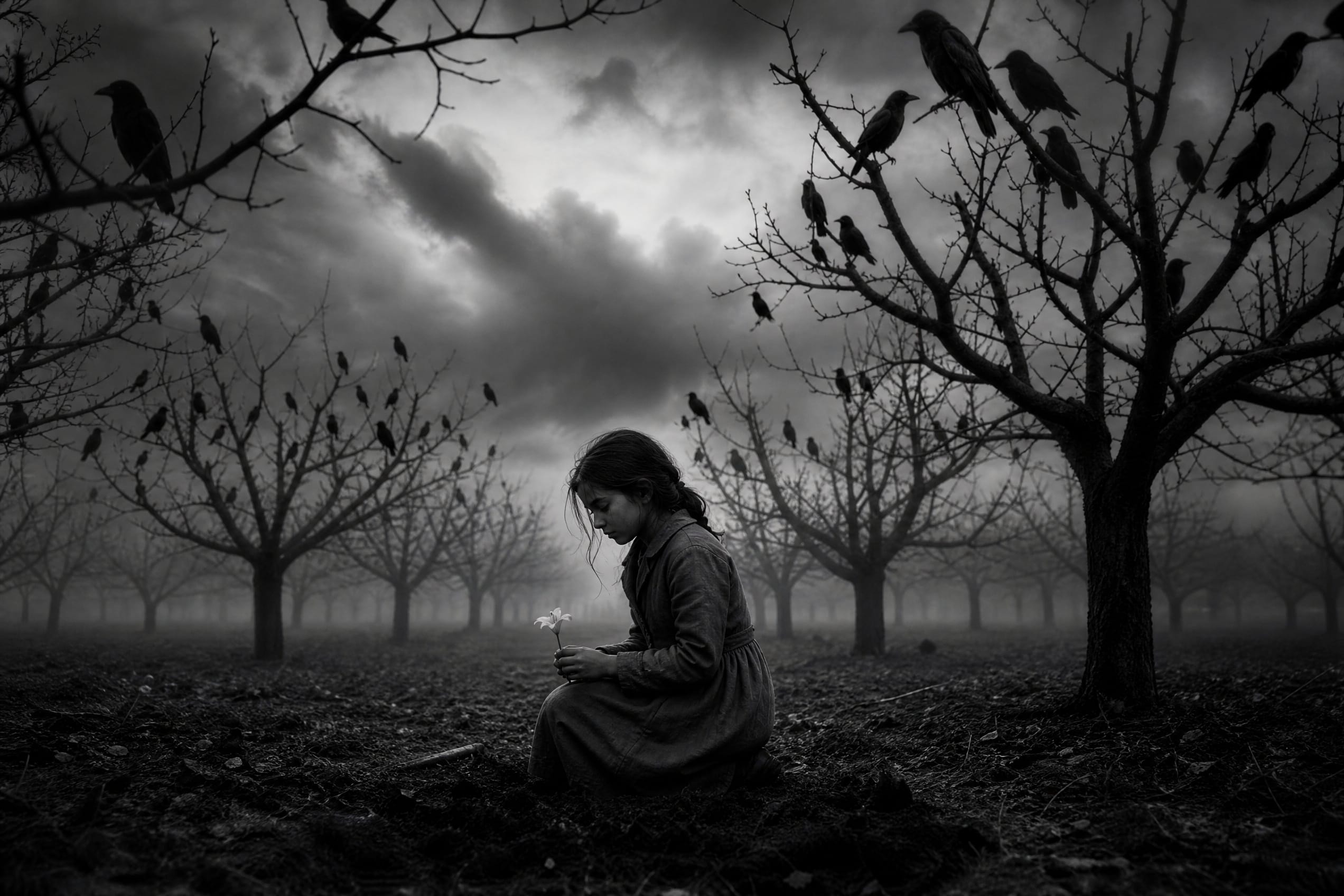
They gathered there every morning before sunrise, black silhouettes perched along the skeletal branches in impossible numbers. Hundreds of them. Sometimes thousands. They never fought over territory. They never scavenged. They simply watched. Their polished eyes followed every passerby with the patient certainty of creatures waiting for something they knew would eventually happen. On windless mornings they remained so perfectly still that the orchard resembled a cathedral filled with silent mourners dressed entirely in feathers.
Even the air behaved differently there.
The wind slowed as it crossed the first row of trees, as though reluctant to disturb whatever slept beneath the roots. Rain carried a richer scent, heavy with wet bark, moss-covered stone, and freshly turned earth that somehow lingered even during the driest summers. Standing among the trees always felt like entering a room where someone had just stopped crying. Nothing looked broken, yet sorrow clung invisibly to every branch, every patch of soil, every breath drawn into waiting lungs.
The old people noticed these things.
The young learned not to ask.
Before every planting season, parents repeated the same warning they themselves had heard as children, their voices carrying an urgency that never quite matched the simplicity of the words.
“Never dig beneath the orchard.”
No one explained why.
Questions faded with time. Habits survived.
Only Eliza refused to inherit silence.
At nine years old, she still believed every mystery deserved an answer and every lonely thing deserved kindness. Her grandmother used to tell her that questions were like seeds. Most died in poor soil. A few grew into forests large enough to swallow entire generations. Eliza had smiled whenever she heard that, never understanding it as a warning. She carried curiosity the way other children carried smooth stones in their pockets, collecting one impossible question after another until her thoughts overflowed with them.
Why did the crows never leave?
Why did no flowers grow beneath the trees?
Why did adults lower their voices whenever they passed the orchard?
Most of all…
Why did everyone seem afraid of a place that had done nothing except stand quietly for longer than anyone could remember?
The storm arrived three days before everything changed.
Rain fell without interruption, soaking the valley until streams overflowed and wagon wheels disappeared beneath deep ribbons of mud. The orchard drank every drop without complaint. Water collected in shallow pools around the trunks before quietly disappearing into the ground, as though the earth beneath the trees remained endlessly thirsty.
On the fourth morning the rain softened into a cold mist that drifted between the branches like pale breath.
Eliza wandered farther than her mother would have allowed.
She had no destination.
Children rarely do.
They simply follow whatever catches their attention.
That morning it was a single white flower growing beside the broken stone wall marking the orchard’s edge.
It shouldn’t have existed.
Everything around it was lifeless.
The soil was black and heavy.
Leaves had decayed into dark ribbons beneath bare limbs.
Even the moss clinging to fallen stones carried the dull gray-green color of old photographs.
Yet there it stood.
One delicate bloom.
Its petals glowed softly against the darkness, untouched by mud despite the days of rain. Tiny droplets rested upon its edges, catching the pale morning light until each one shimmered like a tear refusing to fall.
Eliza knelt.
The ground released the rich scent of wet earth and decomposing leaves as her knees settled into the mud. Cold seeped slowly through the fabric of her dress, yet the soil beneath her fingertips felt strangely warm.
Not warmed by sunlight.
There was no sunlight.
This warmth came from deeper below.
It pulsed faintly against her skin.
Almost…
Like a heartbeat.
She withdrew her hand instinctively.
The warmth vanished.
For a long moment she simply watched the flower sway gently despite the complete absence of wind.
“You don’t belong here,” she whispered.
The words dissolved into the mist.
Then, somewhere high above her, wings shifted.
She looked upward.
Every crow in the orchard had turned toward her.
Hundreds of black eyes.
Unblinking.
Patient.
None called.
None flew.
The silence pressed against her ears until she became painfully aware of every tiny sound—the slow drip of water from the branches, her own breathing growing shallower, the distant pounding of her heart, and somewhere beneath all of it…
A rhythm.
Not heard.
Felt.
A slow, steady pulse traveling upward through the soles of her shoes.
The orchard was alive.
Not with life as she understood it.
With memory.
She didn’t know why she believed that.
The thought simply arrived complete.
As though the earth itself had placed it gently inside her mind.
Without thinking, Eliza lifted the flower carefully from the ground, preserving every fragile root she could. The stem trembled between her fingers, impossibly delicate, yet stubborn enough to survive where nothing else would grow. She searched for a better place beneath the oldest tree, believing with the unquestioning certainty only children possess that lonely things simply needed company.
As she pressed the roots into the waiting earth, the orchard exhaled.
The sound was so soft she almost mistook it for the wind.
But there was no wind.
Only the unmistakable sensation that something ancient had awakened beneath her hands after centuries of dreaming.
Then…
Every crow fell silent at once.
Not quieter.
Silent.
Even the rain seemed to hesitate.
The world held its breath.
And somewhere beneath the roots of the oldest tree…
Someone remembered being forgotten.
Discover more from Memoirs of Madness
Subscribe to get the latest posts sent to your email.


Powerful writing, Mangus.
LikeLiked by 2 people
Thanks, Lisa
LikeLiked by 1 person
You’re welcome.
LikeLike