
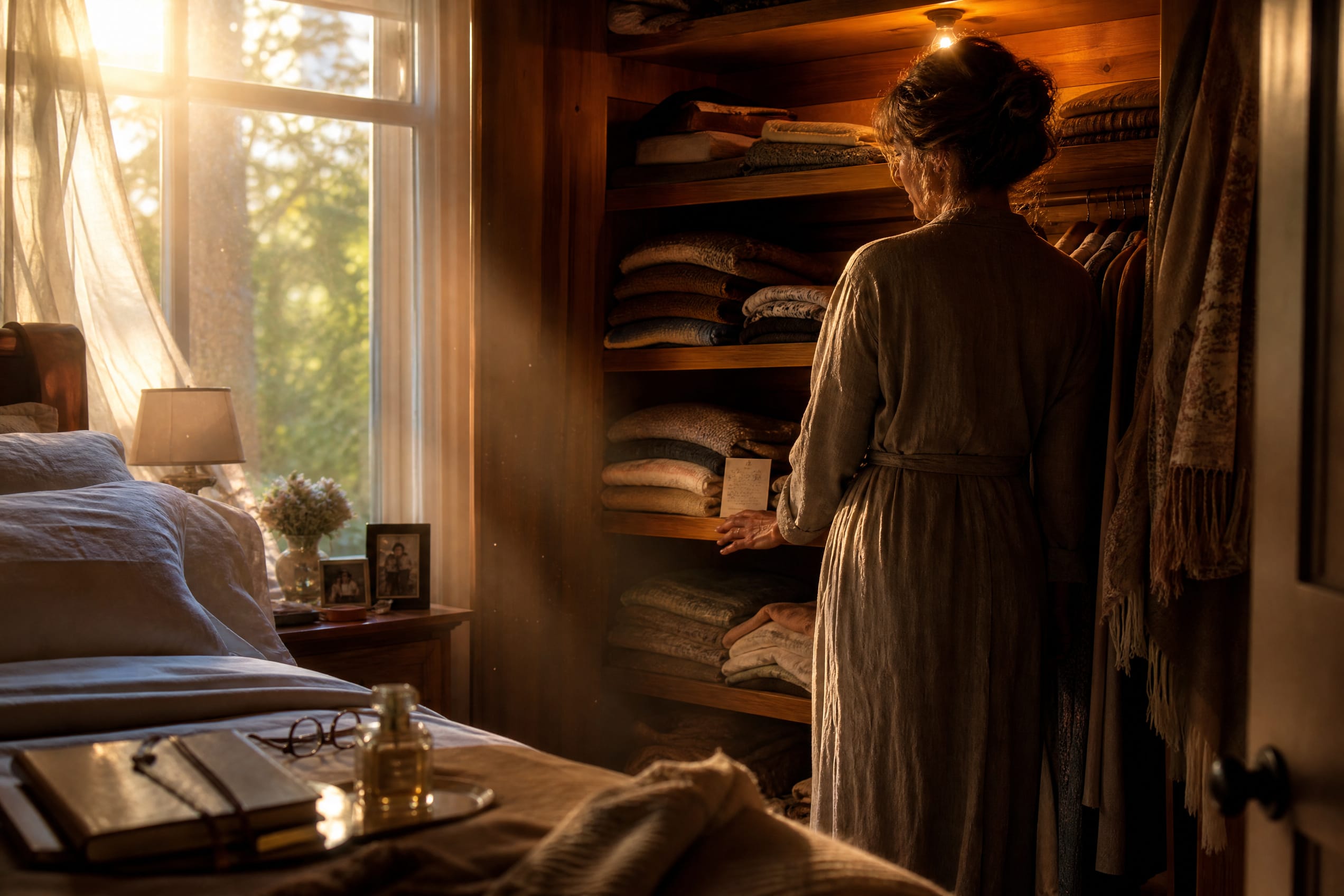
She found the first note on a Tuesday morning, tucked between two wool sweaters she hadn’t worn since before the children were born. The paper had yellowed softly at the edges, as though it had spent years breathing in cedar and darkness, waiting for the exact morning she would finally notice it. The handwriting was unmistakably hers—not the hurried, practical scrawl that now lived on grocery lists, appointment cards, and forgotten sticky notes plastered across the refrigerator, but the looping, patient script she used when she still believed handwriting revealed the architecture of a soul.
Don’t forget who you were before the noise.
She stared until the words blurred. The closet light buzzed faintly overhead, its tired fluorescent hum filling the silence the way distant insects fill a summer evening. Around her, the familiar scent of cedar mingled with clean cotton, lavender sachets that had long ago surrendered their fragrance, and the faint sweetness of perfume lingering in collars she no longer wore. It was remarkable how memory possessed its own scent. She had once hidden inside this very closet after difficult days, not because there was room to hide, but because there was finally room to breathe. Before the calendar became another member of the household. Before conversations turned into logistics. Before every hour belonged to someone else.
She folded the note with more care than it deserved and slipped it into her pocket, insisting to herself that it had to be an old page torn from a forgotten journal.
Memory misplaced things.
Life buried them.
The following evening another note waited inside the pocket of a cardigan she’d almost donated last spring.
You’re drifting again.
A chill traveled across her shoulders despite the warmth of the room.
She read the sentence once.
Then again.
The handwriting belonged to her.
The certainty did not.
It sounded like someone she remembered only in flashes—a woman who once bought train tickets because curiosity outweighed caution, who wandered bookstores without checking the time, who laughed so freely strangers often turned to see what they were missing. Somewhere along the years that woman had learned to lower her voice, soften her opinions, apologize before speaking, and call it maturity.
When had survival become indistinguishable from surrender?
By Thursday the notes had become less mystery than ritual. She found herself delaying bedtime just to stand before the closet door, fingertips resting on the brass knob while anticipation fluttered somewhere beneath her ribs. The rest of the house settled into its nightly chorus—the dishwasher sighing through another cycle, floorboards answering the cooling air with tiny creaks, the muffled drone of a television she wasn’t really watching.
Another folded square waited among her scarves.
You apologized again.
She smiled despite herself.
Then the smile faded.
She replayed the day with uncomfortable clarity.
She had apologized when someone else bumped into her shopping cart.
Apologized for asking a waiter to correct her order.
Apologized for interrupting her husband with a thought she’d almost forgotten.
Three apologies.
None of them hers to make.
She wondered how many invisible pieces of herself had been traded away one unnecessary apology at a time.
Friday’s note rested beneath the sleeve of a linen blouse she’d worn during the interview for the promotion she’d never pursued.
You almost laughed today.
The memory surfaced immediately.
A little girl in the grocery store had been scolding a cantaloupe with absolute conviction, accusing it of being “a very suspicious melon.” The absurdity had risen inside her before she instinctively swallowed it, smoothing her face back into polite adulthood.
She had become someone who edited joy before anyone else could.
The realization settled heavier than she expected.
Saturday arrived wrapped in steady rain that softened the windows into watercolor. The bedroom carried the comforting scent of damp earth drifting through the cracked window, mingling with cedar and aging paper. Another note rested inside the sleeve of the navy blouse she used to wear on days she wanted the world to notice her before she ever opened her mouth.
Stop shrinking to fit rooms you’ve already outgrown.
The words struck with surgical precision.
Her knees gave way before she realized she was sitting.
The cedar floor felt cool beneath her bare legs, its polished grain worn smooth by decades of quiet use. Dust floated lazily through narrow beams of light slipping past the closet door, each particle suspended as though time itself had decided to linger. She leaned her head against the wall and closed her eyes.
She remembered the woman who filled journals because thoughts refused to remain inside her.
The woman who believed forty wasn’t an ending but another beginning.
The woman who collected maps she never used because possibility itself felt beautiful.
She hadn’t lost that woman all at once.
She had misplaced her gradually.
A compromise here.
A postponed dream there.
One quiet surrender after another until absence began wearing the face of normal.
The closet light flickered gently overhead.
Not like a warning.
More like someone breathing.
She realized then that none of the notes had asked her to become someone new.
They had simply refused to let her forget someone she already was.
Sunday morning arrived without ceremony. Pale sunlight spilled across the bedroom floor, carrying the fresh scent of cut grass and distant rain. She opened the closet expecting another folded page waiting faithfully among the clothes.
There was nothing.
She searched anyway.
Sweater pockets.
Coat linings.
The cedar shelves.
Even beneath an old shoebox she hadn’t opened in years.
Nothing.
For one fragile moment panic tightened around her ribs.
Had she imagined everything?
Had the conversation ended because she’d failed some test she never knew she was taking?
Her hand slipped into the pocket of the cardigan where the first note had waited days earlier.
Empty.
She smiled.
Not because she understood.
Because she no longer needed to.
Outside the bedroom someone called her name from the kitchen.
For years she would have answered before the second syllable finished leaving their mouth, another instinct polished by repetition.
Instead she crossed to the window.
The morning air met her skin with surprising coolness, carrying birdsong, damp leaves, freshly cut grass, and the distant laughter of children chasing one another somewhere beyond the fences. She breathed until the scent of cedar faded behind the smell of a world already busy becoming itself.
In the reflection on the glass she caught a glimpse of her own face.
There was no dramatic transformation waiting there.
Only quieter eyes.
Straighter shoulders.
A woman who looked as though she had finally remembered the sound of her own voice.
“There you are,” she whispered.
The words weren’t spoken to the reflection.
They were spoken to someone who had been waiting patiently inside her all along.
Discover more from Memoirs of Madness
Subscribe to get the latest posts sent to your email.
 Memoirs of Madness
Love this Mangus.
LikeLike
thanks, Di
LikeLike