There are rooms that collect dust. There are rooms that collect memories. Then there are rooms that collect people long after they’ve forgotten they ever lived there. The building on Ashcombe Street had stood empty for nearly forty years, or at least that was what the city records insisted. Tax documents listed it as abandoned. Utility companies reported no electricity, no water, no gas moving through its ancient pipes. Yet every few months someone claimed to see a faint glow drifting behind the third-floor windows sometime after midnight. By sunrise the lights were gone, the front door remained locked, and the neighbors quietly returned to pretending they hadn’t looked. Old cities survive because people learn which questions are safer left unanswered. Ashcombe Street had become one of those questions.
Jonah Mercer never believed in haunted buildings. Ghosts required intention. They required unfinished business, vengeance, sorrow clinging stubbornly to old walls. Jonah believed abandoned places were haunted only by imagination. Twenty-two years working for the Municipal Archive had taught him that buildings merely reflected the people who entered them. Empty hospitals echoed because visitors expected suffering. Churches felt sacred because generations had been taught to lower their voices beneath stained glass. Walls remembered sound. People supplied the meaning. That explanation had always been enough. Until tonight.
Rain drummed steadily against the boarded windows as he forced the swollen oak door inward. Damp air greeted him immediately, carrying the smell of mildew, wet plaster, old wool, and something metallic lingering beneath it all. It wasn’t blood. It was older than blood, like forgotten coins resting for decades beneath dark river water. His flashlight carved a narrow path through the darkness, illuminating thousands of suspended dust particles drifting lazily through the beam. They rose and settled with such deliberate rhythm that the building seemed to inhale and exhale around him. Every step across the warped hardwood released another groan from beneath his boots, but the sounds did not echo the way they should have. They lingered. They seemed to consider the room before disappearing, as though the floor itself weighed each footstep before allowing silence to reclaim it.
Jonah stopped walking. The silence pressing around him possessed a texture unlike anything he had experienced before. It wasn’t the absence of sound. It was a presence. Heavy. Patient. It settled gently against his ears until he became aware of things normally hidden beneath everyday noise—the quiet rasp of his own breathing, the leather of his gloves stretching as he tightened his grip on the flashlight, the measured rhythm of his heartbeat climbing into his throat. An uncomfortable thought crossed his mind, absurd enough that he almost laughed aloud.
The building wasn’t empty.
It was listening.
He shook the idea away and unclipped the digital recorder from his jacket. “Municipal Archive Survey Number 1847,” he said, forcing a steadiness into his voice he didn’t entirely feel. “Property vacant approximately thirty-nine years. Significant structural deterioration observed throughout entrance hall.” His recorder captured every word perfectly. The room did not. His voice seemed swallowed the instant it left his mouth, absorbed by the walls before it could return to him. Even silence, he realized, had rules inside this place.
He continued deeper into the building. Wallpaper peeled from the walls in long curling strips that resembled old skin shedding from something enormous. Water stains spread across the ceilings like dark veins beneath translucent flesh. Furniture remained exactly where someone had abandoned it decades earlier, each piece buried beneath blankets of gray dust thick enough to preserve fingerprints indefinitely. Nothing appeared disturbed. Time itself seemed reluctant to remain here. It had simply stopped passing.
Then he noticed the overcoats.
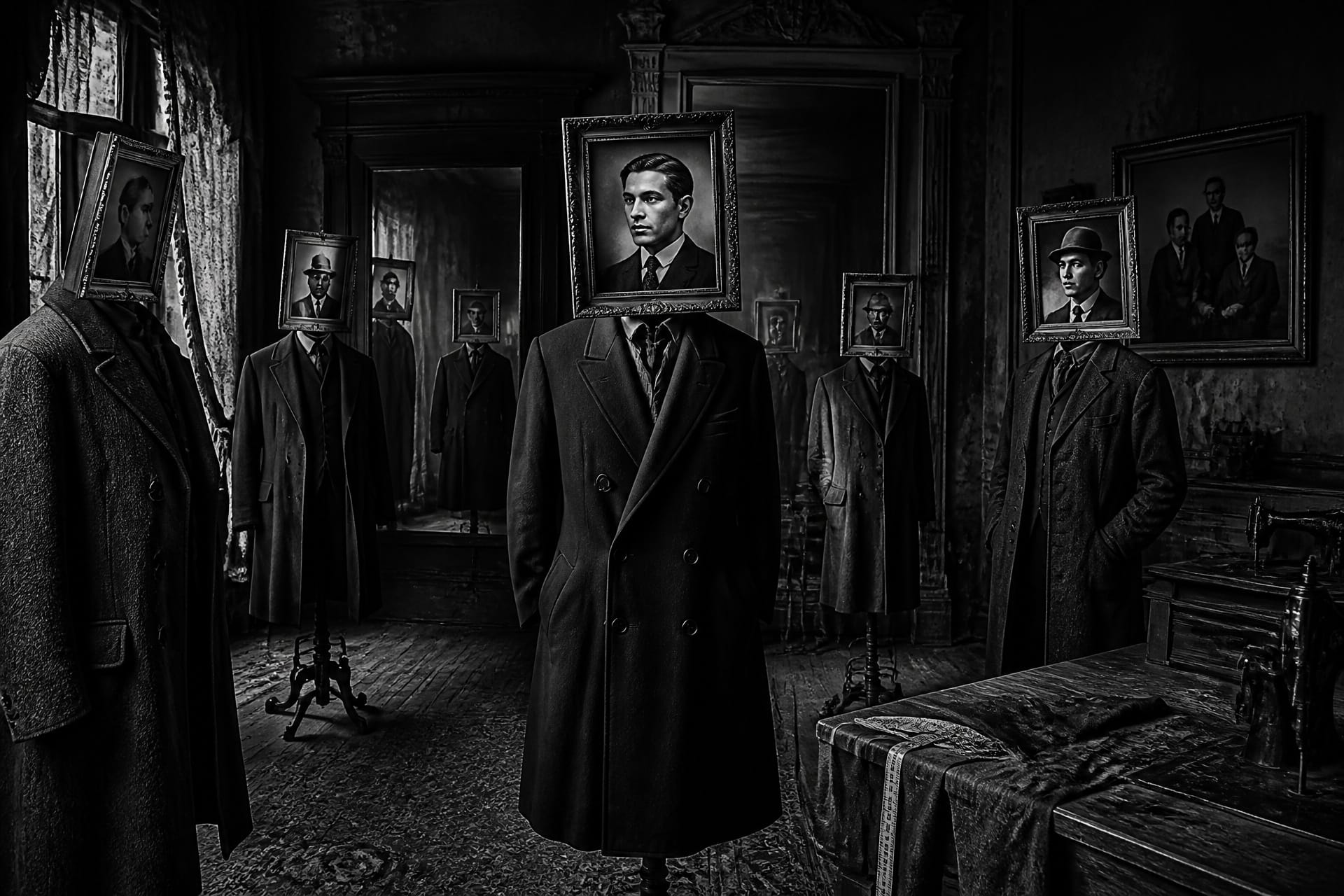
At first he mistook them for people waiting quietly in the darkness. Long wool coats stood motionless throughout the room, each perfectly tailored despite the decay surrounding them. Relief arrived the moment he realized they were mannequins.
It disappeared just as quickly.
None of them had heads.
Where faces should have been rested ornate wooden picture frames. Each frame contained a black-and-white studio portrait so sharply detailed it seemed impossible. Individual strands of hair caught the light. Tiny reflections shimmered within watchful eyes. Fine wrinkles in expensive suits remained crisp despite four decades of abandonment. The photographs had not faded. They had not yellowed. Dust blanketed every surface in the room except the portraits themselves. The glass gleamed as though someone had polished it moments before he arrived.
Curiosity overcame caution.
Jonah stepped closer to the nearest mannequin and reached toward the frame. His fingertips stopped less than an inch away. Warmth radiated from the wood. Not warmth gathered from sunlight or trapped inside old timber, but the unmistakable warmth of living skin. He hesitated only a second before resting two fingers against the frame.
It pulsed.
So faintly he almost convinced himself he’d imagined it.
Behind him, a floorboard creaked.
Not beneath his feet.
Somewhere deeper inside the room.
He turned sharply.
Nothing moved.
Only rows of silent mannequins disappearing into shadow, each one patiently wearing another stranger’s face. His flashlight drifted slowly across them.
One.
Three.
Seven.
Twelve.
Different decades.
Different expressions.
Different lives.
Yet something connected them all in a way he couldn’t explain. The feeling arrived before the thought itself, slipping beneath his skin with quiet certainty. They were familiar—not because he recognized them, but because some forgotten part of him already had.
His pulse quickened as he approached the largest figure standing near the center of the room. The portrait showed a man in a beautifully tailored double-breasted overcoat. His hair was neatly combed. His jaw carried the hard confidence of someone who had learned to mistake control for strength. But it wasn’t the expensive clothing or the expression that stole Jonah’s breath.
It was the eyes.
They were watching him.
Not following him like a trick of perspective.
Watching him.
Patiently.
Knowingly.
He took one cautious step to the left.
The eyes moved with him.
Another step.
Still watching.
The room seemed to grow thinner around him. Each breath felt shallower than the last, as though the house itself had quietly begun consuming the air. His instincts begged him to leave, but curiosity anchored him where he stood. Slowly he brushed away the dust covering the tarnished brass nameplate beneath the frame.
One word emerged.
JONAH.
His mouth went dry. Every muscle in his body tightened as he lifted the flashlight toward the portrait once more.
The face looking back at him was his own.
Not as he was today.
As he might become.
Older.
Colder.
A man whose eyes held no trace of kindness, only the quiet certainty of someone who had survived by abandoning every part of himself worth saving.
Jonah staggered backward. The flashlight slipped from his hand and struck the floor, the beam spinning wildly across the room.
For one impossible heartbeat, every portrait smiled.
When the light settled, the smiles were gone.
But the room had changed.
Every frame had turned.
Every face was looking directly at him.
And somewhere in the darkness beyond the mannequins, a voice barely louder than a breath whispered,
“We’ve been waiting for you.”
Discover more from Memoirs of Madness
Subscribe to get the latest posts sent to your email.
 Memoirs of Madness
Oh my, this is goooooood!!
LikeLike
Thanks, Di
LikeLike