I have become the old man I spent my entire life trying not to become.
The realization didn’t arrive with gray hair or aching joints, nor did it wait patiently inside a mirror for one dramatic morning when I would finally surrender to the obvious. It settled over me the way winter settles over abandoned buildings, quietly claiming one forgotten room after another until there was nowhere left that still belonged to summer. Somewhere between funerals, retirement, late-night coffee, and learning the names of my prescription medications better than the names of new neighbors, I stopped imagining the future and began living almost exclusively in conversations with the past. I never made that decision consciously. Time made it for me while I was busy believing I still had plenty of it.
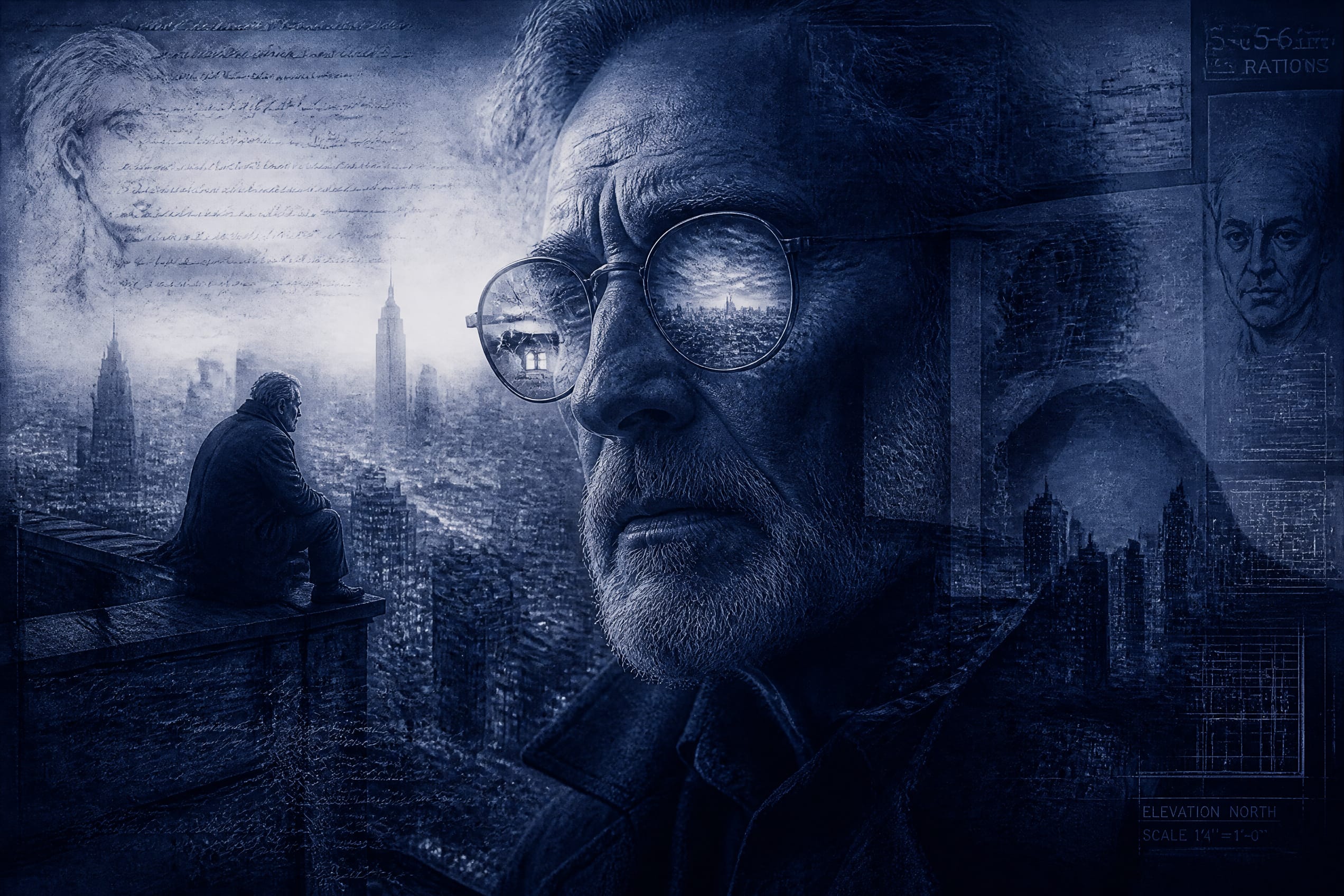
Most evenings I climbed to the rooftop of my building carrying a dented thermos filled with black coffee and a notebook whose pages had become more faithful than most people I had known. The climb left my knees protesting every step, but the city waiting above always made the pain feel like a reasonable admission fee. From the rooftop, New York stretched toward every horizon beneath a blanket of blue darkness, its countless windows glowing like distant campfires scattered across a battlefield too enormous to comprehend. Traffic crawled through narrow streets in slow ribbons of white and red, helicopters drifted across the skyline like patient predators, and somewhere below, sirens stitched themselves into the city’s endless heartbeat. The wind carried rain, diesel fuel, hot electrical transformers, damp brick, and the faint metallic scent that always follows storms, as though lightning leaves traces of itself behind for anyone willing to breathe deeply enough.
The older I became, the less I trusted memory. People speak of memories as though they were photographs tucked safely inside dusty albums, but photographs remain honest. Memory lies with astonishing confidence. It edits conversations to protect our pride, erases cruelty disguised as necessity, softens betrayals we committed while sharpening those committed against us, and somehow convinces us that we were always a little kinder, a little wiser, and a little more courageous than we ever truly managed to be. I spent decades believing my memories belonged to me. It took growing old to realize I belonged to them.
That was why I kept journals.
At least, that was the reason I gave myself.
The truth was uglier.
I was terrified of disappearing before I finished understanding who I had been.
Every notebook represented another failed attempt to pin my life to paper before time quietly carried pieces of it away. Their cracked leather bindings smelled of cedar, dust, fountain-pen ink, and the faint sweetness of yellowing paper that had absorbed decades of cigarette smoke before I finally quit. Some pages still carried tiny brown rings where coffee cups had rested during sleepless nights. Others bore fingerprints darkened by engine grease from jobs I could barely remember working. Entire relationships lived between those covers. Arguments. Birthdays. Funerals. Regrets disguised as observations. Lies disguised as optimism.
The first impossible sentence appeared on a Tuesday.
I remember because Tuesdays have always seemed especially ordinary, and extraordinary things prefer ordinary days. I opened a journal I hadn’t touched in nearly forty years and found a line written in unmistakably familiar handwriting.
If you’re reading this, we survived.
The handwriting belonged to me.
The ink had aged naturally.
The page smelled exactly as old paper should.
Everything insisted the sentence had always been there.
Everything except my memory.
I read the line so many times the words began losing their meaning, dissolving into nothing more than shapes arranged across yellow paper. Eventually I laughed, though the sound emerging from my throat belonged more to nervousness than amusement. Age does peculiar things to memory, I reminded myself. Men forget birthdays, names, directions, entire conversations. Why shouldn’t I forget writing a single sentence four decades earlier? I closed the journal, poured another cup of coffee, and spent the rest of the evening pretending my hands weren’t trembling.
The following night another sentence appeared.
You missed the first clue.
This time I knew.
I had examined that page twice before putting the journal away.
It had been blank.
I told no one.
Who would believe me?
More importantly, who would I become if they did?
Over the following weeks the journals continued changing with maddening restraint. They never added spectacular revelations or impossible prophecies. Instead, they quietly corrected me. An argument I remembered winning now ended with an apology I had conveniently forgotten accepting. A story I had proudly told for years now included details revealing just how frightened I had actually been. Entire paragraphs rewrote themselves, not changing events but exposing motives I had spent decades carefully burying beneath polished anecdotes and selective memory. It was as though someone had become editor of my life and possessed no interest whatsoever in protecting my reputation.
Sleep abandoned me.
Coffee lost its ability to quiet my thoughts.
The apartment began feeling increasingly occupied despite every room remaining visibly empty. Some nights I woke convinced someone had just finished speaking my name. Other nights I could have sworn pages turned softly somewhere beyond the bedroom door, followed by the unmistakable scratch of a fountain pen moving across paper. I searched closets, checked locks twice before bed, even laughed at myself while proving no one else occupied the apartment.
Yet every morning another page had changed.
Then came the entry I knew I had never written.
It wasn’t because the handwriting differed.
It didn’t.
It was because it described something that had happened only hours earlier.
It described the rooftop.
The rain.
The coffee cooling beside me.
It described me standing at the ledge wondering whether my life had amounted to anything that would outlive my obituary.
At the bottom of the page, beneath every word I remembered writing, one final sentence waited.
You still haven’t looked behind you.
A coldness settled into my spine that had nothing to do with the wind sweeping across the rooftop.
Slowly…
Very slowly…
I turned.
The roof was empty.
No footsteps.
No movement.
Only rusted ventilation ducts, puddles reflecting distant city lights, and the endless skyline stretching toward the horizon.
I laughed again.
Too loudly.
Too quickly.
The sound disappeared into the night without echo.
When I looked back at the journal, another sentence had appeared while my eyes had been elsewhere.
Not here.
Behind you.
I carried the notebook downstairs with my pulse hammering so violently I could feel it behind my eyes. Every light inside the apartment remained exactly as I had left it. The hallway stood empty. The bedroom door remained slightly open. The old clock above the kitchen sink ticked with comforting regularity.
Nothing looked wrong.
Until I walked past the hallway mirror.
For just an instant…
The reflection didn’t move.
I took another step.
It remained standing exactly where it had been.
Watching me leave.
By the time I gathered enough courage to turn around, the mirror reflected only an exhausted old man clutching a journal against his chest.
When I finally opened the notebook again, every page had become blank.
Every page…
Except the last.
It contained only today’s date.
Beneath it, written in fresh ink that was still drying before my eyes, were six words that smelled faintly of wet iron instead of ink.
Tomorrow, you’ll finally meet the author.
Discover more from Memoirs of Madness
Subscribe to get the latest posts sent to your email.


I can relate to the aching joints
LikeLike
For sure, thanks Alice
LikeLike
Incredible
LikeLike
thank you
LikeLike
Beautifully written. I recognized the journals of my life, the changes as I grew old, and even those moments of trying to remember why I had written a note long ago. My memories are like photographs stored but visual that play out and return sound, smells, and emotions of a different time. I look in the mirror only briefly because it is difficult not too, while washing my hands and face, and I try to understand what and who I am. I loved this reflection. Again, beautifully written.
LikeLike
thank you
LikeLike
Opening line, and opening paragraph are utterly brilliant!!
LikeLiked by 2 people
thank you
LikeLike