Martha had spent most of her life believing photographs existed to preserve memories, although age had slowly taught her that memories rarely stayed preserved for long. They softened around the edges, shed inconvenient details, exaggerated others, and eventually became stories we told ourselves rather than faithful records of what had happened. Yet photographs seemed different. They offered proof. They captured a fraction of a second and held it still while everything else continued moving forward. For decades she had trusted them more than she trusted herself. Family albums lined her bookshelves. Framed portraits occupied every hallway in her home. Boxes of old snapshots sat in closets and drawers, each one a small attempt to rescue something from the relentless current of time. That belief survived weddings, funerals, birthdays, and countless ordinary afternoons until the day she inherited her grandfather’s camera, an object so unremarkable at first glance that she nearly left it buried among the rest of his belongings.
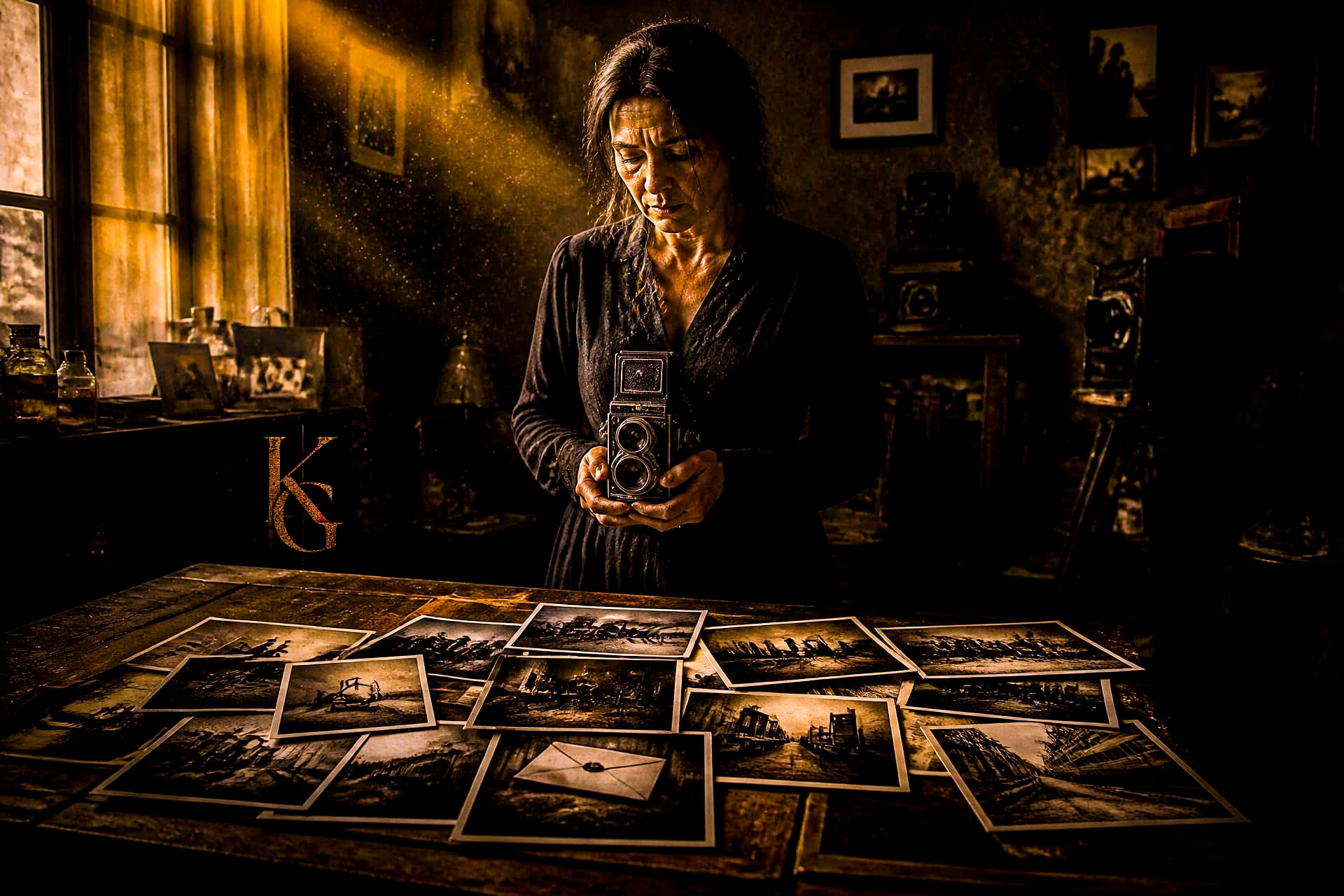
The camera sat in her hands now, heavier than its size suggested, its cracked leather carrying the scent of dust, old wood, and the faint chemical traces of a darkroom long abandoned. Sunlight poured through the tall studio windows in pale golden shafts, illuminating countless dust motes that drifted lazily through the air like fragments of forgotten years. The room itself felt untouched by time, preserved in much the same way photographs attempted to preserve moments. Shelves sagged beneath the weight of albums and negatives. Wooden drawers housed decades of undeveloped film. The wallpaper had faded into muted shades of brown and amber, and the floorboards creaked softly beneath her feet whenever she shifted her weight. Everything in the room seemed to exist in a state of quiet suspension, as though her grandfather had merely stepped out for a moment and might return at any time to continue his work.
Spread across the table before her lay dozens of photographs, and despite examining them repeatedly over the past week, they continued to unsettle her in ways she struggled to articulate. The images possessed the strange familiarity of dreams, recognizable and alien at the same time. None of them contained faces. They should have. Martha knew people had stood before the lens. She remembered taking some of the photographs herself. Yet wherever a face should have appeared, there was something else entirely. A weathered envelope rested unopened beneath the glow of a lamp. A child’s bicycle lay abandoned in a field overtaken by summer weeds. An empty chair sat beside a hospital bed washed in pale morning light. A wedding ring rested alone on a rain-streaked windowsill while storm clouds gathered beyond the glass. Individually, each image appeared mundane. Together, they carried an emotional weight that seemed almost physical, pressing against her chest each time she looked at them.
The longer she studied the photographs, the more she understood that they were not capturing people at all. They were capturing absences. They recorded the shape left behind when something important failed to happen. They documented conversations abandoned midway through a sentence, opportunities dismissed out of fear, forgiveness withheld until it was no longer possible to offer. Looking at the photographs felt disturbingly intimate, as though she had been invited into the private chambers people rarely visited themselves. Most regrets did not announce their arrival dramatically. They settled quietly into a person’s life and remained there, becoming part of the furniture of the soul. Years passed. Careers were built. Families were raised. Entire lives unfolded around them. Yet beneath everything, the regret remained, patient and persistent, waiting for a sleepless night or an unexpected memory to remind its owner that it had never truly left.
The first time Martha used the camera, she had done so out of simple curiosity. She remembered standing before an old mirror near the darkroom, feeling vaguely foolish as she adjusted the focus and pressed the shutter. She expected an awkward self-portrait. What emerged instead left her sitting awake until dawn. The developed photograph showed no reflection. Instead, it revealed a train platform she had not seen in more than twenty years. The memory struck with such force that she could almost hear the station announcements echoing overhead and smell the diesel fumes drifting through the summer heat. She remembered the humidity clinging to her skin, the weight of uncertainty pressing against her ribs, and Daniel standing a few feet away asking her to leave town with him. He had spoken about possibilities with the reckless confidence only youth can sustain. New cities. New jobs. New adventures. A future that existed beyond the boundaries of everything she had ever known.
At the time, Martha had convinced herself she was being practical. She had responsibilities. Stability mattered. Dreams did not pay bills. Risk belonged to people with fewer obligations and less to lose. Those explanations had sounded reasonable then. They still sounded reasonable now. Yet as the years accumulated, she began to understand that reason and regret often occupied the same space. Daniel left. Life continued. She married someone else. Built a career. Purchased a home. Paid her bills on time. Accomplished all the things practical people were supposed to accomplish. Yet every now and then she would hear a train whistle in the distance or see a photograph of some city she had never visited, and a small part of her would wonder who she might have become had she boarded that train.
The camera had not shown her Daniel.
It had shown her the life she still mourned.
That realization changed everything.
Once she understood the language the camera spoke, the rest of the photographs became impossible to dismiss. The local baker’s portrait revealed an adoption form folded carefully inside a kitchen drawer. A retired sheriff’s image showed a revolver resting beside a handwritten confession yellowed with age. A schoolteacher’s photograph became a packed suitcase hidden beneath a bed, covered in a thin layer of dust accumulated over decades. Again and again the camera stripped away appearances and exposed the invisible burdens people carried beneath their carefully curated identities. It did not reveal sins. It revealed sorrows. It exposed the quiet places where fear had disguised itself as wisdom and where pride had masqueraded as strength.
Among all the photographs scattered across the table, however, one image unsettled Martha more than the others because she had no memory of taking it. The photograph depicted a simple kitchen table positioned beside a sunlit window draped with lace curtains. Morning light spilled across the surface, warming the wood with shades of amber and gold. Two coffee mugs rested opposite one another. One was full. Steam curled gently upward, caught forever in the stillness of the image. The other sat empty, waiting. There was nothing remarkable about the scene until Martha noticed the date scratched faintly into the corner.
Tomorrow.
A chill moved through her despite the warmth of the room. She turned the photograph over several times, searching for an explanation hidden somewhere beyond the image itself. There was none. No message. No note. No clue regarding who might sit across from her when morning arrived. Yet the longer she stared at the photograph, the more she felt something shifting inside her. Unlike the others, this image was not documenting a wound. It was documenting a crossroads.
For years she had treated regret as though it were an unavoidable consequence of aging, something every person accumulated alongside wrinkles and gray hair. Looking at the photograph now, she began to wonder if regret was not created by time at all. Perhaps regret was born in the moments when fear persuaded us to postpone the difficult conversation, delay the vulnerable gesture, or ignore the opportunity standing directly in front of us. Perhaps tomorrow’s regrets were being created today.
Her gaze drifted toward the telephone hanging on the wall.
The number remained exactly where it had always been, tucked away in a corner of her memory she visited less often than she pretended. She had not spoken to Daniel in decades. Entire lifetimes had unfolded between them. They had become strangers connected only by history and imagination. Yet as she sat there surrounded by photographs of other people’s unfinished stories, Martha realized that the possibility of rejection no longer frightened her nearly as much as the certainty of silence.
Outside, the afternoon sun continued its slow descent across the sky while shadows stretched along the floorboards like dark rivers. The studio smelled of dust, old paper, and fading chemicals. Somewhere beyond the walls, a dog barked. A screen door slammed. Life carried on with its usual indifference. Yet for the first time in years, Martha felt fully present inside a moment instead of trapped inside a memory.
The camera, she suddenly realized, had never been interested in the past. The past was simply the only language people understood well enough to hear its warning.
With trembling fingers, she reached for the telephone, lifted the receiver, and listened to the dial tone humming softly in her ear. It sounded strangely like possibility.
Discover more from Memoirs of Madness
Subscribe to get the latest posts sent to your email.

