The boxes were empty.
That was the problem.
If they had been full, Marcus could have convinced himself he was carrying something worth saving. Tools. Blueprints. Payroll records. Machine parts worn smooth by decades of use. Something tangible. Something with weight.
Instead, the cardboard felt almost weightless.
And somehow that made it heavier.
Rain hammered against the warehouse windows in uneven bursts, rattling old panes inside rusted steel frames. Water slipped through cracks in the roof and gathered in shallow puddles across the concrete floor. The air smelled of damp dust, machine oil, wet metal, and the faint ghost of welding smoke that had soaked itself into the building’s bones years ago.
Beyond the glass, the city shimmered beneath the storm.
Silver.
Black.
Cold.
Skyscrapers rose into the clouds like monuments built by people who had never worked a twelve-hour shift or carried lunchboxes stained with grease.
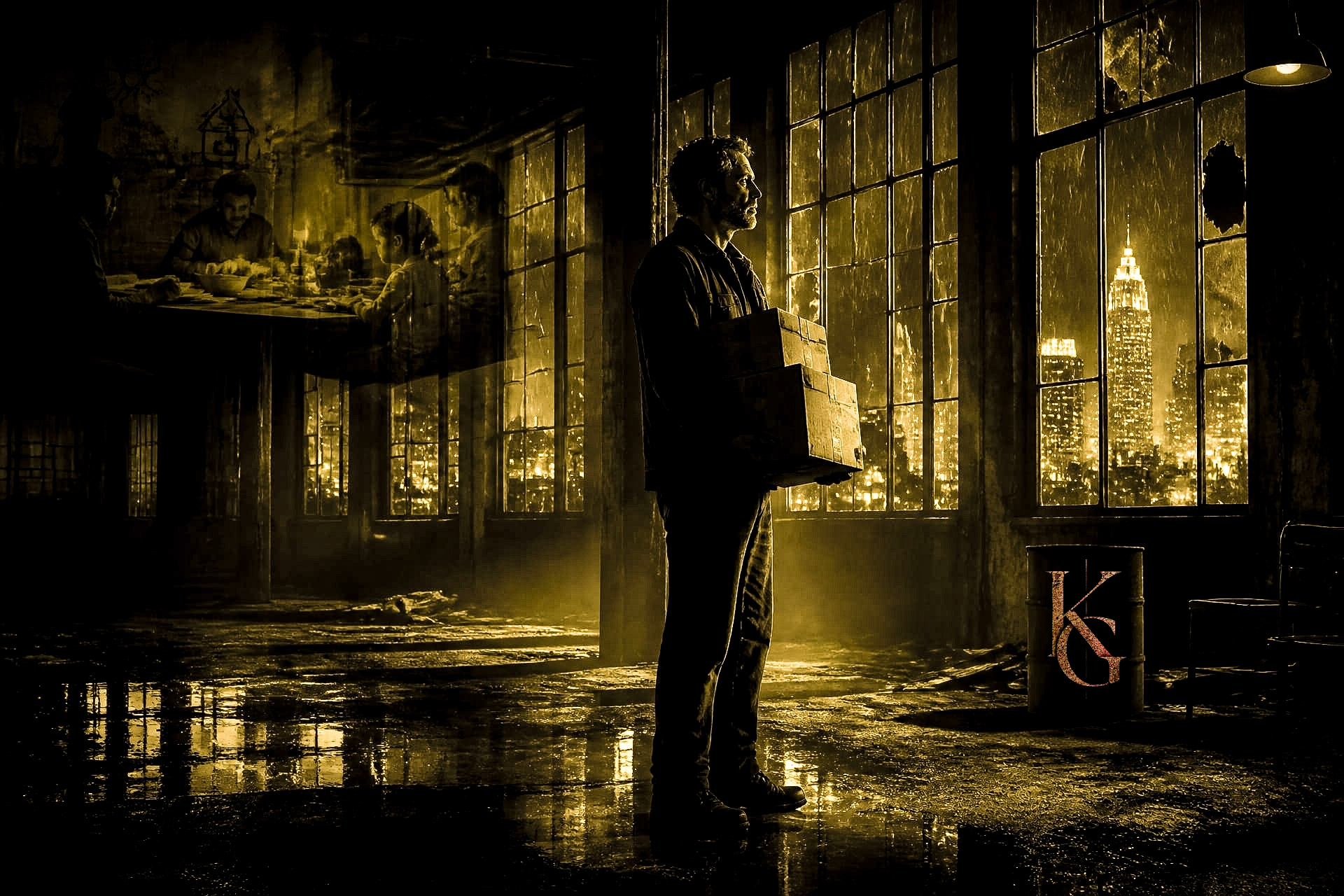
Marcus stood motionless beneath the leaking roof, three empty boxes pressed against his chest.
Thirty-two years.
The number echoed inside him.
Thirty-two years of arriving before sunrise.
Thirty-two years of hearing the whistle announce the beginning and end of another day.
Thirty-two years of machine noise so constant he stopped hearing it.
Now the silence felt unnatural.
Like walking into church and finding God missing.
Water dripped from somewhere overhead.
Plink.
Plink.
Plink.
The sound bounced through the warehouse and disappeared into darkness.
For the first time in decades, Marcus could hear the building breathing.
Factories weren’t supposed to be quiet.
The old foreman, Eddie Russo, used to say a healthy factory sounded like controlled chaos.
“If it gets quiet,” Eddie would tell new hires, “something expensive just happened.”
Marcus smiled despite himself.
Eddie had been dead nine years.
Heart attack.
Gone halfway through a turkey sandwich during lunch break.
One moment complaining about baseball.
The next gone.
Life could be cruelly efficient.
His reflection floated across the rain-streaked windows.
Older than he remembered.
The years seemed to have gathered in his face while he wasn’t paying attention.
The beard he’d stopped trimming after the layoff had grown thick and hirsute, spreading across his jaw and cheeks like stubborn brush reclaiming abandoned ground.
His daughter hated it.
“You look like you’re hiding from civilization,” she’d told him.
Maybe she was right.
The city outside no longer felt familiar anyway.
The neighborhood had changed.
The diners disappeared first.
Then the hardware store.
Then the union hall.
Then the little corner bar where men gathered after shift changes to complain about management, politicians, and whichever baseball team was disappointing them this season.
Now there were luxury lofts.
Boutique coffee shops.
Glass buildings that looked like they had never known dirt.
Progress.
The word tasted bitter.
Progress always seemed to arrive carrying promises for one group of people and eviction notices for another.
Marcus shifted the boxes and walked deeper into the warehouse.
His boots echoed across concrete stained by decades of labor. Each step stirred dust motes into pale shafts of light filtering through broken windows. The place felt larger empty.
Lonelier.
Like a body after the soul had left.
Near the back wall sat an old workbench somehow overlooked during cleanup.
He set the boxes down.
The cardboard collapsed slightly beneath its own emptiness.
That felt appropriate.
His eyes drifted upward.
Something scratched into the wall caught his attention.
A child’s drawing.
Faded almost beyond recognition.
A house.
A table.
Stick figures sitting together beneath a crooked roof.
Marcus stared.
The image reached into him with surprising force.
His son had drawn pictures like that once.
Back when homework assignments involved crayons and impossible optimism.
Back when family dinners happened every night.
Back when everyone fit around the same table.
The memory arrived whole.
His wife laughing while stirring gravy.
His daughter rolling her eyes dramatically.
His son explaining dinosaurs with absolute certainty.
The smell of meatloaf.
Warm bread.
Black pepper.
The scrape of forks.
The noise.
God, the noise.
Families never realize how beautiful noise is until silence moves in and takes the lease.
Marcus closed his eyes.
For a moment he could almost hear them again.
Then the storm rattled the windows and the memory scattered.
The thing nobody tells you about getting older is how much of your life becomes inaccessible.
The people are still there.
The moments are still there.
But you can only visit them.
You can’t stay.
His throat tightened.
Outside, lightning flashed.
The city illuminated briefly.
For an instant he saw himself reflected against the glass.
A man standing alone inside a dead factory carrying empty boxes.
The image felt almost cruel.
Like a joke told by someone who didn’t understand when to stop.
Years earlier, management had promised modernization.
Automation.
Optimization.
Efficiency.
Words delivered by men wearing polished shoes and expensive watches.
Eventually, portions of the operation moved into a highly automated facility connected to a massive data center that monitored production, inventory, shipping schedules, maintenance cycles, and workforce costs.
The executives called it innovation.
The shareholders called it growth.
Marcus remembered sitting through presentations full of colorful graphs and smiling faces.
Nobody mentioned layoffs.
Nobody mentioned communities.
Nobody mentioned fathers trying to pay mortgages.
Nobody mentioned marriages held together by overtime checks.
The future arrived exactly on schedule.
The workers didn’t.
His fingers tightened around the edge of the workbench.
What bothered him most wasn’t losing the job.
Jobs end.
People survive.
What bothered him was how heartless it all felt.
Thirty-two years reduced to a spreadsheet.
A cost analysis.
A quarterly projection.
No villain.
No dramatic betrayal.
Just numbers quietly deciding that human beings had become inefficient.
That kind of cruelty always felt worse.
At least enemies have the decency to hate you.
Algorithms don’t even know your name.
Rain continued striking the windows.
The storm seemed determined to wash the city clean.
Marcus knew better.
Cities don’t wash clean.
They accumulate ghosts.
This warehouse was full of them.
Eddie Russo yelling over machinery.
Maria singing off-key during night shift.
Jenkins hiding sandwiches in his toolbox.
The smell of fresh-cut steel.
The vibration of machines beneath his boots.
The feeling of accomplishment after finishing impossible deadlines.
Thousands of conversations.
Thousands of ordinary moments.
Thousands of lives stacked together like bricks.
The building remembered even if nobody else would.
Marcus looked down at the empty boxes.
Slowly, he picked one up.
Then another.
Then the third.
Not because they mattered.
Because they were all that remained.
He carried them back toward the front windows.
The skyline shimmered beyond the rain.
Beautiful.
Distant.
Indifferent.
For years he’d believed this factory was where he earned a living.
Standing there now, he realized something else.
The factory had never merely paid him.
It had witnessed him.
It had watched him become a husband.
A father.
A widower.
A grandfather.
A man.
The factory hadn’t manufactured products.
It had manufactured time.
And time was the one thing nobody ever got back.
Marcus stood there long after the rain began to soften.
Watching the city.
Watching his reflection.
Watching the storm move slowly across the skyline.
The boxes remained empty.
But for the first time all night, they didn’t feel quite so heavy.
Because maybe the weight had never been inside them.
Maybe it had been inside him all along.
Discover more from Memoirs of Madness
Subscribe to get the latest posts sent to your email.


Times are changing, isn’t it? Happy weekend!
LikeLike