
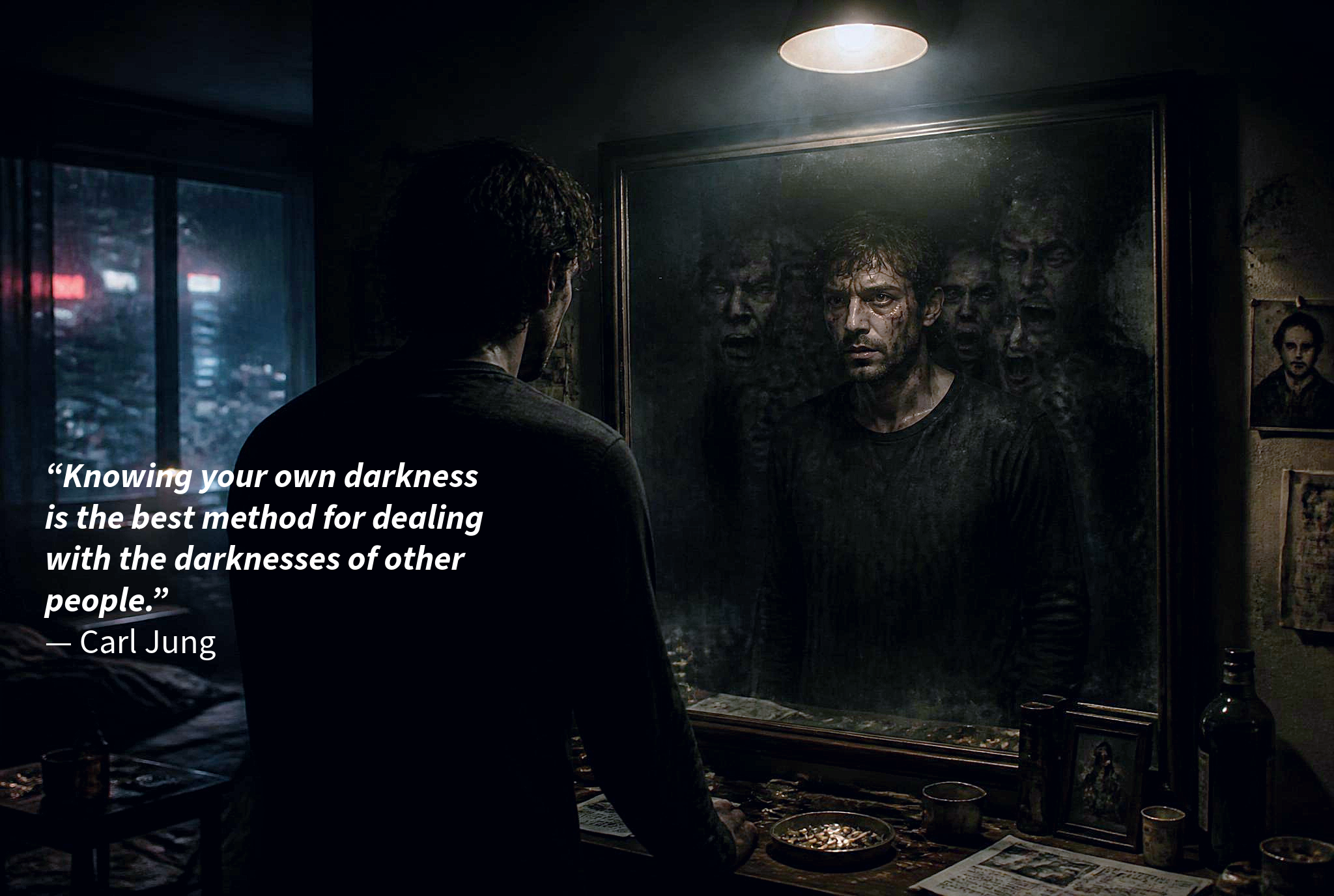
Personal Reflection
There’s something uncomfortable about this quote immediately. Not because it sounds cruel—but because it asks for honesty most people spend years avoiding.
To know your own darkness means more than acknowledging flaws casually. It means recognizing the parts of yourself that do not fit the identity you prefer to present to the world. The envy. The anger. The selfishness. The fear. The emotional wounds capable of becoming weapons if left unconscious long enough.
Most people would rather believe they are purely good.
Life rarely allows that illusion to survive untouched forever.
Because darkness is not always dramatic.
Sometimes it appears quietly through defensiveness. Through the way unresolved pain leaks into conversations, relationships, reactions. A person who feels abandoned becomes emotionally distant before others can leave first. Someone deeply ashamed learns how to attack vulnerability in other people because witnessing openness reminds them of what they buried in themselves years ago.
That’s the difficult thing about unexamined suffering:
it rarely stays contained.
Human beings pass emotional damage to one another constantly without fully understanding where it originated. Hurt people become controlling. Lonely people become emotionally unavailable. Frightened people become cruel in the name of self-protection. And often the behavior makes perfect psychological sense once you trace it back far enough.
But understanding darkness is not the same thing as excusing it.
That distinction matters.
Self-awareness does not magically remove harmful impulses. It simply prevents people from remaining blindly ruled by them. Because the more disconnected someone becomes from their own inner contradictions, the easier it becomes to project them outward onto everyone else.
Mental exhaustion often deepens there—in the war between the self people want to believe they are and the self quietly revealed through their patterns, reactions, and emotional habits.
That confrontation can feel humiliating.
No one enjoys discovering they are capable of bitterness, manipulation, avoidance, jealousy, or emotional cowardice under the right conditions. Yet pretending those capacities do not exist only gives them more control from the shadows.
And perhaps that’s why emotionally mature people often become gentler over time.
Not because they stop recognizing darkness in others…
…but because they finally recognize enough of it inside themselves to understand how human frailty actually works.
Maybe wisdom is not becoming a person without darkness.
Maybe wisdom is learning how to carry awareness of your own inner complexity without allowing it to harden you into cynicism or self-hatred.
Because once you understand your own capacity for fear, contradiction, and emotional damage, compassion stops being abstract morality.
It becomes realism.
The quiet recognition that every human being is fighting battles between woundedness and responsibility internally—whether they admit it openly or not.
And perhaps the goal is not purity.
Perhaps the goal is consciousness.
To know what lives inside you clearly enough that it no longer has to control the lives of everyone around you unconsciously.
Reflective Prompt
What part of yourself becomes hardest to acknowledge when you are emotionally hurt or afraid?
Discover more from Memoirs of Madness
Subscribe to get the latest posts sent to your email.


I guess my inner calm goes out of the window when I’m hurt. I try not to let it bother me, but it does,. However, those who have hurt me in the past are no longer present in my life for whatever reason, most of which IMO is actually of their own doing. I got fed up offering olive branches and my tree just died. They aren’t worth it and that’s what I keep tgelling myself.
LikeLike
Yes. Yeah. Yes.
LikeLike