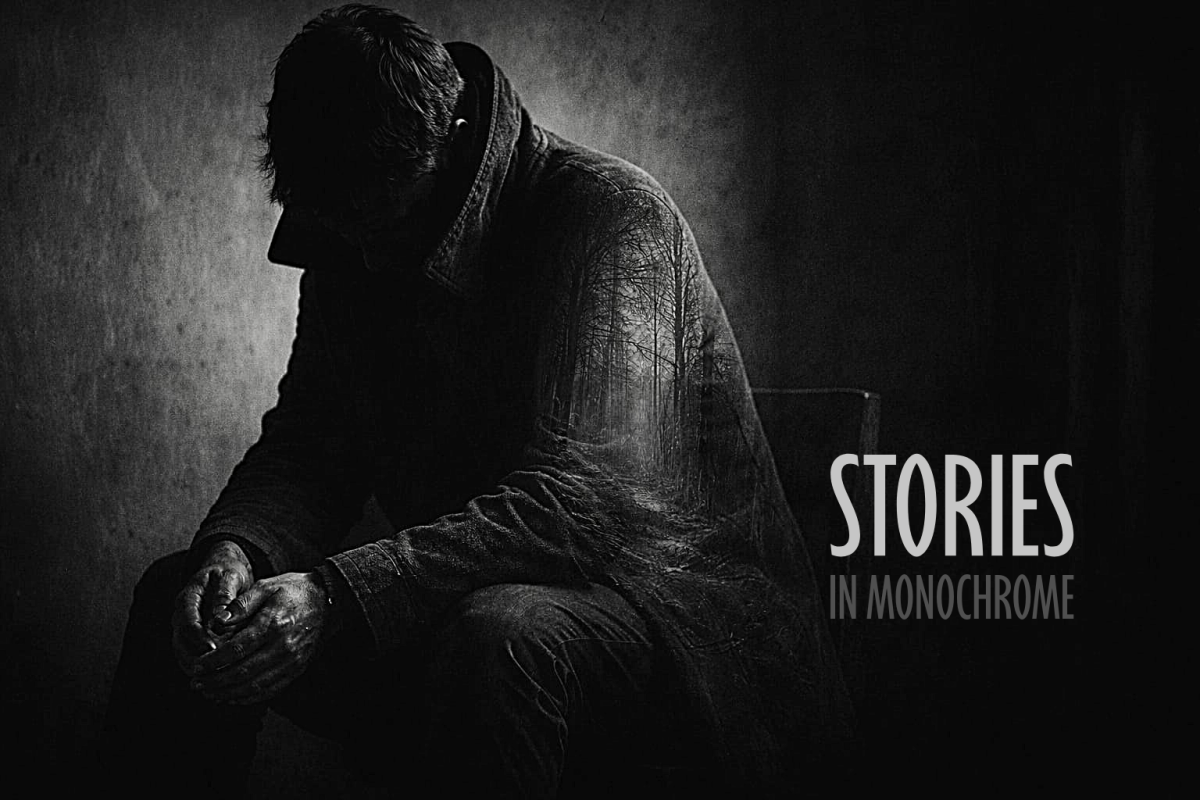

The rain didn’t fall.
It pressed.
Flattened itself against the city like a hand that wouldn’t lift, slicking the streets into black glass, filling the cracks with something that looked too still to be water. The gutters whispered. The buildings held their breath. Even the air felt used—like it had passed through too many lungs before finding his.
He stood beneath a tired streetlight, hood pulled low, cigarette burning slow between his fingers. The smoke tasted bitter tonight, thicker than usual, like it carried something unfinished in it.
Didn’t matter how far he walked.
The city followed.
Or maybe it never let him go.
A squad car rolled past, tires slicing through pooled rain, the sound sharp and hollow. Red and blue light crawled over the brick walls, bled across the broken windows, then slipped off him like he wasn’t worth holding onto. For a second, his reflection surfaced in the storefront glass beside him—then fractured.
Half of him stood in the rain.
The other half stayed behind the glass.
Behind the broken window.
Behind the place he used to pretend was his.
He didn’t look long.
You learn not to.
That building had once smelled like something alive—coffee, cheap whiskey, sweat, laughter that didn’t last but tried anyway. Now it smelled like rot and damp wood, like time had moved in and stopped paying rent. The door hung crooked, breathing slow with every shift of wind. The inside was gutted. Whatever had mattered there had already been taken.
He drew on the cigarette, let the heat settle in his chest, held it there like he was testing how much he could carry before something gave.
There had been a night.
There’s always a night.
It doesn’t announce itself. Doesn’t ask permission. It just arrives and rearranges everything—quietly, efficiently—until the life you knew feels like something you misremembered.
For him, it came through a phone call.
A voice he knew.
Too calm.
That was the first thing that didn’t sit right. Calm meant distance. Calm meant the damage had already been done.
“You need to come down here.”
No explanation.
No rush.
Just weight.
He went.
Because people like him always go. They tell themselves it’s loyalty, or habit, or doing the right thing. Truth is, they don’t know how not to answer when the past calls them by name.
The street had been quiet when he arrived.
Too quiet.
The kind of quiet that presses against your ears until you start hearing things that aren’t there yet.
Police lights washed the walls in slow, pulsing color. Red. Blue. Red again. The world reduced to warning signs no one could read in time. The rain had already started, soft then, tapping at the pavement like it was testing the ground.
There was a body under a sheet.
He didn’t need to see the face.
Didn’t need to check the shoes.
He knew.
That’s how it works.
The answers come first.
The questions just trail behind, trying to make sense of something that already decided not to make sense.
His stomach had gone cold. Not fear. Not shock. Something quieter than that. Something that settled in and stayed.
The cigarette burned down to the filter between his fingers. He hadn’t noticed. He dropped it, crushed it beneath his boot, and lit another like the motion might keep his hands from remembering.
Bad habit.
Better than remembering.
The city keeps score.
Not with numbers.
With pressure.
With the way your shoulders start to carry things you never agreed to hold. With the faces that show up when you close your eyes. With the places that stop being just places and start feeling like warnings.
He tried leaving once.
Packed a bag that felt too light. Bought a ticket that felt too expensive. Told himself there was nothing left for him here.
That was the lie.
There’s always something left.
A debt that doesn’t need to be spoken.
A memory that refuses to fade clean.
A moment that rewires you in ways you don’t notice until it’s too late to undo it.
He made it two towns over before the quiet got too loud.
Different streets. Different faces. Same weight in his chest.
He stepped off the bus before it fully stopped, boots hitting unfamiliar pavement that didn’t recognize him yet—and felt wrong because of it.
He turned around before the driver even asked.
Walked back.
Didn’t question it.
Some roads don’t lead away.
They circle.
A car slowed as it passed him now, tires hissing through water. He felt the look from inside—measured, uncertain, deciding. People in this city learned to read each other the way others read weather.
He kept walking.
Didn’t offer anything.
That’s another rule.
Never give the city more than it already took.
Still, his steps drifted.
Back to the building.
Or maybe they never left.
The broken window caught him again.
This time he stopped.
Rain streaked the glass, bending the reflection, stretching it into something less certain. His face looked different in it—sharper, older, worn in places that didn’t show up in mirrors.
The skyline bled through him.
Buildings cut across his eyes.
Streetlights ran through his jaw.
Headlights moved behind his thoughts like they were looking for a way out.
For a moment, it didn’t feel like he was looking at himself.
It felt like he was looking at the city wearing him.
Using him.
Remembering through him.
“Yeah,” he said under his breath.
It came out rough, like something dragged up instead of spoken.
That tracked.
Rain hit harder, each drop landing with a small, insistent force. It soaked through his jacket, found his skin, settled there like it planned to stay. The cigarette between his fingers burned uneven, the ember flaring whenever the wind caught it, then dimming again.
Somewhere in the distance, a siren started.
Rose.
Leveled.
Held.
Not urgent.
Not desperate.
Routine.
That’s what this place does best.
It turns everything into routine.
Even the things that should have stopped it cold.
Even the things that should have mattered more.
He dropped the cigarette and crushed it into the pavement, grinding it down until there was nothing left to burn.
He stood there a moment longer than he needed to.
Long enough to feel the weight settle.
Long enough to recognize it.
Then he pulled the hood tighter and stepped away from the glass.
Didn’t look back.
Didn’t need to.
The city wasn’t behind him.
It never was.
It moved when he moved.
Sat in his lungs when he breathed.
Waited in the quiet between thoughts.
And no matter how far he walked, how many streets he crossed, how many nights he tried to outrun—
It was already there.
Waiting.
Discover more from Memoirs of Madness
Subscribe to get the latest posts sent to your email.
 Memoirs of Madness
Mangus, this narrative shares an emotional journey. It attempts to connect elements from the past. You did an excellent job in painting these images through your prose.
LikeLike
Your words live.
LikeLiked by 1 person