
Chapter 6 of 8
Some truths do not arrive like lightning.
They do not tear open the sky, illuminate everything at once, and leave you nobly altered in a single cinematic instant. Life rarely respects timing enough for that.
Some truths come the way dawn does.
Slowly. Through cracks. While you are still insisting it is night.
The chapel beneath the city held that kind of truth.
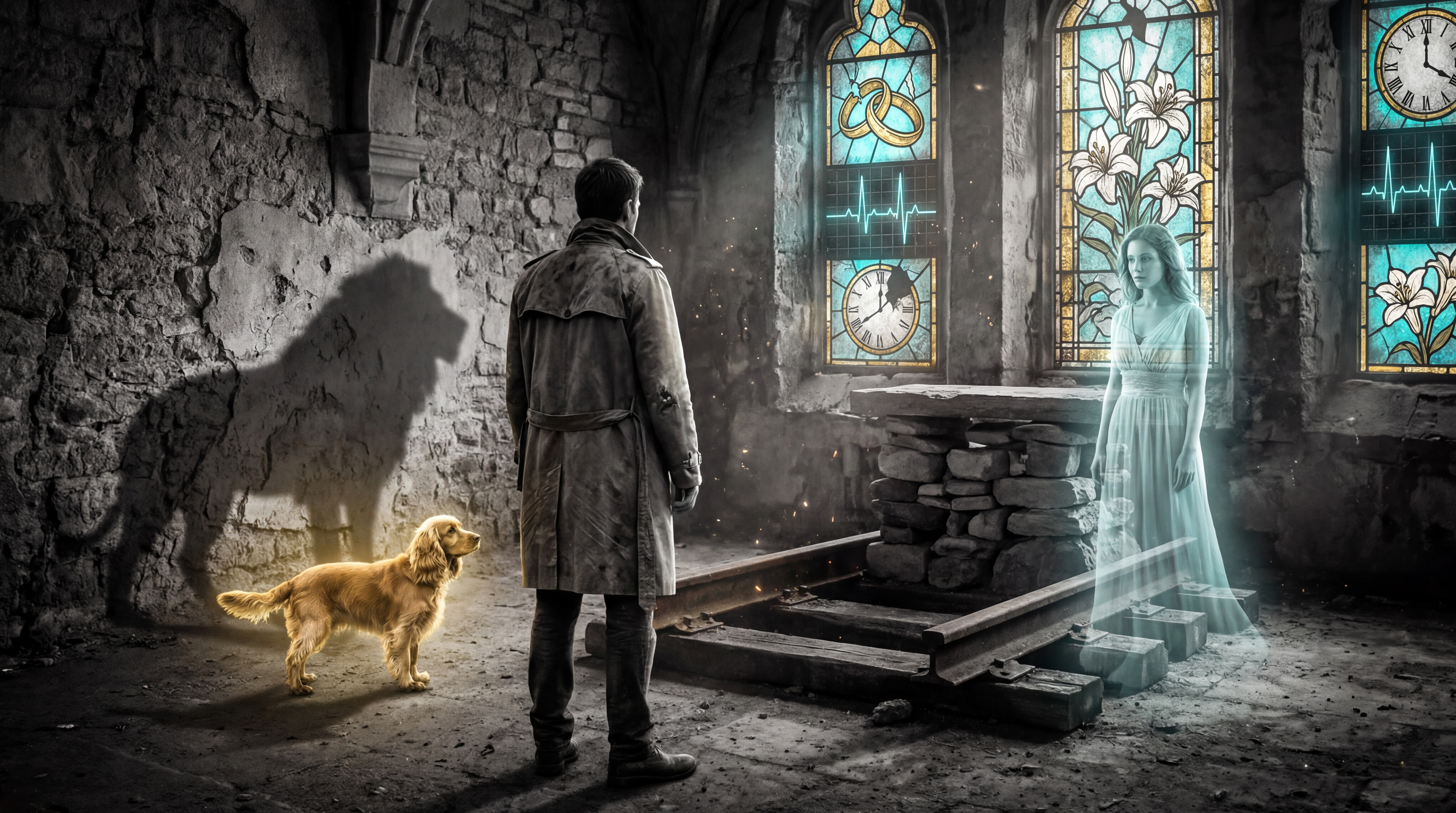
It smelled of wet stone, mineral cold, candle wax gone stale decades ago, and the faint sweet trace of flowers that had once meant devotion and now meant funerals. Dust moved through shafts of pale light like tired souls changing shifts. Water dripped somewhere inside the walls with a patient rhythm that made clocks feel arrogant.
The rails running through the floor disappeared beneath the altar.
Not around it.
Through it.
Steel entering stone like veins feeding a buried heart.
I stood in the center aisle with my coat heavy on my shoulders, still damp from tunnel mist. My shirt clung cold between my shoulder blades. Every breath came visible in the air, a reminder the room took warmth personally.
Mercy stood beside me.
Golden light moved beneath his fur.
Not a glow exactly. More intimate than that. As if sunlight had once entered him and never fully left.
His shadow stretched across the fractured wall behind him and rose impossibly large—a hulking silhouette with broad shoulders, mane-edged neck, the posture of something that had guarded doors before humans learned to build them.
I looked from the wall to the dog barely reaching my knee.
“You have got to be kidding me.”
Mercy sneezed.
The sound was so ordinary I laughed despite myself. Short, sharp, startled laughter—the kind grief occasionally permits as a clerical error.
Across the ruined altar, Lena waited.
Or what remained when memory and longing negotiated a truce.
She wore pale fabric that drifted around her in currents untouched by air. Sometimes I saw the woman I married: the soft line of her mouth, the steady eyes that could calm or dismantle me depending on mood, the slight tilt of her head whenever she knew I was lying and wanted me to suffer through honesty on my own.
Then she blurred.
Mist threaded through shape.
Light pretending to be skin.
The chapel windows behind her glowed with stained glass images rendered in fractured cyan and amber:
Wedding rings.
Lilies.
Clock faces.
A hospital monitor line jagged and frozen in blue.
Every symbol precise enough to wound.
“You sent him,” I said.
My voice sounded rough in that room, too mortal for the acoustics.
Lena looked at Mercy first.
Not me.
Something in that stung more than it should have.
“I begged for help,” she said softly. “He answered.”
Mercy sat immediately, spine straight, expression serene.
Like clergy.
Like management.
I rubbed a hand across my face. My palm came away damp with cold sweat.
“All this time I thought I rescued a dog.”
“You were the one found.”
The words entered clean and stayed lodged.
I thought of the first night I carried him home. His heartbeat against my ribs. The warmth of him in the bed’s empty half. The way he forced walks on mornings I intended to dissolve quietly indoors. How he watched mirrors, doors, shadows, and me with equal seriousness.
How many times had he interrupted the rituals of self-erasure I’d renamed coping?
My throat tightened.
“I should’ve been there.”
There it was.
The sentence beneath every sentence.
The root beneath every branch of my sorrow.
The night Lena collapsed, I missed three calls. I was in a bar three neighborhoods away, drunk enough to mistake numbness for healing. Laughing too loudly at men I barely knew. Performing the role of someone unaffected.
By the time I reached the hospital, machines were already doing the speaking.
I remembered fluorescent lights buzzing overhead. The smell of antiseptic and old coffee. A nurse avoiding my eyes because professionals know when grief is about to become ugly. I remembered signing papers with a hand that no longer belonged to me.
I never forgave myself.
I polished that guilt daily like silver.
Lena drifted closer.
No footsteps.
No disturbance.
Only nearness.
“You think time broke us,” she said. “It was shame.”
The words opened rooms I had boarded shut.
I had hidden from friends because they reminded me of before. Hidden from family because they wanted progress reports. Hidden from joy because joy felt disloyal. Hidden from myself because I knew what waited there: a man who had failed in one decisive hour and spent years trying to make failure look profound.
“I loved you badly after I lost you,” I said.
I meant the bottles lined like soldiers in the sink. The unpaid bills. The curtains closed at noon. The careful maintenance of suffering because pain felt like proof she mattered.
Her face softened.
Or my need made it so.
“You loved me as far as you knew how.”
That mercy was harder to bear than accusation.
Mercy rose and walked to me. He placed one paw on my boot.
Warm.
Solid.
Alive.
No apparition. No metaphor. A breathing animal with sleepy eyes, damp nose, and an ancient administrative role apparently thrust upon him.
I crouched and touched the fur behind his ears.
Silk-soft.
He leaned into my hand with casual affection, as if celestial guardianship and wanting scratches were perfectly compatible traits.
Then the rails beneath us trembled.
A low metallic hum moved through the floor and climbed my legs into my spine. Dust leapt from stone seams. The stained glass flickered.
Mercy’s golden fur darkened at the edges.
Lena turned toward the tunnel opening behind the altar.
For the first time since death had returned her to me, I saw fear in her.
“They found the scent of your guilt,” she whispered.
“Who?”
“The ones who never leave.”
From the dark below came the sound of many feet dragging in unison.
Slow.
Wet.
Deliberate.
Not hurried.
As if they knew nothing living truly escapes itself.
The air changed—colder, fouler, carrying mildew, stagnant water, and the sour rot of emotions stored too long.
Mercy stepped in front of me.
His small body became a line in the world.
Behind him, his shadow swelled vast again—burning eyes, jaws like carved thunder, shoulders broad enough to block doors between worlds.
The little dog bared his teeth.
I looked at him, then at Lena.
My pulse hammered. My palms shook. Somewhere deep beneath terror was another feeling trying to surface.
Hope.
“What happens now?”
She met my eyes with the terrible tenderness of someone who knew love could save and ruin with equal efficiency.
“Now,” she said, “you decide whether to keep mourning me… or save yourself.”
Discover more from Memoirs of Madness
Subscribe to get the latest posts sent to your email.
 Memoirs of Madness
Powerful poignant terrifying real
LikeLike