Entry Eight: Dispatches from the Splinters of My Mind
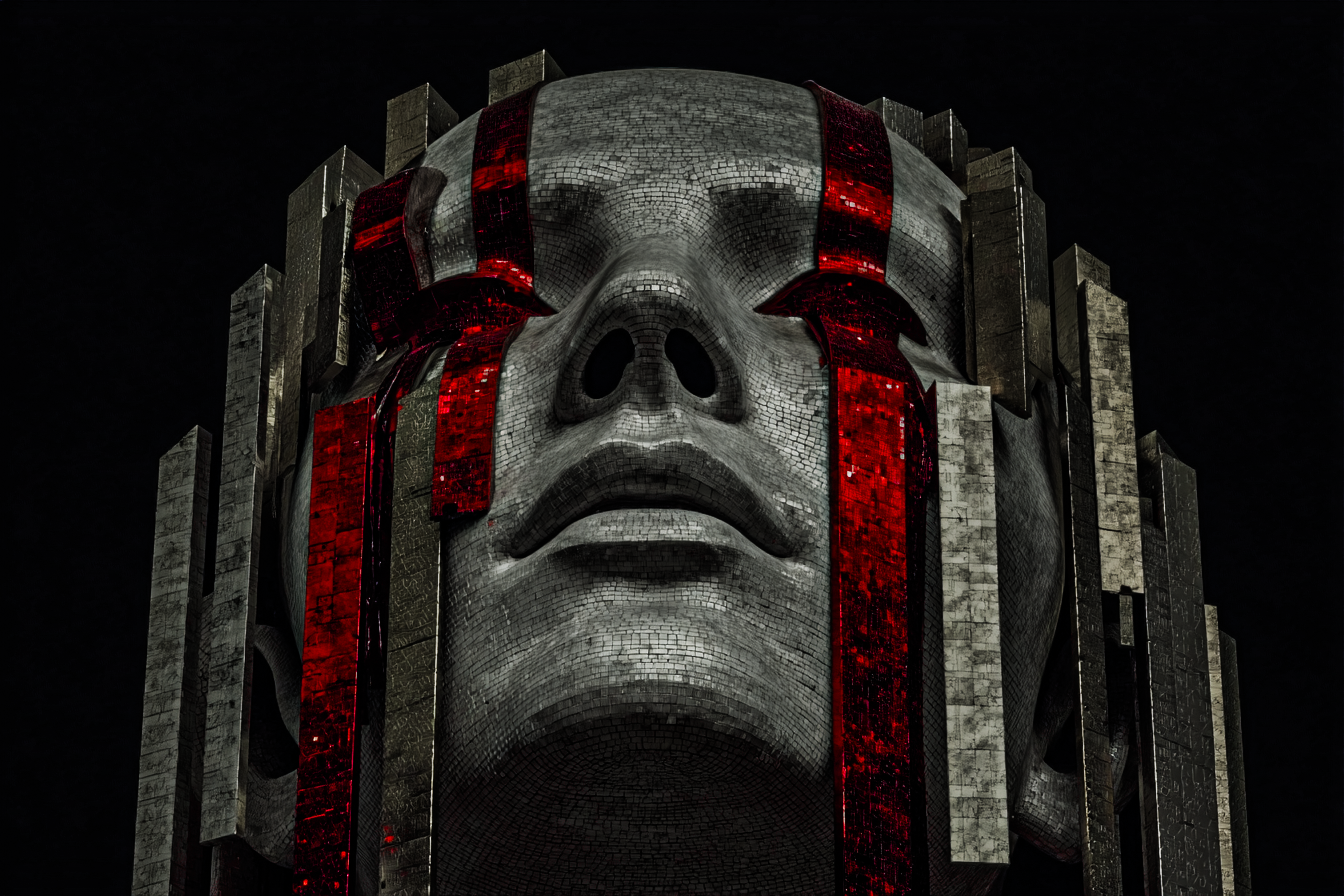
The face hung over her as a dead moon would, immense and inert, plastered to the sky with the obscene permanence of a fossilized wound. It was not sculpted in the image of any god she recognized, nor did it bear the standard of a people desperate to placate the furies or worship their own reflection. Instead, it hovered on the edge of intent and accident—a precipice suspended in time, inevitability chiseled into every brute angle of the jaw. Each block that made up the visage was a shorn-off shard, ash-gray and rough-edged, but arranged so that the fractures and pitting created a ragged, almost animate skin. From a distance, the monument looked inert, but on approach it seemed to lean forward, as if gravity bent toward its own creation.
Up close, the surface shimmered with a faint, sickly gloss, not the result of centuries of wind polishing, but rather something more insidious: a hidden moisture, as though the stone itself exhaled condensation from a deep, slow-breathing lung buried far beneath the earth. The closer she drew, the more this exudation gleamed in the dying light, slicking her hand when she dared to stretch her trembling fingers only an inch from the surface. She jerked her hand away before contact, an involuntary spasm of repulsion, and it seemed to her that the stone recoiled as well, as if momentarily startled by her nearness.
The face’s hollow orbits, each deeper than a well and rimmed in a thousand years’ worth of wind-scoured dust, were not empty but filled with a red so saturated and unyielding that it was neither liquid nor illumination, but a third thing—a dense, coagulating radiance. This red bled outward in precise tracks, each line adhering to a groove so deliberate it made her stomach clench. At dusk, when the world’s colors flattened and the boundary between flesh and stone blurred, these rivulets painted the entire monument as if it wept a world’s worth of dying embers.
Beneath the eyes, the mouth was a gash so perfectly aligned that it projected neither malice nor welcome—simply a vacancy so absolute it wrenched at her. It did not pass judgment or offer answers, but waited in a silence that felt more like appraisal than apathy. When she stared at it, she became conscious of her own tongue, the dryness of her palate, the faint click of her teeth as her jaw tensed in counterpoint to the stone’s passive oblivion. For an instant, she lost the distinction between her own face and the monument’s, as though she were gazing at her own effigy, erected by hands who’d never known her and cared nothing for her likeness.
The statue was girdled by a ring of spines—pillars, each twelve feet high, tilting like teeth around the perimeter. Their faces were gouged by runes shallow and erratic, as if clawed by a desperate hand that knew it must leave a mark, but lacked time or understanding to encode more than a warning. When she turned her head just so, a vibration juddered through her jaw and teeth—a resonance that not only bypassed air but seemed to travel directly through calcified matter. It was not an audible tone but a bone-deep hum, a buried dirge that sang in frequencies meant not for ears but for the marrow itself.
A faint metallic tang rode the air, stinging her nose and settling on her tongue. Her pulse beat harder, a staccato drum against the inside of her skull. She knew she should have been afraid, or at least careful, but curiosity is rarely adaptable. It presses forward in one direction, refusing diversion. Even as some primitive sense screamed retreat, a more insistent force, slow and syrupy as honey, compelled her closer.
At the monument’s base, a set of spiral steps had been hewn directly into the rock, winding up toward the face’s sealed lips. The staircase’s edge was polished to a treacherous smoothness—perhaps by centuries of bare feet, or perhaps by something more recent. Each step she took yanked a shudder up her spine, the chill stone leaching heat from her bones. She tried to picture the hands and feet that had shaped these stairs, that had come before her, but the imagined forms refused to hold: they slipped away at the periphery, just out of sight, like ghosts not quite ready to reveal their sorrow.
As she climbed, the red seepage intensified, painting her arms and face in its cast. The color made her flesh look flayed and raw, as though she’d shed her skin and left it behind on the plain below. Her breath hitched in her throat, every inhalation mirrored by a second, deeper rasp—a guttural echo that rode beside her own, shadowing her ascent. She placed a hand against the cheek, bracing herself, and felt warmth pulsing through the stone—a low, feverish heat, rhythmic but not quite alive. Her heart skipped in answer. The pillars’ hum swelled, shaking her vision, warping the outlines of the world.
Suddenly, the lips moved. At firs,t it was only a quiver at their seam, a ripple of tension, but then the entire mouth flexed—and she swore she saw the faintest suggestion of tongue behind the teeth. She leaned closer, pressing her ear against the fissure. Beneath the monument’s stony shell, she heard breathing: not the shrill whistle of wind through cracks, but a true respiration, cavernous and ponderous, as though the monument had lungs the size of mountains and was only now remembering how to fill them.
The revelation paralyzed her. This was not a tomb built to honor the dead, she realized, nor a shrine to contain some ancient anger. The statue was a sarcophagus, yes, but one not yet emptied. The red running from its eyes was neither pigment nor rainwater but a bodily fluid, leaking from a cocoon that could not hold its contents. The face was a shell, a boundary—and something was trying to cross it.
Even so, she kept climbing, compelled by a mixture of terror and awe, the two emotions indistinguishable now in their velocity. By the final step, her knees trembled and her throat ached from the acid bite of fear, but she crouched anyway at the summit, only inches from the sealed lips. Veins of shimmering ember threaded across their surface, glowing brighter with every pulse of the monument’s breath. She felt a wave of heat roll over her, dense and chemical, and it left her dizzy, her skin tingling as though exposed to low voltage.
Now, as if cued by her presence, the ring of pillars began to thrum in a synchronized rhythm. One after another, they trembled against the ground, a chain reaction that rattled the bones of the earth itself. With each pulse, the red liquid burst a little brighter from the monument’s wounds, feeding rivers that ran down the steps and pooled at their base. Her limbs buzzed with a painful, almost ecstatic electricity.
Without meaning to, she heard herself whisper, “What are you?”
The answer arrived not as speech but as a violence in her skeleton. The words detonated inside her skull and reverberated through her ribcage, as though she’d been struck by a tuning fork forged for a different species. The sensation was not one of comprehension, but of total subjugation—a message delivered in a medium older than language or thought.
You.
The word was a spasm, a convulsion of being. She staggered backward, and the pillars responded, their angled bodies creaking as they pressed inward, shrinking the circumference of the circle until she was contained. The air thickened, the metallic taste blooming into a full, choking flavor. Her lungs seized, and she tasted rust and old ashes on her tongue.
The rivers of red exploded, no longer trickling but surging, a deluge that hissed as it struck the cold stone. In the reflections, she saw faces—hundreds, maybe thousands—each one a warped variant of her own, their eyes wide with terror or ecstasy or both. Each face pressed itself against the surface as if desperate to break through, their mouths open in a cry she could feel but never hear.
You repeated the monument, but now it was not merely a label, but an imperative.
She tried to clap her hands over her ears, but the sound lived behind them, in the architecture of her skull. Where her hands touched skin, she felt fissures opening: thin, pale lines that leaked light, as if her bone marrow had turned into a lantern. Each seam split further, the glow intensifying until the skin could not contain it.
Inheritance, not worship.
The lips of the monument parted, forming syllables that bent the air into impossible shapes. The pillars groaned, their runes flaring with a dark fire. One pillar cracked, then another, each yielding with the wet snap of a femur under pressure. Dust erupted into the air, shrouding the steps. The rivers rose higher, climbing up the pedestal and wrapping around her ankles, then calves, burning her with a heat that did not scald flesh so much as erase it.
She stood rooted in place, unable to turn away, because in that moment she understood: This was not a prison, but an incubator. The thing inside was not a remnant, but a seed.
And it was time to hatch.
What followed was not blackout but erasure. Her mind remained, but submerged, as though she had been drowned beneath a tide of molten syllables. Her body convulsed, every joint unhinging, seams of light splitting wider until the marrow itself glowed.
She tried to scream, but the sound was stolen from her, bent into a chant that was not her own.
It spread through her like fever, like birth, like—
—
Author’s Note:
This entry was inspired by the image of a monumental stone face weeping red channels, surrounded by jagged pillars. I wanted to explore the tension between worship and imprisonment — the idea of a monument that is not passive, but alive, incubating something ancient. The words fake, adaptable, and angle were drawn from community prompts (FOWC, RDP, and Word of the Day) and woven into the text.
Discover more from Memoirs of Madness
Subscribe to get the latest posts sent to your email.
 Memoirs of Madness
Brilliant narrative writing, full of suspense
LikeLiked by 1 person
thank you
LikeLike
Oh wow. Mangus. Hooked from start to finish……….. or new beginning?
LikeLiked by 1 person
Thanks, Di. My editor wont let start a new series until finish with others here on Memoirs. She gets mean when I have a bunch of incomplete series. lmbo!
LikeLike
Yet another great tale. 👏👏
LikeLiked by 1 person
thanks, Fandango
LikeLiked by 1 person
So well written! The way you used contradicting emotions to arrive at an unsettled ambiguity was masterful.
LikeLiked by 1 person
thank you
LikeLike