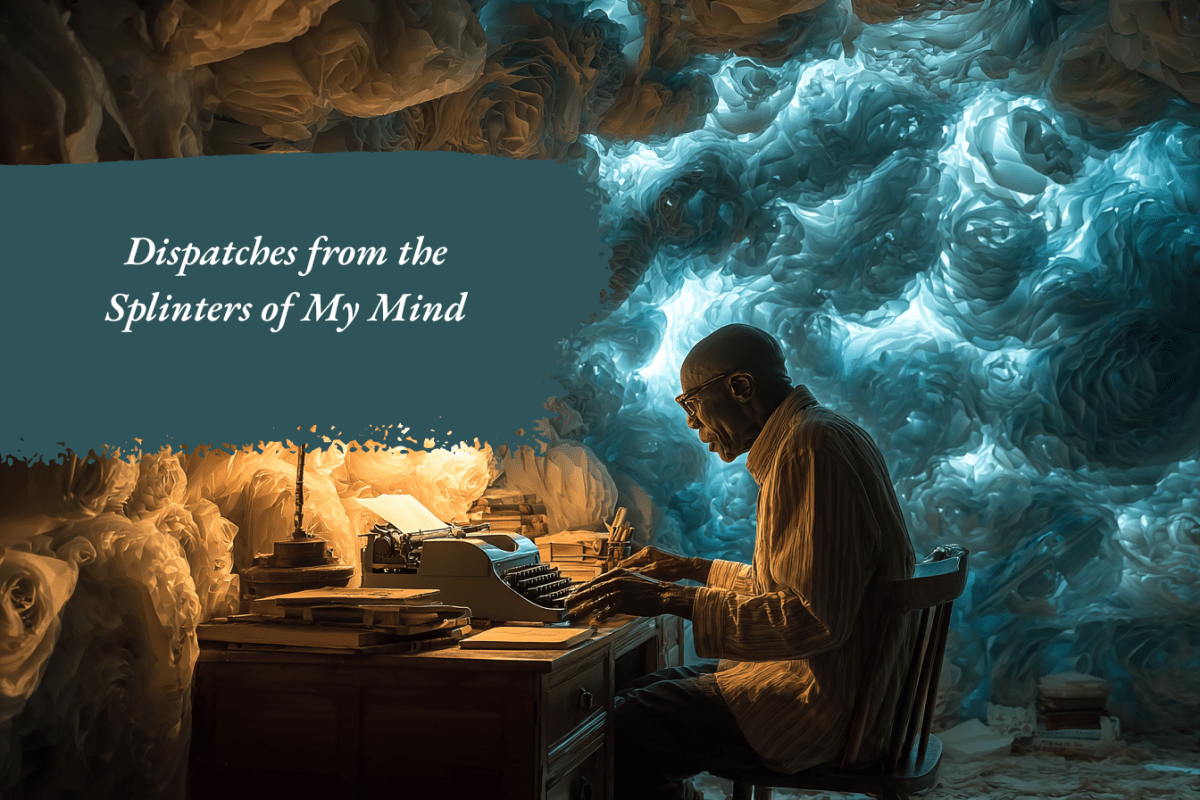
Dispatches from the Splinters of My Mind

Her name is Raquel, but my given name is Rachel. I first noticed her when I hit high school and the air around me started to hum with a voltage—lockers slamming, gossip sparking at the seams, hallways strung like power lines through a town that never slept. She didn’t arrive with voices. No whispers, no commands. Just a pressure at the edge of thought, a cool hand pressed to a fevered brow. She only shows up when I need her. I don’t hear her, but I know when she’s standing just to my left, looking out through my eyes.
The first time, it was October and every tree in the county had decided to bleed. The maples along the football field turned a red so violent the grass looked stunned. A rumor had gone around that I’d said something about a senior’s boyfriend—nothing true, nothing new—just a scrap of talk fed into the hungry mouth of a school day. By the last bell, I could feel the circle forming before I even walked outside. Girls with folded arms. Boys with bored eyes. The taste of pennies. The sky bruised itself purple.
I didn’t have a plan. I never did then. The thing I remember is the wind. It came hard across the parking lot and threaded itself through my hair, then deeper, as if there were a second set of hair inside my head—branches, fine as nerve endings. I felt them sway. And then I wasn’t exactly taller, but I was standing in a different way, like my weight knew how to root. Someone shoved me. The circle tightened. The world clicked into a cleaner focus, edges sharpened, sound pared down to necessary pieces: breath, footfall, a cheap bracelet pinging against bone. The part of me that panicked went quiet, like someone cupped both hands over its mouth and said shhh.
I walked forward. The girl in front of me took a step back without meaning to. I didn’t bare my teeth, make a fist, or say anything that would later be quoted. I just looked at her until she had to break eye contact. The circle sagged. Somewhere a whistle blew—practice starting on the field—and that was that. No heroics. No detention. I went home with the leaves still burning in my skull and the wind still combing through the trees inside me, and it was the first night I understood that Raquel was not a person I could point to. She was a stance. A recalibration. A forest that woke up when I needed cover.
The second time that year, a man in a green cap followed me from the grocery store to the bus stop. My hands shook so hard I almost dropped the bag. The sky was that color between storm and dusk that makes you doubt the honesty of streetlights. I tasted the same pennies. Then the shift: the quiet. The trees. Autumn exhaled, and the world tilted just a fraction. I turned my face toward him the way a deer turns toward the distant snap of a twig. Nothing about me changed. I changed anyway. He crossed the street at the next gap in traffic and kept going. Maybe I was never in danger. Maybe sometimes a girl doesn’t need to prove anything to make it true.
I learned to mark the moments Raquel left. It felt like stepping out of a lake—clothes heavy, hair dripping, adrenaline sickly-sweet on the tongue. I’d sit on my bed and stare at the blank corner of my room until I felt ordinary again. There are only so many times in a week you can be a wildfire before you start to worry about what you’re burning down.
Years run. You lose track. You collect jobs and dead houseplants and the soft weight of other people’s expectations. I left the county for a city that ate its old buildings and spat out condominiums with mouths like glass. I learned to be proficient in email communication. I learned to keep dinner reservations. I learned to carry myself in ways that didn’t invite questions from strangers. Raquel walked with me, a scent I couldn’t name, a second pulse nested under the first. Sometimes months would pass without her, and I’d convince myself I’d grown out of childhood’s private magic, the way you grow out of believing the closet door might need locking. Then something would happen—a hand a beat too slow to withdraw from my waist, a boss whose compliments were salt in fresh cuts—and the wind would turn. The maples inside me would flare hot.
It got worse the year my mother died. Grief scrubbed everything down to the metal. I returned home for a month to sort papers and sort the shape of the silence and to live in the small, gray house whose faucets coughed like old men. The town hadn’t changed much. The football field’s grass is still stunned by autumn. The grocery store is fluorescent and timeless. The bus stop on the corner remains a question that nobody has bothered to answer.
I slept in my childhood room and woke to find the dresser mirror breathing. My face was layered with hers—my mother at twenty, my mother at fifty, my mother already gone—each sliding across the glass like oil on water, never settling. Their eyes moved in different directions, watching corners of the room where nothing stirred. The smell of her perfume—vanilla and cigarette ash—hung in the air though the bottle had been dry for years. Behind them, and behind me, Raquel hovered: not protective, exactly, but like a shadow that had learned to look back.
On the third night of that month, I went walking. I told myself I needed air. The truth is I wanted to find the place where the world felt thin. There’s a cut of road on the edge of town that used to lead to the sawmill. Beyond the road, the forest keeps its own counsel, thick with pine and story and things that don’t bother learning your name. I walked that way, past the last of the porch lights, past the mailbox that always leaned as if listening. The sky had bruised itself again. I thought of purple knees and childhood grass stains that never quite washed out.
The forest welcomed without welcoming. I stepped into the trees and felt something inside me stand up straighter, as if the very matter of me remembered what it was built from. Needles underfoot. Damp earth. The faint iron of water nearby. The wind moved, and my hair followed; the branches inside my head swayed in time. For a second, the overlap made me dizzy—like looking at a double exposure until your eyes grab the wrong layer. I closed them and leaned against a trunk. The bark was rough enough to declare itself. My palms stung. I breathed.
This is the part where people want a miracle. They want a deer to step out onto the path with a crown of leaves tangled in its antlers. They want my mother’s voice to come through clean, radio static scoured away. They want the boundary to drop and the red of the maples to mean something more than a season doing what a season does. I can’t give them that. What happened is simpler. I heard footsteps, and they didn’t belong to me.
Not heavy. Not careless. A person who knew every twig that could break and chose the ones that wouldn’t. I didn’t open my eyes. I didn’t need to. The second pulse rose in me. The forest inside caught the rhythm and matched it, branches swaying in a pattern that wasn’t the wind. The footsteps stopped three paces to my left.
“Rachel,” a woman said.
Not my mother. Not anyone I could pull from a yearbook. The voice came the way cold water knows how to find your wrists. Calm. Unavoidable.
I opened my eyes. There was nobody there.
The thing about absence is how specific it is. The air where a body should have been was charged, as if a thunderhead had chosen human shape and then thought better of it. I turned my head slightly, and in the edge of my vision—caught the way you catch a reflection in a dark window—I saw her. My face doubled and slipped, features not quite aligning, hair like a spill of black water into the tree line. The second mouth set in a small, knowing line. My breath forgot to breathe. The forest inside me stilled to listen.
“Raquel,” I said, and the saying opened a door I hadn’t known was shut.
We stood there—one of us in the path, one of us in the glass of the world. We didn’t speak. If I tell you we communed, you’ll picture incense and soft lights, and I won’t have earned the truth. It was simpler and stranger. She lifted her chin. I felt mine tilt. She narrowed her eyes. I felt the muscles move. She took a breath, and the air entered me twice, filling two sets of lungs layered perfectly out of sync. It hurt in a good way, like stretching after you’ve been carrying other people’s weight all day.
Then the footsteps came again, from deeper in, and this time they were neither careful nor considerate. A man moving too fast to be lost, heading for the shortcut hunters take when they’re late and the light’s gone wrong. He broke a branch. He swore. He was close; he was not yet aware of me. The startled part of me wanted to step off the path, hide behind the particular tree my fifth-grade self knew was good for hiding. The other part—the forest part—just watched the space where he would appear.
Raquel’s hand rose. I didn’t see it. I felt it. A small tightening in the tendons of my right wrist, the way a violinist’s muscle memory wakes before the bow touches the string. When the man reached the curve, he looked up and saw—no, that’s not right. He didn’t see anything he could put a name to. He faltered the way people falter when an old superstition tugs the hem of their good sense. He glanced left. He saw the empty air where Raquel stood and his face went politely blank, as if someone had asked him a question in a language he almost understood. He took two cautious steps backward. He chose another path, the long one. He kept swearing, but softer now, as though he’d agreed to be a guest in a house he hadn’t realized he’d entered.
“Thank you,” I said, and immediately felt foolish for saying it aloud.
Raquel did not nod. She didn’t vanish. She shifted the way light shifts when a cloud decides to be merciful. I closed my eyes again and leaned my forehead against the bark and let the slant of the earth hold me up. Time went the way time went when you finally agreed to sit down. When I opened my eyes, the air was only air, and the double exposure had clicked back into a single frame. I was Rachel in a forest near a town that felt smaller than it used to. My palms remembered bark. My mouth remembered the taste of pennies and then didn’t.
On the walk home, the wind stayed with me. Houses appeared. Porch lights took their places like stars whose contracts had just been renewed. I tried to think of what I would tell anyone who asked why I’d gone out and what I’d found. The story kept refusing to shrink to fit. I passed the mailbox, still listening. I passed the bus stop, still questioning. By the time I reached the gray house, grief had turned from a violent guest to a tired one, the kind that finally stops talking because there’s nothing new to say. I let myself in. The faucet coughed. The floor knew where to creak. I was ordinary again, which is to say intact enough to sleep.
In the morning, I brewed coffee the way my mother did and burned the first slice of toast the way she always did and laughed, which surprised me so much I had to sit down. In the mirror, my face was my face.
But as I turned toward the door, something caught in the glass of the hallway mirror. Not just her—me, but smiling in a way I don’t remember. It’s a thin, private thing. My lips are still; hers move. She whispers without sound, and though I cannot hear the words, the marrow in my bones understands them well enough to ache.
When I’m ready to step outside, I do. The wind turns. The day opens like a field. And there, in the corner of my eye where the world keeps its most honest reflections, a second mouth makes a small, knowing line. We walked. We chose the long way. We let the light take its time deciding for us.
Author’s Note:
Second splinter, pulled straight from a place I didn’t mean to walk into. Some stories don’t ask permission—they just lean in and whisper something you can’t quite remember but still know in your bones. Dispatches from the Splinters of My Mind isn’t here to explain itself. It’s here to leave something sharp under your skin.
Discover more from Memoirs of Madness
Subscribe to get the latest posts sent to your email.
 Memoirs of Madness
Compelling reading Mangus.
LikeLiked by 1 person
Thanks, Di. Its good to writing flash fiction again. The long fiction is kicking my butt…smiles
LikeLiked by 1 person
🙂
LikeLike
A truly riveting read, Mangus. You had me hooked fro the very first line through the very last one. A work of art.
LikeLiked by 1 person
Thanks, Fandango. I’m having fun with this series
LikeLiked by 1 person
Really good, Mangus. I like the idea of the echoes of others getting inside us.
LikeLiked by 1 person
Thanks, Ted … I like the playing around at times
LikeLiked by 1 person