Nineteen and Nowhere

Stories from the Edge of Change – Volume 2, Part 1

“They said the system lost track of him. But he was never theirs to keep.”


The morning rain didn’t bother Ren. He’d learned that water was gentler than people.

He crouched beside the alley dumpster behind the drop-in center, shoulders hunched under a threadbare hoodie two sizes too big, sleeves eaten at the cuffs. His shoes—untied and uneven—squished when he shifted his weight. Rain pooled around the soles, but he stayed put, drawing loops on a soggy intake form with a chewed Bic pen. The form was from three weeks ago. He didn’t remember if he ever turned it in. Didn’t matter.

It was quiet this early. The kind of quiet that makes everything louder. His breath. His heartbeat. The clack of metal shutters two streets over. His fingers trembled, but not from cold.

He hadn’t slept inside in nine days.
But he knew where the cameras were, where the streetlights stopped working. Which stairs stayed dry?

He used to think that was survival. Now it just felt like memorizing a test he’d never pass.

A city bus hissed to a stop up the block, brakes squealing like something in pain. He looked up for a second, then back down. He’d been in those buses, once. With trash bags full of his stuff. Being transferred. “Transitioned.” “Placed.” Words that meant temporary. Always.

The folder in his backpack held every proof of his existence that the county ever gave him:

  • Two expired Medicaid cards
  • A GED prep schedule with coffee stains
  • A letter saying he was denied transitional housing
  • A single photograph, sun-bleached and wrinkled: him and Miss Tanner, his last foster placement, grinning with sparkler smoke behind them

He’d never shown that picture to anyone. He wasn’t even sure if the smile was his.
Sometimes he felt like that photo was the only place he still left a fingerprint.


Inside the drop-in center, they’d already started handing out coffee and hygiene kits. Ren didn’t go in. Not yet. He didn’t want to be seen with wet hair and a panic attack crawling just beneath the skin.

He’d been in a group home once that called itself “trauma-informed.” They still lock the bathroom at night.
He’d rather piss in the alley than ask permission again.

A man passed by, muttering to himself, trailing a shopping cart full of pillows and clinking bottles. Ren didn’t flinch. The cart guy nodded, as if he knew him. Maybe he did.

He did know the feeling: You’re alone but not exempt. Not from the weather. Not from the noise. Not from the memory of being fifteen, hands shaking as a caseworker said, “We’re placing you in a new home.” She said it like it was an opportunity, not another stab wound in a file no one would read.


The sky split open with a gust of cold air, and Ren finally stood. Pulled his hoodie tighter. Slipped the intake form into his back pocket. It had his name spelled wrong anyway.

He stepped out from behind the dumpster, not into confidence or comfort, but into motion. He moved the way you do when no one’s expecting you—not slow, not rushed, just enough to stay above notice.

As he passed the shelter entrance, he saw a boy younger than him sitting on the stoop, wrapped in a trash bag and drawing in the condensation on the glass door.

They didn’t speak. Just exchanged a glance. The kind that said: Yeah, I see you. No, I won’t say your name.

Ren knew that sometimes a glance was the only shield you had left.


He kept walking toward the corner, toward the same coffee shop he never entered, where the manager never made eye contact and the workers tossed day-old bagels out at 11:00. He’d wait nearby. Not to beg. Just to exist adjacent to someone else’s comfort.

This was the work.
Not recovery.
Not healing.
Just… enduring without disappearing.


He passed a torn flyer taped to a lamppost—one of those mental health outreach posters that still had a suicide hotline and a QR code for free therapy that didn’t exist anymore.
Someone had scrawled across the bottom in Sharpie:

“Hope is just the thing they say when they have nothing left to offer.”

Ren stopped.

He stared at that line for a long time.
Then smiled, just barely.

Not because it was funny.
But because he’d believed in hope once—and he’d watched it falter in real time.


Author’s Note

Written for Stories from the Edge of Change – Volume 2.
This piece responds to today’s word prompts:

Ren is fictional, but his story is rooted in reality—lived, endured, and too often ignored.
This piece isn’t about rescue or redemption. It’s about what it costs to keep going when the world has already filed you away.

Some people carry their past in manila folders.
Some names vanish before they’re ever called.
And some stories live in silence until someone listens.

Thank you for reading. Let me know if you’re ready to meet the others.

Series Reflection: Staying at the Edge

Memoirs of Madness – Stories from the Edge of Change

Some stories ask to be written. Others sit beside you for a long time and wait until you’re ready to listen.

Stories from the Edge of Change wasn’t planned as a series. It started as a single image: a man sitting on a bench, cold coffee in one hand, a life’s worth of weight in the other. I didn’t know then that his name was Jake. I didn’t know about Dani. Or Angel. Or Finch.

I just knew the corner felt familiar.

And the more I stayed with it—the more I stayed with them—the more I realized this wasn’t just a set of character sketches. It was a reckoning. A quiet excavation. A window into lives we pass every day and rarely get to sit beside.

Writing Jake’s story—witnessing it—felt like a privilege. Not because he’s extraordinary. But because he isn’t. He’s the kind of man the world walks past. The kind who makes people uncomfortable because he reminds them what’s possible when the bottom falls out.

And still, somehow, he stayed.

Angel came next. Then Finch. Then Pete, who slipped in sideways, like most of the people who don’t want to be noticed but can’t stop bleeding the truth. I didn’t invent these characters. They arrived, piece by piece, in gestures and sidewalk cracks, in coffee steam and whispered meetings.

This arc became more than a series. It became a bench I didn’t want to leave.


I don’t know yet if there’s more to share from this world.
But I do know there are more stories. I can feel them at the edge of things.

Maybe it’s Dani’s voice, finally stepping into the light.
Maybe it’s Angel on a night shift, facing the silence Jake once did.
Maybe it’s someone we haven’t met yet—sitting on the same corner, hoping someone looks up.

If these stories meant something to you—if they echoed or stirred something buried—let me know.

And if not? That’s okay, too. This wasn’t written for applause.
It was written to hold a space.

Thank you for walking with me this far.

The corner’s quiet now. But it still remembers.
And I’ll be here, in case someone else looks up.

– MK

The Corner Again

MoM Series: Stories from the Edge of Change – Part 5

Jake slipped back to Maple and 9th, just before the day’s first sirens.
The sky was a cold bruise overhead—indigo leaking toward gray, the city below still sullen and half-swallowed by fog. Jake’s route here was always the same: the recycled bus air, the smell of new concrete and old bleach at the transfer station, the long walk down streets that still remembered him in all the wrong ways.

He’d liked it better in the days when a hangover let you lie to yourself.
Being sober meant memory was out to get you, every hour of the day.

He hadn’t told anyone he was coming, and wasn’t sure anyone would care. Maple/9th wasn’t home, not really, but the corner had a way of calling him back when the rest of the world got too bright and too loud. Where everything had fractured. Where, by some backwards logic, something like a beginning had managed to dig in and take root, though even now Jake couldn’t explain why.

He stepped off the curb, the city unspooling around him in the blue-tinted hush of pre-dawn. Chains of streetlights blinked uncertainly overhead, fighting the thick mist that made them look like distant, drowned stars. Gutter water gurgled past slumped trash bags, and a wind—sharp and chemical, the kind you only got east of the river—whipped Jake’s soaked collar tight against his throat.

It had rained all night, the kind of slow, pounding storm that got past old window seals and filled alleys with shallow, fast-moving currents.
His boots were soggy from the first block, each step a cold squelch that made him feel both present and exposed.

He carried a dented thermos of black coffee in one fist, and two foil-wrapped breakfast sandwiches in the other. Not an offering; nothing so grand. More like insurance, or ballast, a way to keep his hands busy while waiting for the morning to decide what kind of day it wanted to be.

Jake found his bench across from the bus stop, same warped planks as always, streaked deep with mildew and the ink of other people’s initials. He sat with a practiced slouch, elbows braced on thighs, letting the bench’s damp give him a chill. The wood was beaten soft by years of sun and rain and the pressure of bodies like his—bent, but holding.

The crust of the world here was thin. Every sound cut through.
The city at this hour was a hungover beast, makeshift and miraculous: somewhere a dog barked in warning, a power transformer hummed in gradual crescendo, and a garbage truck, like the planet’s own heartbeat, thudded trash cans up and down the block.

Jake finished his first sandwich in three bites, washing it down with coffee so bitter it felt like punishment. He watched steam coil off the thermos and disappear.

He’d been clean for 343 days—he counted, because not counting was the first step to failure in his book—but the mornings punched hardest. Not cravings, exactly, but the thin, raw quiet where the old engine used to run. The ache was in the absence now, the stretches of time where nothing screamed at you from the inside.

He wondered if he was the only one who found the lack scarier than the compulsion.

People talk about recovery like it’s a sunrise, he’d heard at every group and meeting and shelter table in the city, but that was a lie.
Recovery was more like hitting bottom, and instead of dying, realizing you were still clutching the shovel.

The old-timers called it “the work.” Jake wasn’t sure he believed in the work, but he did believe in gravity, and he knew how easy it was to fall back down the hole.

He wiped rain off his forehead and stared at the bus stop across the street.
The city here was built in layers, old and new pressed together without much logic: a granite Gothic church wedged between a vape shop and an all-night copy center, tenements with windows starting to glow against the gray, stairwells already moving with the first shift crowds.

The light grew by inches. Jake’s eyes stung; he blinked, forcing himself to watch the street, not the rearview movie in his head.

A figure emerged from the alley behind the liquor store, hood low, gait ragged.
Jake tensed—still, after all this time, the old alarms worked.
Then he recognized the walk. Shoes caked in mud, chin up, hands buried deep in a jacket two sizes too big: Angel.

Angel had been a regular at the shelter through four of Jake’s own city-sponsored relapses, which made him family, or as close as anyone got these days. Compared to the Angel of last summer, this version moved with more purpose—less side-to-side drift, no fresh scabs or glassy stare. Angel’s jaw was bruised, but healing. The eyes were alert, focused, like he’d learned to see himself again.

They shared a nod—the kind that says, I see you and I know what you’ve been through, and also, let’s not make this a big deal.
Angel slid onto the bench beside him, landed hard, and let his backpack fall at his feet. Water pooled around their boots, the surface speckled with cigarette ends, leaves, and plastic fork tines.

Neither of them spoke for a stretch.
Jake thought about the time, months ago, when a rehab flyer had drifted down onto his lap from a passing outreach worker. He’d already been clean then—technically, anyway.

Time had a way of flattening out, making you forget how long you’d actually been at it. The city kept its own clock, indifferent to anniversaries.
Some mornings, like this one, Jake felt it pressing in, the weight of nothing left to want except to stay above water.

Angel broke the silence first. “You been coming here a lot?” His voice was hoarse, wary, but there was something sturdy in it, too.

Jake shrugged, tracing a finger along the bench’s warped grain. “Now and then. Corner doesn’t judge.”

Angel pulled a sandwich from the foil and bit in, chewing slowly. “Doesn’t judge—but it remembers,” he said, mouth half-full.
The words hung in the fog, true in a way that made Jake’s teeth ache.

They watched the city wake up.
A woman jogged by—neon sneakers, rain-spattered leggings, earbuds locked into some other world. Down the block, a man in grimy overalls hosed vomit from the stoop of a shuttered bar, his movements quick and practiced.
A bus hissed to a stop, doors gasping open. Nobody got on or off.

Jake passed the thermos to Angel, who sipped and grimaced.
“You still at the center?” Angel asked.

Jake nodded toward the east, where the sunrise was starting to show. “Nights only. Fewer ghosts after midnight.”

Angel wiped his mouth with the back of a sleeve. “Heard you made it eleven months,” he said.
Jake didn’t correct him; time was a rumor on the street.
“I’m two months today,” Angel added, voice almost too soft to carry.

Jake tipped the thermos, spilling out a little coffee to mark the moment.
“That’s something,” he said.

Angel stared out at the rising light, sandwich forgotten in his hand.
“It feels like it could vanish any second,” he said. “Like, if I turn around too fast, it’ll all come back.”

Jake leaned back, the bench groaning under his weight.
He studied the old traffic light—still stuck on red, despite the empty streets.
“Sometimes it does,” he said, “but you don’t.”

The words were barely a whisper, but Angel nodded.
They both knew the math: most of the people who made it this far didn’t stay far for long.
The city was littered with their ghosts—names Jake remembered from the group, faces half-blurred by time and by the drugs that used to be his only way to see clearly.

Angel finished the sandwich and wiped his hands on his jeans. “Ever think about running?” he asked, eyes fixed on the pale clouds.

Jake didn’t have to ask where. “All the time.” He closed his eyes, felt the rain seep through his sleeves, and pictured a map with every city crossed out except this one.

Angel laughed, short and sharp—almost a bark. “I dream of a boat, man. Offshore. No laws, no meetings, nobody waiting to see if you fuck it up again.”
There was a wildness in his voice, but also a kind of longing.
Jake recognized it: the fantasy of disappearance, of finally outpacing your own story.

“You take yourself with you,” Jake said.

Angel let out a breath, not quite a sigh. “Yeah. That’s the problem.”

Across the street, a man in a threadbare hoodie sorted through a heap of cardboard, folding it into a sign.
His hands shook just enough to notice. The buses kept rolling by, ignoring him.
Jake watched as the man scrawled something—maybe a prayer, maybe a joke—across the cardboard and propped it up for the world to see.

Angel noticed, too. “You going to say something?” he asked.

Jake shook his head. “Not yet.”

“Why not?”

He thought about it. “First time, nobody listens. You wait until they look up without asking. That’s when they’re ready.”

Angel stared at the man for a long time. “And if he never looks up?”

Jake pressed his boots flat against the concrete, feeling the water squish beneath the sole.

“Then we stay,” he said. “Until he does. Or until someone else comes along who knows how to wait.”

Angel didn’t answer. But he didn’t move either. That was enough.


There were mornings when Jake imagined leaving—not running, just… slipping away. Boarding a train headed somewhere nameless, getting on a boat, disappearing into the haze like an offshore storm no one tracks.
But he never moved. Never packed. The fantasy was like a scar: it only hurt when you pressed.

He stayed because someone had once stayed for him.
That’s all it had ever taken.

The bench creaked beneath his shifting weight.
The corner, as always, said nothing.
But it remembered.

And Jake—sober, scarred, still learning—remembered too.


🖋️ Final Author’s Note:

Today’s story incorporates the prompt words offshore, downpour, and creed from FOWC, RDP, and Word of the Day.

This marks the final chapter in the first arc of Stories from the Edge of Change, a MoM original series about survival without spectacle.

Jake didn’t get a miracle. He didn’t get closure. He got a bench, a corner, and a reason to stay long enough to matter.

Sometimes, that’s all we get.
And sometimes, it’s enough.
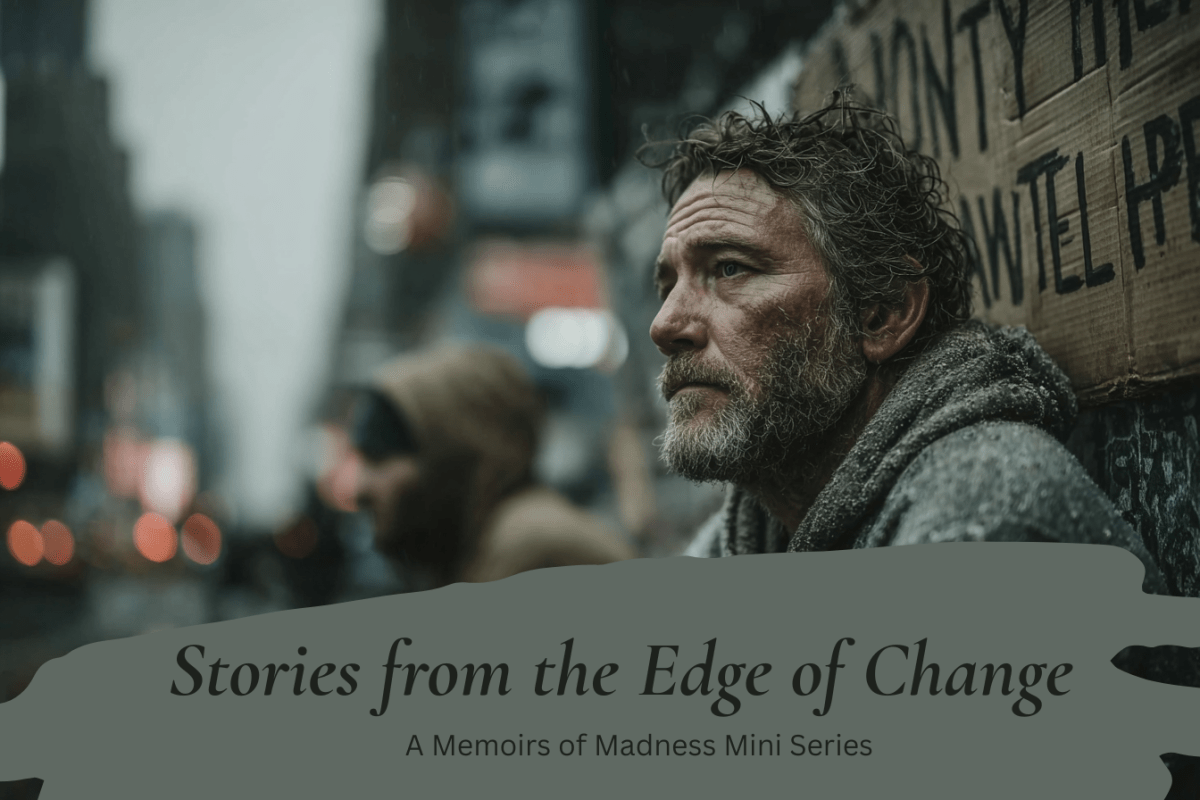
Second Shift

MoM Series: Stories from the Edge of Change – Part 4

Jake worked nights.

He liked the quiet. Fewer eyes. Less explaining to do. The outreach center kept him on the roster as a volunteer—two days a week, graveyard shift. It was mostly sweeping, coffee refills, folding blankets, and unlocking doors when someone showed up crying, shaking, or bleeding. They didn’t advertise the hours. The ones who needed it already knew.

He didn’t talk much to the clients. Just nodded. Kept his voice low. Gave out clean socks and disposable razors, and sometimes leftover sandwiches if the early crew hadn’t raided the fridge. A woman once called him a ghost in a hoodie. He took it as a compliment.


They didn’t know his history.

Most of the staff thought he was someone’s cousin. Someone in the program. He was both, in a way. Still figuring out what version of himself was worth keeping. He told the director he didn’t want to lead groups or give speeches. He just wanted to stay close to the door—for the ones who weren’t ready to walk through it alone.

That night, it was cold again. Not dramatic. Not headline cold. Just the kind that seeps through your boots and settles in your bones. The kind that makes concrete ache. Jake had learned the difference between degrees that made headlines and those that just broke people.

He was wiping down the intake counter when the door buzzer snapped.

The front desk kid—a college intern with a buzzcut and the stubborn optimism of someone who hadn’t failed big yet—waved him over.

“Guy outside’s got no ID. Twitchy. Keeps asking for someone named Pete. Said you’d know what that means.”

Jake’s stomach knotted. He did.


Pete had been there in Jake’s first rehab stint—loud, bitter, always quick to spot your softest spot and stomp on it. He was the kind of man who’d mock your breakdown and then sit with you on the curb afterward, passing a half-smoked cigarette like it was communion.

They’d had a moment, months ago, after the group. Pete had come apart in the stairwell, cracked wide open from something the counselor said about fatherhood. Jake had sat next to him, quiet. Didn’t try to fix it. Just stayed.

That was the last time he’d seen him.

Now Pete was back. Gaunt. Twitching. Cheeks hollowed like spoons. His hoodie was soaked around the collar, eyes glazed like bad glass.

Jake opened the door.


Pete stumbled in, clothes clinging wet. The rainfall outside had picked up, soft but relentless. He looked like a man who’d slept under bridges and crawled out just long enough to fall again.

“Shit, man,” Pete mumbled. “Didn’t know where else to go.”

Jake didn’t answer right away. The smell of damp wool and stale sweat filled the gap between them. Pete’s arms trembled at his sides like he was holding invisible weights.

“Come in,” Jake said. “You need a blanket?”

Pete blinked. “You still here?”

“Still here.”


They sat him down. Pete wouldn’t sign the detox papers. Said he just wanted warmth. Just wanted to sit somewhere without a knife in his back or a siren in his ear. Jake gave him coffee. Black. No sugar. His hands were shaking so bad that half of it sloshed onto the floor.

“I was clean,” Pete muttered. “Six months. Then my brother died in a car crash. I don’t even cry. Just go buy a bottle like I’m on autopilot.”

Jake said nothing. Let him say it without interruption.

“I thought I was good, like I was done paying. Like I was… exempt.”
He laughed once. It cracked like a cough. “Grief doesn’t work like that. No punch card. No discounts.”

Outside, the rainfall whispered against the windows. Steady. Relentless. A low percussion against the building.

Jake thought of that phrase Pete used to say in rehab. “You want grace? Get a dog.”
He understood now. Grace wasn’t something you earned. It was something that showed up when you didn’t run from the stoop.


Later, when Pete fell asleep curled around a donated coat, Jake stepped outside. The pavement was slick with oil and rain. Steam rose from the sewer grates like the city was exhaling something it didn’t need anymore.

He didn’t feel proud. Didn’t feel like a hero. He just felt… rooted. Present. Like a chair that had stopped wobbling.

Some nights, that was enough.


🖋️ Author’s Note:

Written for today’s FOWC, RDP, and Word of the Day prompts: stoop, rainfall, and pavement.

Second Shift is part of Stories from the Edge of Change, a series about quiet recoveries, unglamorous grace, and showing up when there’s nothing left to prove. Sometimes, staying close to the door is the most radical thing you can do.