The roses had no business surviving this long.
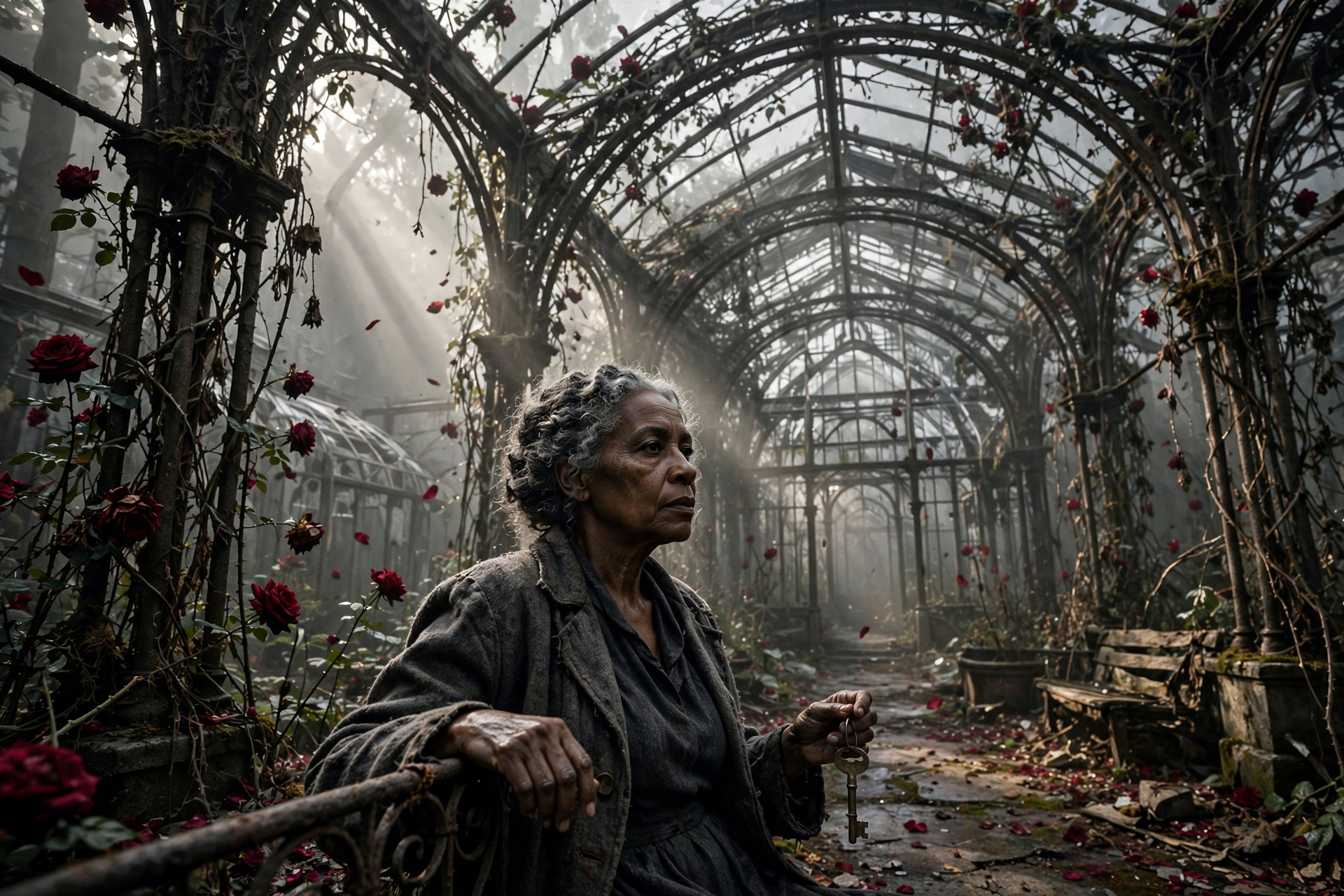
Evelyn Baptiste had been telling herself that for thirty-seven years, although she had long since abandoned the notion that survival required anyone’s permission. The conservatory had surrendered to neglect decades earlier. Its glass ceiling was a patchwork of broken panes and empty iron ribs, its marble walkways fractured by roots that had spent generations working their way toward the light. Rust had consumed the elaborate arches, turning what had once been an architectural indulgence into something resembling the skeleton of a magnificent, long-dead animal. Yet the roses continued to bloom, their crimson blossoms spilling over the corroded metal as though determined to demonstrate that beauty could be every bit as stubborn as ruin.
She arrived shortly after sunrise, carrying a tarnished brass key in her right hand and a lifetime of carefully managed recollections in her left. The morning mist hung low among the arches, softening the jagged outlines of the broken greenhouse. Sunlight entered through the shattered roof in long, fractured shafts, illuminating drifting pollen and the occasional falling petal. Somewhere beyond the garden walls, a mourning dove called to its mate. Evelyn paused beneath the first arch and listened until the bird fell silent.
At sixty-eight, she had learned to appreciate silence without mistaking it for peace.
Her knees complained as she stepped over a broken section of paving stone. She wore the same charcoal coat she’d owned for nearly twenty years, its cuffs worn smooth and its lining repaired twice. Her silver hair was braided close to her scalp, and her face possessed the particular severity of a woman who had spent much of her life refusing to explain herself to people determined to misunderstand her anyway.
The seventh arch stood near the conservatory’s eastern wall.
She knew its location without counting the others. She could have found it blindfolded, though the thought of stumbling through the debris at her age struck her as an unnecessarily dramatic way to break a hip.
Evelyn approached slowly.
The roses were blooming.
She counted them as she always did.
One.
Two.
Three.
She moved along the arch, her eyes following the twisted vines.
Four. Five. Six.
The blossoms were darker than she remembered, their petals heavy with moisture. She reached toward the seventh, stopping just short of touching its thorns.
Seven. Eight. Nine.
Her breathing slowed.
Ten. Eleven. Twelve.
She nodded.
Then she saw the thirteenth.
It grew near the base of the arch, slightly apart from the others. Its stem was younger, its leaves brighter, and its petals possessed a deep burgundy hue that approached black where the morning light failed to reach them.
Evelyn stared.
For several moments, she did nothing.
Then she whispered a name she had not spoken aloud in thirty-seven years.
“Claudine.”
The conservatory had belonged to the Whitcomb family, whose wealth had been acquired through methods polite society preferred not to examine too closely. They owned textile mills, rental properties, and enough influence at city hall to ensure that their inconveniences rarely became public concerns. Their estate occupied nearly forty acres on the northern edge of town, surrounded by limestone walls and iron gates that served less to keep strangers out than to remind them where they belonged.
Evelyn’s mother, Beatrice, worked in the Whitcomb household for twenty-six years.
She cooked, cleaned, washed linens, polished silver, and raised three generations of Whitcomb children while her own daughter spent most afternoons waiting in the servants’ kitchen for the bus that would carry them home. Beatrice possessed an extraordinary talent for enduring indignities without allowing them to become visible. She understood the difference between submission and survival, although Evelyn, in her youth, had mistaken one for the other.
Claudine Whitcomb was two years older than Evelyn.
She had pale skin, auburn hair, and a talent for making trouble that seemed to grow in direct proportion to her father’s determination to prevent it. The girls met when Evelyn was eleven and Claudine thirteen. Their friendship began with a stolen peach, an accusation, and a lie that Claudine told to protect Evelyn from punishment.
For years afterward, Evelyn wondered whether that first kindness had been genuine or simply another amusement available to a girl who had never been required to consider the consequences of her generosity.
They became inseparable during the summers.
Claudine taught Evelyn to ride a bicycle. Evelyn taught Claudine how to climb the enormous oak behind the carriage house without tearing her expensive dresses. They shared books, secrets, and the peculiar intimacy of children who believed the world could be persuaded to accommodate their friendship if they simply refused to acknowledge its objections.
The conservatory became their sanctuary.
Among the roses and the damp, fragrant earth, they could pretend that the distance between their lives was no greater than the width of the stone bench where they sat.
That illusion survived until they were old enough to understand what it cost.
Evelyn crouched beside the thirteenth rose, ignoring the protest from her knees.
The soil surrounding its roots had been disturbed recently. Someone had cleared away the weeds, loosened the earth, and planted the cutting with considerable care. A narrow strip of faded blue ribbon was tied around the stem.
Evelyn recognized the ribbon immediately.
Claudine had worn one just like it in her hair the summer everything changed.
She reached toward the flower, then withdrew her hand.
“No,” she murmured.
The word emerged with more force than she’d intended.
A breeze moved through the broken conservatory, stirring the leaves overhead. Several petals drifted onto the pathway.
Evelyn stood, brushing dirt from her coat.
“Thirty-seven years,” she said to the empty garden. “You had thirty-seven years.”
No one answered.
She hadn’t expected anyone to.
Nevertheless, she waited.
The summer of 1989 had been unusually hot. The city endured weeks of oppressive humidity, and the Whitcomb estate smelled of cut grass, chlorine, and roses beginning to rot on their stems.
Evelyn was thirty-one, recently divorced, and working as an administrative assistant at a law office downtown. Her mother had retired from the Whitcomb household three years earlier, though retirement was a generous description for a woman whose pension barely covered the rent.
Claudine had returned from New York following the collapse of her second marriage.
They had not spoken in nearly a decade.
Their reunion occurred in the conservatory, where Evelyn had gone to retrieve a box of her mother’s belongings that the Whitcomb housekeeper had discovered in storage.
Claudine was waiting beside the seventh arch.
“You look good,” she’d said.
Evelyn regarded her.
“You look expensive.”
Claudine laughed.
For a moment, they were girls again.
Then the moment passed.
Claudine had changed. Her confidence remained, but something beneath it had hardened. She smoked constantly, spoke too quickly, and possessed the restless manner of someone accustomed to moving before the consequences of her actions could catch up.
She wanted Evelyn’s help.
Her father, Arthur Whitcomb, had been falsifying financial records connected to several properties his company owned. The buildings were deteriorating, their tenants subjected to dangerous conditions while the family collected rents and diverted maintenance funds elsewhere.
Claudine had discovered documents proving that her father knew about the violations.
She had also discovered something worse.
A fire in one of the buildings had killed four people, including two children. The official investigation blamed faulty electrical wiring and concluded that the owners had been unaware of the problem.
The documents told a different story.
Claudine had copied them.
She intended to expose her father.
Evelyn listened without interrupting.
When Claudine finished, she placed a thick envelope on the stone bench.
“I need someone I can trust.”
Evelyn looked at the envelope.
“Why me?”
“Because you’ve always been the only person who tells me the truth.”
Evelyn remembered laughing.
Not because the statement amused her, but because she understood how little Claudine knew about the woman sitting across from her.
“Truth,” Evelyn said, “is a luxury your family has always been able to afford.”
Claudine flinched.
“That’s not fair.”
“No,” Evelyn replied. “It isn’t.”
The brass key had belonged to Beatrice.
Arthur Whitcomb gave it to her during her final year of employment, instructing her to keep it until he requested its return. It opened a narrow storage room beneath the conservatory, a space once used for gardening equipment and later converted into a private archive.
Beatrice never explained why Arthur trusted her with the key.
She simply placed it in a small wooden box beside her bed and told Evelyn never to lose it.
After her mother’s death, Evelyn discovered the key among her belongings.
She had carried it ever since.
Not because she intended to use it.
Because she knew what it opened.
And because she knew what remained inside.
Evelyn followed the cracked pathway toward the conservatory’s eastern wall. The entrance to the storage room was partially concealed behind a collapsed section of trellis. Thick vines had spread across the doorway, their thorns catching at her coat as she pulled them aside.
The door was smaller than she remembered.
Or perhaps she had simply grown accustomed to the idea of it.
She inserted the key.
It resisted.
Evelyn turned it harder, feeling the old mechanism grind beneath her fingers.
Then the lock surrendered.
The door opened inward with a long, reluctant groan.
The room smelled of damp wood and old paper. Shelves lined the walls, most of them empty. A broken chair lay overturned near the entrance, and water stains spread across the plaster ceiling.
Against the far wall stood a narrow metal cabinet.
Evelyn approached it.
She knew what was inside.
She had known for thirty-seven years.
The question was whether she possessed the courage to look at it again.
Claudine had given her the documents on a Thursday afternoon.
By Saturday morning, Arthur Whitcomb knew.
He arrived at Evelyn’s apartment shortly before nine, accompanied by a lawyer whose expensive suit seemed almost comically inappropriate for the neighborhood.
Arthur was a tall man with carefully trimmed silver hair and the practiced courtesy of someone who had never needed to raise his voice to frighten another person.
He asked for the envelope.
Evelyn refused.
He offered money.
She refused again.
Then he mentioned her mother.
Beatrice was living in a small apartment above a bakery on Mercer Street. She suffered from arthritis, high blood pressure, and a heart condition that required medication Evelyn could barely afford.
Arthur knew all of this.
He also knew that Beatrice’s pension came through a private arrangement with the Whitcomb family.
He explained, with remarkable gentleness, that certain arrangements could be reconsidered.
Evelyn remembered the way his lawyer studied the carpet while Arthur spoke.
She remembered the sunlight falling across the kitchen table.
She remembered thinking that evil rarely announced itself with sufficient theatricality to make recognition convenient.
Sometimes it wore a good suit and spoke in complete sentences.
Arthur left without the envelope.
But he left Evelyn with a decision.
That evening, she went to the conservatory.
Claudine was waiting.
Evelyn told her what had happened.
Claudine became furious.
“He can’t do that.”
Evelyn stared at her.
“Of course he can.”
“We’ll go to the police.”
“Your father owns half the people who would investigate him.”
“Then the newspapers.”
“And what happens to my mother?”
Claudine opened her mouth.
Closed it.
For the first time in their friendship, Evelyn saw genuine uncertainty in her face.
“I’ll help her,” Claudine said.
Evelyn shook her head.
“You don’t understand.”
“Then explain it to me.”
Evelyn looked at the woman who had once stolen peaches with her, who had shared her books and secrets, who had genuinely believed that friendship could erase the differences between their lives.
“You can afford to be brave, Claudine. My mother can’t.”
Claudine’s expression changed.
“Is that what you think this is? Some kind of game?”
“No. That’s the problem. You still think everybody gets to play by the same rules.”
They argued until the afternoon light began to fade.
Claudine accused Evelyn of cowardice.
Evelyn accused Claudine of confusing rebellion with sacrifice.
Neither accusation was entirely fair.
Neither was entirely wrong.
Finally, Claudine took the envelope from Evelyn’s hands.
“I thought you were different.”
Evelyn remembered how deeply those words wounded her.
Not because Claudine intended cruelty.
Because Evelyn had once believed the same thing.
The metal cabinet opened with surprising ease.
Inside sat a wooden box, its surface coated with dust.
Evelyn lifted it carefully.
The documents remained where she had placed them thirty-seven years earlier.
Property records.
Inspection reports.
Correspondence bearing Arthur Whitcomb’s signature.
And a handwritten letter from Claudine.
Evelyn had read that letter only once.
She unfolded it now.
Evelyn,
I know what you’re afraid of. I know what my father threatened, and I know that asking you to risk your mother’s security was unfair.
But four people died because he decided their lives were worth less than the money it would cost to keep them safe.
I can’t make that disappear.
Neither can you.
I don’t need you to forgive me for asking. I need you to understand why I can’t stop.
Whatever happens, I want you to know that our friendship was never a game to me.
Claudine
Evelyn sat on the floor.
The letter trembled in her hands.
She remembered what happened afterward.
Claudine disappeared from the estate three days later.
Arthur told the family she’d returned to New York. Her marriage had failed, he said, and she needed time to recover from the embarrassment.
Evelyn never believed him.
She tried calling Claudine’s apartment.
Disconnected.
She wrote letters.
Returned unopened.
Eventually, she stopped asking questions.
Not because she believed Arthur’s explanation.
Because she feared what the truth might demand of her.
Two months later, Arthur Whitcomb died of a stroke.
His company dissolved over the following years, its properties sold and its records scattered among lawyers, accountants, and family members who preferred not to discuss the past.
The conservatory was abandoned.
And Evelyn began planting roses.
Twelve of them.
One for each month of the year Claudine disappeared.
She told herself the ritual was an act of remembrance.
But sitting in the storage room, surrounded by the evidence she’d concealed, Evelyn finally admitted that remembrance had been the easier part.
The harder part was acknowledging that she had allowed four dead strangers to remain without justice because she was afraid of losing someone she loved.
She had made a choice.
She had reasons.
Those reasons did not erase the consequences.
“Thought I might find you here.”
The voice came from the doorway.
Evelyn looked up.
A woman stood beneath the rusted frame, her figure silhouetted against the morning light. She was younger than Evelyn by perhaps twenty years, with dark auburn hair streaked with gray and a face that carried an unsettling resemblance to someone Evelyn had spent decades trying not to remember too clearly.
The woman stepped inside.
“My name is Margaret Whitcomb.”
Evelyn stared.
“Claudine’s daughter?”
Margaret nodded.
Evelyn closed her eyes.
For years, she’d imagined Claudine dead. It had seemed the only explanation for her disappearance, and eventually the possibility had hardened into something resembling certainty.
“Is she alive?”
Margaret hesitated.
“She died last winter.”
Evelyn lowered her head.
The words should have surprised her.
Instead, they settled into a place that had been waiting for them.
“She lived in Oregon,” Margaret continued. “For most of my life. She worked at a community legal clinic. Helped tenants fight landlords, mostly. She was good at it.”
Evelyn looked at her.
“She never came back?”
“No.”
“Why?”
Margaret considered the question.
“She said there were places a person could leave without ever really escaping.”
Evelyn looked down at the letter.
Margaret stepped closer.
“She told me about you.”
“Did she?”
“Yes.”
Evelyn waited.
“She said you were the bravest person she’d ever known.”
A bitter laugh escaped Evelyn’s throat.
“Then your mother had a poor understanding of courage.”
Margaret didn’t argue.
Instead, she crouched beside the cabinet.
“She told me you kept something here.”
Evelyn looked at the documents.
“She knew?”
Margaret nodded.
“She said you might need them someday.”
Evelyn stared at her.
“Why didn’t she come back for them?”
“She tried.”
The room seemed to grow colder.
Margaret continued.
“She came back in 1994. Your mother had already passed, and you weren’t living at your old address. She went to the estate, but the gates were locked. She couldn’t find you.”
Evelyn swallowed.
“I was still in town.”
“I know.”
“She could’ve found me.”
“Probably.”
The answer was so simple that Evelyn almost laughed.
Margaret sat beside her.
“She was afraid, too.”
For a long time, neither woman spoke.
Outside, the morning breeze moved through the roses.
Finally, Evelyn asked, “Why plant another one?”
Margaret smiled faintly.
“Because there were thirteen.”
Evelyn frowned.
“Thirteen what?”
“People who knew.”
Margaret reached into her coat and removed a small notebook.
“My mother spent years trying to reconstruct what happened. She found twelve people who knew about the building’s condition before the fire. Inspectors, company employees, contractors. Some helped cover it up. Others looked away.”
She paused.
“And then there was you.”
Evelyn felt the words settle.
Not as an accusation.
As a fact.
Margaret placed the notebook beside the documents.
“She never put your name on the list.”
“Why not?”
“Because she understood why you were afraid.”
Evelyn looked at the thirteenth rose through the open doorway.
“And you?”
Margaret considered her.
“I think understanding somebody’s reasons and excusing what they did are two different things.”
Evelyn nodded slowly.
“Your mother teach you that?”
“Among other things.”
For the first time that morning, Evelyn smiled.
It was a small expression, weary and reluctant.
“She always was a difficult woman.”
Margaret laughed.
“That’s what everybody says.”
They carried the documents into the conservatory and spread them across the old stone bench.
Some pages had deteriorated beyond recognition. Others remained remarkably intact. The inspection reports were legible, as were several letters bearing Arthur Whitcomb’s signature.
Margaret photographed everything with her phone.
Evelyn watched, occasionally pointing out names or explaining details Margaret couldn’t understand.
The process took nearly two hours.
When they finished, Margaret closed the wooden box.
“What happens now?” Evelyn asked.
“I have a lawyer who wants to look at these. The families might finally get some answers.”
“After all this time?”
“Maybe. Some things can’t be prosecuted anymore. Some records are gone. I don’t know what we’ll be able to prove.”
Evelyn looked toward the broken roof.
“Four people died.”
“I know.”
“And I could have done something.”
Margaret didn’t answer immediately.
“Yes,” she said at last. “You could have.”
Evelyn felt the truth of it more sharply than any accusation.
She had spent thirty-seven years constructing explanations for her silence. Some were reasonable. Some were necessary. Others had become so familiar that she no longer questioned them.
But none changed what had happened.
“I loved my mother,” she said.
Margaret nodded.
“I believe you.”
“I was afraid she’d lose everything.”
“I believe that, too.”
Evelyn looked at her.
“Doesn’t make it right.”
“No.”
The simplicity of the answer unsettled her.
She had expected judgment or forgiveness. Perhaps she had even hoped for one or the other.
Margaret offered neither.
Only the truth.
And Evelyn, who had spent much of her life believing truth required an audience willing to applaud it, found herself strangely relieved.
They left the conservatory shortly before noon.
The mist had lifted, revealing the full extent of the garden’s deterioration. Sunlight poured through the shattered roof, illuminating the rusted arches and the tangled vines that had slowly reclaimed them.
Evelyn stopped beneath the seventh arch.
The thirteenth rose stood apart from the others, its dark petals moving gently in the breeze.
Margaret waited beside her.
“Are you going to keep coming back?” she asked.
Evelyn studied the flowers.
For thirty-seven years, she’d returned to count the roses, believing that the ritual honored a friendship she’d failed to protect.
Now she understood that the counting had served another purpose.
It allowed her to remember without acting.
To mourn without answering.
To keep the past alive while refusing to disturb it.
“I don’t know,” she said.
Margaret nodded.
Then she began walking toward the entrance.
Evelyn remained beneath the arch.
She reached for the thirteenth rose, carefully avoiding the thorns, and touched one of its dark petals.
It was soft.
Almost impossibly so.
She thought of Claudine at thirteen, stealing peaches and laughing beneath the summer sun. She thought of the woman Claudine became, stubborn and frightened and determined to do something decent despite the cost.
She thought of her mother, whose hands had been permanently roughened by years of work, and of the four people whose names she had never bothered to learn.
Then Evelyn did something she had not done in thirty-seven years.
She stopped counting.
She turned toward the entrance, where Margaret stood waiting in the sunlight.
“Margaret?”
The younger woman looked back.
“Yes?”
“Would you tell me about your mother?”
Margaret smiled.
“Which part?”
Evelyn considered the question.
“All of it.”
They walked out together, leaving the roses to the morning light.
Behind them, the conservatory continued its slow surrender to time. Rust worked patiently through the iron. Roots widened the cracks in the stone. The roses climbed higher, indifferent to the histories people had assigned them.
Evelyn knew the garden would eventually disappear.
Perhaps the city would demolish it. Perhaps the vines would finish what neglect had begun.
Either way, she would not be there to count what remained.
For the first time, the thought did not trouble her.
There were four names she needed to learn.
And a story she could no longer afford to leave untold.
Discover more from Memoirs of Madness
Subscribe to get the latest posts sent to your email.

