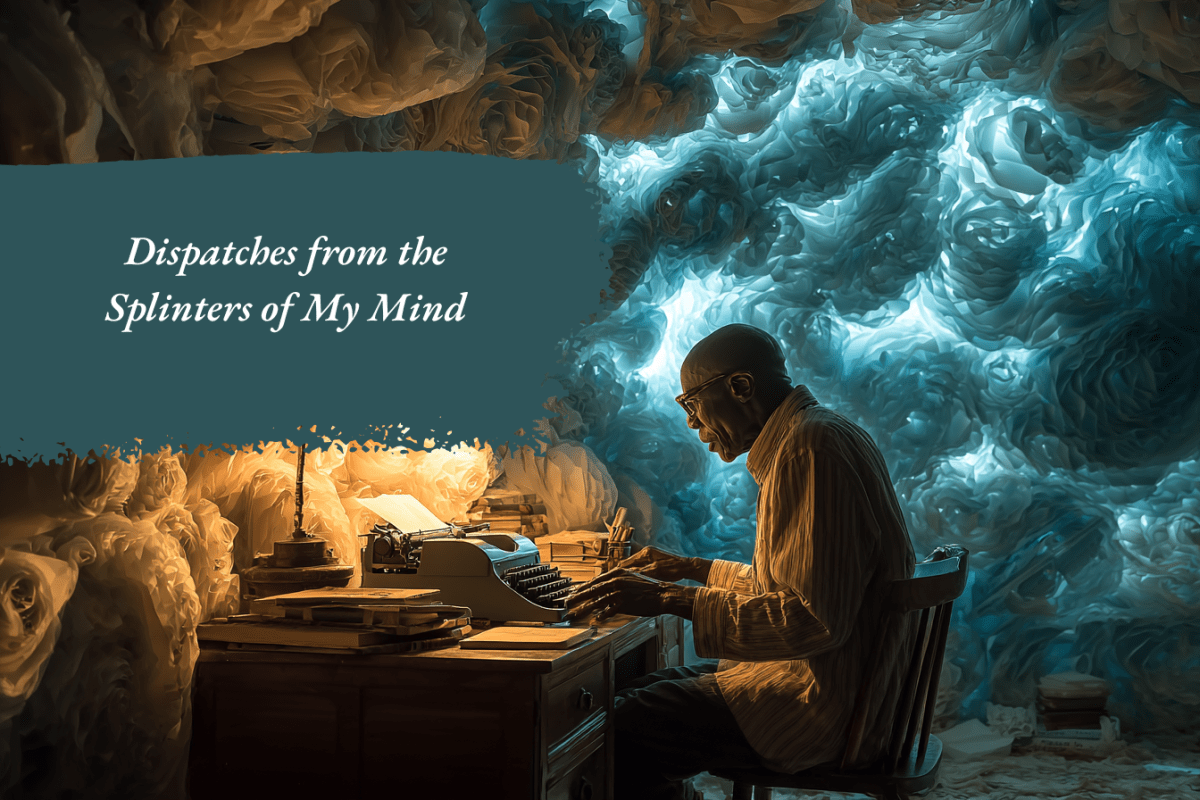

Dispatches from the Splinters of My Mind — Entry 40
The first blue line appeared beneath Nadia Voss’s left eye when she was seven years old, on an otherwise unremarkable Tuesday afternoon, while her mother stood at the kitchen sink washing a plate that had already been washed twice.
Outside, rain dragged itself down the windows in crooked ribbons. The house smelled of boiled cabbage, furniture polish, and the damp wool of her father’s coat hanging beside the back door. Nadia sat at the kitchen table with a coloring book spread beneath her elbows, watching her mother scrub the same white plate with such determination that the sponge had begun to disintegrate.
“Is Daddy coming home?”
Her mother stopped moving.
It was a small interruption, barely noticeable, but Nadia remembered it afterward with extraordinary clarity. The water continued running. A drop fell from the woman’s wrist onto the linoleum. Somewhere in the house, the old refrigerator shuddered and resumed its mechanical humming.
“Of course he is, sweetheart.”
The line appeared immediately.
It began near the corner of Nadia’s eye, a delicate thread of cobalt blue that traveled down her cheek before disappearing beneath her jaw. There was no pain, only a peculiar sensation of coolness, as though someone had drawn a wet fingertip across her skin.
Her mother noticed it while drying her hands.
“Good heavens, child. What have you gotten into?”
She rubbed Nadia’s cheek with a damp dishcloth, then with soap, then with the rough edge of a towel. The mark remained. By evening, it had faded into something resembling a faint bruise, and by morning, it was gone.
Her father never came home.
For years afterward, Nadia believed the line had appeared because her mother had lied.
She was nearly thirty before she understood that the distinction wasn’t nearly so simple.
At forty-three, Nadia had become exceptionally skilled at listening to what people didn’t say.
She worked in the municipal records office, a narrow, poorly ventilated building where the fluorescent lights hummed like trapped insects and the windows overlooked the brick wall of a neighboring warehouse. Her responsibilities involved death certificates, property transfers, marriage licenses, and the occasional correction of a birth record. It was a profession built upon the comforting assumption that everything important could be reduced to a name, a date, and a sufficiently official signature.
Nadia knew better.
She had processed death certificates for men whose wives had stopped loving them decades before their hearts stopped beating. She had watched estranged children sign inheritance documents with trembling hands, insisting they wanted nothing from the deceased while their faces betrayed an entirely different hunger. She had listened to elderly couples explain why they needed copies of marriage certificates that had been misplaced fifty years earlier.
The blue markings appeared whenever something important remained deliberately unspoken.
Not every lie produced one. A clerk exaggerating the quality of her weekend left Nadia’s skin untouched. Neither did a stranger offering an insincere compliment or a husband pretending to enjoy his wife’s dreadful cooking.
The marks responded to something deeper.
A truth withheld because its revelation might change the shape of another person’s life.
Over time, Nadia learned to recognize the sensations. A small omission produced a coolness along her wrists. A buried betrayal left thin branching lines beneath her collarbone. Grief disguised as indifference could spread across her shoulders like frost creeping over window glass.
She never knew precisely what the person was concealing.
Only that something had been left unsaid.
And increasingly, that silence seemed to be taking up residence inside her.
The woman arrived shortly before closing on a Thursday in late October.
She was perhaps seventy, dressed in a charcoal coat with a missing button and carrying a brown leather handbag whose seams had begun to split. Her hair was arranged beneath a faded blue scarf, and her hands bore the unmistakable evidence of years spent working with them: swollen knuckles, roughened fingertips, and a pale scar crossing the back of her right hand.
“I need a death certificate,” she said.
Nadia reached for the appropriate form.
“Name of the deceased?”
The woman hesitated.
“Elena Voss.”
Nadia looked up.
“Voss?”
“Yes.”
“Relation?”
Another hesitation.
“My daughter.”
A thin blue line appeared across Nadia’s left wrist.
She kept her expression neutral.
“Date of death?”
“November seventeenth.”
“Year?”
The woman opened her handbag and removed a folded piece of paper. Her fingers trembled as she smoothed it against the counter.
“This year.”
Nadia glanced toward the calendar hanging beside her desk.
October twenty-ninth.
She looked back at the woman.
“Ma’am, November seventeenth hasn’t happened yet.”
The woman’s expression did not change.
“I know.”
For several seconds, neither spoke.
Then the woman folded the paper, returned it to her handbag, and stepped away from the counter.
“I’m sorry,” she said. “I came too early.”
Nadia felt something cold move beneath the skin of her throat.
“Wait.”
The woman stopped.
“Do I know you?”
The question seemed to trouble her more than anything else Nadia had said.
Finally, she answered.
“Not anymore.”
The blue line beneath Nadia’s throat darkened.
By the time she reached the building’s front entrance, the woman had disappeared into the afternoon rain.
That evening, Nadia discovered the markings had begun changing.
She stood before her bathroom mirror beneath the unforgiving yellow light, examining the familiar blue tracery across her shoulders and collarbone. Over the years, the marks had accumulated into delicate networks resembling architectural drawings or the branching veins of leaves pressed between the pages of an old book.
But now there were new shapes.
Fine golden lines intersected the blue, forming triangles, circles, and intricate geometric patterns. Some appeared to extend beyond her skin, hovering at the edge of her reflection like the unfinished calculations of an invisible mathematician.
She touched one beneath her right eye.
A memory surfaced.
She was standing in a hospital corridor.
The floor smelled of disinfectant and burnt coffee. A vending machine buzzed against the far wall, its fluorescent display illuminating a row of untouched sandwiches. Somewhere beyond a pair of swinging doors, a woman was crying.
Nadia held a small blue blanket.
Someone approached her.
A man whose face she couldn’t remember.
“Have you told her?”
Nadia shook her head.
“You have to.”
“I can’t.”
“She deserves to know.”
The memory vanished.
Nadia staggered against the sink, knocking a glass onto the tile. It shattered beneath her feet, scattering fragments across the floor.
She had never worked in a hospital.
She had never owned a blue blanket.
Yet the memory possessed the stubborn physical certainty of something lived rather than imagined.
And beneath her right eye, the golden pattern had grown.
The following morning, Nadia searched the municipal archives for Elena Voss.
There were seventeen entries bearing the surname, including her own birth certificate and the death record of a distant uncle. None belonged to an Elena Voss.
She searched neighboring counties, historical records, marriage indexes, and archived newspaper notices.
Nothing.
At eleven forty-three, her telephone rang.
The caller identification displayed no number.
“Nadia?”
The voice belonged to a woman.
Older. Familiar.
“Who is this?”
“You need to stop looking.”
Nadia gripped the receiver.
“Are you the woman who came yesterday?”
A pause.
“No.”
“Then who are you?”
The voice softened.
“Someone who remembers what happened when you found her the first time.”
A sharp pain moved across Nadia’s forehead. She closed her eyes and saw a white room, a narrow bed, and a woman sitting beside a window with her back turned.
There was blood on the floor.
Not much.
Just enough to make the white tiles seem unbearably bright.
“What happened?” Nadia whispered.
The caller exhaled.
“You asked us not to tell you.”
The line went dead.
By Saturday, the gold had spread across Nadia’s face.
It moved in fine, deliberate formations, connecting the blue markings into something resembling a map. She could trace its pathways from her temples to her cheekbones, down the curve of her neck, and beneath the collar of her blouse.
At first, she attempted to conceal it with makeup.
The cosmetics would not adhere.
They collected along the edges of the markings, leaving the gold exposed, as though the lines existed slightly above the surface of her skin.
She stopped trying.
Instead, she remained inside her apartment, listening to the rain strike the windows and the building settle around her.
At three in the afternoon, someone knocked.
Three slow taps.
Nadia approached the door.
“Who is it?”
No answer.
She looked through the peephole.
The hallway was empty.
When she opened the door, a small cardboard box rested against the threshold.
Inside was a blue blanket.
Folded neatly.
Beneath it lay a photograph of a young woman standing beside a hospital bed. Her face was partially obscured by shadow, but Nadia recognized the arrangement of her hair, the narrow shoulders, and the small scar beneath her left eyebrow.
It was herself.
Or someone who looked exactly like her.
On the back of the photograph, someone had written:
You promised you would remember.
Nadia turned it over again.
The woman in the photograph was holding a newborn child.
The baby’s face had been carefully scratched away.
The memory returned that night.
Not gradually, as the others had, but with the violence of a door being forced open.
She was in the hospital corridor again. The vending machine hummed. The air smelled of disinfectant and stale coffee. The blue blanket lay across her arms, its soft fabric damp beneath her fingers.
The man stood before her.
This time, she could see his face.
He was young, perhaps thirty, with dark hair and a thin scar along his jaw.
“She won’t survive another one,” he said.
Nadia looked toward the swinging doors.
“Then we stop.”
“You know we can’t.”
“We have to.”
The man took her wrist.
A blue line appeared beneath his fingers.
“Tell her the truth.”
Nadia shook her head.
“If I tell her, she’ll remember.”
“She already remembers.”
“No.” Nadia’s voice broke. “She remembers pieces. That’s different.”
Behind the doors, someone screamed.
The man released her wrist.
And then he said something that followed Nadia out of the memory and into the darkness of her bedroom.
“How many times are you going to make her lose the same child?”
Sunday morning arrived without sunlight.
The sky hung low and colorless over the city, and the rain had become a fine mist that blurred the neighboring buildings into indistinct shapes.
Nadia sat at her kitchen table with the photograph before her.
She had not slept.
The golden patterns covered most of her face now, their delicate intersections forming a complicated structure that seemed to shift whenever she looked away.
She studied the scratched-out face of the child.
Then she noticed something she had overlooked.
The woman holding the baby wore a hospital identification bracelet.
Nadia retrieved a magnifying glass from her desk.
The lettering was faint but legible.
ELENA VOSS.
She stared at the name.
Her own face looked back at her from the photograph.
But the bracelet belonged to someone else.
Or perhaps the woman in the photograph wasn’t Nadia at all.
A knock interrupted her thoughts.
Three slow taps.
She opened the apartment door.
The elderly woman from the records office stood in the hallway, her charcoal coat damp with mist. She carried the same worn handbag, and beneath her blue scarf, her hair had come loose around her temples.
“You found it,” the woman said.
Nadia stepped aside.
The woman entered without hesitation, moving through the apartment with the quiet familiarity of someone returning to a place she had once called home.
She stopped before the kitchen table.
For a long time, she studied the photograph.
Then she sat down.
“Do you remember me?” she asked.
Nadia shook her head.
The woman’s eyes filled with tears.
“That’s what you always say.”
The gold beneath Nadia’s skin began to burn.
“Who are you?”
The woman reached across the table and placed her hand over Nadia’s.
A blue line appeared along Nadia’s wrist.
Then another.
And another.
The markings spread rapidly, branching across her arms and climbing toward her shoulders. The gold followed, connecting the blue into an intricate lattice that seemed to pulse beneath the skin.
Nadia tried to pull away.
The woman held her gently.
“Don’t be frightened.”
“Tell me what’s happening.”
The woman’s expression changed.
Not into cruelty or indifference.
Something worse.
Recognition.
“You asked me that the last time.”
Nadia felt the room shift around her.
The walls seemed farther away. The kitchen table stretched into an unfamiliar shape, and somewhere beyond the apartment, she heard the unmistakable mechanical hum of a hospital ventilation system.
The elderly woman leaned closer.
“There are things we refuse to say because we’re afraid of what the truth will do to someone we love.”
Nadia’s breathing became shallow.
“And there are things,” the woman continued, “we refuse to say because we know exactly what the truth will do.”
She released Nadia’s hand.
The blue markings began to fade.
The gold remained.
“Who is Elena?” Nadia whispered.
The woman looked toward the photograph.
Then toward the empty chair beside the kitchen window.
“Which Elena?”
Nadia did not remember the woman leaving.
She remembered the kitchen growing dark, the sound of rain against the glass, and the peculiar sensation of something moving beneath her skin.
When she finally stood, the apartment was silent.
The photograph remained on the table.
But the child’s face was no longer scratched away.
A little girl looked directly into the camera, her expression solemn, her dark eyes impossibly familiar.
Nadia touched the photograph.
A memory stirred.
A small hand gripping her finger.
The smell of warm milk.
A lullaby she had never learned but somehow knew every word to.
Then a voice.
Not from the photograph.
Not from the hallway.
From somewhere inside her.
You promised.
Nadia closed her eyes.
The gold across her face grew warm.
And for the first time in thirty-six years, she remembered the words she had spoken beside that hospital bed.
Not the promise.
The confession that came before it.
She opened her mouth.
The words were there, waiting.
But before she could speak, a thin blue line appeared across the photograph.
It moved slowly over the child’s face, dividing one eye from the other.
Nadia watched it spread.
Then she looked toward the kitchen window.
Her reflection stood in the dark glass.
Behind her, the elderly woman was holding the blue blanket.
And beside the woman stood a little girl.
The child raised one finger to her lips.
Nadia turned.
There was no one there.
When she looked back at the window, the little girl had disappeared.
Only the elderly woman remained.
She was smiling.
And across her face, beneath the wrinkles and the years, delicate golden lines were beginning to appear.
Some truths remain buried because no one remembers where they were hidden. Others remain buried because someone is still standing guard.
Until next Tuesday, when another splinter finds its way to the surface.
Discover more from Memoirs of Madness
Subscribe to get the latest posts sent to your email.


So good!
LikeLike