
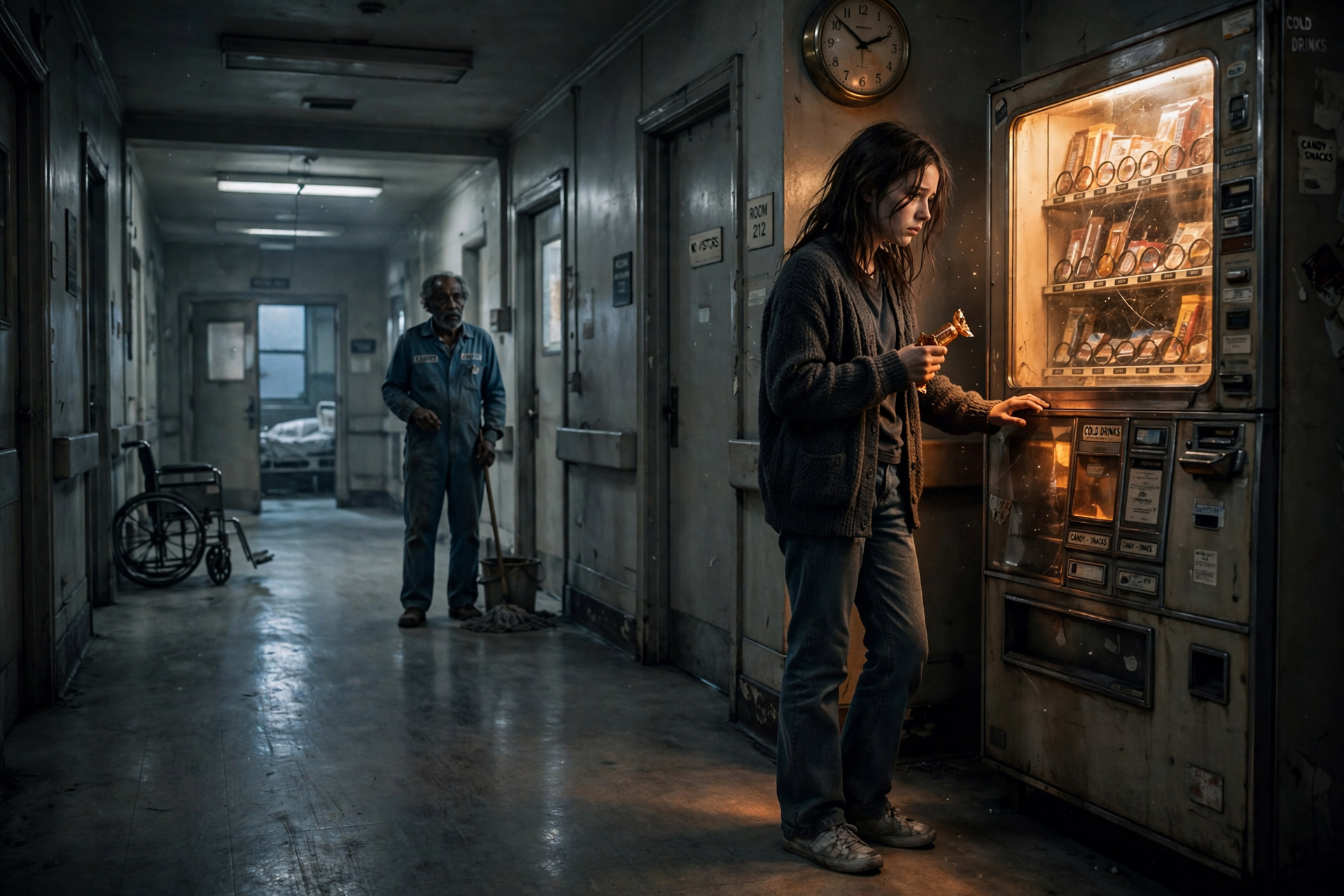
The first time Walter Hines noticed the girl, he was trying to remove a coffee stain from the fourth-floor corridor of St. Bartholomew’s Hospital. It was 2:11 in the morning, and the stain had already survived two applications of industrial cleaner, a stiff-bristled brush, and a considerable amount of profanity. Walter was beginning to suspect that whatever had spilled wasn’t coffee at all. He straightened his aching back, considered the possibility of retirement for perhaps the thousandth time, and heard the vending machine accept a dollar.
He looked up.
A teenage girl stood beneath the flickering fluorescent light, studying the selection behind the scratched glass. She wore faded jeans, canvas sneakers, and a charcoal cardigan several sizes too large for her narrow shoulders. Her dark hair was gathered into a loose ponytail, though several strands had escaped and fallen across her face. She couldn’t have been more than sixteen. There was nothing particularly remarkable about her appearance, except perhaps the hour. Most visitors had gone home, and those who remained generally occupied the waiting rooms, staring into their phones or bargaining with whatever higher power they believed might still be listening.
The machine rattled, hesitated, and surrendered a chocolate bar.
“You’re lucky,” Walter said. “That miserable contraption owes me three dollars and an apology.”
The girl glanced over her shoulder. Her smile was small but genuine.
“You have to hit the side before you put your money in.”
“That so?”
She nodded. “Twice. Not too hard, though. It gets stubborn.”
Walter looked at the machine. “Sounds like my second wife.”
The girl laughed, a brief, unguarded sound that seemed strangely out of place in the corridor. Then she retrieved her candy, tucked it into her cardigan pocket, and walked toward the east wing.
Walter watched her disappear around the corner before returning to the stain. He eventually gave up and placed a yellow caution sign over it. Some battles, he had learned, were best left for the morning shift.
The following night, she appeared again.
Same time. Same cardigan. Same candy bar.
Walter noticed because he had spent thirty-eight years working nights, and after a while, the smallest irregularities became more interesting than the emergencies. Hospitals were peculiar places after midnight. They possessed a rhythm entirely different from the one daylight imposed upon them. Elevators opened without passengers. Televisions murmured behind closed doors. Somewhere, someone was always crying, though rarely loudly enough to be heard beyond the room. The building smelled of disinfectant, stale coffee, warmed plastic, and the faint medicinal sweetness that clung to people undergoing treatments whose names Walter had long ago stopped trying to pronounce.
He had seen men arrive carrying flowers and leave carrying plastic bags filled with their wives’ belongings. He had watched children race toy cars along the same corridors where other children learned they would never walk again. He had cleaned blood from emergency-room floors and birthday cake from oncology waiting rooms. After nearly four decades, he understood that hospitals were not simply places where people came to get well.
Sometimes they were places where people came to learn how to live with what couldn’t be fixed.
The girl returned on Wednesday, Thursday, and Friday.
Always at 2:11.
Always the same chocolate bar.
Always toward the east wing.
On Saturday, Walter decided to speak to her again.
“You planning to put that machine through college?”
She looked at him, puzzled.
“All the money you’re feeding it,” he explained. “Figure you ought to get something back.”
She smiled. “It’s only a dollar fifty.”
“That’s what they want you to think. Add it up over a year, and you’ve got yourself a decent pair of shoes.”
She glanced down at her worn sneakers.
“These are still good.”
Walter chuckled. “Fair enough.”
She turned toward the hallway, but he called after her.
“Somebody you visiting?”
The girl stopped.
For a moment, Walter thought she hadn’t heard him. Then she turned, her expression no longer quite as open.
“Yes.”
“Family?”
She considered the question.
“Something like that.”
Walter nodded. He had worked around enough suffering to recognize when a person had reached the boundary of what they were willing to share.
“Well, you take care of yourself.”
“You too, Mr. Hines.”
She walked away.
Walter stood motionless beside his cleaning cart.
He hadn’t told her his name.
By the following Tuesday, curiosity had become an irritation Walter couldn’t quite scratch. He asked Lorraine Bell, the overnight charge nurse, whether she knew anything about the girl.
Lorraine had worked at St. Bartholomew’s for twenty-six years and possessed the sort of patience that came from dealing with frightened families, arrogant physicians, and administrators who believed staffing shortages could be solved with motivational posters.
“What girl?” she asked, without looking up from her paperwork.
“Young thing. Sixteen, maybe seventeen. Dark hair. Gray sweater. Comes through here every night around two.”
Lorraine continued writing.
“Lots of people come through here, Walter.”
“Not at exactly two-eleven every blessed morning.”
That got her attention.
She raised her head.
“Two-eleven?”
“Give or take a second.”
Lorraine set down her pen.
“Where does she go?”
“East wing. Past the old nurses’ station.”
The expression that crossed Lorraine’s face was brief, but Walter saw it. He had spent too many years observing people when they thought no one was paying attention.
“Walter, that section’s been closed since the renovation.”
“I know it’s closed.”
“Then why would someone be going down there?”
“That’s what I’m asking you.”
Lorraine studied him for a moment.
“You sure you’re seeing somebody?”
Walter felt something tighten beneath his ribs.
He had recently begun misplacing things. His reading glasses turned up in the refrigerator once, and another time he spent twenty minutes searching for keys already hanging from his belt. His daughter had suggested he see a doctor. He told her that at seventy-two, forgetting where he’d put his glasses was considerably less troubling than remembering every foolish thing he’d done while wearing them.
But Lorraine’s question bothered him.
“I’m old, Lorraine. Not imaginary.”
She softened.
“I didn’t mean it like that.”
“Then how’d you mean it?”
She sighed.
“Just be careful down there, okay? Maintenance hasn’t checked those rooms in months.”
Walter waited for her to say something else.
She didn’t.
That night, he positioned his cleaning cart near the vending machine at 2:05.
The hallway was empty.
At 2:08, an orderly pushed a wheelchair toward the elevators. At 2:09, someone coughed behind a closed door. At 2:10, the fluorescent light above the vending machine flickered twice.
At 2:11, the girl appeared.
Walter hadn’t seen her approach.
One moment, the corridor was empty. The next, she was standing before the machine, pressing the button for the same chocolate bar.
He felt an uncomfortable sensation move along his spine.
“Evening,” he said.
She glanced toward him.
“Morning, actually.”
“Depends on whether you’ve been to bed.”
She smiled.
The machine released the candy bar with its usual metallic complaint.
Walter stepped closer.
“Mind if I ask you something?”
“Depends.”
“On what?”
“Whether it’s a stupid question.”
He laughed.
“Fair enough. How’d you know my name?”
She looked at him for a long moment.
“You told me.”
“When?”
“A long time ago.”
Walter studied her face. There was something familiar about her eyes, though he couldn’t place it. He had known hundreds of patients over the years, perhaps thousands. Faces passed through the hospital like weather, leaving impressions that gradually softened beneath the weight of newer memories.
“Have we met before?”
The girl lowered her gaze to the candy bar.
“Yes.”
“Here?”
She nodded.
Walter waited.
“Who are you visiting, sweetheart?”
Her fingers tightened around the wrapper.
“Someone who doesn’t have anybody else.”
He glanced toward the darkened east wing.
“There’s nobody down there.”
She looked up.
“That’s what everybody keeps saying.”
Then she walked away.
Walter watched until she disappeared around the corner.
For the first time in thirty-eight years, he left his cleaning cart unattended and followed.
The east wing had once housed the hospital’s pediatric oncology unit. Walter remembered when it had been full of painted murals, plastic toys, and the determined optimism of people who understood that optimism was sometimes the only medicine they could administer themselves. There had been cartoon animals on the walls and paper stars suspended from the ceiling. The staff celebrated birthdays with extraordinary enthusiasm, even when everyone knew there might not be another.
After the renovation, the unit moved to the newer building across the courtyard. The old rooms were stripped of equipment, the murals painted over, and the corridor sealed off until the administration decided what to do with it.
Walter found the double doors standing open.
He was certain they had been locked earlier.
Beyond them, the hallway stretched into darkness. Emergency lights cast a weak green glow across the linoleum. The air smelled different here, less of disinfectant and more of dust, plaster, and the peculiar dryness of rooms that had gone too long without human breath.
He heard footsteps ahead.
Soft.
Unhurried.
“Miss?”
No answer.
He continued past Room 411, then 413. The doors stood partially open, revealing empty spaces where beds had once been. In Room 415, a forgotten curtain hung crookedly from its ceiling track.
At Room 417, he stopped.
The door was closed.
A thin line of light shone beneath it.
Walter reached for the handle, hesitated, then knocked.
“Hello?”
Nothing.
He opened the door.
The room was empty.
No bed. No furniture. No girl.
Only a square of pale moonlight on the floor and a single chocolate bar resting on the windowsill.
Walter approached it slowly.
The wrapper was unopened.
Beside it lay a folded piece of paper, yellowed at the edges.
He unfolded it.
The handwriting was childish, the letters uneven and pressed hard into the page.
Dear Mr. Hines,
Thank you for talking to me when everybody else was too sad.
I hope you don’t forget me.
Love,
Annie
Walter lowered himself onto the windowsill.
For several moments, he couldn’t breathe properly.
Then he remembered.
Her name had been Annie Mercer.
She was fifteen when she arrived at St. Bartholomew’s, though illness had reduced her to something smaller and more fragile than her age suggested. She had an extraordinary appetite for conversation and an equally extraordinary talent for asking questions adults preferred not to answer.
Walter first met her when she caught him singing while polishing the floor outside her room.
“You’re terrible,” she’d announced.
Walter had stopped singing.
“Well, I wasn’t charging admission.”
“Good. You’d owe everybody a refund.”
He laughed so hard he nearly dropped the mop.
After that, she became part of his nightly routine.
He would stop outside her room after finishing the fourth-floor corridor, and she would ask him about his life. Not the polite questions adults asked one another, but the blunt, searching questions of someone who had begun to suspect that time was less generous than people claimed.
Had he ever been in love?
Had he ever done something unforgivable?
Did he believe people could be happy and sad at the same time?
Walter answered as honestly as he could.
He told her about his first marriage, which had ended because two people could love each other and still make a terrible mess of things. He told her about his second wife, who had left him for a man with better teeth and fewer opinions. He told her about his daughter, who lived three states away and called every Sunday, though he sometimes let the phone ring because he didn’t know how to explain that he was lonely without making her feel responsible.
Annie listened.
Sometimes she laughed.
Sometimes she simply nodded.
And every night at 2:11, Walter bought two chocolate bars from the vending machine.
One for her.
One for himself.
They ate them together while she told him about the things she intended to do when she got out.
She wanted to see the ocean.
She wanted to learn to drive.
She wanted to kiss a boy without her mother standing somewhere nearby pretending not to watch.
And she wanted to become a veterinarian, although she admitted she was afraid of large dogs.
Walter promised to teach her how to drive when she got better.
He had meant it.
That was the part he remembered most clearly now.
He had meant every word.
Annie died on a Thursday morning in February, seventeen years earlier.
Walter had been off duty.
When he returned that evening, her room was empty.
A nurse told him what had happened, and he stood in the hallway for several minutes, staring at the closed door. Then he went downstairs, bought two chocolate bars, and returned to his cleaning cart.
He ate neither.
For weeks afterward, he continued buying them. Eventually, he stopped. Life had a way of demanding attention, even when the heart had other business to attend to.
And somewhere along the years, Annie’s face had begun to fade.
Not entirely.
Just enough.
Walter sat in the empty room with the letter trembling between his fingers.
He remembered the last thing she’d said to him.
“Don’t forget me, Mr. Hines.”
He’d smiled.
“Girl, you talk too much for anybody to forget you.”
Now, seventeen years later, he was ashamed to realize how close he’d come.
The following night, Walter arrived at the vending machine at 2:10.
He carried two dollars in quarters and a small photograph he’d found in an old box at home. It showed Annie sitting upright in her hospital bed, wearing an oversized baseball cap and holding up two fingers behind Walter’s head. He remembered Lorraine taking the picture. He remembered Annie laughing when she saw it.
He had forgotten that he still owned it.
At 2:11, the girl appeared.
She looked at the photograph in his hand.
“You found it.”
Walter nodded.
“Took me half the afternoon.”
She smiled.
“You look younger.”
“I was younger.”
“And you had hair.”
“Now you’re just being disrespectful.”
She laughed.
Walter felt his throat tighten.
He had forgotten that laugh.
Not the sound itself, exactly, but the way it seemed to arrive before she could stop it, as though joy had a habit of sneaking past whatever defenses illness had forced her to build.
He held up the photograph.
“Annie?”
Her smile softened.
“Hello, Mr. Hines.”
He wanted to ask her a hundred questions. Where had she been? Why had she returned? Was she frightened? Was she alone? Had she seen the ocean? But standing before her, Walter understood that some questions were merely the living trying to negotiate with things beyond their understanding.
Instead, he reached into his pocket.
“Got enough for two.”
Annie glanced at the vending machine.
“You have to hit the side first.”
“I remember.”
He struck the machine twice with the heel of his hand.
Not too hard.
It accepted his money.
The first chocolate bar dropped into the tray.
Then the second.
Walter retrieved them and handed one to Annie.
For a moment, their fingers touched.
Her hand was warm.
That surprised him more than anything else.
They sat together on the bench across from the elevators, beneath a fluorescent light that buzzed like an irritated insect. Annie opened her candy bar and broke off a piece.
Walter did the same.
Neither spoke for a while.
Finally, Annie looked at him.
“Are you still lonely?”
Walter considered lying.
He had become rather good at it over the years. Not the malicious sort of lying, but the smaller, socially acceptable variety. The kind that allowed people to ask how you were doing without being burdened by the answer.
“Sometimes,” he admitted.
“Why don’t you call your daughter?”
He looked at her.
“How do you know I don’t?”
Annie shrugged.
“You told me you let the phone ring.”
“That was seventeen years ago.”
“Doesn’t mean you stopped.”
Walter stared at the chocolate bar in his hand.
“No,” he said quietly. “I suppose it doesn’t.”
Annie leaned back against the wall.
“People are funny.”
“That’s one word for it.”
“They spend so much time being afraid of losing somebody that sometimes they forget to enjoy having them.”
Walter looked at her.
“Where’d you learn that?”
She smiled, but there was sadness in it.
“Here.”
The elevator chimed.
Walter turned toward the sound.
When he looked back, Annie was gone.
Her candy wrapper lay folded neatly on the bench.
Beside it sat the photograph.
Walter picked it up.
For the first time, he noticed something written on the back.
Don’t spend so much time missing people that you forget the ones who are still here.
He read the words twice.
Then he placed the photograph carefully inside his shirt pocket and returned to work.
Walter called his daughter the following afternoon.
She answered on the fourth ring.
“Dad?”
“Hey, baby.”
A pause.
“Everything okay?”
“Yeah. Everything’s fine.”
Another pause.
“You sure?”
Walter looked around his kitchen. The sink held two unwashed dishes. A newspaper lay folded beside a cold cup of coffee. Afternoon sunlight fell across the table, illuminating dust he hadn’t noticed gathering along the windowsill.
For years, he had told himself that solitude suited him. That he preferred the quiet, the absence of demands, the freedom to move through his days without explaining himself to anybody.
Some of that was true.
But not all of it.
“I was wondering,” he said, “if you might have some time for your old man this weekend.”
His daughter didn’t answer immediately.
When she did, her voice had changed.
“Dad, you know I always have time for you.”
Walter closed his eyes.
He knew.
That was what made it worse.
The girl never returned to the vending machine.
Walter continued working nights, though he finally submitted the retirement paperwork he’d been carrying around in his locker for nearly three years.
On his last evening, Lorraine brought him a small cake from the cafeteria. Several nurses stopped by to wish him well. A young orderly he’d once helped through a particularly difficult shift shook his hand and thanked him for being decent when decency had seemed in short supply.
Walter accepted their kindness awkwardly.
He had never been particularly comfortable being the center of anything.
At 2:10, he wheeled his cleaning cart to the fourth-floor corridor for the final time.
The vending machine stood beneath its flickering light, looking as tired and stubborn as ever.
Walter reached into his pocket.
Two dollars.
He struck the side twice.
Not too hard.
The machine hummed, rattled, and released two chocolate bars.
He placed one in his pocket.
The other he carried down the east corridor.
The double doors were locked.
Walter stood before them for a moment, listening to the building breathe around him. Somewhere behind the walls, pipes clicked as they cooled. A distant monitor sounded its measured warning. An elevator opened, then closed.
He looked at the candy bar in his hand.
“Well, Annie,” he murmured, “I reckon this is where I get off.”
He placed the chocolate bar on the narrow ledge beside the doors.
Then he turned and walked away.
He had nearly reached the elevators when he heard it.
A girl’s laughter.
Brief.
Unrestrained.
Familiar.
Walter stopped.
For a moment, he considered turning around.
Then he smiled and continued walking.
There were people waiting for him.
And for once, he intended to be on time.
Discover more from Memoirs of Madness
Subscribe to get the latest posts sent to your email.


Damn! This was good. I shed tears.
LikeLike
I read this an cried – my son died – daughter died – so did my wife / what a great but sad story – all the feelings I have silently dealt with were unleashed / hope young miss Mercer has found her peace.
LikeLike