The photographer asked her to turn slightly toward the light, and for the first time in thirty-two years, Naomi Ishikawa found herself taking instructions from a man holding a camera. She complied without complaint, although she had never particularly cared for being told how to sit, where to look, or what expression might make her more appealing to strangers. At fifty-eight, she considered herself sufficiently experienced in the art of being looked at without being seen.
The studio smelled of old wood, warm electrical equipment, and the faint chemical sweetness of developing fluid. Someone had placed a vase of artificial lilies on a narrow table near the entrance, their white petals collecting dust beneath a window that hadn’t been opened in years. Naomi noticed them immediately. She had always disliked artificial flowers. They seemed to her a peculiar kind of dishonesty, promising permanence without ever having experienced the inconvenience of being alive.
“Are you comfortable?” the photographer asked.
“Comfortable enough.”
He smiled, perhaps expecting something more accommodating. Naomi offered nothing further.
His name was Daniel Mercer, a man somewhere in his forties whose thinning hair and carefully maintained beard suggested an ongoing negotiation with middle age. He had been recommended by a woman at the botanical garden where Naomi volunteered on Wednesdays. His portfolio contained portraits of brides, newborns, elderly couples, and a remarkable number of women staring wistfully through rain-covered windows.
Naomi had specifically requested that there be no windows in her photograph.
“No scenery,” she’d told him over the telephone. “No flowers, no furniture worth noticing, and absolutely nothing that looks like an advertisement for a life insurance company.”
Daniel had laughed.
She hadn’t been joking.
Now, seated beneath the soft illumination of a single studio light, Naomi adjusted the dark fabric across her shoulders. The dress had belonged to her younger sister, who had purchased it for an anniversary dinner she never lived to attend. Naomi had kept it folded in the bottom drawer of her dresser for eleven years. She had nearly given it away twice, but something about the weight of the fabric had always stopped her.
“Beautiful tattoos,” Daniel remarked, adjusting his camera.
“Some of them.”
He lowered the lens.
“Some?”
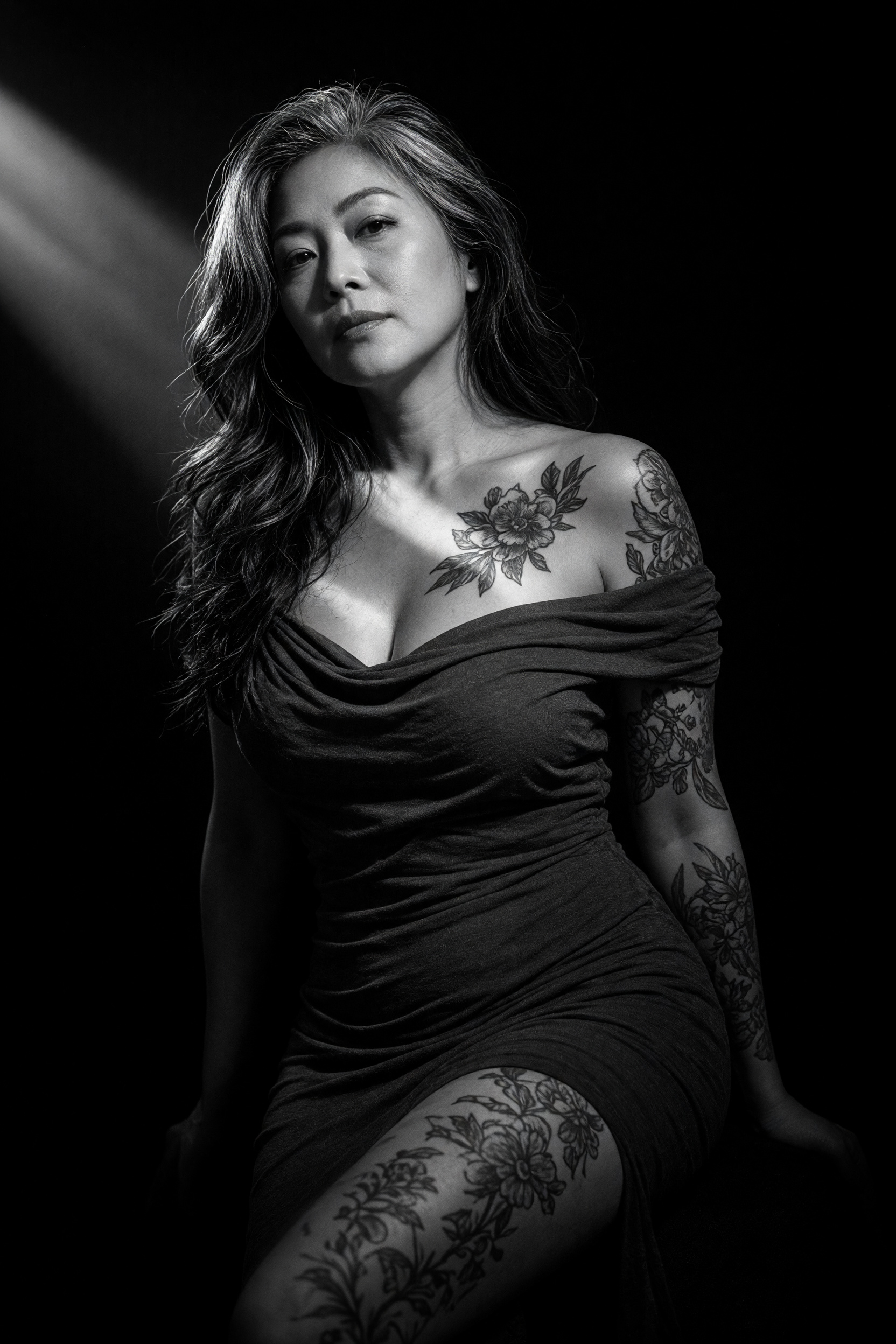
Naomi looked down at the flowers winding across her right arm. Chrysanthemums, peonies, and cherry blossoms, their intricate black outlines disappearing beneath the folds of her dress. There were more across her shoulder, another cluster along her thigh, and a small, unfinished branch near her collarbone.
“Beauty wasn’t always the intention.”
Daniel nodded with the solemn expression of someone who believed he understood.
Naomi had encountered that expression frequently throughout her life. People were remarkably generous with understanding when it cost them nothing.
“The first one was for my mother,” she said, touching the chrysanthemum near her shoulder. “She hated tattoos. Thought they were something people acquired when they ran out of respectable ways to disappoint their parents.”
Daniel chuckled.
“Did she ever see it?”
“She paid for it.”
He looked surprised.
“People change their minds,” Naomi said. “Occasionally, they even improve them.”
Her mother had been sixty-three when the cancer arrived, although arrived was hardly the right word. The disease had probably been there for years, growing quietly in places no one thought to investigate. By the time the doctors found it, they spoke in careful sentences, their voices weighted with professional sympathy and an unwillingness to make promises.
During her final months, Naomi’s mother had become unexpectedly interested in things she’d once dismissed. She listened to jazz, ate ice cream directly from the carton, and confessed that she had never particularly enjoyed being married. One afternoon, while Naomi was helping her dress, she traced the faint blue veins along her daughter’s wrist.
“You ought to do something foolish before you get old,” she’d said.
Naomi had been thirty-six.
Two weeks later, they went to a tattoo parlor together.
Her mother chose the flower.
She died before it had finished healing.
For years afterward, Naomi had associated the faint itching of newly tattooed skin with the terrible intimacy of watching someone disappear. Eventually, the association softened, becoming less a wound than a familiar ache, something she could carry without having to put it down.
“Would you like me to photograph that one separately?” Daniel asked.
“No. They belong together.”
He adjusted the lighting.
Naomi watched his reflection in the dark glass of a framed photograph hanging behind him. He was trying to find the most flattering angle, moving the light incrementally, studying the shadows beneath her eyes and the silver strands threading through her hair.
“Don’t remove the lines,” she said.
“I’m sorry?”
“The lines around my eyes. The ones beside my mouth. Whatever else you photographers think needs correcting.”
“I generally do very little retouching.”
“Good. I’d hate to pay for a photograph of someone who never existed.”
Daniel lowered his camera again. This time, he smiled without the professional polish.
“Fair enough.”
The second tattoo had been for her husband.
Not because he died.
Because he left.
That distinction had always mattered to Naomi, although she rarely explained why. Death was a departure neither party could negotiate. Leaving was something else entirely, an act of will that often required one person to carry the consequences of another person’s freedom.
They had been married nineteen years when he announced, over breakfast, that he needed to discover who he was outside their marriage. He said it gently, as though gentleness might somehow reduce the cruelty of the statement. Naomi remembered the smell of burnt toast, the refrigerator humming behind her, and the small crescent of coffee left at the bottom of his cup.
She remembered asking whether he intended to take the good silverware.
It had been a ridiculous question.
But grief, she discovered, rarely arrived wearing the appropriate clothing.
The peony on her upper arm had been completed six months after the divorce. Its petals were dark, almost bruised, and the artist had asked whether she wanted a little color to brighten it.
“No,” she’d answered. “Let it be what it is.”
For a long time, she believed the flower represented betrayal.
Years later, she understood that it marked the afternoon she stopped waiting for an apology.
That was the peculiar thing about memory. The event remained unchanged, but the meaning could continue growing long after everyone involved had moved on.
Daniel took several photographs.
The shutter clicked softly, almost apologetically.
“You’re very natural in front of the camera,” he observed.
“I’m sitting in a chair.”
“Most people find that harder than you might imagine.”
“Most people spend too much time wondering what other people see.”
“And you don’t?”
Naomi considered the question.
“I used to.”
Outside, rain began tapping against the studio’s narrow windows. Somewhere in the building, an old radiator complained with a metallic groan. Daniel adjusted the light again, bringing her face out of shadow while allowing the rest of her body to recede into the black background.
“There’s one tattoo you haven’t mentioned,” he said.
Naomi knew which one he meant.
The unfinished branch near her collarbone.
It was barely noticeable unless someone looked closely. A few delicate lines, the suggestion of a stem, two leaves, and the beginning of a blossom that had never been completed.
She had carried it for seventeen years.
“That one was supposed to be for my daughter.”
Daniel stopped adjusting the camera.
“Was?”
Naomi looked toward the artificial lilies near the entrance.
Her daughter, Emi, had been twenty-one when they stopped speaking. The argument itself had been ordinary enough, one of those collisions between love and expectation in which neither person recognized how much damage was being done until the wreckage was already scattered around them.
Naomi had wanted her daughter to finish university.
Emi wanted to travel.
Naomi spoke of responsibility.
Emi spoke of freedom.
Eventually, they both said things that were not entirely true but were sufficiently cruel to be remembered.
The silence that followed lasted three months, then six, then a year. Pride took over where anger had exhausted itself. Birthdays passed. Holidays came and went. Mutual acquaintances offered occasional updates, each delivered with the uncomfortable discretion usually reserved for terminal diagnoses.
Naomi had begun the tattoo on Emi’s twenty-second birthday, believing that the act might somehow bridge the distance between them.
Halfway through the session, she asked the artist to stop.
She couldn’t explain why.
Perhaps she feared completing something that still had a chance to change.
Perhaps she simply wasn’t ready to make the absence permanent.
Daniel said nothing for a while.
Then, quietly, “Did you ever reconcile?”
Naomi looked at him.
“Not yet.”
The words hung between them.
Not yet.
Such a small phrase to contain so many years.
Daniel lifted the camera, then hesitated.
“Would you prefer to take a break?”
“No.”
She straightened slightly, allowing the dress to settle naturally across her shoulders. The unfinished branch remained visible just above the fabric, its delicate lines reaching toward the hollow of her throat.
“Take the photograph.”
He raised the camera.
For a moment, Naomi thought about all the portraits she had avoided over the years. Family gatherings where she volunteered to hold the camera. Weddings where she stood behind taller relatives. Holidays documented in photographs that proved everyone had been present except the woman who had spent most of the day preparing the meal.
She had told herself she disliked photographs because they were dishonest.
Now she wondered whether the dishonesty had been hers.
There was a particular cruelty in believing that one’s life could be postponed until everything unfinished had been resolved. She had spent years waiting for the right apology, the right conversation, the right morning when she might wake and discover that the past had finally grown tired of following her.
Meanwhile, the years continued passing with their usual indifference.
Her hair turned silver.
Her hands acquired their mother’s veins.
The flowers on her skin softened at the edges.
And somewhere, a daughter she still loved was growing older without her.
“Whenever you’re ready,” Daniel said.
Naomi looked directly into the lens.
She did not smile.
There was nothing tragic about that decision. She simply had no desire to manufacture happiness for the benefit of a photograph. She had known happiness, certainly, and expected to know it again. But happiness was only one expression among the many a human face was entitled to wear.
The shutter clicked.
Daniel studied the image on his monitor.
“That’s the one,” he said.
Naomi stood and approached the screen.
The woman looking back at her was older than the one she carried in her memory. Her hair fell in untidy silver waves across one shoulder. The dark dress revealed flowers that had faded with time but remained unmistakably hers. The light caught the fine lines around her eyes, the slight asymmetry of her mouth, and the small scar beneath her chin from a childhood bicycle accident.
There was no attempt to make her younger.
No effort to make her softer.
She looked like someone who had lived.
Naomi studied the photograph for a long time.
Then she noticed the unfinished branch.
For seventeen years, she had regarded it as evidence of something broken. A conversation abandoned, a relationship suspended, a love that had somehow become too complicated to express.
But in the photograph, the branch appeared to be reaching toward something beyond the frame.
It was unfinished.
That did not necessarily mean it was ruined.
“Could you make two prints?” she asked.
“Of course. What sizes?”
“Eight by ten. Both of them.”
Daniel made a note.
“One for you and one for someone special?”
Naomi reached for her coat.
“Something like that.”
Outside, the rain had settled into a fine mist, softening the city lights and turning the pavement into a dark mirror. She stood beneath the studio awning for several minutes, watching pedestrians hurry past beneath umbrellas, each carrying destinations and disappointments she would never know.
Then she took her phone from her handbag.
Emi’s number was still there.
She had never deleted it, although she had no idea whether it remained current. Over the years, she had composed dozens of messages and sent none. Some were apologies. Others were explanations. A few were angry enough that she felt grateful, afterward, for having kept them to herself.
This time, she typed only a few words.
I had my picture taken today. I thought you might like a copy.
She read the message twice.
Then she added:
I would like to see you.
Naomi pressed send before she could begin negotiating with her fear.
There was no immediate reply.
She hadn’t expected one.
She slipped the phone into her handbag and stepped into the rain.
For the first time in seventeen years, the unfinished flower felt less like a reminder of what she’d lost and more like a place where something might still grow.
And that, she decided, was enough for one afternoon.
Discover more from Memoirs of Madness
Subscribe to get the latest posts sent to your email.

