Macro Monday | October 26, 2026
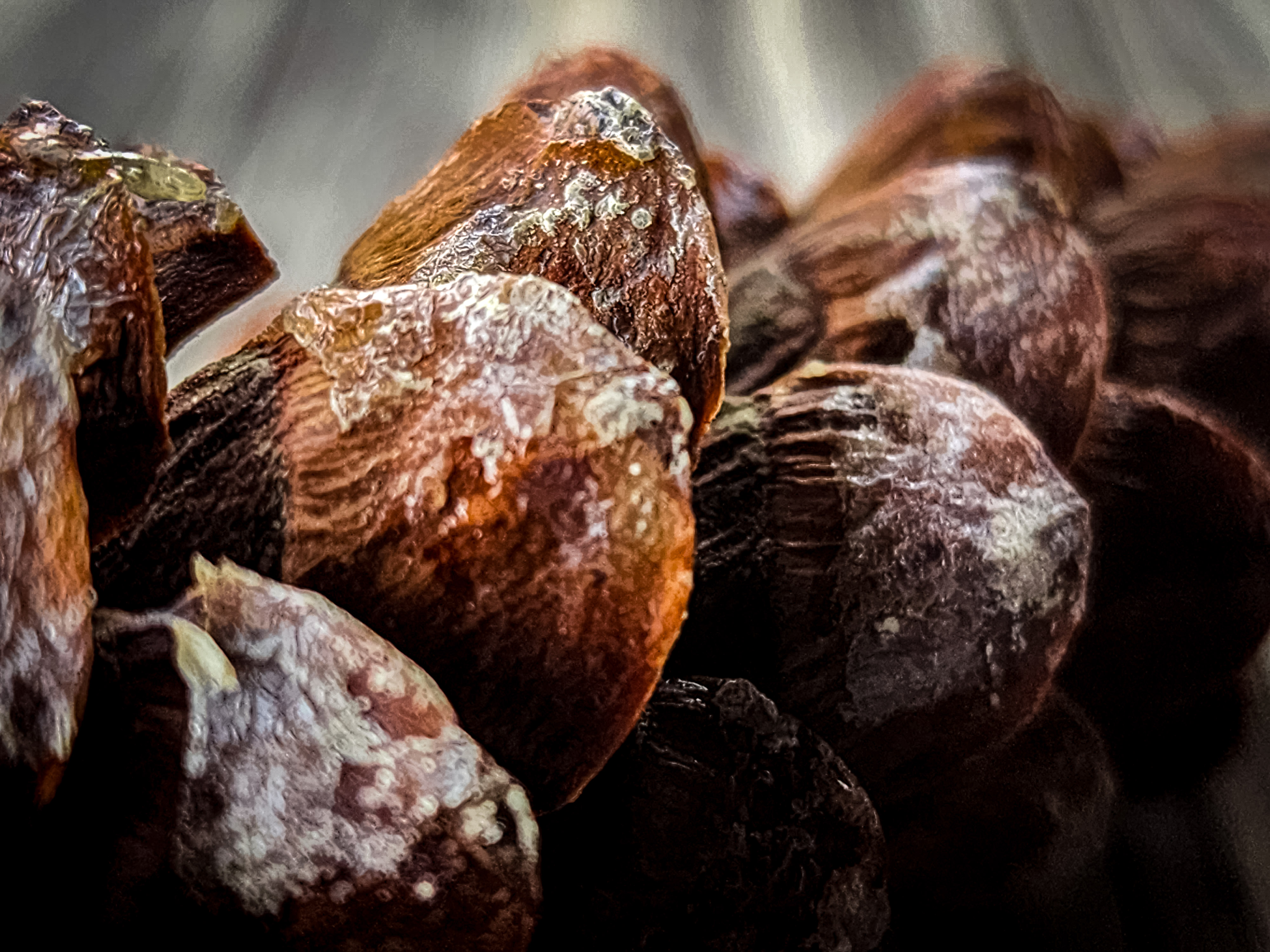
There is an entire world hidden beneath the surface of things we barely notice. Sometimes, it takes a camera lens and a few moments of curiosity to remind us just how much we overlook. Take these little fellows, for example. A collection of nuts, huddled together as though they’re attending some clandestine meeting beneath the autumn sun. Nothing particularly remarkable about them at first glance. Brown, weathered, a little rough around the edges, and certainly not the sort of thing that would stop traffic. Yet, when I moved closer and began examining their surfaces through my camera, an entirely different landscape emerged. There were ridges, fractures, subtle variations in color, and intricate patterns that reminded me of weathered mountain ranges. Each carried its own imperfections, its own history, and something hidden beneath an exterior that offered very few clues about what might be waiting inside.
I suppose that’s the trouble with appearances. They tell us just enough to convince us we understand something, while withholding nearly everything that might prove us wrong.
We humans are particularly talented at making judgments based on appearances. Give us a few seconds with a stranger, and we’ll construct an entire biography without so much as exchanging a greeting. Clothing, posture, facial expressions, the vehicle someone drives, or even the neighborhood they happen to live in become evidence in a trial nobody knew was taking place. We examine the packaging, reach a conclusion, and congratulate ourselves on our remarkable powers of observation. Never mind that we might be spectacularly wrong. Apparently, confidence and accuracy are not required to occupy the same room.
I’ve encountered enough people throughout my life to understand that the most interesting things about someone are rarely visible when you first meet them. A quiet person might possess an extraordinary imagination. Someone who appears confident may be holding together a thousand private uncertainties. The fellow sitting alone at the end of the counter, drinking coffee and minding his own business, might have enough stories to fill a library. Or perhaps he’s simply waiting for his eggs. Both possibilities deserve consideration, although I suspect he’d prefer you leave him alone until breakfast arrives.
The point is that we seldom know what another person carries.
Some carry ambitions they’ve never spoken aloud. Others carry regrets, unfinished conversations, memories of people who no longer occupy a place at their dinner table, and dreams that have survived long after circumstances suggested they should have been abandoned. There are people walking among us who have endured things we cannot imagine, yet they continue showing up for work, buying groceries, laughing at ridiculous jokes, and participating in the ordinary business of living. Their burdens don’t announce themselves. Neither do their strengths. Both remain tucked away beneath the surface, waiting for circumstances that may or may not reveal them.
And that brings me back to these humble little nuts.
Depending on the species, a seed can contain the beginnings of something far larger than itself. Beneath that unassuming exterior lies a remarkably complicated arrangement of stored energy, biological instructions, and the machinery necessary to begin another stage of life. Under suitable conditions, what appears to be a dormant object can become a living plant. Given enough time, favorable circumstances, and a fair amount of luck, something small enough to fit between two fingers might eventually become something that casts a shadow across the ground.
Of course, that’s the romantic version.
Nature, as it turns out, is considerably less sentimental about potential than we are. Not every seed germinates. Some are eaten, some decay, and others find themselves deposited somewhere so inhospitable that even a determined weed would consider relocating. Potential is not a promise. It is a possibility, and possibilities require more than simply existing.
I think we sometimes forget that when talking about people.
We’re fond of telling one another that we can become anything we want if we work hard enough, believe strongly enough, and refuse to surrender. It’s an appealing sentiment, particularly when printed across a photograph of a mountain at sunrise. Unfortunately, mountains have never been especially forthcoming about the realities of rent, medical bills, family obligations, or the countless circumstances that influence what a person can accomplish.
Determination matters. So does opportunity. So does timing. And occasionally, so does having someone willing to open a door that has remained stubbornly closed.
I’ve known people with extraordinary talents who never received the opportunity to develop them. I’ve also known individuals who were handed every conceivable advantage and somehow managed to accomplish remarkably little beyond making everyone else’s life more complicated. Life has never been particularly interested in distributing its resources according to merit. If it were, we’d probably have considerably fewer incompetent people occupying positions of authority.
But I digress.
What fascinates me about these small, weathered objects is how little their surfaces reveal about what they contain. Their rough exteriors suggest age and exposure, but they tell us almost nothing about what remains viable inside. One might hold the beginning of new growth. Another might be empty, damaged, or long past its opportunity. Looking at them from the outside, we cannot always distinguish between the two.
And perhaps that is where the photograph begins to say something about us.
We are not seeds, of course. Human lives are infinitely more complicated than the biological instructions tucked inside a protective shell. Our possibilities are shaped by experience, relationships, choices, circumstances, and the occasional catastrophic lapse in judgment. We grow in unexpected directions. Sometimes, we discover abilities late in life that would have surprised our younger selves. Other times, we spend years pursuing something only to realize that what we wanted at twenty bears little resemblance to what matters at fifty.
I can certainly attest to that last part.
The younger version of me had some rather interesting ideas about how life was supposed to unfold. He was confident, occasionally reckless, and possessed the remarkable ability to make decisions without consulting anyone who might have known better. I suspect that if we met today, we’d have a lengthy discussion about priorities, patience, and the wisdom of occasionally keeping one’s mouth shut. He would probably ignore most of my advice, which would explain a great deal about how I arrived here in the first place.
Still, I wouldn’t dismiss him.
That younger fellow carried possibilities I hadn’t yet discovered. Some developed into things I value deeply. Others disappeared along the way, either through circumstance or choices that seemed perfectly reasonable at the time. A few remain tucked away somewhere, waiting for me to stop making excuses and give them another look.
Perhaps that’s another misconception we carry about potential. We imagine it belongs primarily to the young, as though possibilities come with an expiration date printed somewhere beneath the packaging. Childhood is filled with questions about what we want to become, while adulthood gradually replaces those questions with inquiries about what we’ve accomplished. Eventually, if we live long enough, people begin asking what we used to do.
Used to.
Two small words capable of making an entire lifetime sound like a completed transaction.
I have never particularly cared for that arrangement. There is something fundamentally absurd about suggesting that curiosity, creativity, or the desire to discover something new should diminish simply because we’ve accumulated a few decades of experience. If anything, those experiences ought to give us more material to work with. We may not possess the same energy we had at twenty, and certain parts of the body have developed an unfortunate habit of filing complaints without consulting management, but that doesn’t mean the mind has surrendered its capacity for discovery.
Sometimes, the things we carry inside ourselves are not waiting to become something entirely new. They’re waiting to be recognized for what they have already become.
That distinction matters.
We live in a culture fascinated by transformation. Reinvent yourself. Become a better version. Unlock your potential. Apparently, being a reasonably decent human being who is still figuring things out isn’t sufficiently marketable. There must always be another level, another achievement, another mountain waiting to be conquered. Somewhere along the way, we began treating existence as though it were a never-ending performance evaluation.
And heaven forbid we simply enjoy an afternoon without accomplishing something that can be entered into a spreadsheet.
Yet, the more I examine the world through my camera, the less convinced I become that everything needs to justify its existence through accomplishment. These nuts don’t have to become towering trees to deserve a moment of attention. Their textures are interesting now. Their shapes and imperfections have value within the photograph regardless of what might eventually emerge from them. Whatever possibilities they contain do not erase the significance of what they already are.
The same consideration ought to extend to people.
A person’s worth should not depend entirely upon what they might accomplish tomorrow, any more than it should be reduced to what they accomplished yesterday. There is dignity in simply being, in surviving difficult seasons, in maintaining kindness when circumstances have provided every excuse to abandon it. There is value in the quiet work of raising a family, caring for someone who cannot care for themselves, listening when another person needs to be heard, or finding the courage to begin again after life has thoroughly rearranged the furniture.
Not everything meaningful announces itself with applause.
Some of the most important things we carry remain invisible to everyone except those who have taken the time to know us. Compassion developed through suffering. Patience learned through disappointment. Wisdom acquired by making mistakes we’d rather not discuss in polite company. A sense of humor that somehow survived experiences that weren’t particularly funny at the time.
And yes, occasionally, a stubborn streak that refuses to acknowledge when the universe has made a perfectly reasonable argument against our plans.
I may know a little something about that.
When I look at this photograph, I see more than a collection of weathered surfaces. I see layers, contradictions, and possibilities that cannot be determined by appearance alone. The light reveals the smallest fractures and ridges, but it cannot penetrate the shells to tell me everything they contain. There are limits to what even the finest lens can reveal.
Photography teaches us to look more carefully, but it should also remind us that seeing something clearly is not the same as understanding it completely.
That’s a lesson worth carrying beyond the viewfinder.
We can examine the world in extraordinary detail and still misunderstand what we’re looking at. We can know someone’s history without knowing their heart. We can recognize their accomplishments without appreciating their sacrifices. We can witness their struggles without understanding the strength required to endure them. And we can spend years believing we understand ourselves, only to discover another possibility waiting beneath a layer we hadn’t thought to examine.
Perhaps that is why I continue reaching for my camera.
Not because I expect every photograph to reveal some profound universal truth. Sometimes, I’m simply fascinated by the way sunlight catches an interesting surface. Sometimes, the subject is there, the camera is handy, and curiosity gets the better of me. There doesn’t always have to be a philosophical explanation for taking a picture.
Although, considering how often I manage to turn an innocent photograph into several pages of reflection, I suspect my camera might disagree.
Nevertheless, I’m grateful for these little interruptions. They remind me that the world contains more than what we notice during our hurried passage through it. Every ordinary object has details we haven’t examined. Every person has experiences we haven’t heard. And somewhere beneath the familiar surfaces of our own lives, there may still be possibilities we haven’t considered.
Not all of them will develop into something extraordinary. Some may never amount to anything beyond a passing thought or an unfinished experiment.
That’s all right.
Possibility doesn’t need to become greatness to have meaning. Sometimes, its greatest gift is reminding us that the story isn’t necessarily finished.
I don’t know what these little nuts contain, or what circumstances brought them together. I only know that their weathered surfaces caught my attention long enough for me to stop, look closer, and appreciate something I might otherwise have ignored.
And perhaps that’s enough for one Monday morning.
After all, there’s no telling what we might discover if we stop judging everything by its packaging and take a little time to consider what lies beneath.
Including ourselves.
Because the things we carry inside are not always burdens, regrets, or memories of what has been lost.
Sometimes, they’re the beginnings of something we haven’t yet imagined.
And wouldn’t that be something worth discovering?
Discover more from Memoirs of Madness
Subscribe to get the latest posts sent to your email.


We never know what’s in the wrapper from just seeing the outside. Take ducks swimming on the water. Beautiful and serene., calm elegance in motion. Under the surface they are paddling like hell to help maintain this illusion. We take so much for granted, barely register the hidden core, and with people, we are surprised when our image of them doesn’t match their emerging personality as we get to know them.
I’m not a fan of nuts by the way, but they have their own secrets to tell don’t they, the battered and cracked outer casing protecting the contents therein. Great post Mangus.
LikeLike
There is dignity in simply being, in surviving difficult seasons, in maintaining kindness when circumstances have provided every excuse to abandon it. In all honesty, the first thought upon reading the first paragraph was ‘don’t judge a book by it’s cover’. Then I thought, brava, you haven’t discarded that younger version of yourself, but welcomed him. Then I wondered, if that young man had taken a different path, a different turn, what would his life been like? What type of differences and meaning would have become his. Hindsight is 50 50 isn’t it? something like that…still, I often gander back and ‘turning points’ and wonder. What if is a nonsensible moment….it can’t be answered in any way shape or form. Still, the possibilities, the experiences the decisions might have been incredibly different conjuring an amazingly different outcome. Having said that, and knowing what my life became, what I experienced, there are things I most definitely could have done without. Even though I’m grateful for the things that turned out right. I found this monumentally delightful thoughtful and respectful to the ‘what once was – congratulations to the younger version of you – and the wisdom and thoughtful man you’ve become. Lovely.
LikeLike